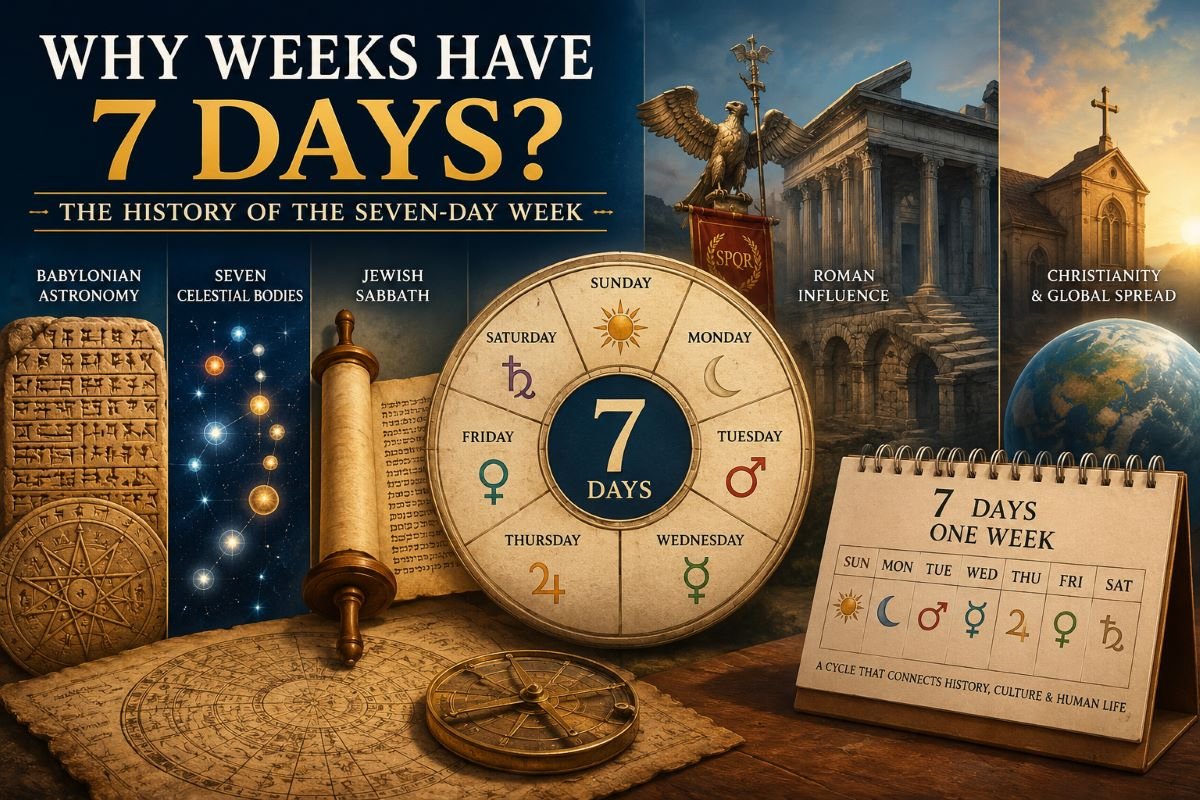
Have you ever wondered why a week has seven days?
A day has a clear astronomical explanation: Earth takes about 24 hours to rotate once. A year follows Earth's orbit around the Sun. A month is loosely connected to the Moon's cycle.
But a week is different.
Seven days do not divide evenly into a lunar month, a solar year, or any other major natural astronomical cycle. The seven-day week is therefore largely a human cultural invention—one that developed over thousands of years and eventually became one of the world's most widely shared ways of organizing time.
So why seven?
The answer takes us back through the ancient civilizations of Mesopotamia, the religious traditions of the ancient Near East, the planetary traditions of the Greco-Roman world, and the eventual spread of Christianity.
To understand why we still have seven days in a week today, we need to go back thousands of years and trace how astronomy, religion, and culture shaped the way humanity measures time.
The Week Is Not Based on a Natural Cycle
The first important point is that the seven-day week is not like the day, month, or year.
A day corresponds approximately to Earth's rotation.
A year corresponds to Earth's revolution around the Sun.
A lunar month is approximately related to the Moon's 29.5-day cycle.
But seven days are simply a conventional unit of time. Seven days equal 168 hours, yet there is no natural astronomical event that occurs precisely every 168 hours.
This makes the history of the week particularly interesting.
Ancient societies could have chosen five, eight, ten, or another number of days. In fact, different civilizations did use different systems before the seven-day week became dominant. Ancient Rome, for example, used an eight-day market cycle, while other societies experimented with longer or shorter divisions of time.
The seven-day system eventually won—not because it was mathematically perfect, but because several powerful cultural traditions reinforced it.
The Moon May Have Helped Inspire the Seven-Day Cycle
One of the oldest explanations for seven days is connected to the Moon.
A complete lunar cycle takes approximately 29.5 days. The Moon also appears to pass through four major visible stages:
- New Moon
- First Quarter
- Full Moon
- Last Quarter
Each quarter of the lunar cycle lasts roughly seven and a third days.
Ancient observers therefore had a natural reason to think of the lunar month as being divided into approximately four periods of seven days. The Babylonians, who were exceptionally skilled observers of the sky, developed sophisticated systems for tracking lunar and celestial movements.
However, the connection was never mathematically exact.
A lunar month is about 29.5 days, not 28 days. Four periods of seven days therefore do not perfectly fit the Moon's actual cycle.
This distinction is important: the Moon may have helped make seven attractive, but it does not completely explain the modern continuous seven-day week.
The Babylonians and the Importance of Seven
Ancient Mesopotamia played a major role in the story.
Babylonian astronomers paid close attention to the heavens and identified seven prominent celestial bodies that appeared to move against the background of fixed stars:
- The Sun
- The Moon
- Mars
- Mercury
- Jupiter
- Venus
- Saturn
These were called “planets” in the ancient sense of wandering celestial bodies. Their movements were closely associated with religion, astrology, and the organization of time.
The number seven consequently acquired considerable cultural and astronomical significance.
Ancient Babylonian timekeeping also included recurring seventh-day observances. However, it is important not to imagine that the Babylonian calendar was already identical to today's uninterrupted seven-day cycle. The relationship between lunar months and seven-day divisions was more complicated, and the evidence for the development of the modern continuous week is a subject of historical study.
So the Babylonians provided an important part of the foundation—but they did not simply create the modern week in its final form.
The Seven-Day Week and Ancient Jewish Tradition
Another major part of the story comes from the Hebrew Bible and Jewish tradition.
The Book of Genesis describes creation as a sequence of six days of work followed by a seventh day of rest. This seventh day became associated with the Sabbath, one of the central institutions of Jewish religious life.
The Jewish seven-day cycle was distinctive because it could continue independently of the phases of the Moon.
That was a major development.
Instead of beginning a new cycle whenever a lunar month began, the seven-day sequence could continue continuously:
Day 1 → Day 2 → Day 3 → Day 4 → Day 5 → Day 6 → Day 7 → Day 1 again
This concept helped establish a recurring weekly cycle that was independent of the lunar calendar.
Historical scholarship emphasizes that the modern seven-day week developed from more than one tradition. The biblical/Jewish week and the planetary week associated with ancient astrology were distinct traditions that eventually converged.
Why Seven Became More Important Than Other Numbers
The number seven had an unusual combination of cultural and astronomical importance in the ancient world.
There were seven prominent celestial bodies visible to ancient observers.
The lunar month was approximately four periods of seven days.
The seventh day acquired religious significance in Jewish tradition.
As these ideas interacted, seven became deeply embedded in systems of timekeeping and religious practice.
This is one reason the seven-day week proved remarkably durable.
It was not just a convenient scheduling device. It became connected to astronomy, religion, ritual, commerce, and social organization.
The Greeks and the Planetary Week
The ancient Greeks also contributed to the development of planetary ideas about time.
The seven visible “planets” became associated with gods and astrological concepts. Over time, the planetary system became linked with individual days.
The important development was not simply choosing seven days. It was also assigning a celestial body to each day.
This eventually produced the familiar planetary pattern that can still be seen in many modern weekday names.
The precise history of how the planetary sequence developed is complex, and historians continue to debate aspects of its transmission. What is clear is that the planetary seven-day cycle became increasingly visible in the Mediterranean world during the centuries before and after the beginning of the Common Era.
How the Romans Helped Spread the Seven-Day Week
The Roman Empire played a decisive role in transforming the seven-day cycle into a widespread system.
For a long time, Romans traditionally used an eight-day cycle known as the nundinal cycle, which was particularly important for markets and civic life.
But during the late Roman Republic and early Roman Empire, the seven-day planetary week became increasingly popular.
By the early centuries of the Common Era, the seven-day week was being used by different communities across the Roman world. Jewish, Christian, and pagan traditions all contributed to its growing acceptance.
This was a crucial turning point.
The seven-day week was no longer just an ancient Near Eastern or religious practice. It was becoming a broadly recognized system of organizing everyday time.
Where the Names of the Days Come From
The names of the weekdays preserve another fascinating part of this history.
In Latin, several Roman weekday names were connected with the classical planets and their associated gods.
For example:
- Saturday — associated with Saturn
- Sunday — associated with the Sun
- Monday — associated with the Moon
- Tuesday — associated with Mars
- Wednesday — associated with Mercury
- Thursday — associated with Jupiter
- Friday — associated with Venus
Many Germanic languages later substituted Germanic or Norse gods for some of the Roman gods.
This is why English weekday names do not all look Roman, even though the underlying planetary tradition is closely related to the Roman seven-day system.
For example:
Tuesday is associated with Tiw, a Germanic god corresponding broadly to the Roman Mars.
Wednesday comes from Woden, associated with Mercury.
Thursday comes from Thor, associated with Jupiter.
Friday comes from Frigg or a related Germanic tradition associated with Venus.
The names therefore preserve layers of ancient cultural history.
Sunday, Monday and Saturday Are Easier to Recognize
Some English weekday names retain their celestial origins more clearly.
Sunday literally points toward the Sun.
Monday is connected with the Moon.
Saturday preserves the Roman association with Saturn.
These names demonstrate how ancient astronomy and mythology remain hidden in everyday language.
Every time someone says “Monday,” they are using a word whose deeper history reaches back thousands of years to humanity's attempts to understand and organize the sky.
Christianity Helped Make the Seven-Day Week Universal
Christianity played an enormous role in spreading and standardizing the seven-day week throughout the Roman world and beyond.
Early Christians inherited the Jewish seven-day framework while also developing their own emphasis on Sunday, the day associated with the resurrection of Jesus.
As Christianity expanded through the Roman Empire, the seven-day cycle became increasingly integrated into religious and social life.
By the fourth century CE, the seven-day week had become widespread throughout the Roman Empire.
A particularly important milestone came in AD 321, when Roman Emperor Constantine officially recognized Sunday as a day of rest in the Roman Empire.
This did not create the seven-day week from nothing. Rather, it helped reinforce an already widespread seven-day system and gave it official civil importance.
The Seven-Day Week Survived Different Calendars
One remarkable feature of the week is its ability to exist alongside different calendar systems.
People could use different methods for organizing:
- Years
- Months
- Lunar cycles
- Religious festivals
- Civil dates
Yet they could still share the same seven-day cycle.
This flexibility helped the week survive major changes in calendar systems.
The Julian calendar could use a seven-day week.
The Gregorian calendar could use a seven-day week.
Lunar and lunisolar calendars could also coexist with a seven-day cycle.
In this sense, the week became somewhat independent from the calendar itself.
Why Didn't We Switch to a 10-Day Week?
The seven-day week was not inevitable.
Other systems existed.
Ancient Egypt used a ten-day division in parts of its calendar, while Rome traditionally used an eight-day market cycle. Later calendar reformers also proposed alternative weekly systems.
One famous modern example was the French Revolutionary Calendar, which introduced a 10-day work cycle called the décade.
It did not survive.
The Soviet Union also experimented with alternative work-week structures during the twentieth century, including five- and six-day cycles.
These experiments ultimately failed to replace the deeply established seven-day week.
The lesson is important:
A calendar system is not determined only by mathematics. Social habits, religion, economics, institutions, and cultural continuity matter just as much.
Why the Seven-Day Week Became So Hard to Replace
Once billions of people began organizing their lives around the same seven-day rhythm, replacing it became extremely difficult.
Businesses schedule around weeks.
Schools organize classes around weeks.
Religious communities observe weekly traditions.
Governments use weekly calendars.
Workers receive weekly schedules and pay.
Sports competitions are organized around weekly cycles.
Modern digital calendars are built around the same seven-day structure.
Changing the length of the week would therefore require changing countless systems simultaneously.
The seven-day week survived not because it is mathematically perfect, but because everyone already knows how it works.
The Week Does Not Divide Evenly Into a Year
There is another interesting mathematical problem.
A normal year has 365 days.
365 ÷ 7 = 52 weeks + 1 day
A leap year has 366 days.
366 ÷ 7 = 52 weeks + 2 days
So a calendar year can never contain exactly 52 complete seven-day weeks.
This is why the same date does not fall on the same weekday every year.
For example, if January 1 falls on a Monday one year, January 1 will normally shift to Tuesday the following year, with leap years producing an additional shift.
The seven-day week therefore fits imperfectly into the solar year—but that imperfection has never been enough to make society abandon it.
The Modern Week Is a Cultural Achievement
Today, the seven-day week feels completely natural.
We say:
“See you next week.”
“The weekend is coming.”
“Next Monday.”
“Every Sunday.”
The concept is so familiar that it can be easy to forget how unusual it actually is.
The week is not directly produced by Earth's rotation.
It is not a precise fraction of the Moon's orbit.
It does not divide evenly into the year.
It exists because ancient civilizations developed particular ways of organizing time, and later societies adopted, modified, standardized, and preserved them.
From Babylon to the Modern Calendar
The history of the seven-day week can therefore be understood as a long chain of cultural transmission:
Ancient Mesopotamian astronomy
↓
The significance of the number seven
↓
Lunar divisions and seventh-day observances
↓
The biblical/Jewish seven-day cycle
↓
Planetary week and ancient astrology
↓
Roman adoption and standardization
↓
Christian expansion across the Roman world
↓
Medieval European calendars
↓
Modern international society
The modern week is the result of this accumulated history rather than the invention of one person or one civilization.
Why Do We Still Have Seven Days?
So, why does a week have seven days?
The simplest answer is:
Because ancient traditions made seven a culturally important division of time, and later civilizations adopted and standardized it.
The deeper answer is more fascinating.
The seven-day week emerged from a mixture of ancient observations of the Moon, Mesopotamian astronomy, the significance of seven celestial bodies, Jewish religious tradition, planetary astrology, Roman culture, and Christian expansion.
Eventually, the seven-day cycle became so deeply embedded in human society that it survived competing calendar systems, political changes, religious transformations, and attempts at reform.
Today, almost everyone uses it without questioning it.
The next time you reach the weekend after seven days, remember that this simple cycle carries thousands of years of human history.
Frequently Asked Questions
Why are there exactly 7 days in a week?
There is no single reason. The seven-day week developed through several ancient traditions, especially Mesopotamian astronomy, lunar divisions, Jewish religious practice, and later Roman planetary traditions.
Did the Babylonians invent the seven-day week?
The Babylonians were extremely important to the development of seven-based timekeeping, but saying they simply “invented the modern week” is too simplistic. The modern continuous seven-day week resulted from the convergence of several traditions.
Is the seven-day week based on the Moon?
The Moon probably helped inspire seven-day divisions because a lunar month is approximately four periods of seven days. But the Moon's cycle is about 29.5 days, so the relationship is not exact.
Why are there seven planets in the ancient system?
Ancient astronomers identified seven prominent celestial bodies visible to the naked eye that moved relative to the fixed stars: the Sun, Moon, Mercury, Venus, Mars, Jupiter, and Saturn.
Who named the days of the week?
There was no single person who named all seven days. Weekday names developed through different cultural traditions, particularly Jewish, Greek, Roman, and Germanic traditions.
Why is Saturday named after Saturn?
The English word Saturday comes from the Roman association between the seventh day and Saturn. Other languages use different names based on their own religious and linguistic traditions.
Why is Sunday considered special?
Sunday became especially important in Christianity because it is associated with the resurrection of Jesus. The Roman Empire later gave Sunday official recognition as a day of rest under Constantine in AD 321.
Has anyone tried to replace the seven-day week?
Yes. Various civilizations and modern governments have experimented with different weekly cycles, including eight-day, ten-day, five-day, and six-day systems. None replaced the seven-day week globally.
Is the seven-day week used worldwide?
The seven-day week is now the dominant global system for organizing recurring weekly time, although cultures and religions may use different calendars, weekday names, and conventions for determining when a day or week begins.
Conclusion
The seven-day week is one of the oldest surviving human conventions for organizing everyday life.
It began long before modern clocks, smartphones, and digital calendars. Its story involves ancient sky-watchers, lunar cycles, religious traditions, planetary astrology, Roman society, and the expansion of Christianity.
What began as an ancient cultural system eventually became a global standard.
And that is what makes the seven-day week so remarkable:
It is not a law of nature. It is a piece of human history that became so universal that it now feels completely natural.
Comments
No comments yet.