Introduction
In a world that operates across borders, cultures, and continents, the need for a unified time standard is more critical than ever. Whether coordinating international flights, managing global financial markets, synchronizing internet servers, or conducting scientific research, a common reference point for time is essential. This reference point is known as Coordinated Universal Time (UTC).
UTC is the backbone of modern timekeeping. It provides a standardized framework that allows countries, organizations, and technologies to operate in harmony despite geographical differences. Without UTC, global coordination would be inefficient, inconsistent, and prone to errors.
To understand its broader importance, it is helpful to explore why time zones exist, as UTC serves as the central reference for all time zones worldwide.
This article explores what UTC is, how it was developed, how it works, and why it is indispensable in today’s interconnected world.
What Is UTC?
Definition of UTC
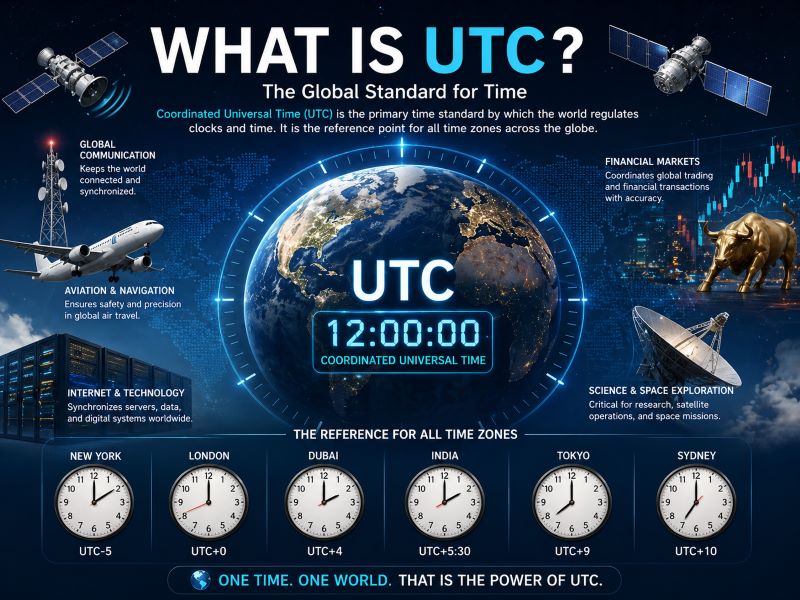
Coordinated Universal Time (UTC) is the primary time standard used worldwide to regulate clocks and time. It is not a time zone itself but a reference time from which all global time zones are calculated.
- UTC ±0 is the base reference
- Other time zones are offsets (e.g., UTC+5, UTC−3)
Why It Is Called “UTC”
Interestingly, the abbreviation UTC does not match English or French directly:
- English: Coordinated Universal Time (CUT)
- French: Temps Universel Coordonné (TUC)
To avoid favoring one language, the compromise abbreviation UTC was adopted internationally.
The Evolution of Global Timekeeping
From Solar Time to Standard Time
Before modern timekeeping:
- Time was based on the Sun
- Each location had its own local time
This system became impractical with the rise of:
- Railways
- Telegraph communication
- Industrialization
Greenwich Mean Time (GMT)
The first major global standard was Greenwich Mean Time (GMT):
- Based on the Prime Meridian in Greenwich, England
- Used for navigation and global coordination
GMT laid the foundation for UTC.
Transition from GMT to UTC
As science advanced, GMT proved insufficient for precise measurements. Variations in Earth’s rotation caused inconsistencies.
To solve this, UTC was introduced:
- Based on atomic clocks
- More precise and stable than GMT

How UTC Works
Atomic Timekeeping
UTC is based on atomic clocks, which measure time using the vibrations of atoms.
These clocks are:
- Extremely accurate
- Stable over long periods
- Essential for scientific and technological applications
To understand precision in timekeeping, explore how modern clocks achieve accuracy.
Leap Seconds
Because Earth’s rotation is not perfectly constant, UTC occasionally adds leap seconds.
Purpose:
- Align atomic time with Earth’s rotation
- Maintain synchronization with solar time
UTC vs Local Time
Local time = UTC + offset
Examples:
- New York: UTC−5
- India: UTC+5:30
- Japan: UTC+9
Why UTC Matters Globally
1. International Communication
UTC ensures that people across the world can coordinate effectively.
Examples:
- Global meetings
- Broadcast schedules
- Online collaboration
2. Aviation and Navigation
In aviation:
- All flight schedules use UTC
- Eliminates confusion across time zones
Pilots and air traffic controllers rely on UTC for safety and precision.
3. Global Financial Markets
Financial systems depend on accurate timing:
- Stock exchanges
- Trading systems
- Transaction timestamps
Even milliseconds matter in high-frequency trading.
4. Internet and Technology
The internet relies heavily on UTC:
- Server synchronization
- Data logging
- Cybersecurity systems
Without UTC, digital systems would become inconsistent.
5. Scientific Research
UTC is essential in:
- Astronomy
- Space exploration
- Physics experiments
Understanding time in space exploration highlights its importance in advanced science.
UTC and Time Zones
The Relationship
UTC is the reference point for all time zones.
- Time zones are defined as offsets from UTC
- Enables global standardization
Example
| Location | Time Zone | Offset |
|---|---|---|
| London | UTC | 0 |
| New York | EST | UTC−5 |
| India | IST | UTC+5:30 |
UTC vs GMT: What’s the Difference?
Key Differences
| Feature | UTC | GMT |
|---|---|---|
| Basis | Atomic clocks | Solar time |
| Accuracy | Extremely high | Less precise |
| Usage | Global standard | Historical/legacy |
Modern Usage
- UTC is used in science and technology
- GMT is still used in everyday contexts
UTC in Space and Science
Space Missions
Space agencies rely on UTC for:
- Navigation
- Communication
- Data synchronization
Astronomy
Astronomers use UTC to:
- Track celestial events
- Coordinate global observations
Challenges of UTC
Leap Second Debate
Some argue leap seconds:
- Complicate systems
- Cause technical issues
Others believe they are necessary.
Global Adoption Issues
While UTC is widely used:
- Some systems still rely on local time
- Human habits resist change
The Future of UTC
Towards a Fully Synchronized World
As technology advances:
- More systems will rely on UTC
- Automation will increase
AI and Time Coordination
Artificial Intelligence will enhance:
- Scheduling
- Predictive systems
- Real-time global coordination
Philosophical Perspective
UTC represents more than a technical system:
- It reflects global cooperation
- It unifies human activity
Time, while natural, is organized by human systems.
Conclusion
Coordinated Universal Time (UTC) is the foundation of modern global timekeeping. It enables synchronization across continents, industries, and technologies, ensuring that the world operates efficiently and cohesively.
From aviation and finance to science and the internet, UTC plays a critical role in nearly every aspect of modern life. It transforms time from a local experience into a global standard.
As humanity continues to advance technologically and explore beyond Earth, UTC will remain an essential framework—guiding coordination, innovation, and progress.
Ultimately, UTC is not just a measure of time; it is a system that connects the world.
Comments
No comments yet.