Introduction
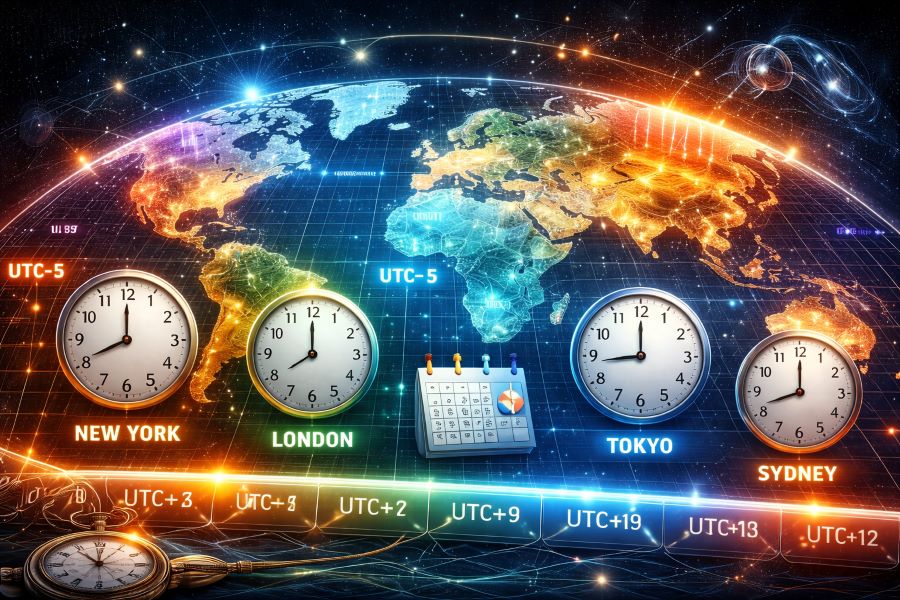
Time is one of the most fundamental dimensions of human existence. It structures daily life, regulates economic systems, and enables coordination across societies. Yet, despite its universal importance, time is not experienced uniformly across the Earth. Because our planet rotates, different regions encounter daylight and darkness at different moments. This natural variation gave rise to one of humanity’s most essential organizational systems: time zones.
In the modern world, time zones underpin nearly every global activity—from international travel and financial markets to digital communication and scientific research. Without them, coordinating across countries and continents would be chaotic. However, this system did not emerge naturally; it was created in response to practical challenges brought about by industrialization, technological advancement, and globalization.
To fully appreciate its significance, it is useful to consider why time itself is the most valuable resource, as time zones represent humanity’s attempt to organize this finite resource on a planetary scale.
This article explores the origins, development, and global impact of time zones, explaining why they exist and how they continue to shape modern civilization.
The Natural Foundation of Time
Earth’s Rotation and the Day–Night Cycle
The concept of time zones originates from Earth’s rotation. The planet completes one full rotation approximately every 24 hours. As it spins, different parts of the Earth face the Sun at different times, creating the cycle of day and night.
- When a region faces the Sun → daytime
- When it turns away → nighttime
This continuous rotation means that solar time differs across longitudes, forming the natural basis for time differences.
Longitude and Time Calculation
The Earth is divided into 360 degrees of longitude. Since it rotates 360 degrees in 24 hours:
- 15 degrees = 1 hour
- 1 degree = 4 minutes
This mathematical relationship is the foundation of the global time zone system.

Life Before Time Zones
Local Solar Time
Before standardized timekeeping, each city or town followed its own local solar time, determined by the position of the Sun.
- Noon = when the Sun is highest in the sky
This system worked effectively for small, isolated communities but became problematic as societies expanded.
The Problem of Inconsistency
By the 18th and early 19th centuries:
- Every town had a slightly different time
- Differences of minutes—or even hours—existed between locations
This caused confusion in:
- Travel schedules
- Trade and commerce
- Communication systems
As human mobility increased, the need for standardization became urgent.
The Industrial Revolution and the Need for Standard Time
Railways: The Turning Point
The Industrial Revolution introduced railways, connecting cities across vast distances. Accurate scheduling became essential for:
- Passenger coordination
- Freight movement
- Safety
However, local time created chaos:
- Train schedules were inconsistent
- Passengers missed connections
- Accidents occurred due to timing errors
Railway companies needed a unified system.
The Role of the Telegraph
The telegraph enabled instant communication across long distances. However, without a shared time reference, coordinating messages remained difficult.
Together, railways and telegraphs created the demand for a standardized global time system.
The Birth of Standard Time
Railway Time and Greenwich Mean Time
In the mid-19th century:
- British railway companies adopted a single standard time
- This was based on Greenwich Mean Time (GMT)
This marked one of the first large-scale uses of standardized time.
National Adoption
Governments soon recognized the benefits:
- Britain officially adopted GMT
- Other countries followed
This transition replaced local time with standardized national systems.
The International Meridian Conference (1884)
A Global Agreement
In 1884, representatives from 25 countries met in Washington, D.C., to establish a global time system.
Key Outcomes
The conference resulted in:
- The Prime Meridian at Greenwich
- Division of the world into 24 time zones
- Each zone representing a one-hour difference
This system laid the foundation for modern global timekeeping.
Why Greenwich Was Chosen
Greenwich was selected because:
- It was widely used in navigation
- British influence dominated global trade
How Time Zones Work
Standard Structure
The world is divided into 24 time zones:
- Each spans approximately 15 degrees
- Each differs by one hour
The reference point is Coordinated Universal Time (UTC).
Irregular Boundaries
In reality, time zones are not perfectly straight:
- Adjusted for national borders
- Influenced by politics and economics
This results in a complex global map.
Political and Cultural Influences on Time Zones
Non-Standard Time Zones
Although the global time zone system is theoretically based on uniform one-hour increments aligned with longitudinal divisions, real-world implementation reflects a far more complex and adaptive structure. Many countries and regions adopt non-standard or politically adjusted time offsets to better align with their geographical realities, economic priorities, and cultural identities.
For instance, in South Asia, India follows UTC+5:30, while Nepal uses UTC+5:45, reflecting both geographic alignment and national identity.
Globally:
- North America: Canada (UTC−3:30 in Newfoundland), flexible U.S. policies
- Europe: Economic alignment across countries
- Middle East: Iran (UTC+3:30), religious and political influences
- Australia: Regional offsets like UTC+9:30
These variations demonstrate that time zones are shaped by:
- Political decisions
- Cultural identity
- Economic priorities
- Geographic considerations
Daylight Saving Time (DST)
Purpose
DST shifts clocks to optimize daylight:
- Spring → forward
- Autumn → backward
Advantages and Challenges
Advantages:
- Energy savings
- Extended daylight
Challenges:
- Health impacts
- Confusion
- Uneven global adoption
Time Zones and Global Systems
International Travel
Time zones are essential for:
- Flight scheduling
- Airport operations
- Passenger coordination
Global Business
Businesses operate across time zones:
- Meetings across continents
- Remote teams
- Financial markets
Technology and the Internet
Modern technology relies on precise time synchronization:
- Data centers
- Financial transactions
- Cloud systems
Time Zones in Science and Space
Astronomy
Astronomers use standardized time to observe celestial events globally.
Space Exploration
Space missions depend on precise timing for:
- Navigation
- Communication
- Data analysis
Understanding time in space exploration highlights how critical synchronization is beyond Earth.
Challenges of Time Zones
Complexity
- Hundreds of variations
- DST changes
- Regional exceptions
Human Error
Incorrect conversions can cause:
- Missed flights
- Business losses
- Scheduling conflict

The Future of Time Zones
Global Time System
Some propose using UTC worldwide.
Challenges:
- Cultural resistance
- Daily life disruption
Technology Solutions
Modern tools help manage time:
- Smartphones
- AI scheduling
- Automation systems
AI and Temporal Intelligence
AI is transforming time management:
- Predictive scheduling
- Real-time coordination
- Global optimization
Philosophical Perspective
Time zones reveal an important truth:
- Time is natural
- But its organization is human-made
They reflect how humanity adapts natural systems to social needs.
Conclusion
Time zones exist because the Earth rotates, creating natural differences in daylight across the globe. However, the system we use today is the result of human innovation, driven by the need for coordination in an increasingly interconnected world.
From local solar time to global synchronization, time zones represent a remarkable achievement in human organization. They enable international travel, global communication, scientific advancement, and economic activity.
As technology evolves, the way we manage time may change, but the need to organize time across space will remain constant.
Time zones are not just lines on a map—they are a framework that connects humanity, allowing billions of people to operate within a shared global system.
Comments
No comments yet.