Introduction
Time is one of the most universal systems used in everyday life. We use it to organize work, school, travel, appointments, communication, and countless other activities. Although the measurement of time is universal, the way we display and communicate it can vary between countries, cultures, and technologies.
One of the most familiar ways of displaying time is the 12-hour clock, which uses AM and PM to distinguish between the first and second halves of the day.
At first, AM and PM seem simple. However, certain times—especially 12:00 AM and 12:00 PM—can cause confusion. People may also be unsure whether 12:30 AM is considered morning, how AM/PM relates to the 24-hour clock, or which format is clearer when communicating internationally.
This guide explains what AM and PM mean, how the 12-hour clock works, why midnight and noon are confusing, how AM/PM developed historically, how it compares with the 24-hour clock, and how modern technology handles time formats.
What Do AM and PM Mean?
The abbreviations AM and PM come from Latin expressions.
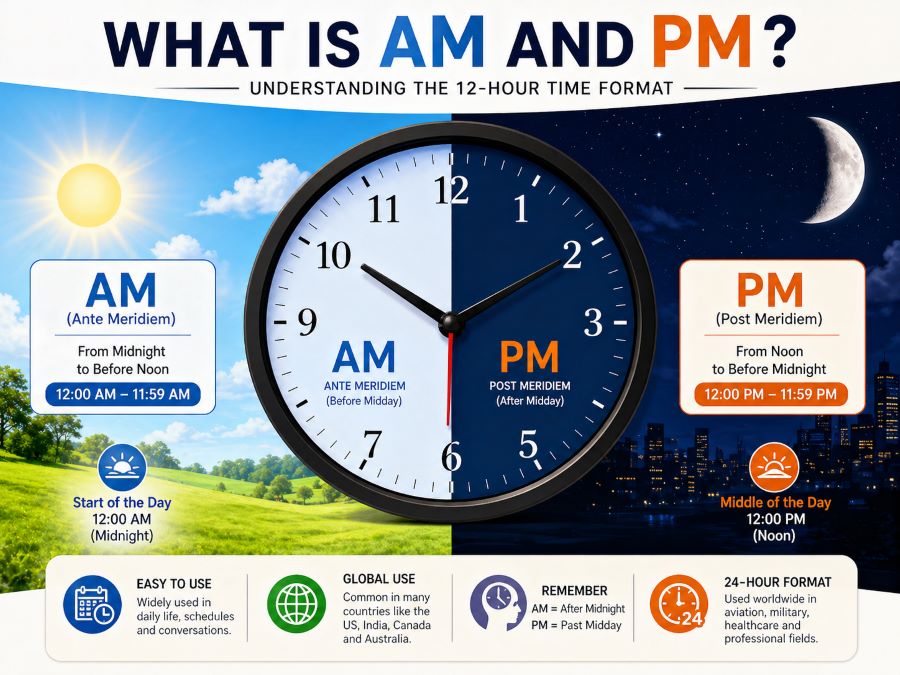
- AM — Ante Meridiem: before midday
- PM — Post Meridiem: after midday
The Latin word meridiem refers to midday or noon.
In practical terms:
- AM covers the period from midnight up to, but not including, noon.
- PM covers the period from noon up to, but not including, the next midnight.
The 12-hour clock therefore divides one 24-hour day into two 12-hour periods.
How the 12-Hour Clock Works
The 12-hour clock repeats the numbers 1 through 12 twice during each day.
| 12-Hour Time | Period |
| 12:00 AM – 11:59 AM | AM |
| 12:00 PM – 11:59 PM | PM |
For example:
- 6:00 AM → morning
- 11:00 AM → late morning
- 12:00 PM → noon
- 3:00 PM → afternoon
- 7:00 PM → evening
- 11:00 PM → night
Without AM and PM, a time such as 7:00 would be ambiguous. It could mean 7:00 in the morning or 7:00 in the evening.
Why Is 12 AM Midnight?
One of the most common questions about the 12-hour clock is whether 12 AM means midnight.
Yes.
12:00 AM is midnight, the beginning of a new calendar day.
The sequence around midnight is:
11:59 PM → 12:00 AM → 12:01 AM
For example, if Monday ends at 11:59 PM, the next minute is Tuesday at 12:00 AM.
This is one reason dates and times should sometimes be written together. Saying "Monday at 12:00 AM" can still be misunderstood by someone who is unfamiliar with the convention.
For important schedules, writing "midnight at the start of Tuesday" can be clearer.
Why Is 12 PM Noon?
12:00 PM is noon, the middle of the day in conventional clock terminology.
The sequence around noon is:
11:59 AM → 12:00 PM → 12:01 PM
So:
- 11:59 AM → one minute before noon
- 12:00 PM → noon
- 12:01 PM → one minute after noon
The apparent reversal at 12 o'clock is confusing because the numerical hour changes from 11 to 12 while the AM/PM designation changes at the same boundary.
An Easy Way to Remember AM and PM
A useful way to understand the system is to focus on midnight and midday rather than trying to memorize the abbreviations.
- 12:00 AM = midnight
- 12:00 PM = noon
Then remember:
AM comes before noon.PM comes after noon.
Another useful sequence is:
12 AM → 1 AM → 2 AM → ... → 11 AM → 12 PM → 1 PM → ... → 11 PM → 12 AM
This shows exactly where the transition occurs.
Is 12:30 AM Morning or Night?
Technically, 12:30 AM occurs after midnight and before noon, so it belongs to the AM period.
In everyday language, however, people may describe it as late at night rather than early morning.
For example:
- 12:30 AM → after midnight
- 2:00 AM → early morning / late night
- 6:00 AM → morning
- 11:00 AM → late morning
This demonstrates an important distinction: clock notation and everyday descriptions of time are not always identical.
Is 12:30 PM Afternoon?
12:30 PM is after noon, so it belongs to the PM period and is generally described as early afternoon.
For example:
- 12:00 PM → noon
- 12:30 PM → early afternoon
- 3:00 PM → afternoon
- 6:00 PM → evening
The exact boundary between afternoon and evening is a matter of ordinary language rather than a universal timekeeping standard.
Historical Development of the 12-Hour Clock
The 12-hour clock has a long history.
Ancient Egyptian Timekeeping
Ancient Egyptian timekeeping used divisions of the day and night into groups of twelve. Sundials were used to measure daylight, while astronomical observations helped people organize nighttime periods.
The length of these historical hours was not always identical to the modern fixed-length hour.
Over time, the idea of dividing a full day into twelve daytime and twelve nighttime portions contributed to traditions that eventually influenced later clock systems.
Babylonian Influence
Ancient Babylonian mathematics contributed significantly to the development of sexagesimal, or base-60, calculations.
The modern division of:
- 60 minutes per hour
- 60 seconds per minute
is connected to this broader mathematical tradition.
Medieval Mechanical Clocks
Mechanical clocks later made standardized displays of hours increasingly practical.
Many early public and mechanical clocks used a 12-hour cycle. As mechanical timekeeping became more widespread, the 12-hour display became deeply established in European societies.
Standardized Time
The growth of railways, industrialization, telecommunications, and international commerce created a stronger need for consistent timekeeping.
Standard time zones and standardized clocks made it easier to coordinate activities across increasingly connected regions.
AM and PM in Everyday Life
The 12-hour system remains common in everyday communication.
Personal Schedules
Examples include:
- Wake up at 6:30 AM
- Start work at 9:00 AM
- Lunch at 1:00 PM
- Finish work at 5:30 PM
- Dinner at 8:00 PM
Appointments
A meeting scheduled for 10:00 AM is clearly different from one scheduled for 10:00 PM.
For this reason, including AM or PM is important whenever the context does not already make the intended time obvious.
Transportation
Transportation systems may use either 12-hour or 24-hour displays depending on the country, operator, and type of service.
Airports, railways, and other transportation systems often use standardized displays designed to minimize ambiguity.
12-Hour Clock vs 24-Hour Clock
The same moment can be represented in two different ways.
| 12-Hour Format | 24-Hour Format |
| 12:00 AM | 00:00 |
| 6:00 AM | 06:00 |
| 11:30 AM | 11:30 |
| 12:00 PM | 12:00 |
| 3:00 PM | 15:00 |
| 6:30 PM | 18:30 |
| 11:45 PM | 23:45 |
The 24-hour clock removes the need for AM and PM because each hour has a unique number from 00 through 23.
For example:
3:00 PM = 15:00
and
11:00 PM = 23:00
How to Convert AM/PM to 24-Hour Time
Conversion is straightforward once the two special cases are understood.
AM Times
For most AM times, the hour remains the same.
- 1:00 AM → 01:00
- 7:30 AM → 07:30
- 11:45 AM → 11:45
The exception is midnight:
12:00 AM → 00:00
PM Times
For most PM times from 1 PM through 11 PM, add 12 to the hour.
- 1:00 PM → 13:00
- 3:30 PM → 15:30
- 8:00 PM → 20:00
- 11:00 PM → 23:00
The exception is noon:
12:00 PM → 12:00
Which Format Is Better: 12-Hour or 24-Hour?
Neither format is universally required for every situation. Their usefulness depends on the context.
12-Hour Format
The 12-hour clock is familiar to many people and fits naturally into everyday speech.
Examples:
- "I'll call you at 7 PM."
- "The store opens at 9 AM."
- "The appointment is at 2:30 PM."
24-Hour Format
The 24-hour clock gives every hour a unique numerical representation.
This can be particularly useful for:
- transportation schedules
- technical systems
- international coordination
- healthcare and operational environments
- software and databases
- situations where ambiguity should be minimized
For example, 18:00 cannot be confused with 6:00 in the morning.
Global Use of AM and PM
Time-format preferences vary around the world.
Some populations commonly use the 12-hour system in everyday communication, while other countries and institutions commonly use the 24-hour system.
Even within the same country, usage can vary according to:
- spoken language
- written communication
- transportation
- government services
- workplace conventions
- digital devices
- international business
Therefore, it is better to think of AM/PM and the 24-hour clock as different conventions used in different contexts, rather than assigning one format to an entire country in every situation.
AM and PM in Digital Devices
Modern phones, computers, watches, and other devices can usually display time using either system.
A device configured for a 12-hour locale may display:
8:45 PM
while a 24-hour configuration may display:
20:45
The underlying moment is the same.
Modern software can also format the same timestamp differently depending on the user's:
- locale
- language
- regional settings
- application preferences
This allows international applications to present time in a way familiar to their users.
AM/PM and Computer Systems
Computers generally need to represent time in a precise and unambiguous way.
Applications may store or exchange timestamps using standardized representations and then format those timestamps for users.
For example, a system may internally work with a standardized timestamp while displaying:
3:30 PM
to one user and:
15:30
to another.
This distinction between time representation and time display is important in software development.
A database, API, or application should not rely on a user's visual clock format to determine the actual moment in time.
AM and PM, Dates, and Time Zones
AM and PM alone do not identify a unique moment worldwide.
For example, 9:00 AM in New York and 9:00 AM in India occur at different moments because the locations use different time zones.
A complete international appointment may therefore require:
- date
- time
- time zone
For example:
October 15, 2026, 9:00 AM — New York time
is much clearer than simply saying:
9:00 AM
Time-zone differences can also change the AM/PM designation. A meeting that is in the afternoon in one location may occur in the evening or at night somewhere else.
This is why international scheduling tools and calendar applications need to handle both time zones and local date changes.
AM/PM and Daylight Saving Time
In regions that observe daylight saving time, local clocks can shift by one hour during part of the year.
For example, a meeting scheduled using a local time zone may have a different relationship to another location depending on whether daylight saving time is currently in effect.
This means that simply converting a time using a fixed offset can sometimes produce an incorrect result.
Modern time-zone systems account for historical and current offset rules when converting between locations.
Common AM and PM Mistakes
Mistake 1: Confusing 12 AM and 12 PM
Remember:
12 AM = midnight
12 PM = noon
Mistake 2: Writing "12 AM Midnight"
Although commonly understood, redundant expressions can sometimes create confusion.
For important schedules, simply writing midnight or specifying the date can be clearer.
Mistake 3: Using AM/PM with 24-Hour Time
Avoid combinations such as:
18:00 PM
The correct forms are either:
6:00 PM
or:
18:00
Mistake 4: Omitting AM/PM
Writing:
The meeting is at 7:00.
can be ambiguous.
Writing:
The meeting is at 7:00 PM.
is clearer.
Mistake 5: Ignoring the Date
"Midnight on Monday" can sometimes be interpreted differently depending on whether someone means the beginning or end of Monday.
For important events, include the exact date.
Best Practices for Communicating Time
For everyday communication:
- Include AM or PM when necessary.
- Use "noon" instead of 12 PM when it improves clarity.
- Use "midnight" instead of 12 AM when there is potential ambiguity.
- Include the date for important events.
- Include the time zone for international communication.
For technical and international systems:
- Use unambiguous time representations.
- Store and transmit timestamps consistently.
- Handle time zones explicitly.
- Account for daylight saving rules where applicable.
- Avoid assuming that every user prefers the same clock format.
AM and PM in Education
Children often learn the 12-hour clock because it connects naturally with daily routines.
For example:
7:00 AM → wake up
8:00 AM → school
12:00 PM → midday
7:00 PM → evening
Learning AM and PM helps students understand the relationship between clock time and the daily cycle.
As they progress, students can also learn to convert between 12-hour and 24-hour formats.
AM and PM in Global Business
International organizations frequently work across multiple time zones.
A simple statement such as:
"Let's meet at 10 AM."
may not be sufficient when participants are located in different regions.
A clearer message might specify:
10:00 AM India Standard Time (IST)
or provide the corresponding local times for participants.
Calendar software can automatically perform many of these conversions, but users should still verify the date and time zone when scheduling important meetings.
AM and PM in Aviation, Healthcare, and Other Operational Environments
In environments where timing errors can have serious consequences, unambiguous time notation is especially important.
Many operational systems use the 24-hour clock because each hour has a unique numerical value.
For example:
22:00
immediately identifies the hour without requiring an AM/PM interpretation.
The exact conventions vary by organization and industry, but the general principle is the same: reduce ambiguity wherever precise timing matters.
The Relationship Between AM/PM and Modern Time Standards
AM and PM describe how a time is displayed in a 12-hour clock.
They are not themselves a global time standard.
Modern global timekeeping also involves systems such as:
- UTC
- time zones
- UTC offsets
- daylight saving rules
- standardized date and time representations
For example, two locations can display different local AM/PM times while still referring to the same instant.
Understanding this distinction is important when moving from everyday timekeeping to international and technical applications.
The Future of Time Formats
Digital technology continues to reduce the practical difficulty of converting between time formats.
Modern applications can automatically:
- convert between 12-hour and 24-hour formats
- adjust for time zones
- account for daylight saving changes
- display local time based on regional settings
- schedule events across multiple locations
As global communication becomes increasingly digital, users do not necessarily need to perform these calculations manually.
However, understanding the underlying system remains valuable because incorrect interpretation of a time can still lead to missed appointments, scheduling errors, and communication problems.
Frequently Asked Questions
Is 12 AM midnight?
Yes. 12:00 AM represents midnight, the beginning of a new calendar day.
Is 12 PM noon?
Yes. 12:00 PM represents noon, the middle of the conventional day.
Is 12:30 AM morning?
12:30 AM is in the AM period because it occurs after midnight and before noon. In everyday speech, however, it may also be described as late at night.
Is 12:30 PM afternoon?
Yes. 12:30 PM occurs after noon and is generally described as early afternoon.
What does AM stand for?
AM stands for Ante Meridiem, a Latin expression meaning before midday.
What does PM stand for?
PM stands for Post Meridiem, meaning after midday.
What is 12 AM in 24-hour time?
12:00 AM = 00:00 in the 24-hour clock.
What is 12 PM in 24-hour time?
12:00 PM = 12:00 in the 24-hour clock.
What is 3 PM in 24-hour time?
3:00 PM = 15:00.
Why do people use both 12-hour and 24-hour clocks?
Different regions, industries, applications, and individuals use different conventions. The 12-hour format is familiar in many everyday contexts, while the 24-hour format provides a unique number for every hour of the day.
Conclusion
AM and PM are simple but important components of the 12-hour clock.
AM represents the period before noon, while PM represents the period after noon. The two most important reference points are:
12:00 AM = midnight
12:00 PM = noon
The 12-hour clock has deep historical roots and remains widely used in everyday communication. At the same time, the 24-hour clock provides an unambiguous numerical representation that is particularly useful in many technical, operational, and international contexts.
Modern digital systems make it possible to move between these formats automatically, but understanding how they work remains important. When dates, time zones, and daylight-saving rules are involved, precise communication becomes even more valuable.
Whether you write 7:00 PM, 19:00, or describe an event as occurring in the evening, the goal is the same: to communicate a moment in time clearly and accurately.
Comments
No comments yet.