Introduction
Writing a date may seem simple, but the way a date is represented can vary significantly between countries, languages, organizations, and computer systems.
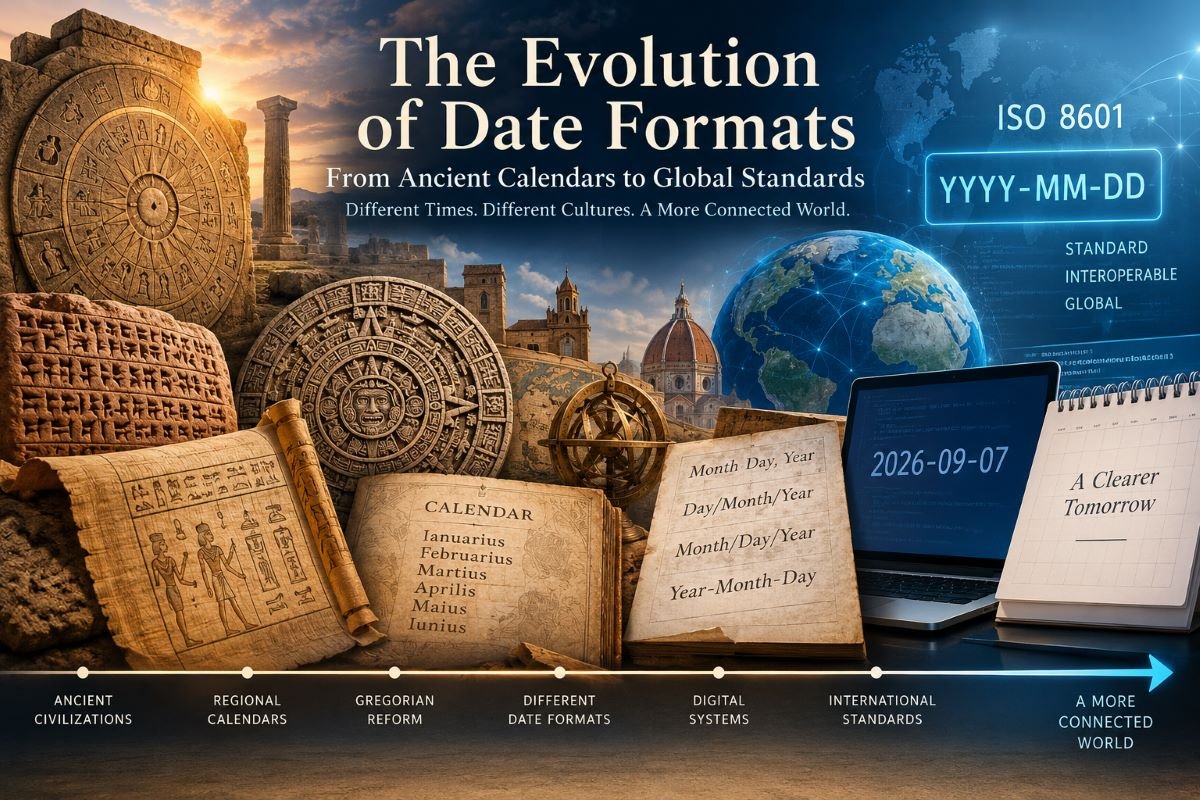
For example, the same calendar date may be written in different ways:
Month Day, Year
Day/Month/Year
Month/Day/Year
or, in a standardized machine-readable form:
Year-Month-Day
Depending on the convention being used, these representations may refer to the same calendar day. The difference may appear minor, but it reflects a much longer history of calendars, regional traditions, written records, international communication, and technological standardization.
Date formats were not created by a single civilization or introduced at one particular point in history. They developed gradually as societies created calendars, governments and institutions maintained records, commerce expanded, international communication increased, and eventually digital systems required dates to be represented in consistent and unambiguous ways.
Different regions developed different conventions for arranging the basic components of a date. Some commonly place the day first, others the month, while standardized technical systems may place the year first. Dates may also be written using words, numbers, or combinations of both. Different calendar systems have also provided different ways of identifying dates and organizing time.
As communication expanded beyond local and national boundaries, these differences became increasingly important.
A date that is immediately clear within one convention can be ambiguous when interpreted using another.
For example, a numeric date written as 04/05/Year may represent the fourth day of the fifth month or the fifth day of the fourth month, depending on the convention being used.
In everyday communication, context may make the intended meaning obvious. In international business, transportation, legal and administrative records, financial systems, scientific research, databases, and software applications, however, ambiguous date representations can create significant problems.
The modern approach to date representation is therefore the result of a long historical development—from ancient calendar systems and regional conventions to international standards and digital information exchange.
One of the most important milestones in this development is ISO 8601, an international standard that provides structured representations for dates and times used in information interchange.
Why Humans Needed Calendars
Before discussing date formats, it is important to understand why calendars developed in the first place.
Humans have always needed to recognize recurring patterns.
The most obvious cycles are found in nature:
- Day and night
- Phases of the Moon
- Seasonal changes
- Annual agricultural cycles
- Solar movements
- Recurring cultural and religious events
Early societies depended on these patterns for everyday life.
Farmers needed to know when to plant and harvest. Religious communities needed ways to determine ceremonial dates. Governments required systems for administration and taxation. Merchants needed to organize trade, while travelers and sailors needed methods for recording journeys.
A calendar transformed recurring natural cycles into an organized system.
However, calendars did not develop identically everywhere.
Different civilizations created different methods for dividing time into days, months, seasons, and years. Some systems were primarily lunar, some solar, while others combined lunar and solar principles.
This diversity became one of the earliest sources of complexity in date representation.
A calendar answers a fundamental question:
How does a society organize recurring units of time?
A date adds another layer:
How does that society identify a particular day within that system?
These two concepts are closely related but are not identical.
Understanding this distinction is essential to understanding the later development of international date standards.
Ancient Calendars and the Development of Date Recording
Ancient civilizations developed sophisticated calendar systems long before modern international standards existed.
The ancient Egyptians developed a solar calendar associated with a 365-day year. Mesopotamian societies developed calendar practices involving lunar observation. Other civilizations created systems based on astronomical observation, agriculture, political administration, and religious traditions.
The important point is that a calendar does more than count days.
It provides a framework for identifying a particular day within a larger cycle.
Once societies began keeping written records, dates became increasingly important.
Historical documents, contracts, royal decrees, religious records, tax documents, and commercial transactions all needed ways to indicate when events occurred.
Early date records could contain considerably more information than a modern numeric date.
A document might identify a year by the reign of a ruler, a particular festival, an astronomical event, or a combination of calendar elements.
Such systems worked effectively within their own administrative and cultural environments.
The difficulty arose when records from different societies or historical periods needed to be compared.
A date meaningful within one calendar or administrative system could require considerable interpretation when encountered by someone using another.
This was not necessarily a flaw in the original system. Calendars were designed to serve particular communities and purposes.
The challenge emerged as communication expanded.
The Roman Calendar and the Path Toward the Gregorian System
The calendar traditions that eventually influenced much of modern international date usage have important roots in the Roman world.
The Julian calendar, introduced under Julius Caesar in 46 BCE, established a structured solar calendar with a leap-year system.
Over time, however, a small difference between the calendar year and the astronomical seasonal cycle accumulated.
By the sixteenth century, calendar reform had become an important issue in Europe.
The Gregorian calendar was introduced in 1582 under Pope Gregory XIII. Its revised leap-year rules brought the calendar more closely into alignment with the seasonal year.
The reform was not adopted everywhere simultaneously.
Different countries and communities adopted the Gregorian calendar at different points in history.
This history demonstrates an important distinction:
Calendar standardization and date-format standardization are not the same thing.
A calendar determines how dates are organized.
A date format determines how a date is expressed.
Modern ISO 8601 defines representations based on the Gregorian calendar. It does not attempt to replace every calendar system used by different cultures.
This distinction is especially important when discussing the history of international date standards. ISO 8601 belongs primarily to the history of information representation and interchange, rather than the invention of calendars themselves.
Why Date Order Became a Problem
Once dates began to be written numerically, another problem became increasingly visible: the order of the components.
A numeric date may contain three basic elements:
- Day
- Month
- Year
But there is no universal requirement that these elements appear in the same order in everyday regional usage.
A day-month-year pattern places the day first.
A month-day-year pattern places the month first.
A year-month-day pattern places the year first.
Each can be understandable within a defined context.
The problem occurs when the context is missing.
A numeric expression such as:
04/05/Year
does not by itself reveal whether the first number represents the day or the month.
This means that the problem is not necessarily that one regional convention is wrong.
The problem is that different conventions can assign different meanings to the same sequence of numbers.
As long as communication remained primarily local, people could rely on shared conventions.
International communication changed the situation.
Trade and International Communication Increased the Need for Consistency
As international trade, diplomacy, transportation, scientific cooperation, and administration expanded, documents increasingly crossed national and cultural boundaries.
A company in one country might send an invoice to a business in another.
A shipping organization might exchange schedules with an overseas partner.
Governments might share administrative records.
Scientists might publish measurements for an international audience.
A date format that was obvious to the sender could be interpreted differently by the recipient.
The problem was therefore more than linguistic.
It became a problem of information exchange.
Human readers can sometimes resolve ambiguity through context. They may recognize the likely convention from the surrounding document, the language being used, or the organization that produced the record.
Computer systems are less forgiving.
A software system processing a numeric date needs a defined interpretation. If one system assumes day-month-year while another assumes month-day-year, the same sequence of characters can produce different results.
The consequences can include incorrect records, scheduling problems, failed data processing, inconsistent databases, and communication errors.
As information began moving more frequently across borders, the value of common technical conventions increased.
The Rise of International Standardization
The twentieth century brought a broader movement toward international standardization.
As countries and organizations became increasingly interconnected, common technical conventions became essential.
Standardization became important in areas such as:
- Engineering
- Manufacturing
- Transportation
- Telecommunications
- Scientific research
- Government administration
- International commerce
- Information technology
Date and time representation became part of this broader standardization effort.
The objective was not to tell every culture how it should speak about dates in ordinary conversation.
People could continue using the date formats familiar to them.
The goal was instead to provide a clear and structured method for exchanging date and time information.
This distinction is central to understanding ISO 8601.
An international standard does not necessarily eliminate local conventions.
Instead, it can provide a common technical representation for situations where information needs to move between different systems, organizations, languages, and regions.
The Origins of ISO 8601
The international standard now known as ISO 8601 was first published by the International Organization for Standardization in 1988.
The original standard was titled:
Data elements and interchange formats — Information interchange — Representation of dates and times.
The first edition was published in June 1988. The standard was subsequently revised, including editions published in 2000 and 2004.
Its purpose was fundamentally practical.
International information systems needed a way to represent dates and times so that their meaning would remain clear regardless of local conventions.
ISO 8601 therefore belongs to the history of information interchange, not simply the history of calendars.
Humans had already been using calendars for thousands of years before ISO 8601 existed.
What ISO 8601 addressed was a much newer problem:
How can date and time information be represented consistently when it moves between people and systems?
That question became increasingly important as computing and international data exchange expanded.
Why ISO 8601 Uses Year-Month-Day
One of the most recognizable features of ISO 8601 is the year-month-day structure:
YYYY-MM-DD
The components are:
- YYYY — four-digit year
- MM — two-digit month
- DD — two-digit day
The structure moves from the largest unit to the smallest.
This provides an important advantage.
The representation does not depend on whether the reader normally uses day-month-year or month-day-year conventions.
The year-first structure also provides a useful technical property.
When dates are represented consistently using this format, their textual order naturally corresponds to chronological order.
For example:
| YYYY-01-15 |
| YYYY-06-20 |
| YYYY+01-02-05 |
| YYYY+02-11-30 |
When the year, month, and day components are consistently represented with appropriate zero padding and the same calendar system, the sequence can be sorted naturally.
This makes the structure useful for:
- Databases
- Filenames
- Logs
- Archives
- Digital records
- Software systems
- Data processing
The importance of the format therefore extends beyond visual clarity.
Its structure is also useful for machines.
Why the Hyphens Matter
ISO 8601 provides both basic and extended representations.
The extended form uses separators:
YYYY-MM-DD
The basic form can omit the separators:
YYYYMMDD
The extended form is generally easier for people to read.
The basic form can be useful where a compact representation is preferred.
The important principle is that the components remain structured and ordered.
The separators do not determine the meaning by themselves. Instead, they make the boundaries between the year, month, and day easier to recognize.
This is particularly useful when a date is being read by both humans and software.
A standardized structure reduces the need to infer meaning from local punctuation or word order.
ISO 8601 Is More Than YYYY-MM-DD
Although YYYY-MM-DD is the most recognizable ISO 8601 representation, the standard covers a broader range of date and time representations.
These include:
- Calendar dates
- Times of day
- Combined date and time
- UTC-related representations
- Local time and UTC offsets
- Time intervals
- Recurring intervals
- Week dates
- Ordinal dates
This broader scope explains why ISO 8601 is important to information technology.
It is not simply a preferred way to print a date.
It provides structured representations for temporal information that can be exchanged between systems.
This becomes especially important when an application needs to communicate not just a calendar date but also a specific time, a time-zone relationship, a duration, or a recurring temporal event.
The standard therefore belongs to a larger technical ecosystem concerned with making temporal information understandable and interoperable.
Calendar Dates, Ordinal Dates, and Week Dates
A date does not always have to be expressed using a month and day.
Calendar Date
The most familiar representation uses the year, month, and day:
YYYY-MM-DD
This identifies a particular calendar date within the Gregorian calendar.
Ordinal Date
An ordinal date identifies a day by its position within the year.
Instead of identifying the month and day separately, the representation uses the year together with the numerical position of the day within that year.
This can be useful in scientific, industrial, engineering, and operational environments.
Week Date
ISO 8601 also provides a week-date representation.
Instead of identifying a day using a conventional month and day, a week date identifies a calendar week and a weekday.
This can be useful for:
- Business planning
- Production schedules
- Logistics
- Manufacturing
- Weekly reporting
- Operational systems
These different representations demonstrate an important principle:
There is more than one useful way to describe a date.
A good standard provides structured alternatives while maintaining clear rules for interpretation.
The Connection Between Date Standards and Time Zones
Dates cannot always be separated completely from time.
A particular moment can occur on one calendar date in one location and on another calendar date elsewhere.
For example, an event occurring late at night in one time zone may already belong to the following calendar day in another location.
This is why international date-and-time representation also needs to account for time zones and UTC offsets.
A structured timestamp can contain information about:
- The calendar date
- The time of day
- The relationship of the local time to UTC
This becomes particularly important in international software systems.
An online transaction can occur in one country while being processed by a server in another.
A flight can cross several time zones.
A scientific instrument can transmit data to a laboratory thousands of kilometers away.
A global organization can have employees and systems operating in many different locations.
Without a clear time reference, records can become difficult to compare.
Date representation and time-zone information therefore often work together to provide a complete description of when an event occurred.
UTC and the International Measurement of Time
The history of international date representation is closely connected with the development of standardized time scales.
Coordinated Universal Time (UTC) is the international reference time scale used for coordinating standard time and frequency information.
The Bureau International des Poids et Mesures (BIPM) is responsible for the international realization and dissemination of UTC and related time scales.
However, UTC and ISO 8601 are not the same thing.
UTC is a time scale.
ISO 8601 is a representation standard.
The distinction is important.
UTC helps provide a common reference for determining a time.
ISO 8601 provides rules for representing date and time information.
Modern digital systems often need both.
A system may use UTC as a reference while representing the resulting date and time using a structured format.
This separation between a time scale and a representation standard is an important part of modern timekeeping infrastructure.
From Paper Documents to Computer Systems
Date-format standardization became even more important with the rise of computers.
Paper documents can sometimes be interpreted using surrounding information.
Computers need explicit rules.
Suppose a database stores a numeric date using a regional convention.
If the database does not clearly define the order of the components, another system receiving the data may interpret it differently.
A structured representation such as:
YYYY-MM-DD
reduces this ambiguity.
This is one reason ISO-style dates are widely used in programming, databases, APIs, scientific data, digital archives, and machine-readable documents.
A standard format reduces the amount of custom interpretation software has to perform.
That can improve interoperability.
One system can generate a date, another can receive it, and both can interpret the structure according to the same rules.
This is particularly valuable in distributed systems where different applications may be developed independently.
Why Date Formats Matter for File Names and Data
The year-month-day structure is particularly useful when dates are included in filenames.
Consider a collection of files using regional numeric formats:
| MM-DD-YYYY-report |
| DD-MM-YYYY-report |
| MM-DD-YYYY-report |
Even when the dates themselves are valid, sorting and interpreting the filenames can be difficult if different conventions are mixed.
A consistently structured format is easier to manage:
| YYYY-MM-DD-report |
| YYYY-MM-DD-report |
| YYYY-MM-DD-report |
When the year, month, and day components are consistently ordered and formatted, alphabetical sorting can also correspond to chronological ordering.
This simple property is one reason ISO-style dates are useful among:
- Developers
- Researchers
- Archivists
- Data analysts
- System administrators
- Organizations managing large collections of files
A well-designed date format can therefore improve both human readability and machine processing.
It can also make long-term digital archiving easier because the date structure remains recognizable without requiring knowledge of a particular country's local convention.
Why Different Countries Still Use Different Date Formats
If ISO 8601 provides an internationally recognized representation, why do people still write dates differently?
Because international standards do not automatically replace local language and cultural conventions.
People continue to use familiar forms in everyday communication.
A person may naturally write a date using a month-first pattern.
Another may use a day-first pattern.
A technical system may use a year-first representation.
These forms can remain useful within their respective contexts.
ISO 8601 becomes especially valuable when information crosses boundaries.
Typical applications include:
- International business
- Software systems
- Scientific research
- Government data exchange
- Transportation
- Banking
- Websites
- APIs
- Digital archives
- Databases
The purpose is therefore not necessarily to eliminate every local date format.
It is to provide an unambiguous common representation when systems and people need to exchange information internationally.
This distinction allows local traditions and international technical standards to coexist.
A person can use a familiar format for everyday communication while a computer system can use a standardized representation behind the scenes.
The Modern ISO 8601 Standard
The current main standard is ISO 8601-1:2019, titled:
Date and time — Representations for information interchange — Part 1: Basic rules.
This edition specifies representations of dates in the Gregorian calendar and times based on the 24-hour clock, including combined date-and-time representations and time shifts related to UTC.
ISO 8601-1:2019 replaced ISO 8601:2004.
The standard has continued to be reviewed and maintained as part of the international standards process.
This continuing development demonstrates an important characteristic of technical standards.
Standards are not necessarily permanent documents.
As technology, information systems, and interoperability requirements evolve, standards may be reviewed and revised to remain useful.
The modern ISO 8601 family therefore represents the continuation of a standardization process that began with the need for reliable international information exchange.
Why Standardization Became Essential in the Digital Age
The importance of date standards has increased because modern systems communicate constantly.
A single digital service may interact with:
- Mobile devices
- Web browsers
- Databases
- Cloud servers
- Payment systems
- APIs
- International users
- External software
- Government services
These systems may be developed by different organizations and operate in different countries.
Without common conventions, every connection would require additional rules for interpreting date information.
Standardization reduces that complexity.
Instead of asking every system to negotiate its own date format, developers can rely on established conventions.
This is one of the less visible foundations of modern digital infrastructure.
Most users never think about the format stored behind a calendar application.
They simply select a date.
Behind that simple interface, however, software must represent the date in a structured form, store it correctly, transmit it when necessary, compare it with other dates, and display it according to the user's preferred convention.
This creates an important distinction between storage format and display format.
A user interface may show a familiar local date format, while the underlying system may store or exchange the date using a standardized representation.
This separation allows international systems to support different user preferences without sacrificing consistency in data exchange.
Common Date-Format Mistakes
Ambiguous date formats remain a common source of errors.
One of the most problematic patterns is a short numeric date containing several components without an explicit convention.
For example:
01/02/03
Depending on the system, this can be interpreted in multiple ways.
The ambiguity involves both the order of the components and the meaning of a two-digit year.
Modern digital systems therefore generally benefit from:
- Four-digit years
- Clearly defined component order
- Consistent separators
- Explicit time-zone information when required
- Clearly documented input and output conventions
A structured representation communicates significantly more information than an ambiguous short form.
The problem is not limited to software.
Ambiguous dates can also create confusion in contracts, forms, invoices, schedules, records, research data, and international correspondence.
The general principle is simple:
The more international and automated an environment becomes, the more important explicit date representation becomes.
The Historical Journey from Calendars to Standards
The development of date formats can be understood as a progression of increasingly complex communication needs.
Stage 1: Natural Cycles
Early societies observed the Sun, Moon, seasons, and recurring environmental patterns.
Stage 2: Calendars
Civilizations developed systems for organizing days into larger cycles such as months and years.
Stage 3: Written Records
Governments, religious institutions, merchants, and historians began recording events using dates.
Stage 4: Regional Conventions
Different societies developed their own ways of writing and displaying dates.
Stage 5: International Communication
Trade, science, transportation, and diplomacy brought different conventions into contact.
Stage 6: International Standardization
Organizations developed common methods for representing dates and times.
Stage 7: Digital Interchange
Computers required explicit, machine-readable representations.
Stage 8: Global Systems
Modern applications exchange temporal information between people, devices, databases, organizations, and countries.
The underlying need remained similar throughout this history:
People needed a reliable way to identify when something happened.
What changed was the scale and complexity of communication.
What ISO 8601 Changed
ISO 8601 did not invent calendars.
It did not invent years, months, or days.
It did not eliminate regional date conventions.
Its contribution was more specific.
It established internationally recognized rules for representing date and time information in a consistent manner.
The familiar YYYY-MM-DD representation is therefore more than a modern stylistic preference.
It is part of a broader effort to make temporal information easier to exchange between different countries, organizations, languages, and computer systems.
Dates may look simple, but without agreed rules, the same numbers can have different meanings.
Standardization provides a way to reduce that ambiguity.
The importance of ISO 8601 is therefore not that everyone must write dates in exactly the same way in everyday life.
Its importance is that systems exchanging information can use a shared structure when clarity and interoperability matter.
Why Date Standards Matter for the Future
The importance of date and time standards is unlikely to disappear.
International commerce, cloud computing, scientific collaboration, autonomous systems, satellite networks, and large-scale digital records all depend on reliable temporal information.
Modern systems increasingly operate across geographic boundaries.
Data may be created in one location, stored in another, processed somewhere else, and viewed by users around the world.
In such environments, a shared temporal representation becomes increasingly valuable.
Future technologies may require even more precise and interoperable timestamps.
Artificial intelligence systems, distributed computing, scientific instruments, financial infrastructure, navigation systems, and international data exchanges all need to know not only what happened but also when it happened.
As systems become more autonomous, the relationship between events can become just as important as the events themselves.
A standardized temporal representation helps preserve those relationships when information moves between different systems.
This makes date and time standards part of the infrastructure supporting increasingly interconnected technologies.
Final Verdict
The history of date formats is much older than modern computers.
Ancient societies developed calendars to organize natural cycles. Written records made dates essential for history, government, religion, commerce, and administration. Different regions then developed their own conventions for expressing those dates.
For centuries, local differences were manageable because most communication remained within relatively limited geographic and administrative environments.
International trade, transportation, science, diplomacy, and eventually digital communication changed that situation.
Computers made the problem even more significant because software cannot safely rely on assumptions about how a numeric date should be interpreted.
International standards such as ISO 8601 provided a practical solution.
The familiar YYYY-MM-DD structure gives systems a clear and internationally recognized way to represent Gregorian calendar dates without depending on regional day-month or month-day conventions.
The deeper story is therefore not simply about how people write dates.
It is about how humanity developed increasingly precise ways to record, communicate, exchange, and process information about time.
From ancient calendars to digital databases, the underlying purpose has remained remarkably consistent: to identify when something happened and communicate that information reliably.
What changed was the scale of human cooperation.
A modern date representation may contain only a few characters, but its usefulness depends on centuries of calendar development, administrative practice, scientific observation, international cooperation, and technological standardization.
Frequently Asked Questions
Why are there different date formats around the world?
Different societies developed their own conventions for expressing dates. Day-month-year, month-day-year, and year-month-day patterns are all used in different contexts.
What is the ISO 8601 date format?
The most familiar ISO 8601 calendar-date representation is YYYY-MM-DD. It provides a structured way to represent a Gregorian calendar date.
Why is YYYY-MM-DD useful?
It provides a clearly ordered representation that avoids much of the ambiguity associated with day-month-year and month-day-year numeric formats. Consistently formatted dates can also be sorted naturally in chronological order.
When was ISO 8601 first introduced?
The first edition of ISO 8601 was published in 1988. The standard was subsequently revised, including editions published in 2000 and 2004. The current main edition is ISO 8601-1:2019.
Does ISO 8601 standardize every calendar?
No. ISO 8601-1:2019 defines representations based on the Gregorian calendar. It does not standardize every calendar system used around the world.
Is ISO 8601 only for dates?
No. It also covers representations involving times, combined dates and times, UTC-related information, time shifts, intervals, recurring intervals, week dates, and ordinal dates.
What is the difference between ISO 8601 and UTC?
ISO 8601 is a standard for representing date and time information. UTC is an international reference time scale. They serve different purposes but are frequently used together.
Why can a numeric date be ambiguous?
Because different regional conventions can arrange the day, month, and year in different orders. Without knowing the convention, the same sequence of numbers may have different interpretations.
Why do computers need standardized date formats?
Computers process information according to defined rules. A standardized representation reduces ambiguity and makes it easier for different systems to exchange and interpret date information consistently.
Why does ISO 8601 put the year first?
Year-month-day provides a large-to-small ordering and is particularly useful for machine processing, data storage, and chronological sorting.
Can people continue using local date formats?
Yes. Local formats remain useful in everyday communication. ISO 8601 is particularly valuable when date and time information needs to be exchanged across countries, organizations, languages, or computer systems.
Why are date standards important for international business?
International organizations exchange contracts, invoices, schedules, shipping information, financial records, and digital data across borders. Consistent date representation reduces the risk of different parties interpreting the same numeric date differently.
What is an ordinal date?
An ordinal date identifies a day by its position within a year rather than by using a month and day. This can be useful in scientific, industrial, and operational contexts.
What is an ISO week date?
An ISO week date identifies a date using a calendar week and weekday rather than the conventional month-and-day structure. It can be useful for systems organized around weekly planning and reporting.
Why are time zones relevant to date formats?
The same moment can correspond to different calendar dates in different locations. Date-and-time representations may therefore need to include a time-zone relationship or UTC offset when precise international coordination is required.
Comments
No comments yet.