Introduction
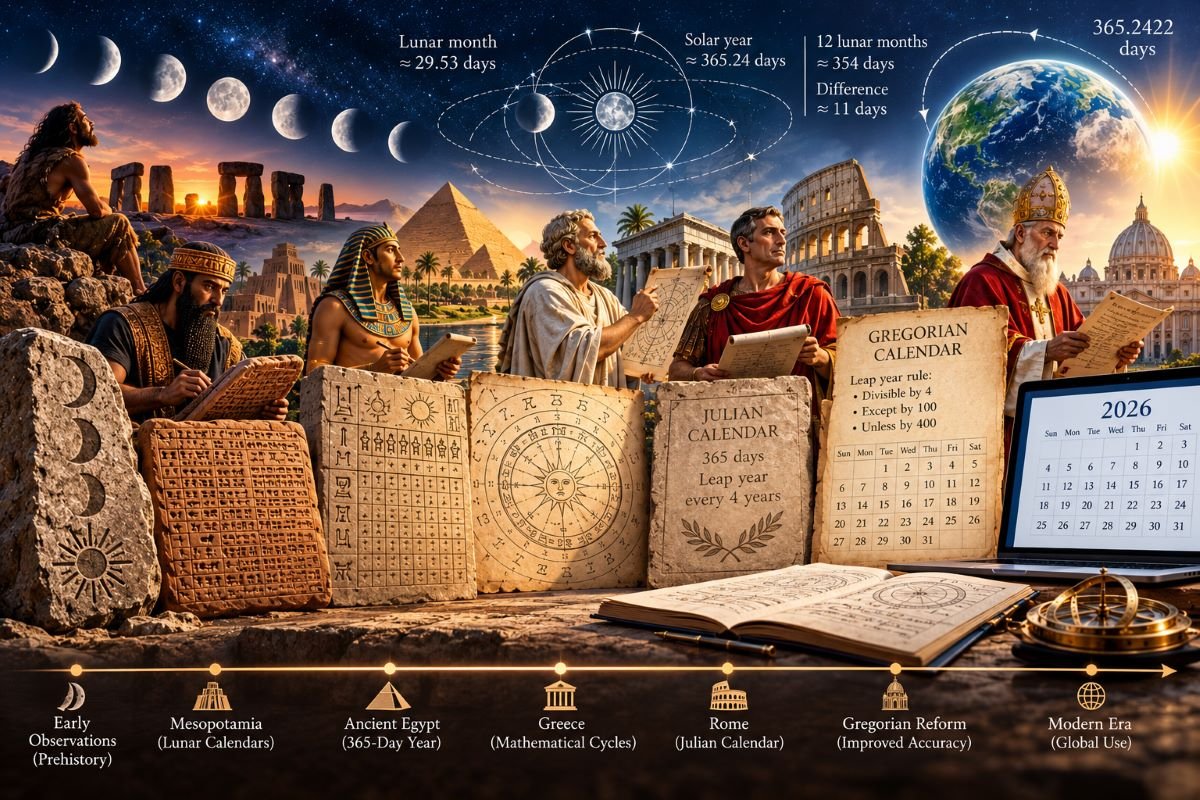
Long before digital clocks, printed calendars, and date-calculation software existed, human societies faced a fundamental challenge: how to measure the passage of time and organize it into a reliable system. Communities needed to recognize seasonal changes, determine when to plant crops, prepare for floods, coordinate religious ceremonies, and record important events. These practical needs encouraged people to observe the sky, count repeating natural cycles, and develop increasingly sophisticated methods of measuring time.
The history of calendar mathematics is closely connected to the development of astronomy, arithmetic, geometry, and early scientific thinking. Important contributions emerged in ancient Iraq, Egypt, Greece, Italy, India, and China. These civilizations developed different approaches to lunar cycles, solar years, astronomical observations, and the organization of dates.
Early calendars were not necessarily mathematical in the modern sense. Many relied on visible natural events, local traditions, or the decisions of religious authorities. Over centuries, however, people began recognizing numerical relationships between astronomical cycles. They discovered that lunar months did not divide evenly into solar years, that seasons gradually drifted away from fixed calendar dates, and that additional days or months sometimes had to be inserted to maintain alignment.
Different civilizations developed different solutions. Mesopotamia, in present-day Iraq became an important center for lunar-calendar observations and mathematical astronomy. Ancient Egypt developed a 365-day civil calendar that helped organize agricultural and administrative activities. Astronomers in Greece investigated relationships between lunar and solar cycles, while reforms in ancient Rome, in present-day Italy produced the Julian calendar, an important predecessor of the modern Gregorian calendar. Ancient India also developed sophisticated calendrical traditions based on astronomical calculations, while China maintained its own long-standing lunisolar calendar tradition.
Calendar mathematics emerged through the gradual combination of astronomical observation, numerical calculation, and practical timekeeping. Its development illustrates how human societies transformed recurring natural phenomena into organized systems of measurement.
The history of timekeeping also helps explain why modern countries follow different local times. Today, France has the greatest number of time zones when its overseas territories are included, while Russia and the United States span many time zones across large geographical areas. Australia and Canada also use multiple time zones. In contrast, China officially uses a single standard time zone across its vast mainland territory, despite its considerable east–west geographic span.
Understanding these historical and geographical differences reveals why modern calendars contain leap years, unequal month lengths, repeating weekday patterns, and time-zone rules that may appear complicated at first glance.
Before Mathematical Calendars: Observing Natural Cycles
The earliest foundations of calendar mathematics appeared when humans began recognizing that natural events occurred in repeating patterns.
The changing appearance of the Moon was one of the most noticeable cycles. Over approximately 29.5 days, the Moon progresses through its familiar phases, from new Moon to full Moon and back again. This cycle provided a practical way to estimate the passage of time without requiring specialized instruments.
Seasonal changes provided another important reference. The length of daylight, the position of the Sun at sunrise and sunset, and the appearance of particular stars could indicate when seasonal activities should begin.
For communities dependent on agriculture, these observations had practical consequences. Planting too early or too late could affect the availability of food. Flooding, rainfall, animal migrations, and changes in temperature also influenced the timing of important activities.
Early timekeeping therefore developed from the relationship between observation and survival.
Recognizing repetition
The first step toward calendar mathematics was recognizing that certain events repeated.
If a visible lunar phase returned after approximately the same interval, people could use that pattern to organize activities. If the Sun appeared to reach a similar seasonal position after roughly one year, that recurrence could serve as a longer time unit.
These observations introduced an important mathematical idea: a cycle can be measured by counting the intervals between recurring events.
However, natural cycles are not perfectly interchangeable.
A lunar cycle lasts approximately 29.53 days, while the seasonal year is approximately 365.24 days. Neither value is an exact whole number of days, and twelve lunar cycles do not equal one solar year.
These differences eventually became central problems in calendar development.
The Moon and the First Calendar Calculations
Lunar cycles offered early societies a convenient way to divide time into months.
The Moon changes appearance in a regular sequence that can be observed without complex equipment. A full cycle takes approximately 29.53 days, which means that individual lunar months are not an exact whole number of days.
A practical calendar, however, generally needs to identify complete days. As a result, calendar makers had to work with months containing either 29 or 30 days.
A sequence of such months can approximate the lunar cycle.
For example, a twelve-month lunar year containing six 29-day months and six 30-day months would contain:
12 months × an average of 29.5 days = 354 days.
This is close to, but shorter than, the solar year.
The difference is approximately eleven days each year.
That discrepancy creates an important problem. A calendar based exclusively on lunar months gradually moves through the seasons. A month associated with spring in one year may occur in winter after sufficient time has passed.
This relationship between lunar and solar cycles encouraged the development of more advanced calendar systems.
From observation to prediction
Initially, communities could determine the beginning of a month by observing the Moon. Over time, people began recording observations and recognizing patterns that made future events easier to anticipate.
Records of lunar appearances allowed observers to estimate when a new month would begin. Repeated observations could also reveal that certain sequences of lunar months occurred more frequently than others.
This was an early form of mathematical modeling: past observations were used to predict future events.
The growing ability to predict celestial cycles helped transform calendars from simple records of natural phenomena into systems with rules.
Mesopotamia: Mathematics and the Organization of Time
Ancient Mesopotamia, particularly Babylonia, made important contributions to the development of mathematical astronomy and calendar calculation.
Mesopotamian societies used lunar-based calendars in which months were connected to the Moon's phases. Their calendars also had to accommodate agricultural seasons, religious ceremonies, and administrative requirements.
The relationship between lunar months and the solar year required periodic adjustment.
Twelve lunar months are shorter than a solar year, so an additional month sometimes had to be inserted to keep the calendar aligned with the seasons. This practice is known as intercalation.
Intercalation as a mathematical solution
Intercalation is one of the earliest examples of calendar mathematics addressing a mismatch between two natural cycles.
Suppose a calendar year contains approximately 354 days, while the solar year contains approximately 365.24 days.
The annual difference is:
365.24 − 354 ≈ 11.24 days.
After three years, the accumulated difference becomes approximately:
3 × 11.24 = 33.72 days.
This is slightly more than one lunar month.
Without correction, the calendar would gradually lose its seasonal alignment. Adding an extra month at appropriate intervals helps compensate for this difference.
Historical Babylonian practices developed over time, and the precise rules varied across periods. By the first millennium BCE, Babylonian astronomers were using increasingly systematic methods to regulate their lunisolar calendar.
Numerical traditions
Mesopotamian mathematics also developed a sophisticated sexagesimal, or base-60, number system.
The legacy of this numerical tradition is visible in modern measurements of time and angles. An hour contains 60 minutes, and a minute contains 60 seconds. A full circle contains 360 degrees.
These conventions did not all emerge from a single calendar reform, but they demonstrate how ancient mathematical traditions influenced later systems of measurement.
Mesopotamian astronomy helped establish the principle that celestial cycles could be described, recorded, and predicted using numerical relationships.
Ancient Egypt and the 365-Day Year
Ancient Egypt developed a civil calendar that became especially important for administration, agriculture, and religious organization.
The Nile River's annual flood was central to Egyptian life. Recognizing the seasonal pattern of the flood helped communities plan agricultural activities and manage resources.
Egyptian observers also paid attention to the annual appearance of Sirius, the brightest star in the night sky. Its heliacal rising, when it first became visible shortly before sunrise after a period of invisibility, was associated with the seasonal cycle and the Nile flood.
The relationship was not perfectly fixed, but astronomical observations contributed to the development of Egyptian timekeeping.
The structure of the Egyptian civil calendar
The Egyptian civil year contained 365 days.
It consisted of:
- Twelve months of 30 days each
- Five additional days at the end of the year
The calculation was straightforward:
12 × 30 = 360 days.
Adding five days produced:
360 + 5 = 365 days.
This structure was mathematically convenient because every month had the same length.
Unlike calendars with irregular month lengths, the Egyptian civil calendar provided a consistent administrative framework for recording dates and organizing annual activities.
The problem of seasonal drift
The actual seasonal year is slightly longer than 365 days.
If a calendar uses exactly 365 days every year, it falls behind the seasonal cycle by approximately one-quarter of a day annually.
After four years, the difference approaches one day.
After approximately 120 years, the discrepancy accumulates to about one month.
Over longer periods, the calendar date associated with a seasonal event gradually shifts.
The Egyptian civil calendar's lack of a regular leap-year correction therefore created a substantial long-term difference between the calendar year and the solar year.
This illustrates a fundamental principle of calendar mathematics: a system can be simple and consistent in its internal structure while gradually drifting away from the natural cycle it was intended to represent.
Early Astronomical Records and the Development of Prediction
As civilizations accumulated records of celestial events, calendar calculations became more systematic.
Observations of lunar phases, eclipses, planetary movements, and the changing positions of stars helped astronomers identify recurring patterns.
The process required several mathematical activities:
- Recording the dates of observations.
- Comparing intervals between similar events.
- Identifying approximate repeating cycles.
- Estimating future occurrences.
- Adjusting calendar arrangements when predictions and observations differed.
This process was not limited to one civilization. Different societies developed independent astronomical traditions, often in response to their own environmental, religious, and administrative needs.
Why long-term records mattered
A single observation could establish that an event occurred. Repeated observations were needed to estimate its cycle.
For example, the time between two lunar phases could be measured over several months. Comparing many intervals made it possible to estimate the average lunar month more accurately.
Likewise, seasonal observations accumulated over many years could reveal that the solar year was not exactly 365 days.
The more accurately these cycles were measured, the better calendar makers could anticipate seasonal changes and plan corrections.
This relationship between accumulated observations and numerical refinement became an essential feature of scientific timekeeping.
Greek Astronomy and the Relationship Between Lunar and Solar Cycles
Ancient Greek astronomers inherited knowledge from earlier civilizations and developed their own approaches to astronomical calculation.
Greek mathematical astronomy explored geometric models, numerical cycles, and methods for predicting celestial events.
One important calendar problem was the relationship between lunar months and solar years.
Twelve lunar months contain approximately 354.37 days, while a solar year contains approximately 365.24 days. A calendar combining both cycles must account for their difference.
Greek astronomers and calendar makers investigated recurring patterns that could bring lunar months back into approximate alignment with the seasons.
The Metonic cycle
One important development was the 19-year cycle associated with Meton of Athens in the fifth century BCE.
The cycle is based on the observation that 19 solar years are approximately equal to 235 lunar months.
Using modern average values:
19 solar years ≈ 19 × 365.2422 = 6,939.60 days.
235 lunar months ≈ 235 × 29.5306 = 6,939.69 days.
The difference between these approximations is small, roughly two hours over the full cycle.
The relationship is not exact, but it provides a useful way to coordinate lunar months with the seasons.
A lunisolar calendar can use a sequence of ordinary years and years containing an additional month to approximate this pattern.
Why the cycle mattered
The Metonic cycle demonstrated that two astronomical cycles with different lengths could approximately realign after a predictable interval.
This is an important mathematical concept. When two cycles do not match within a single year, their relationship may still repeat approximately over a longer period.
Such cycles made calendar planning more systematic because they reduced reliance on isolated observations.
The Metonic relationship also influenced later astronomical and calendar traditions, although different societies adapted it according to their own requirements.
The Roman Calendar Before Julius Caesar
The early Roman calendar developed within a religious and civic framework.
Traditional accounts describe an early calendar with ten named months, followed by a later twelve-month arrangement. The details of the earliest Roman calendar are debated by historians, and later Roman writers sometimes attributed reforms to legendary rulers.
By the Roman Republic, the calendar had twelve months, but its organization was not always aligned consistently with the solar year.
Roman calendar officials had authority to regulate intercalation, including the insertion of an additional month. These decisions could be influenced by political and administrative circumstances as well as by the intended seasonal alignment.
The difficulty of inconsistent adjustments
A calendar requires stable rules if it is to provide reliable long-term date references.
When additional months are inserted irregularly, the relationship between a recorded date and the seasons can become unpredictable.
Administrative activities, religious observances, public duties, and political terms may then become difficult to coordinate.
This problem demonstrated the practical importance of standardized calendar mathematics.
A calendar system needed a predictable relationship between its internal structure and the annual cycle.
Julius Caesar and the Julian Calendar Reform
In 46 BCE, Julius Caesar introduced a major reform of the Roman calendar, with assistance from astronomical expertise traditionally associated with Sosigenes of Alexandria.
The reform established the Julian calendar, which used a regular leap-year system.
The basic rule was straightforward:
- A common year contained 365 days.
- An additional day was added approximately every four years.
- A leap year therefore contained 366 days.
The average length of a Julian calendar year was:
365 + 1/4 = 365.25 days.
This was a substantial improvement over an administrative system in which intercalation could occur irregularly.
Why a leap day was needed
The Julian reform recognized that the calendar year should approximate the solar year rather than remain fixed at 365 days.
Adding one day every four years compensated for the extra fraction of a day in the seasonal cycle.
The calendar became easier to administer because the correction followed a predictable numerical rule.
However, the Julian calendar's average year was still slightly too long.
The tropical year, which is closely related to the seasonal cycle, averages approximately 365.2422 days.
The difference was:
365.25 − 365.2422 = 0.0078 days per year.
That amounts to approximately 11 minutes and 14 seconds annually.
Although the discrepancy was small in an individual year, it accumulated over centuries.
The Julian reform demonstrates how a simple mathematical correction can greatly improve a calendar while still leaving room for further refinement.
The Seven-Day Week and Its Mathematical Role
The seven-day week is another important element in the history of calendar mathematics.
Unlike the month and year, the seven-day week is not a direct subdivision of the seasonal year. Its historical development involved cultural, religious, and astronomical traditions.
Mesopotamian astronomical traditions contributed to the symbolic importance of seven celestial bodies visible to the naked eye in antiquity: the Sun, Moon, Mercury, Venus, Mars, Jupiter, and Saturn.
The seven-day week became established through historical processes involving Babylonian, Jewish, Hellenistic, and Roman traditions. Its widespread adoption took place over many centuries.
Why the seven-day cycle matters mathematically
Once a seven-day week is established, weekday calculations become a modular arithmetic problem.
Seven days form one complete weekly cycle.
Adding seven days returns a date to the same weekday. Adding fourteen or twenty-one days does the same.
This creates a repeating pattern that can be described mathematically using division by seven.
For example:
365 ÷ 7 = 52 remainder 1.
A common year therefore contains 52 complete weeks and one additional day.
A leap year contains 366 days:
366 ÷ 7 = 52 remainder 2.
The additional days explain why weekdays shift from one year to the next.
Although the seven-day week has cultural origins, its mathematical consequences are central to modern calendar calculations.
The Gregorian Calendar: Correcting the Julian System
By the sixteenth century, the Julian calendar had accumulated a noticeable discrepancy relative to the seasonal year.
Because its average year was slightly too long, dates associated with seasonal astronomical events gradually shifted.
The issue became particularly important for determining the date of Easter, whose calculation depends on the relationship between the spring equinox and the lunar cycle.
In 1582, Pope Gregory XIII introduced a calendar reform that produced the Gregorian calendar.
The reform made two major changes:
- It corrected the accumulated seasonal displacement through a change in calendar dates.
- It modified the leap-year rule to improve the calendar's long-term average accuracy.
The initial reform omitted ten calendar dates in the territories that adopted it in 1582, moving directly from October 4 to October 15.
Not every country adopted the Gregorian calendar immediately. Adoption occurred at different times in different regions, which created historical differences in date recording.
The Gregorian leap-year rule
The Gregorian system uses the following rule:
- Years divisible by four are leap years.
- Century years are not leap years unless divisible by 400.
For example:
- 1600 was a leap year.
- 1700 was not a leap year.
- 1800 was not a leap year.
- 1900 was not a leap year.
- 2000 was a leap year.
- 2024 was a leap year.
- 2026 is a common year.
This system produces 97 leap years in every 400-year cycle.
The average Gregorian year is therefore:
365 + 97/400 = 365.2425 days.
This is closer to the average tropical year than the Julian calendar's 365.25-day average.
Why the 400-year cycle matters
Over 400 years, the Gregorian calendar contains:
400 × 365 + 97 = 146,097 days.
Dividing by seven gives:
146,097 ÷ 7 = 20,871 weeks.
The cycle therefore contains an exact whole number of weeks.
This mathematical property helps explain why weekday arrangements repeat over a complete Gregorian 400-year cycle.
It also provides a foundation for efficient date-calculation algorithms.
From Astronomical Observation to Calendar Algorithms
Calendar mathematics gradually shifted from primarily observational methods toward increasingly formal algorithms.
Early calendar makers often relied on visible celestial events and accumulated records. Later astronomers used numerical tables, geometric models, and mathematical relationships to calculate dates and predict recurring events.
Modern calendar software extends this tradition through algorithms that determine weekdays, month lengths, leap years, and date differences.
The weekday calculation problem
Suppose someone wants to determine the weekday of a date several centuries in the past.
Counting every day from the beginning of a calendar system would be inefficient.
Instead, a mathematical algorithm can calculate the number of days between a known reference date and the requested date. The total can then be reduced modulo seven.
The remainder identifies the weekday offset.
Various algorithms use different arrangements of the same basic ideas. Some calculate year contributions, month offsets, and leap-year corrections directly. Others convert a date into a continuous day number.
The underlying principle remains the same: a complex date sequence can be analyzed using numerical relationships and repeating cycles.
Calendar arithmetic as a general method
A calendar algorithm must account for several features:
- Unequal month lengths
- Leap-year rules
- The starting weekday of a reference date
- Changes between months and years
- The calendar system being used
These rules transform a date into a mathematical object that can be compared, calculated, and manipulated consistently.
The Development of Continuous Date Counting
As astronomy and historical research required comparisons across long periods, continuous numerical representations of dates became increasingly useful.
One important example is the Julian Day system used in astronomy.
Despite its name, the Julian Day system is not the same thing as the Julian calendar.
It assigns a continuous numerical count to days relative to a defined reference epoch. This makes it possible to compare observations without repeatedly handling different month lengths or leap-year boundaries.
For example, once two dates have been converted into compatible numerical day values, the interval between them can be calculated by subtraction.
This method is particularly useful for astronomical observations, historical chronology, and computational date arithmetic.
Continuous date counting illustrates an important development in calendar mathematics: rather than treating each date as an isolated combination of year, month, and day, it can be represented as a position on a continuous numerical scale.
Historical Calendars and the Problem of Conversion
The Gregorian calendar is widely used for civil purposes today, but it is not the only calendar system that has existed.
Historical research may involve the Julian calendar, Hebrew calendar, Islamic calendar, Chinese calendar, Persian calendar, Hindu calendar traditions, and other systems.
These calendars differ in their organization and underlying principles.
Some are primarily solar. Others are lunar or lunisolar. Their year boundaries, month structures, and methods of inserting additional days or months may differ substantially.
Consequently, a historical date cannot always be interpreted correctly without identifying its calendar system.
The Julian-Gregorian distinction
A date recorded in the Julian calendar may correspond to a different Gregorian date.
The difference between the two calendars has changed over time because the Gregorian system corrected the accumulated discrepancy rather than applying one fixed offset to every historical period.
This creates complications when comparing records from countries that adopted the Gregorian reform at different times.
Historians must therefore consider both the calendar system and the location in which a record was produced.
Why historical conversion matters
Accurate calendar conversion is important for:
- Comparing historical documents
- Establishing the chronology of events
- Interpreting astronomical observations
- Studying the development of religious festivals
- Understanding old administrative records
- Building historical databases
Calendar mathematics provides the rules needed to compare dates that were originally recorded using different systems.
The Relationship Between Calendar Mathematics and Astronomy
Calendar mathematics has always been connected to astronomy, but the two fields address somewhat different questions.
Astronomy investigates celestial objects and their motions.
Calendar mathematics organizes dates according to numerical rules designed to represent time and, in many cases, approximate astronomical cycles.
A calendar may use the seasonal year as a reference without perfectly reproducing every detail of Earth's motion.
This distinction matters because astronomical cycles are not always constant, perfectly uniform, or expressible as exact whole numbers of days.
Why approximation is unavoidable
The Earth's rotation, orbital motion, and relationship with the Moon involve different physical processes.
A civil calendar, however, needs a manageable number of days and a stable arrangement of months and years.
Calendar makers must therefore balance mathematical simplicity with astronomical accuracy.
The Gregorian calendar is one example of this compromise. Its leap-year rule provides a close approximation to the seasonal year while remaining easy enough to apply through a simple divisibility test.
Other calendar systems make different choices according to their cultural, religious, and administrative requirements.
The history of calendar mathematics is consequently a history of designing practical systems around natural cycles that do not divide evenly into one another.
The Influence of Calendar Mathematics on Modern Computing
Modern computers perform calendar calculations almost instantly, but the underlying problems are connected to questions that calendar makers have addressed for centuries.
Digital systems must determine whether a year is a leap year, calculate the weekday for a date, identify the number of days in a month, and compare dates across month and year boundaries.
Programming languages and databases provide date-handling functions that automate these tasks.
However, reliable results still depend on using the correct calendar rules and clearly defining the operation.
For example, adding 30 days to a date is not necessarily the same as adding one calendar month. Similarly, a date in a historical document may require a different calendar interpretation from a modern civil date.
Time zones introduce additional complexity because the same instant can correspond to different local calendar dates in different parts of the world.
These distinctions show that calendar mathematics remains relevant even when calculations are performed by software.
Important Lessons from the History of Calendar Mathematics
The historical development of calendars reveals several broader mathematical principles.
First, observation can lead to measurement
Recognizing repeating natural events creates opportunities to estimate intervals and develop numerical descriptions.
Second, different cycles may not align naturally
The lunar month, seasonal year, and day have different lengths. Combining them requires approximations or periodic adjustments.
Third, simple rules can improve consistency
The Julian leap-year rule made calendar administration more predictable. The Gregorian rule refined that approach by introducing century-year exceptions.
Fourth, accumulated error matters
A small annual difference can become significant over centuries. Long-term accuracy requires attention to small numerical discrepancies.
Fifth, mathematical systems reflect practical needs
Calendars were developed not only to describe astronomy but also to support agriculture, religion, government, trade, and recordkeeping.
Sixth, historical context matters
A date must be interpreted according to the calendar system and conventions in use when it was recorded.
These principles extend beyond calendars. They are relevant to measurement systems, scientific modeling, numerical prediction, and the design of standards.
Why the Origins of Calendar Mathematics Still Matter
Understanding the history of calendar mathematics helps explain features of modern date systems that might otherwise seem arbitrary.
The unequal lengths of months, the existence of leap years, the seven-day week, and the distinction between different calendar systems all reflect historical decisions and mathematical constraints.
The subject also demonstrates that modern technology depends on ideas developed through centuries of observation, calculation, and refinement.
Calendar software may hide the calculations behind a simple interface, but the system still needs reliable rules for handling dates.
For students, programmers, historians, and anyone interested in the measurement of time, the history of calendar mathematics provides a useful example of mathematics developing in response to practical human needs.
It shows how people moved from observing recurring natural events to constructing numerical systems capable of organizing dates across generations.
Conclusion
The origins of calendar mathematics lie in humanity's effort to understand repeating patterns in nature and organize daily life around them.
Early observations of the Moon and changing seasons provided the foundation for measuring months and years. Mesopotamian societies developed systematic lunar calendars and mathematical astronomy. Ancient Egypt established a convenient 365-day civil calendar, while Greek astronomers explored long-term relationships between lunar months and solar years.
Roman calendar reform introduced a regular leap-year structure through the Julian calendar. The Gregorian reform later refined that system by correcting accumulated seasonal drift and establishing a more accurate leap-year rule.
Over time, calendar mathematics expanded beyond astronomical observation into weekday calculations, continuous date counting, historical conversion, and modern computer algorithms.
The central challenge has remained remarkably consistent: natural cycles do not divide neatly into whole numbers of days, months, and years. Calendar systems must therefore use carefully designed rules to balance simplicity, predictability, and accuracy.
Modern calendars are the result of centuries of experimentation, cultural exchange, mathematical reasoning, and scientific refinement. Their familiar dates conceal a complex history of human attempts to measure and organize time.
Frequently Asked Questions
What is calendar mathematics?
Calendar mathematics is the use of mathematical rules to organize dates, calculate time intervals, determine weekdays, account for leap years, and relate calendar units to astronomical cycles.
When did calendar mathematics begin?
Its earliest foundations developed through prehistoric observations of lunar phases and seasonal changes. Formal calendar systems became increasingly sophisticated in ancient civilizations, including Mesopotamia and Egypt.
Which civilization contributed to early calendar mathematics?
Several civilizations made important contributions. Mesopotamia developed mathematical astronomy and lunisolar calendar practices, while ancient Egypt established a 365-day civil calendar. Greek and Roman traditions later contributed to further refinements.
Why did ancient societies use lunar calendars?
The Moon's changing phases provided a visible, repeating cycle that could be observed without specialized instruments. Lunar months were therefore practical units for organizing religious, social, and administrative activities.
What is intercalation?
Intercalation is the insertion of an additional day or month into a calendar to help keep it aligned with an astronomical cycle or another calendar structure.
What was the Metonic cycle?
The Metonic cycle is an approximately 19-year relationship in which 19 solar years correspond closely to 235 lunar months. It provides a useful framework for lunisolar calendar calculations.
Why was the Julian calendar introduced?
The Julian calendar reform, introduced under Julius Caesar in 46 BCE, established a more regular calendar structure with a leap year approximately every four years.
Why was the Gregorian calendar needed?
The Julian calendar's average year was slightly too long, causing calendar dates to drift relative to the seasons. The Gregorian reform corrected accumulated displacement and adjusted the leap-year rule.
What is the difference between the Julian and Gregorian calendars?
The Julian calendar uses a leap year every four years. The Gregorian calendar excludes most century years from being leap years, except those divisible by 400, resulting in a closer approximation to the seasonal year.
Why is February sometimes 29 days long?
February receives an additional day during leap years to compensate for the fact that the seasonal year is slightly longer than 365 days.
Why is the seven-day week important in calendar mathematics?
The seven-day week creates a repeating cycle. Weekday calculations can therefore use modular arithmetic, particularly remainders after division by seven.
Is the Julian Day system the same as the Julian calendar?
No. The Julian Day system is a continuous numerical method for counting days from a reference epoch, primarily used in astronomy and scientific calculations. The Julian calendar is a civil calendar introduced during the Roman period.
How is calendar mathematics used today?
It supports date calculators, scheduling applications, databases, payroll systems, historical research, astronomical calculations, international meeting planners, and software that manages dates and time.
Why are historical calendar conversions complicated?
Different calendar systems use different rules, and countries adopted reforms at different times. Accurate conversion requires identifying the original calendar system and applying the appropriate historical rules.
Comments
No comments yet.