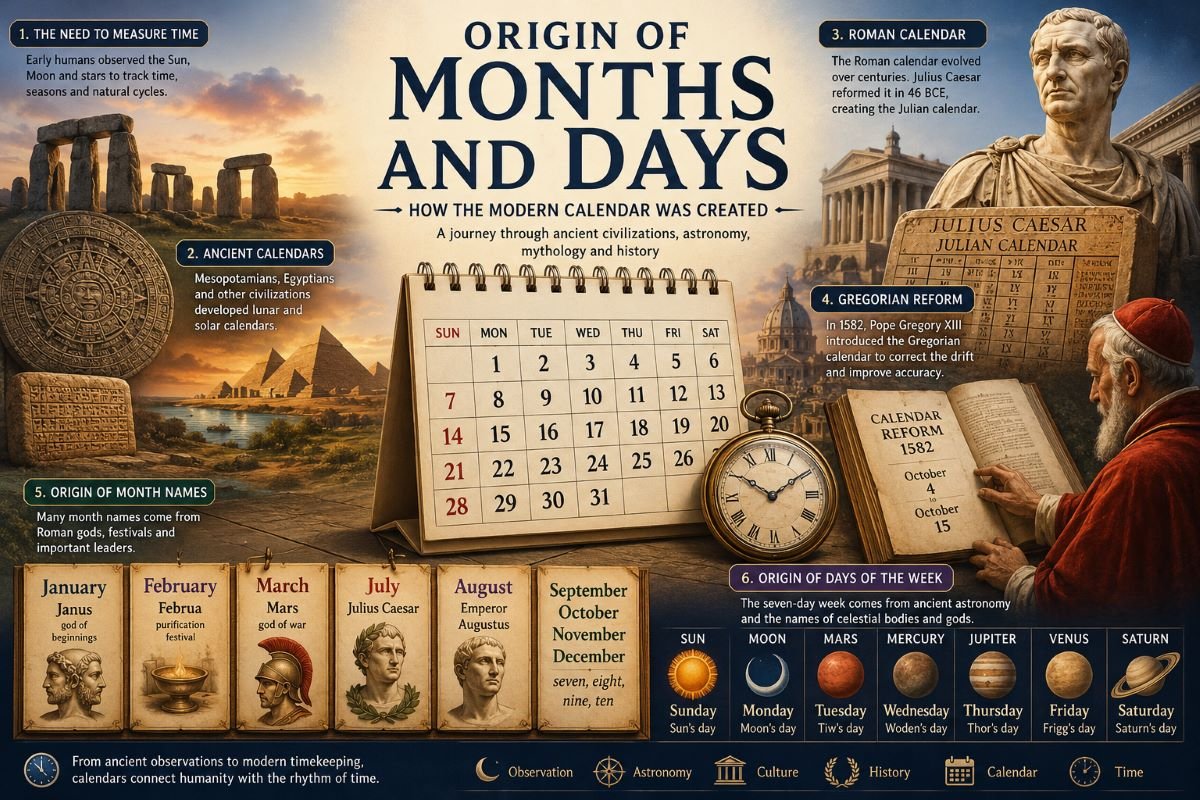
Introduction
Every modern calendar looks familiar. The year is divided into months, months into days, and the week into seven days. January comes before February, Monday follows Sunday, and a new year begins on a date recognized by billions of people around the world.
But these divisions are not as simple or as natural as they may appear.
A day is closely connected to Earth's rotation. A year reflects Earth's journey around the Sun. A month has a long historical connection with the cycle of the Moon. The seven-day week, however, is primarily a cultural and religious tradition rather than a direct consequence of Earth's astronomical cycles.
The calendar used by much of the modern world is therefore not simply a representation of nature. It is the result of thousands of years of observation, astronomy, mathematics, religion, politics, language, and cultural change.
The names of our months and days preserve traces of that history. Some months are named after Roman gods. Others preserve the names of Roman rulers. September, October, November, and December retain numerical names from an older Roman calendar. The English names of several weekdays preserve the names of Germanic and Norse gods, while Sunday and Monday retain direct references to the Sun and Moon.
To understand why our calendar looks the way it does today, it is useful to go back to the earliest civilizations that began systematically measuring time.
Why Did Humans Need Calendars?
The earliest humans did not need a calendar in the modern sense. Nature itself provided obvious signals for the passage of time.
The Sun rose and set every day. The Moon changed through a recognizable cycle. Seasons returned in broadly predictable patterns. Plants grew and disappeared, animals migrated, and temperatures changed.
For hunter-gatherer societies, these natural cycles provided important information about when to move, hunt, gather food, or prepare for changing environmental conditions.
As human societies became larger and more settled, however, simply observing nature was no longer enough.
Agricultural communities needed to know when to plant and harvest crops. Religious communities needed to determine when ceremonies and festivals should take place. Governments needed systems for taxation, administration, trade, military organization, and record keeping.
Time therefore became something that had to be measured, recorded, and organized.
This led to one of humanity's most important intellectual developments: the calendar.
The Three Natural Cycles of Time
Most ancient calendars were built around three major astronomical cycles.
The first was the day, associated with the cycle of daylight and darkness caused primarily by Earth's rotation.
The second was the month, historically connected with the Moon. From one new moon to the next, the lunar cycle lasts approximately 29.5 days.
The third was the year, associated with Earth's orbit around the Sun. The seasonal year is approximately 365.24 days long.
These cycles do not fit together perfectly.
Twelve lunar months total only about 354 days, roughly 11 days shorter than a solar year. A solar year, meanwhile, cannot be divided evenly into whole lunar months.
This mismatch created one of the fundamental challenges of ancient calendar making.
A society following the Moon alone would gradually see its months move through the seasons. A society following the Sun would have to give up a direct correspondence between calendar months and lunar phases.
Ancient civilizations developed different solutions to this problem.
The Moon and the Origin of the Month
The connection between the Moon and the month is one of the oldest relationships in human timekeeping.
The Moon passes through a repeating sequence of phases, including the new moon, crescent phases, first quarter, full moon, and the waning phases that eventually lead back toward a new moon.
The complete synodic cycle lasts approximately 29.5 days.
This made the Moon a convenient natural timekeeper for early societies.
Unlike many astronomical phenomena, the changing appearance of the Moon is easily visible without instruments. People could observe its phases and use them to identify recurring periods.
The linguistic relationship between the words month and Moon in several languages also reflects this ancient connection.
Early lunar calendars commonly used alternating months of approximately 29 and 30 days. But twelve lunar months produced a year considerably shorter than the solar year.
That meant a purely lunar calendar could not remain aligned with agricultural seasons indefinitely.
Civilizations therefore had to find ways to reconcile lunar observation with the solar year.
Ancient Mesopotamia and the Development of Calendars
One of the earliest major centers of organized calendar development was Mesopotamia, the region between the Tigris and Euphrates rivers.
Ancient Mesopotamian civilizations, including the Sumerians and Babylonians, carefully observed the sky. Their societies depended heavily on agriculture, trade, religion, and administration, all of which required reliable systems for organizing time.
The Babylonian calendar was lunisolar. Months were connected with lunar cycles, while the calendar as a whole was periodically adjusted to remain connected with the solar year.
This sometimes required inserting an additional month.
The practice of inserting an extra period into a calendar to reconcile different astronomical cycles is known as intercalation.
Mesopotamian mathematical traditions also had a lasting influence on the history of time measurement. Their use of a sexagesimal, or base-60, numerical system became part of a broader mathematical tradition that eventually influenced the division of an hour into 60 minutes and a minute into 60 seconds.
The clock systems used today are therefore connected, indirectly, with mathematical ideas developed thousands of years ago.
Ancient Egypt and the Solar Year
Ancient Egypt developed another important approach to organizing the year.
Egyptian civilization depended heavily on the Nile and its seasonal flooding. Understanding the annual cycle was therefore essential for agriculture and administration.
The ancient Egyptian civil calendar used 12 months of 30 days, producing 360 days. Five additional days were then placed at the end of the year, creating a 365-day calendar.
This was a relatively simple and practical system.
However, the true seasonal year is slightly longer than 365 days.
The difference is only about one-quarter of a day per year, but even a small error accumulates over centuries.
Without a correction, the calendar would gradually move relative to the seasons.
This illustrates one of the central problems of calendar design: astronomical cycles rarely fit neatly into whole numbers.
Why Is a Solar Year Not Exactly 365 Days?
It is common to think of a year as exactly 365 days.
In reality, the tropical year—the cycle relevant to the repetition of the seasons—is approximately 365.2422 days.
That fraction of a day may seem insignificant, but it accumulates.
If a calendar used exactly 365 days every year, it would gradually drift relative to the seasons.
After several years the difference would become noticeable. Over centuries it would become substantial.
This is why calendar systems need periodic corrections.
Adding an extra day at carefully chosen intervals allows a calendar to remain much more closely synchronized with the seasonal cycle.
The modern Gregorian calendar uses a more precise leap-year rule than the Julian calendar that preceded it.
The Challenge of Combining the Moon and Sun
Ancient calendar makers faced another problem.
A lunar month lasts approximately 29.5 days.
A solar year lasts approximately 365.24 days.
Twelve lunar months therefore equal only about 354 days.
The difference is around 11 days each year.
After three years, the difference can approach a full month.
For agricultural societies, this could become a serious problem.
A festival associated with spring could eventually occur at a different point in the agricultural year if no correction was made.
One solution was the lunisolar calendar.
A lunisolar calendar follows lunar cycles for its months but periodically inserts an additional month to keep the calendar aligned with the solar year.
Different ancient civilizations used different versions of this approach.
The development of calendars was therefore not simply a matter of counting days. It was an attempt to reconcile several natural cycles that do not divide evenly.
The Origin of the Twelve Months
The twelve months used in the modern Gregorian calendar were not created all at once.
The system developed through centuries of calendar traditions, particularly those associated with ancient Rome.
Some month names came from Roman gods and religious traditions. Others were associated with political leaders. Several preserve numerical names from an older arrangement of the Roman year.
Understanding the twelve months therefore requires understanding the evolution of the Roman calendar.
The Early Roman Year
According to ancient Roman tradition, the earliest Roman calendar had ten months and began with March.
The traditional sequence was:
- Martius
- Aprilis
- Maius
- Iunius
- Quintilis
- Sextilis
- September
- October
- November
- December
This traditional arrangement explains one of the strangest features of modern month names.
The Latin roots of September, October, November, and December correspond to:
- September — seven
- October — eight
- November — nine
- December — ten
Yet today these months are the ninth, tenth, eleventh, and twelfth months.
The explanation is historical.
January and February were later placed before March. The positions of the later months therefore shifted, but their traditional names survived.
The names are essentially linguistic fossils from an earlier calendar.
January — The Month of Janus
January takes its name from Janus, an ancient Roman god associated with beginnings, transitions, doorways, gates, and passages.
Janus was traditionally depicted with two faces looking in opposite directions.
This made him an especially appropriate symbol for a new beginning. One face could be understood as looking toward the past while the other looked toward the future.
The Latin name for January was Ianuarius, derived from Janus.
January's eventual position at the beginning of the Roman civil year was influenced by Roman administrative practice. Roman consuls began their annual terms on January 1 from the second century BCE onward, helping establish the date as an important beginning of the official year.
The modern association between January and new beginnings therefore has both religious symbolism and historical roots.
February — The Month of Purification
February comes from the Latin Februarius and is associated with Februa, a Roman period or set of purification rituals.
February occupied a distinctive position in the Roman calendar and eventually became the shortest month of the year.
Its unusual length is not simply an astronomical necessity.
It is largely a legacy of Roman calendar development and subsequent reforms.
When Julius Caesar reorganized the calendar, February was assigned 28 days in ordinary years and received an additional day in leap years.
That basic structure survives today.
March — The Month of Mars
March takes its name from Mars, the Roman god of war.
The Latin name was Martius.
March was traditionally the first month of the early Roman year.
Its association with Mars made sense within Roman society, where the beginning of the year was associated with the return of favorable conditions for military activity as well as agricultural work.
When January and February were later placed before March, March retained its ancient name.
April — A Month with an Uncertain Origin
April is one of the month names whose exact origin remains uncertain.
Its Latin form was Aprilis.
One traditional explanation connects it with the Latin verb aperire, meaning "to open," possibly referring to flowers opening during spring.
This is an attractive explanation, but it is not certain.
Other theories connect the name with older Mediterranean traditions.
The uncertainty is important because ancient word origins are not always preserved in reliable historical records.
Unlike some other month names, April does not have a universally accepted etymology.
May — The Month of Maia
May is traditionally associated with Maia, a figure connected with growth and fertility in Roman tradition.
The Latin name was Maius.
The association is appropriate for a month linked with spring growth in the Northern Hemisphere.
As with several ancient month names, however, the precise historical development of the name is more complicated than a simple one-to-one connection with a single deity.
June — The Month of Juno
June takes its name from Juno, one of the most important goddesses in Roman religion.
The Latin name was Iunius.
Juno was associated with marriage, women, childbirth, and the protection of the Roman state.
Over later centuries, June developed a strong cultural association with weddings, particularly in European traditions.
The modern month therefore preserves a name that originated in ancient Roman religion.
July — Julius Caesar's Month
July has a particularly direct political history.
Its earlier Roman name was Quintilis, meaning "fifth."
Under the older Roman calendar, March was the first month, making Quintilis the fifth.
After Julius Caesar's calendar reform, the month was renamed Julius in his honor.
The name eventually became July in English.
July therefore preserves the name of one of the most influential figures in Roman history.
August — Augustus' Month
August has a similar political origin.
Its earlier Roman name was Sextilis, meaning "sixth."
Under the older March-first system, Sextilis was the sixth month.
It was later renamed Augustus in honor of the Roman emperor Augustus.
The English name August derives from this Latin form.
A popular story claims that Augustus changed the month to 31 days so that the month named after him would not be shorter than July. This story is widely repeated, but historians generally regard it as an oversimplification or later legend.
The history of Roman month lengths was more complicated.
September — The Seventh Month
September comes from the Latin septem, meaning "seven."
In the traditional Roman calendar, March was the first month, making September the seventh.
After January and February were placed before March, September became the ninth month.
Its name did not change.
October — The Eighth Month
October comes from the Latin octo, meaning "eight."
It was the eighth month in the older Roman arrangement.
After the calendar structure changed, it became the tenth month.
Again, the old name survived.
November — The Ninth Month
November comes from the Latin novem, meaning "nine."
It was originally the ninth month.
After January and February were moved ahead of March, it became the eleventh month.
The name remained unchanged.
December — The Tenth Month
December comes from the Latin decem, meaning "ten."
It was the tenth and final month of the traditional Roman year.
Today it is the twelfth month.
The numerical name survived the change in calendar structure.
This explains why the final four month names appear to be one number behind their modern positions.
Why Do Months Have Different Numbers of Days?
The modern calendar contains months of 28, 29, 30, and 31 days.
This arrangement may appear arbitrary, but it is the result of historical attempts to approximate the solar year using whole days.
A solar year is approximately 365.24 days.
Dividing that equally among twelve months would produce an average of just over 30 days per month.
But calendar makers could not normally use fractions of a day.
They therefore distributed whole days among the months.
The Roman calendar eventually developed the pattern that influenced the Julian and Gregorian calendars.
The Julian Calendar Reform
By the first century BCE, the Roman calendar had accumulated serious problems.
The earlier system used irregular calendar adjustments, including the insertion of an additional month when necessary.
Such adjustments could be complicated and, at times, subject to political influence.
Julius Caesar therefore initiated a major calendar reform with the help of the Alexandrian astronomer Sosigenes of Alexandria.
The result was the Julian calendar, introduced in 45 BCE.
The reform established a much more predictable system.
Ordinary years contained 365 days.
Every fourth year contained 366 days.
The average year was therefore:
365.25 days
This was a close approximation of the solar year and represented a major improvement over the earlier Roman system.
Why Is February the Shortest Month?
The extra leap day was placed in February.
February already had a special position in the Roman calendar and had traditionally been treated differently from other months.
The Julian system therefore used February as the place for the additional day.
Today:
- February normally has 28 days.
- February has 29 days in a leap year.
The unusual length of February is therefore a historical legacy of Roman calendar reform.
Why Are Leap Years Necessary?
If every calendar year contained exactly 365 days, the calendar would slowly drift relative to the seasons.
The Julian solution was simple:
Add one day every four years.
This produced an average year of 365.25 days.
The system was very effective, but it was not perfect.
The tropical year is slightly shorter than 365.25 days.
The difference was only around 11 minutes per year.
That sounds insignificant, but over approximately 128 years it accumulated to about one day.
Over many centuries, the difference became substantial.
Eventually another reform was required.
The Gregorian Calendar
The Gregorian calendar was introduced in 1582 under Pope Gregory XIII.
Its purpose was to correct the accumulated drift of the Julian calendar and improve the leap-year system.
The Gregorian calendar retained the basic structure of twelve months but changed the rule used to determine leap years.
A year divisible by four is normally a leap year.
However, century years are treated differently.
A century year must also be divisible by 400 to be a leap year.
Therefore:
- 1600 was a leap year.
- 1700 was not.
- 1800 was not.
- 1900 was not.
- 2000 was a leap year.
- 2100 will not be a leap year.
This produces an average Gregorian year of approximately 365.2425 days, much closer to the seasonal year than the Julian average.
The Calendar Change of 1582
When the Gregorian calendar was introduced, the accumulated difference between the Julian calendar and the seasonal cycle had reached approximately ten days.
In countries adopting the reform in 1582, the calendar moved from:
October 4, 1582
directly to:
October 15, 1582.
Ten calendar dates were omitted.
No physical time disappeared.
The reform simply changed the calendar's date labels to bring them back into closer alignment with the seasonal cycle.
Not every country adopted the Gregorian calendar at the same time.
Some continued using the Julian calendar for decades or centuries.
This created periods in which different countries could assign different calendar dates to the same physical day.
Why Did the Gregorian Calendar Become the Global Civil Calendar?
The Gregorian calendar gradually spread through international trade, diplomacy, science, navigation, government administration, and eventually modern technology.
As countries became increasingly interconnected, a common civil calendar became increasingly useful.
International businesses needed consistent dates for contracts and payments.
Ships and later aircraft needed standardized dates for navigation and schedules.
Scientists needed common systems for recording observations and experiments.
Governments needed standardized dates for legal and administrative records.
Modern computers, databases, websites, financial systems, and communication platforms further reinforced the need for consistent calendar conventions.
Today, the Gregorian calendar is the most widely used international civil calendar.
However, it is not the only calendar used in the world.
Traditional Calendars in the Modern World
Many cultures continue to use traditional calendars for religious, cultural, and ceremonial purposes.
Examples include:
- The Islamic calendar, which is primarily lunar.
- The Hebrew calendar, which is lunisolar.
- The traditional Chinese calendar, which is lunisolar.
- Various Hindu calendar systems that combine lunar and solar calculations.
- Buddhist calendar traditions used in several Asian cultures.
A person may use the Gregorian calendar for work, school, government documents, or international communication while using another calendar to determine religious festivals or cultural celebrations.
This coexistence demonstrates that calendars are more than scientific systems.
They are also cultural institutions.
The Origin of the Seven-Day Week
The month is historically connected with the Moon, and the year is connected with Earth's relationship to the Sun.
The seven-day week is different.
There is no direct astronomical requirement for a week to contain seven days.
The seven-day cycle developed through several ancient traditions, including Mesopotamian astronomical practices, Jewish religious tradition, and the later Greco-Roman planetary week.
Ancient observers identified seven prominent celestial bodies that appeared to move against the background of the fixed stars:
- Sun
- Moon
- Mars
- Mercury
- Jupiter
- Venus
- Saturn
To ancient observers, these were the prominent "wandering" lights of the sky.
The Greek word planētēs, meaning "wanderer," eventually gave rise to the modern word "planet."
These seven celestial bodies became associated with the seven days.
Jewish Tradition and the Seven-Day Cycle
Jewish tradition played a major role in the historical development of the seven-day cycle.
The Hebrew Bible describes six days of creation followed by a seventh day of rest, the Sabbath.
The Sabbath became a central institution of Jewish religious life.
Unlike the lunar month, the seven-day cycle continues continuously rather than resetting at the beginning of each month.
This helped establish the week as a recurring social and religious unit.
Later, Christianity and Islam also developed important religious practices around the seven-day week.
The Roman Planetary Week
By the Hellenistic and Roman periods, the seven-day week was associated with the seven celestial bodies.
Roman names for the days included:
- dies Solis — day of the Sun
- dies Lunae — day of the Moon
- dies Martis — day of Mars
- dies Mercurii — day of Mercury
- dies Iovis — day of Jupiter
- dies Veneris — day of Venus
- dies Saturni — day of Saturn
English eventually developed a mixture of Roman astronomical traditions and Germanic religious names.
Where Did the Weekday Names Come From?
Sunday — The Day of the Sun
Sunday means the day of the Sun.
Its Old English form was Sunnandæg.
The name corresponds closely to the Roman concept dies Solis, or "day of the Sun."
The Sun was one of the most important celestial objects in ancient societies because it determined daylight, influenced agriculture, and marked seasonal changes.
Monday — The Day of the Moon
Monday comes from Old English Mōnandæg, meaning Moon's day.
It corresponds to the Roman dies Lunae, or "day of the Moon."
The connection is particularly appropriate because the Moon was one of humanity's earliest natural timekeepers.
Tuesday — The Day of Tiw
The Roman day associated with Tuesday was dies Martis, the day of Mars.
Mars was the Roman god of war.
Germanic-speaking cultures adapted the planetary week by associating Mars with Tiw, a Germanic deity.
Old English Tīwesdæg eventually developed into Tuesday.
Wednesday — The Day of Woden
Wednesday comes from Old English Wōdnesdæg, meaning Woden's day.
Woden is the Old English form of the deity more widely known as Odin.
The corresponding Roman day was associated with Mercury.
The modern English word Wednesday is therefore a linguistic survival of Germanic mythology.
Thursday — The Day of Thor
Thursday comes from Old English Þūnresdæg, meaning Thor's day.
Thor was associated with thunder, strength, storms, and protection.
The corresponding Roman day was associated with Jupiter, another powerful sky and thunder deity.
The Germanic tradition therefore connected Jupiter's day with Thor.
Friday — The Day of Frigg
Friday comes from Old English Frīgedæg, meaning Frigg's day.
The Roman day was associated with Venus.
Frigg was an important Germanic and Norse goddess associated with marriage and family.
The correspondence between Frigg and Venus is not a perfect one-to-one identification, but the linguistic tradition became established.
Saturday — The Day of Saturn
Saturday is unusual in English because it preserves the Roman name more directly.
The Roman day was dies Saturni, the day of Saturn.
The English form developed from Old English Sæternesdæg.
Unlike Tuesday through Friday, Saturday retained the Roman deity rather than replacing it with a Germanic equivalent.
The Weekday Names at a Glance
| Modern Day | English Origin | Roman Association |
| Sunday | Sun's day | Sun |
| Monday | Moon's day | Moon |
| Tuesday | Tiw's day | Mars |
| Wednesday | Woden's day | Mercury |
| Thursday | Thor's day | Jupiter |
| Friday | Frigg's day | Venus |
| Saturday | Saturn's day | Saturn |
The English week is therefore a mixture of several historical traditions.
Sunday and Monday preserve celestial objects.
Tuesday through Friday preserve Germanic or Norse figures associated with Roman planetary counterparts.
Saturday preserves a Roman deity.
Why Do Romance Languages Have Different Weekday Names?
Languages descended from Latin often preserve the Roman planetary associations more directly.
Spanish, for example, has:
- lunes — Moon
- martes — Mars
- miércoles — Mercury
- jueves — Jupiter
- viernes — Venus
French similarly has:
- lundi
- mardi
- mercredi
- jeudi
- vendredi
English took a different linguistic path because Germanic-speaking cultures adapted several Roman associations into their own mythology.
This is why the same seven-day cycle can have very different names in different languages.
Why Did the Seven-Day Week Survive?
The seven-day week became deeply embedded in religious, cultural, and economic life.
A day is relatively short.
A month is relatively long.
A week provides a convenient intermediate period for organizing work, school, markets, religious observance, and social activities.
Societies have experimented with other week lengths. The French Revolutionary calendar, for example, introduced a ten-day cycle called the décade.
It did not survive.
Once a society organizes its institutions around a particular weekly cycle, replacing it becomes extremely difficult.
The seven-day week is therefore both an ancient tradition and a remarkably durable social system.
The Calendar as a Historical Archive
The modern calendar can be understood as a kind of historical archive.
Every time someone writes January, they use a name connected with Janus.
Every March preserves the name of Mars.
Every July recalls Julius Caesar.
Every August recalls Augustus.
Every September contains the Latin word for seven.
Every Sunday preserves an ancient connection with the Sun.
Every Thursday carries the name of Thor.
These historical meanings have largely disappeared from everyday awareness, but the words survived.
The calendar therefore carries fragments of ancient civilizations into modern life.
Calendar Time and Clock Time
The history of months and days also reveals an important distinction between calendar time and clock time.
A calendar organizes longer periods:
- days
- weeks
- months
- years
A clock divides shorter periods:
- hours
- minutes
- seconds
These systems developed from related but different needs.
Ancient societies used astronomical observations to establish larger cycles.
Later civilizations developed increasingly precise methods for dividing the day.
Today, atomic clocks can measure time with extraordinary precision, while calendars provide the framework used to organize dates.
Together, these systems allow modern society to coordinate activities across countries and time zones.
From Sundials to Atomic Clocks
Humanity's understanding of time has progressed dramatically.
Early civilizations observed the Sun and Moon.
Sundials used shadows to indicate the passage of daylight.
Water clocks allowed time to be measured without relying directly on sunlight.
Mechanical clocks later introduced gears and escapements.
Pendulum clocks greatly improved precision.
Quartz clocks provided another major advance.
Modern atomic clocks use extremely stable atomic transitions to maintain highly precise measurements of time.
Yet despite all this technological progress, people continue to organize their lives using month names that originated in ancient Rome and weekday names that preserve ancient astronomical and mythological traditions.
This contrast is remarkable.
The technology of timekeeping has changed dramatically.
The calendar has changed much more slowly.
Why Does the Year Begin on January 1?
There is nothing in Earth's orbit that makes January 1 an objectively natural beginning of the year.
It is a historical convention.
Roman administrative practice helped establish January 1 as an important beginning of the civil year, particularly after Roman consuls began their annual terms on that date.
Over time, the convention became increasingly established.
Other cultures and historical calendar systems have begun their years at different times.
Some have connected the beginning of the year with spring, religious events, agricultural cycles, or other astronomical and cultural markers.
January 1 therefore represents a historical convention rather than an unavoidable astronomical fact.
Why Does the Week Keep Repeating?
The seven-day week is another example of a human convention that became deeply established.
The sequence repeats continuously:
Sunday → Monday → Tuesday → Wednesday → Thursday → Friday → Saturday.
There is no astronomical event that physically resets the week.
The cycle continues because societies have agreed to maintain it.
This makes the week different from the day and year.
The day is connected with Earth's rotation.
The year is connected with Earth's orbit around the Sun.
The month has a historical connection with the Moon.
The week is primarily a cultural institution.
Why Does the Calendar Matter in the Digital Age?
Modern technology has changed almost every aspect of timekeeping.
A smartphone can automatically display the date.
Computers can calculate leap years.
Digital calendars can synchronize appointments across continents.
Online systems can convert dates and times between different regions.
Yet all these technologies depend on standardized calendar conventions.
A database needs to record when a transaction occurred.
An airline needs to know the date of departure.
A scientific observation requires a date and time.
A website needs publication and update dates.
International businesses need common dates for contracts and schedules.
Modern technology has therefore not eliminated the calendar.
It has made standardized calendar systems even more important.
The Modern Calendar and a Connected World
Today, people can communicate instantly across continents.
A person in India can schedule a meeting with someone in Canada, publish an article for readers in Europe, or travel across several time zones in a single day.
For these activities to work smoothly, people need reliable ways to describe dates and times.
The Gregorian calendar provides a common civil framework.
Time zones provide geographic context.
Clocks provide the time of day.
UTC provides an international reference for precise time coordination.
Together, these systems allow modern civilization to operate across the planet.
The calendar may have ancient roots, but its importance has never been greater.
Why Understanding Calendar History Matters
Understanding where months and days came from may seem like a purely historical exercise.
But it provides a broader lesson about how human societies organize knowledge.
Calendars are systems of shared agreement.
Nature provides recurring cycles, but humans decide how to label and divide them.
The Sun does not announce that a new year has begun on January 1.
The Moon does not require every month to contain exactly 30 days.
Earth does not reset a seven-day counter every Sunday.
These are conventions developed by human civilizations.
Yet once societies agree on them, they become extraordinarily powerful.
They coordinate millions and eventually billions of people.
That is why a calendar can be both artificial and essential at the same time.
The Long Journey from Ancient Timekeeping to Today
The history of months and days is ultimately a history of problem-solving.
Ancient people looked at the sky and recognized repeating patterns.
They observed the Sun.
They followed the phases of the Moon.
They tracked the seasons.
They recorded the movements of celestial bodies.
From these observations came increasingly sophisticated systems of timekeeping.
Mesopotamian civilizations developed complex astronomical traditions.
Egyptian calendar makers developed a 365-day civil calendar.
Roman civilization developed and repeatedly modified the calendar that eventually provided the names and basic structure of the modern months.
Julius Caesar introduced a major reform.
The Julian calendar provided a much more predictable system.
The Gregorian reform later corrected its accumulated error.
Over centuries, the calendar spread through commerce, religion, government, science, technology, and international communication.
What began as humanity's attempt to understand natural cycles eventually became a global social system.
What the Month Names Tell Us
The twelve month names can almost be read as a timeline of history.
January — Janus and new beginnings.
February — Roman purification traditions.
March — Mars and the old beginning of the Roman year.
April — an uncertain etymology with possible seasonal associations.
May — Maia and associations with growth.
June — Juno and Roman religious tradition.
July — Julius Caesar and political power.
August — Augustus and imperial history.
September — seven.
October — eight.
November — nine.
December — ten.
Together, they reveal that the calendar is not the product of a single era.
It is layered history.
What the Weekday Names Tell Us
The seven weekday names tell a similarly complex story.
Sunday and Monday preserve the Sun and Moon.
Tuesday comes from Tiw.
Wednesday comes from Woden.
Thursday comes from Thor.
Friday comes from Frigg.
Saturday preserves Saturn.
Behind these names is an even older history involving astronomy, religion, mythology, and cultural exchange.
The modern week is therefore a combination of astronomical observation and human tradition.
Frequently Asked Questions
Why are there 12 months in a year?
The twelve-month system developed through ancient calendar traditions, particularly those influenced by lunar cycles and the Roman calendar. Twelve lunar months approximate a lunar year, although they are shorter than the solar year. The Roman calendar eventually established the twelve-month structure that strongly influenced the modern Gregorian calendar.
Why does February have 28 days?
February inherited its unusual length from the Roman calendar tradition. During the Julian calendar reform, February was assigned 28 days in ordinary years and received an additional day during leap years.
Why does February have 29 days in a leap year?
Earth's seasonal cycle is slightly longer than 365 days. Adding an extra day at appropriate intervals keeps the calendar synchronized with the seasons.
Why is September called September if it is the ninth month?
September comes from the Latin word septem, meaning seven. In the older Roman calendar, March was the first month and September was the seventh. January and February were later placed before March, but the original name remained.
Why are there seven days in a week?
The seven-day week developed through several ancient traditions, including Mesopotamian astronomical practices, Jewish religious tradition, and the later Greco-Roman planetary week. The cycle eventually became a widely shared cultural institution.
Why is Tuesday named after Tiw?
Tuesday comes from Old English Tīwesdæg, meaning "Tiw's day." Tiw was a Germanic deity associated with the corresponding Roman day of Mars.
Why is Thursday named after Thor?
Thursday comes from an Old English expression meaning "Thor's day." Thor was associated with thunder and the sky, making him a cultural counterpart to Jupiter, the Roman deity associated with the corresponding day.
Why is Wednesday pronounced differently from its spelling?
Wednesday developed from Old English Wōdnesdæg, meaning "Woden's day." Over centuries, pronunciation changed considerably while the written form retained much of its historical structure.
Is the Gregorian calendar the only calendar used today?
No. The Gregorian calendar is the most widely used international civil calendar, but many religious and cultural traditions continue to use other calendar systems, including Islamic, Hebrew, Chinese, Hindu, and Buddhist calendar traditions.
Is the Gregorian calendar perfectly accurate?
No calendar is perfectly aligned with every astronomical cycle. The Gregorian calendar is an extremely close approximation of the seasonal year and is sufficiently accurate for ordinary civil purposes over very long periods.
Conclusion
The calendar hanging on a wall or displayed on a phone can look like an ordinary grid of numbers.
But behind that simple grid is thousands of years of human history.
The month is connected to the Moon.
The year follows the seasonal relationship between Earth and the Sun.
The seven-day week grew from ancient astronomical, religious, and cultural traditions.
The names of the months preserve Roman gods, political leaders, and ancient numerical systems.
The names of the weekdays preserve the Sun, Moon, Roman planetary traditions, and Germanic and Norse mythology.
The leap year represents humanity's attempt to correct the small but persistent difference between a 365-day calendar and the actual length of Earth's seasonal cycle.
The Gregorian calendar represents another step in that continuing effort to create a reliable shared system for organizing dates.
What makes the story remarkable is that these ancient decisions still influence everyday life.
When we write a date, plan a meeting, celebrate a birthday, schedule a trip, or simply ask what day it is, we are participating in a system shaped by civilizations that existed thousands of years ago.
The calendar is therefore more than a way to count days.
It is a record of humanity's attempt to understand the sky, measure the seasons, organize society, preserve traditions, and create a common language for the passage of time.
Modern clocks can now measure time with extraordinary precision, but the calendar that organizes our lives still carries the fingerprints of the ancient world.
Time has always been moving forward. The calendar is how humanity learned to give that movement a structure.
Comments
No comments yet.