Part 1 — Introduction, What Is a Time Zone, and Why the World Uses Different Time Zones
Introduction
Time plays a central role in modern life. Whether you are scheduling an international business meeting, booking a flight, attending an online class, or calling friends and family overseas, understanding time zones is essential. Because the Earth is round and rotates continuously, different regions experience sunrise, noon, and sunset at different moments. Without a standardized system, coordinating activities across countries would be confusing and inefficient.
Today, the world uses a globally recognized system of time zones that allows every country and territory to maintain a consistent local time while remaining synchronized with the rest of the world. Although people often refer to "24 time zones," the reality is more complex. Several countries use half-hour and 45-minute offsets, while others span multiple time zones due to their large geographic size.
This guide provides a comprehensive overview of the world's time zones, including UTC offsets, countries, major cities, and commonly used time zone names. Whether you are a traveler, student, software developer, researcher, or simply curious about global timekeeping, this article will help you understand how the international time system works.
By the end of this guide, you will learn:
- What a time zone is and why it exists.
- How Coordinated Universal Time (UTC) serves as the world's time standard.
- Why some countries have multiple time zones while others use only one.
- Which countries use unusual 30-minute and 45-minute offsets.
- A complete list of all standard UTC time zones from UTC−12 to UTC+14.
What Is a Time Zone?
A time zone is a geographic region where the same standard time is observed. Every location within a particular time zone sets its clocks to the same official time, making it easier for people, businesses, transportation systems, and governments to coordinate daily activities.
The Earth rotates once approximately every 24 hours. As it turns, different parts of the planet receive sunlight at different times. If every city followed only the position of the Sun, neighboring towns could have slightly different local times, making railway schedules, communication, and international trade extremely difficult.
To solve this problem, countries gradually adopted standardized time zones during the late nineteenth century. Instead of every town using its own local solar time, entire regions agreed to follow one official time based on a specific longitude.
Most time zones are measured as an offset from Coordinated Universal Time (UTC). For example:
- UTC+00:00 is the international reference time.
- UTC+05:30 is 5 hours and 30 minutes ahead of UTC.
- UTC−08:00 is 8 hours behind UTC.
This standardized approach ensures that people around the world can accurately calculate local times regardless of location.
Why Do Time Zones Exist?
Time zones exist because the Earth rotates from west to east. A complete rotation takes approximately 24 hours, meaning different parts of the world experience daylight at different times.
When it is noon in London, it is already evening in parts of Asia but still early morning in North America. If every country used exactly the same clock time without considering the Earth's rotation, local time would no longer match daylight. In some places, the Sun might rise in the afternoon or set in the middle of the night.
Standardized time zones help ensure that:
- Morning generally begins after sunrise.
- Noon occurs close to when the Sun reaches its highest point.
- Businesses and schools operate during daylight hours.
- International communication remains organized.
- Transportation systems use consistent schedules.
Although political, economic, and historical factors sometimes influence national time policies, the fundamental purpose of time zones remains the same: aligning local clock time with the natural day-night cycle while maintaining global consistency.
How Time Zones Work
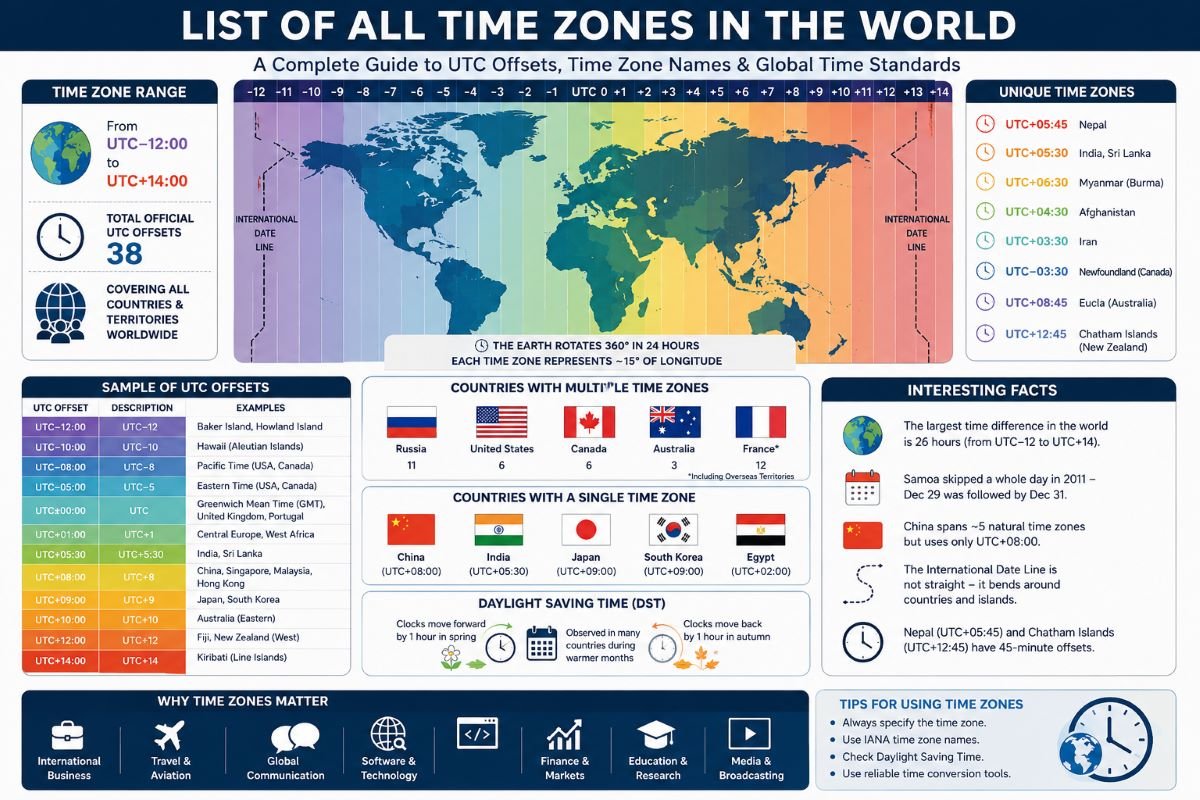
The Earth is divided into approximately 360 degrees of longitude. Since one complete rotation takes 24 hours, every 15 degrees of longitude corresponds to roughly one hour of time difference.
This principle forms the basis of the global time zone system.
For example:
- Moving east generally adds one hour.
- Moving west generally subtracts one hour.
- Crossing the International Date Line changes the calendar date.
In practice, time zone boundaries rarely follow exact lines of longitude. Instead, they are adjusted to match national borders, administrative regions, economic relationships, and population centers. As a result, neighboring countries may choose different UTC offsets even when they are geographically close.
UTC vs GMT: A Brief Overview
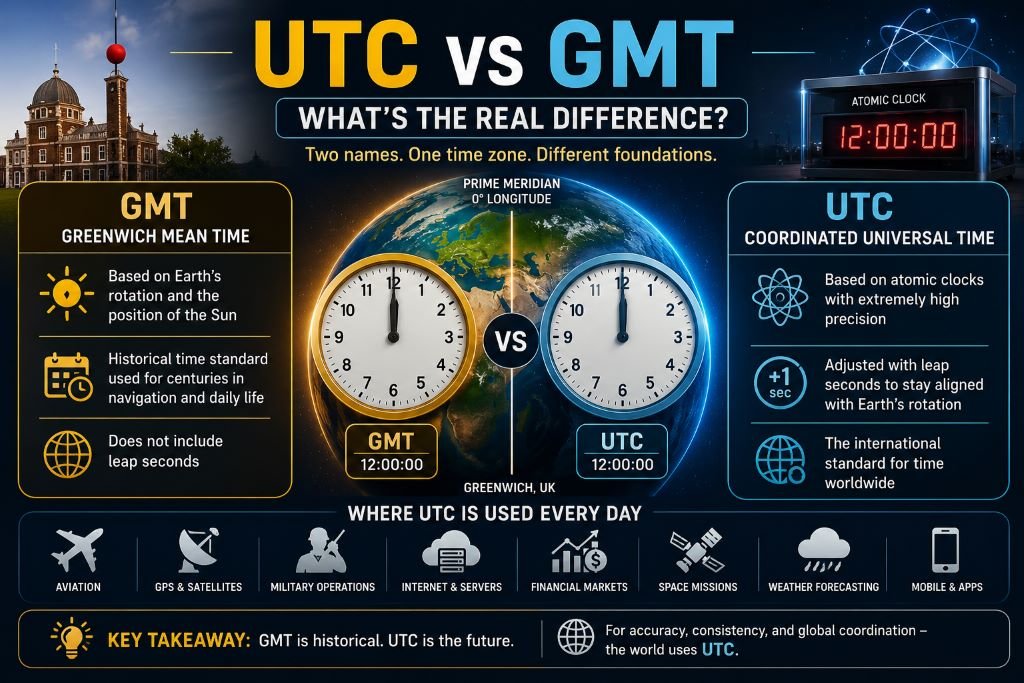
Many people use UTC (Coordinated Universal Time) and GMT (Greenwich Mean Time) interchangeably, but they are not exactly the same.
GMT originated as the mean solar time at the Royal Observatory in Greenwich, England, and historically served as the world's primary reference time. Today, UTC is the internationally accepted time standard. It is maintained using highly accurate atomic clocks and adjusted with leap seconds when necessary to remain closely aligned with the Earth's rotation.
For everyday purposes, UTC and GMT display the same clock time. However, UTC is the official standard used in aviation, navigation, telecommunications, scientific research, computer systems, and international timekeeping.
Part 2 — How Many Time Zones Are There? Understanding UTC Offsets and the Global Time Zone System
How Many Time Zones Are There?
One of the most common questions people ask is, "How many time zones are there in the world?" The answer depends on how time zones are counted.
Many people learn that the Earth has 24 time zones, which is true in a simplified geographical sense. Since the Earth rotates once every 24 hours and spans approximately 360 degrees of longitude, dividing 360 by 24 gives 15 degrees of longitude per hour. This creates the concept of 24 primary hourly time zones.
However, the real-world timekeeping system is much more complex.
Today, the world officially recognizes 38 different UTC offsets, ranging from UTC−12:00 to UTC+14:00. These include not only full-hour offsets but also half-hour and 45-minute offsets used by several countries and territories.
For example:
| UTC Offset | Example Country or Territory |
| UTC−12:00 | Baker Island (United States) |
| UTC−05:00 | Colombia, Peru |
| UTC±00:00 | United Kingdom (winter), Ghana |
| UTC+05:30 | India |
| UTC+05:45 | Nepal |
| UTC+08:45 | Australian Central Western (unofficial regional use) |
| UTC+09:30 | Australia (Northern Territory, South Australia) |
| UTC+12:45 | Chatham Islands (New Zealand) |
| UTC+14:00 | Kiritimati (Kiribati) |
This expanded system allows countries to choose time zones that best match their geography, economic needs, and historical preferences.
Understanding Coordinated Universal Time (UTC)
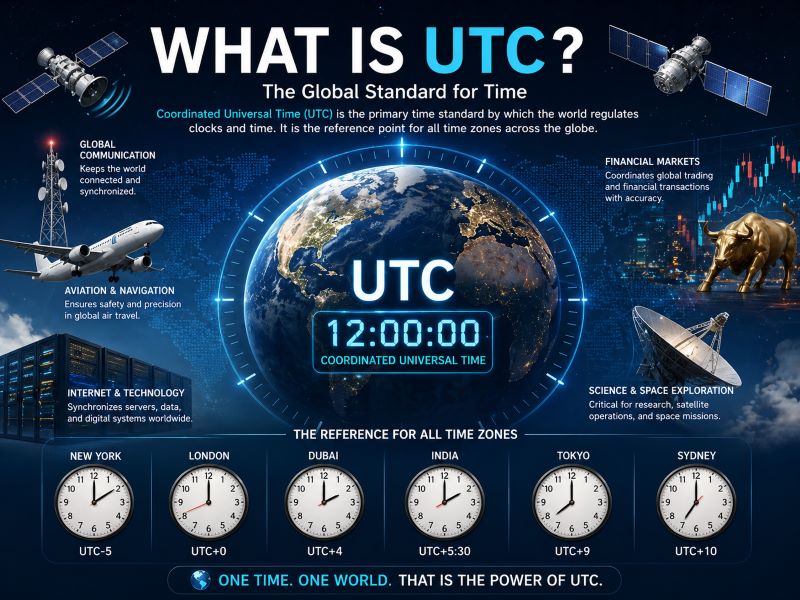
Every modern time zone is measured relative to Coordinated Universal Time (UTC).
UTC serves as the world's official reference time. Instead of being tied to any single country, it provides a neutral international standard used by governments, airlines, shipping companies, scientists, internet services, financial markets, and computer systems.
When you see a time zone written as:
- UTC−08:00
- UTC+01:00
- UTC+05:30
it simply indicates how many hours and minutes the local time differs from UTC.
For example:
If UTC is 12:00 PM
| Time Zone | Local Time |
| UTC−05:00 | 7:00 AM |
| UTC±00:00 | 12:00 PM |
| UTC+01:00 | 1:00 PM |
| UTC+05:30 | 5:30 PM |
| UTC+10:00 | 10:00 PM |
UTC never changes because of seasons or Daylight Saving Time, making it the ideal reference point for international coordination.
Why Do Time Zones Range from UTC−12 to UTC+14?
At first glance, it might seem unusual that the world's time zones extend beyond UTC+12.
This is primarily due to the International Date Line (IDL), an imaginary line that runs roughly along the 180° longitude in the Pacific Ocean. Crossing this line changes the calendar date by one day.
To keep countries and island groups on the same calendar date for social, economic, and administrative reasons, some territories have adopted time zones beyond the traditional ±12-hour range.
For example:
- UTC−12:00 is the last time zone to experience a calendar day.
- UTC+14:00 is the first time zone to begin a new calendar day.
As a result, the maximum time difference between two places on Earth can be 26 hours, even though the clock difference appears to be only 24 hours. This occurs because they are on different calendar dates.
What Is a UTC Offset?
A UTC offset represents the amount of time added to or subtracted from Coordinated Universal Time to determine local standard time.
The format always follows:
- UTC+Hours
- UTC−Hours
Some examples include:
| UTC Offset | Difference from UTC |
| UTC−08:00 | 8 hours behind |
| UTC−03:00 | 3 hours behind |
| UTC±00:00 | Same as UTC |
| UTC+04:00 | 4 hours ahead |
| UTC+09:00 | 9 hours ahead |
Many countries use whole-hour offsets, making calculations straightforward. However, not every nation follows this pattern.
Why Do Some Countries Use Half-Hour Time Zones?
Although one-hour intervals are the global standard, several countries have chosen 30-minute offsets.
These decisions are often based on geography, historical development, or political compromise.
Examples include:
| UTC Offset | Country or Region |
| UTC−03:30 | Newfoundland (Canada) |
| UTC+03:30 | Iran (Standard Time) |
| UTC+04:30 | Afghanistan |
| UTC+05:30 | India |
| UTC+06:30 | Myanmar |
| UTC+09:30 | Australia (Northern Territory & South Australia) |
| UTC+10:30 | Lord Howe Island (standard time) |
For example, India follows UTC+05:30, allowing a single national time that sits roughly between the country's eastern and western extremes. This provides a practical compromise for a nation spanning nearly 30 degrees of longitude.
Similarly, Newfoundland uses UTC−03:30, reflecting historical decisions made before Canada's national time system became standardized.
Why Do Some Places Use 45-Minute Time Zones?
Even less common are 45-minute UTC offsets, used in only a few locations around the world.
Examples include:
| UTC Offset | Location |
| UTC+05:45 | Nepal |
| UTC+08:45 | Australian Central Western region (unofficial regional observance) |
| UTC+12:45 | Chatham Islands (New Zealand) |
Nepal's UTC+05:45 is one of the most well-known examples. It was adopted to align the country's official time more closely with its central longitude while maintaining a distinct national standard.
The Chatham Islands, located east of mainland New Zealand, use UTC+12:45, placing them 45 minutes ahead of New Zealand Standard Time.
These unique offsets demonstrate that time zones are shaped not only by geography but also by local administrative and historical considerations.
Time Zones Are Political as Well as Geographical
Although longitude provides the scientific basis for time zones, political decisions often determine where boundaries are drawn.
Countries may adopt a single national time zone even if they span several geographical zones, while others divide their territory into multiple official time zones.
For example:
- China spans enough longitude for several natural time zones but observes a single national standard time (UTC+08:00).
- Russia uses multiple official time zones across its vast territory.
- Australia, Canada, and the United States each operate several time zones to better match local daylight hours.
These decisions are influenced by transportation, trade, governance, and national unity rather than geography alone.
Why Time Zones Matter Today
Modern society depends on accurate time coordination more than ever before.
Time zones are essential for:
- International business meetings
- Airline and railway schedules
- Global financial markets
- Online education
- Cloud computing and data centers
- Software development
- Live sports broadcasts
- International television programming
- Scientific research
- Emergency response coordination
Without standardized time zones, organizing activities across continents would be significantly more difficult.
Part 3 — Complete List of All Time Zones (UTC−12 to UTC−1)
Now that you understand how the global time zone system works, it's time to explore the complete list of world time zones. This section covers every standard UTC offset from UTC−12:00 to UTC−01:00, including the countries, territories, and major cities where each time zone is observed.
It is important to remember that some locations may temporarily change their clocks during Daylight Saving Time (DST). Unless otherwise noted, the UTC offsets listed below refer to standard time.
UTC−12:00 (Anywhere on Earth – AoE)
UTC Offset: UTC−12:00
UTC−12:00 is the westernmost time zone on Earth. It is often referred to as Anywhere on Earth (AoE) because it represents the last place on the planet where a calendar day remains in progress. Many international deadlines use this time zone so that participants worldwide have the maximum amount of time to complete submissions.
Countries and Territories
- United States (Baker Island)
- United States (Howland Island)
Major Locations
- Baker Island
- Howland Island
Interesting Facts
- Last time zone to experience the end of a calendar day.
- Widely used for international academic and business deadlines.
- No permanent civilian population.
UTC−11:00 (Samoa Standard Time)
UTC Offset: UTC−11:00
UTC−11:00 is primarily observed by several islands in the South Pacific. Although these islands are geographically close to countries using positive UTC offsets, they remain on a different calendar day because of the International Date Line.
Countries and Territories
- American Samoa
- Niue
- United States Minor Outlying Islands (some territories)
Major Cities
- Pago Pago (American Samoa)
- Alofi (Niue)
Interesting Facts
- Neighboring Samoa observes UTC+13 during standard time, creating one of the world's largest date differences.
- Crossing the International Date Line between Samoa and American Samoa changes the calendar by an entire day.
UTC−10:00 (Hawaii–Aleutian Standard Time)
UTC Offset: UTC−10:00
This time zone is best known for serving the Hawaiian Islands. Hawaii does not observe Daylight Saving Time, making its local time consistent throughout the year.
Countries and Territories
- United States (Hawaii)
- French Polynesia (Tahiti)
- Cook Islands
Major Cities
- Honolulu
- Hilo
- Kahului
- Papeete
- Avarua
Interesting Facts
- Hawaii enjoys one of the most stable time systems in the world.
- Tahiti also observes UTC−10 throughout the year.
- Popular tourist destinations in this time zone attract millions of international visitors annually.
UTC−09:30 (Marquesas Time)
UTC Offset: UTC−09:30
UTC−09:30 is one of the world's rare half-hour time zones. It is used only in the Marquesas Islands of French Polynesia.
Countries and Territories
- French Polynesia
Major Cities
- Taiohae
- Atuona
Interesting Facts
- One of the least commonly used official UTC offsets.
- Demonstrates that not all global time zones follow whole-hour intervals.
UTC−09:00 (Alaska Standard Time)
UTC Offset: UTC−09:00
UTC−09:00 covers much of Alaska and parts of the North Pacific. Because Alaska stretches across a vast geographic area, the state has historically used multiple time zones, although most populated areas now follow Alaska Standard Time.
Countries and Territories
- United States (Alaska)
- French Polynesia (Gambier Islands)
Major Cities
- Anchorage
- Fairbanks
- Juneau
- Sitka
- Homer
- Rikitea
Interesting Facts
- Alaska is the largest U.S. state by land area.
- Summer daylight can last more than 20 hours in northern Alaska.
- Some remote Aleutian Islands use UTC−10 instead.
UTC−08:00 (Pacific Standard Time)
UTC Offset: UTC−08:00
UTC−08:00 is one of the world's most recognized time zones because it includes major economic and technology centers in western North America.
Countries and Territories
- United States
- Canada
- Mexico
Major Cities
- Los Angeles
- San Francisco
- San Diego
- Vancouver
- Victoria
- Tijuana
Interesting Facts
- Silicon Valley operates in this time zone.
- Many major technology companies are headquartered here.
- During summer, many regions shift to UTC−07 due to Daylight Saving Time.
UTC−07:00 (Mountain Standard Time)
UTC Offset: UTC−07:00
UTC−07:00 is widely used across western North America and parts of Mexico.
Countries
- United States
- Canada
- Mexico
Major Cities
- Phoenix
- Denver
- Edmonton
- Calgary
- Chihuahua
Interesting Facts
- Arizona (except the Navajo Nation) does not observe Daylight Saving Time.
- The Rocky Mountains span much of this time zone.
UTC−06:00 (Central Standard Time)
UTC Offset: UTC−06:00
UTC−06:00 serves large parts of North America and portions of Central America. It covers major agricultural, industrial, and commercial regions.
Countries
- Canada
- United States
- Mexico
- Guatemala
- Belize
- Honduras
- El Salvador
- Nicaragua
- Costa Rica
Major Cities
- Chicago
- Winnipeg
- Mexico City
- Guatemala City
- San José
- Tegucigalpa
Interesting Facts
- Chicago is one of the largest cities in this time zone.
- Several Central American countries observe UTC−06 throughout the year without DST.
UTC−05:00 (Eastern Standard Time)
UTC Offset: UTC−05:00
UTC−05:00 is among the busiest time zones in the world, supporting hundreds of millions of people and numerous global financial institutions.
Countries
- United States
- Canada
- Colombia
- Peru
- Ecuador (mainland)
- Panama
- Jamaica
- Cuba (standard time)
- Haiti
Major Cities
- New York
- Toronto
- Ottawa
- Washington, D.C.
- Lima
- Bogotá
- Kingston
- Panama City
Interesting Facts
- New York is home to one of the world's largest financial markets.
- Toronto is Canada's largest metropolitan area.
- Several countries remain on UTC−05 year-round.
UTC−04:00 (Atlantic Standard Time)
UTC Offset: UTC−04:00
UTC−04:00 is observed across eastern Canada, parts of the Caribbean, and northern South America.
Countries and Territories
- Canada
- Barbados
- Dominican Republic
- Bolivia
- Venezuela
- Puerto Rico
- U.S. Virgin Islands
Major Cities
- Halifax
- Santo Domingo
- San Juan
- Bridgetown
- La Paz
- Caracas
Interesting Facts
- Atlantic Canada uses this time zone during standard time.
- Venezuela has changed its national UTC offset several times during its history.
UTC−03:30 (Newfoundland Standard Time)
UTC Offset: UTC−03:30
This is one of the world's best-known half-hour time zones.
Countries
- Canada
Major Cities
- St. John's
- Mount Pearl
- Corner Brook
- Gander
Interesting Facts
- Newfoundland is the only Canadian province using a half-hour standard time.
- The offset reflects the province's historical preference before joining Canada.
UTC−03:00 (South American Time)
UTC Offset: UTC−03:00
UTC−03:00 covers much of eastern South America and includes several of the continent's largest cities.
Countries
- Brazil
- Argentina
- Uruguay
- Suriname
- French Guiana
Major Cities
- São Paulo
- Rio de Janeiro
- Buenos Aires
- Montevideo
- Cayenne
Interesting Facts
- São Paulo is South America's largest city.
- Argentina remains on UTC−03 throughout the year.
- Brazil previously observed Daylight Saving Time but discontinued the practice nationally.
UTC−02:00
UTC Offset: UTC−02:00
UTC−02:00 is primarily used by remote Atlantic islands and certain research stations.
Territories
- South Georgia and the South Sandwich Islands
- Some Antarctic research stations
Major Locations
- King Edward Point
Interesting Facts
- One of the least populated official time zones.
- Mainly serves scientific research and government operations.
UTC−01:00 (Azores Time)
UTC Offset: UTC−01:00
UTC−01:00 is observed mainly by islands in the Atlantic Ocean.
Countries and Territories
- Portugal (Azores)
- Cape Verde (historically; currently UTC−01 is no longer national standard, Cape Verde uses UTC−01 year-round as Cabo Verde Time)
Major Cities
- Ponta Delgada
- Horta
- Angra do Heroísmo
- Praia
Interesting Facts
- The Azores are an autonomous region of Portugal.
- Because of their Atlantic location, the islands are one hour behind mainland Portugal during standard time.
- This time zone acts as a transition between the Americas and Europe.
Part 4 — Complete List of All Time Zones (UTC±00:00 to UTC+07:00)
After exploring the time zones west of the Prime Meridian, we now move eastward, beginning with UTC±00:00, the world's reference time. This section covers every standard UTC offset from UTC±00:00 through UTC+07:00, including the countries, territories, and major cities where each time zone is observed.
Many of these time zones are home to some of the world's largest financial centers, busiest airports, and fastest-growing economies. Together, they represent billions of people across Europe, Africa, the Middle East, and Asia.
UTC±00:00 (Coordinated Universal Time)
UTC Offset: UTC±00:00
UTC±00:00 is the global reference time from which every other time zone is calculated. It passes through the Prime Meridian at Greenwich, London, and serves as the foundation of international timekeeping.
Countries and Territories
- United Kingdom (winter)
- Iceland
- Ghana
- Burkina Faso
- Côte d'Ivoire
- Guinea
- Liberia
- Mali
- Mauritania
- Senegal
- Sierra Leone
- The Gambia
- Western Sahara (parts)
Major Cities
- London (winter)
- Accra
- Reykjavík
- Dakar
- Monrovia
- Abidjan
Interesting Facts
- UTC itself never changes for Daylight Saving Time.
- The Prime Meridian (0° longitude) passes through Greenwich, London.
- UTC is used by aviation, navigation, satellites, and internet infrastructure worldwide.
UTC+01:00 (Central European Time / West Africa Time)
UTC Offset: UTC+01:00
UTC+01:00 is one of the most widely used time zones in Europe and Africa. Depending on the country, it is known as Central European Time (CET) or West Africa Time (WAT).
Countries
Europe
- Germany
- France
- Italy
- Spain (mainland)
- Belgium
- Netherlands
- Luxembourg
- Switzerland
- Austria
- Poland
- Czech Republic
- Slovakia
- Hungary
- Slovenia
- Croatia
- Serbia
- Bosnia and Herzegovina
- Montenegro
- North Macedonia
- Albania
Africa
- Nigeria
- Algeria
- Tunisia
- Cameroon
- Niger
- Chad
- Angola
- Benin
- Republic of the Congo
Major Cities
- Paris
- Berlin
- Rome
- Madrid
- Brussels
- Amsterdam
- Vienna
- Warsaw
- Lagos
- Algiers
Interesting Facts
- Paris, Berlin, and Rome all share the same standard time.
- Nigeria, Africa's most populous country, uses UTC+01:00 year-round.
- Most European countries switch to UTC+02 during summer.
UTC+02:00 (Eastern European Time / Central Africa Time)
UTC Offset: UTC+02:00
UTC+02:00 covers large parts of Eastern Europe, Southern Africa, and portions of the Middle East.
Countries
- Finland
- Estonia
- Latvia
- Lithuania
- Greece
- Romania
- Bulgaria
- Moldova
- Ukraine (most regions)
- Egypt
- South Africa
- Zambia
- Zimbabwe
- Botswana
- Malawi
- Rwanda
- Burundi
- Lesotho
- Eswatini
Major Cities
- Helsinki
- Athens
- Bucharest
- Sofia
- Cairo
- Johannesburg
- Cape Town
- Harare
- Riga
- Vilnius
Interesting Facts
- South Africa remains on UTC+02 throughout the year.
- Egypt has periodically introduced and removed Daylight Saving Time.
- Several Eastern European countries shift to UTC+03 during summer.
UTC+03:00 (Moscow Time / East Africa Time / Arabia Standard Time)
UTC Offset: UTC+03:00
UTC+03:00 spans Eastern Europe, the Middle East, and East Africa. It includes major international trade hubs and several rapidly growing cities.
Countries
- Saudi Arabia
- Türkiye
- Iraq
- Kuwait
- Qatar
- Bahrain
- Yemen
- Jordan
- Kenya
- Ethiopia
- Tanzania
- Uganda
- Belarus
- Russia (western regions)
Major Cities
- Riyadh
- Istanbul
- Baghdad
- Doha
- Nairobi
- Addis Ababa
- Minsk
- Moscow
- Kuwait City
Interesting Facts
- Saudi Arabia uses UTC+03 throughout the year.
- Türkiye adopted permanent UTC+03 in 2016.
- Moscow remains one of Europe's largest metropolitan areas.
UTC+03:30 (Iran Standard Time)
UTC Offset: UTC+03:30
UTC+03:30 is one of the world's few official half-hour time zones.
Country
- Iran
Major Cities
- Tehran
- Mashhad
- Isfahan
- Shiraz
- Tabriz
Interesting Facts
- Iran selected a half-hour offset to better align local time with its geographic position.
- It is one of the few countries using UTC+03:30 as its national standard time.
UTC+04:00 (Gulf Standard Time)
UTC Offset: UTC+04:00
UTC+04:00 is widely used across the Persian Gulf, the Caucasus, and parts of the Indian Ocean.
Countries
- United Arab Emirates
- Oman
- Georgia
- Armenia
- Azerbaijan
- Mauritius
- Seychelles
Major Cities
- Dubai
- Abu Dhabi
- Muscat
- Tbilisi
- Yerevan
- Baku
- Port Louis
Interesting Facts
- Dubai has become one of the world's busiest aviation hubs.
- The UAE observes UTC+04 throughout the year without Daylight Saving Time.
UTC+04:30 (Afghanistan Time)
UTC Offset: UTC+04:30
UTC+04:30 is another uncommon half-hour time zone.
Country
- Afghanistan
Major Cities
- Kabul
- Kandahar
- Herat
- Mazar-i-Sharif
Interesting Facts
- Afghanistan adopted UTC+04:30 to better fit its central longitude.
- The country observes this time year-round.
UTC+05:00 (Pakistan Standard Time)
UTC Offset: UTC+05:00
UTC+05:00 is used across Central and South Asia.
Countries
- Pakistan
- Uzbekistan
- Turkmenistan
- Maldives
- Tajikistan
Major Cities
- Islamabad
- Karachi
- Tashkent
- Ashgabat
- Malé
- Dushanbe
Interesting Facts
- Pakistan maintains a single national time zone despite its size.
- The Maldives follows UTC+05 for all inhabited islands.
UTC+05:30 (India Standard Time)
UTC Offset: UTC+05:30
UTC+05:30 is one of the world's most recognized time zones and is home to nearly one-fifth of the global population.
Countries
- India
- Sri Lanka
Major Cities
- New Delhi
- Mumbai
- Bengaluru
- Chennai
- Kolkata
- Hyderabad
- Colombo
Interesting Facts
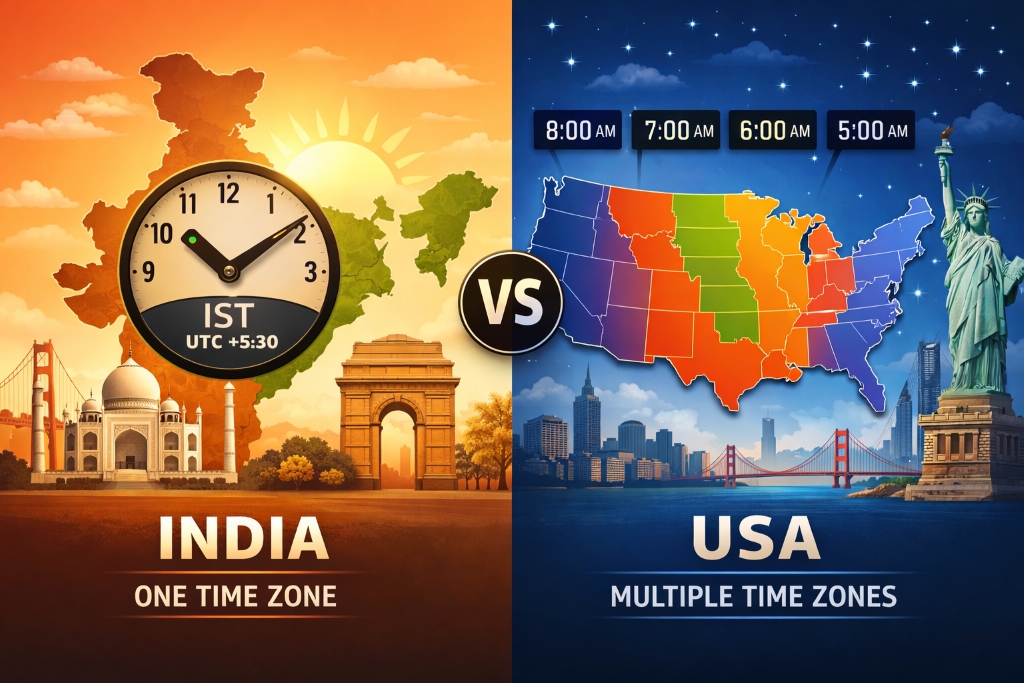
- India follows Indian Standard Time (IST) nationwide.
- The reference meridian for IST passes near Mirzapur, Uttar Pradesh.
- India has observed a single national time zone since independence.
- Sri Lanka also uses UTC+05:30.
UTC+05:45 (Nepal Time)
UTC Offset: UTC+05:45
UTC+05:45 is one of the world's most distinctive official time zones.
Country
- Nepal
Major Cities
- Kathmandu
- Pokhara
- Lalitpur
- Bharatpur
Interesting Facts
- Nepal is the only sovereign country using UTC+05:45.
- The 45-minute offset reflects the country's historical preference and geographic location.
UTC+06:00 (Bangladesh Standard Time)
UTC Offset: UTC+06:00
UTC+06:00 is used across parts of South and Central Asia.
Countries
- Bangladesh
- Bhutan
- Kazakhstan (eastern regions)
- Kyrgyzstan
Major Cities
- Dhaka
- Thimphu
- Bishkek
- Almaty
Interesting Facts
- Bangladesh has one official national time.
- Bhutan has remained on UTC+06 without Daylight Saving Time.
UTC+06:30 (Myanmar Time)
UTC Offset: UTC+06:30
UTC+06:30 is another example of a national half-hour time zone.
Country
- Myanmar
Major Cities
- Yangon
- Naypyidaw
- Mandalay
Interesting Facts
- Myanmar has used UTC+06:30 for decades.
- It is one of the few countries using a half-hour offset as its national standard time.
UTC+07:00 (Indochina Time)
UTC Offset: UTC+07:00
UTC+07:00 is widely observed across mainland Southeast Asia and parts of Indonesia.
Countries
- Thailand
- Vietnam
- Cambodia
- Laos
- Indonesia (Western Indonesia)
Major Cities
- Bangkok
- Hanoi
- Ho Chi Minh City
- Phnom Penh
- Vientiane
- Jakarta
Interesting Facts
- Bangkok and Jakarta are among Southeast Asia's largest metropolitan areas.
- Vietnam has used a single national time zone for many years.
- Indonesia spans three official time zones, with western regions following UTC+07.
Part 5 — Complete List of All Time Zones (UTC+08:00 to UTC+14:00)
The final section of the world's UTC offset list takes us across East Asia, Australia, Oceania, and the Pacific Islands, ending at UTC+14:00, the earliest standard time zone on Earth. These regions include some of the world's largest economies, busiest ports, fastest-growing cities, and island nations that are the first to welcome each new day.
From the financial centers of China, Singapore, and Hong Kong to the remote Pacific islands near the International Date Line, these time zones demonstrate how geography, politics, and history have shaped global timekeeping.
UTC+08:00 (China Standard Time)
UTC Offset: UTC+08:00
UTC+08:00 is one of the world's most populated time zones. It is used across East Asia and parts of Southeast Asia, serving hundreds of millions of people.
Countries and Territories
- China
- Singapore
- Malaysia
- Brunei
- Philippines
- Mongolia (parts)
- Australia (Western Australia)
- Indonesia (Central Indonesia excludes; Western Indonesia is UTC+07, Eastern UTC+09)
- Hong Kong (China SAR)
- Macau (China SAR)
- Taiwan
Major Cities
- Beijing
- Shanghai
- Shenzhen
- Hong Kong
- Singapore
- Kuala Lumpur
- Manila
- Perth
- Taipei
- Bandar Seri Begawan
Interesting Facts
- China uses a single national time zone (UTC+08:00) despite spanning nearly five geographical time zones.
- Singapore and Malaysia share the same standard time throughout the year.
- Perth is Australia's largest city in the UTC+08:00 time zone.
- Hong Kong remains one of the world's leading international financial centers.
UTC+08:45 (Australian Central Western Time)
UTC Offset: UTC+08:45
UTC+08:45 is an uncommon regional time zone observed in parts of Western Australia.
Region
- Eucla region (Western Australia)
Major Locations
- Eucla
- Mundrabilla
- Border Village
Interesting Facts
- This is not an official Australian national time zone, but it is widely used by communities along the Eyre Highway.
- It helps bridge the difference between UTC+08:00 and UTC+09:30.
UTC+09:00 (Japan Standard Time)
UTC Offset: UTC+09:00
UTC+09:00 is one of Asia's most important time zones, covering several technologically advanced nations.
Countries
- Japan
- South Korea
- North Korea (currently)
- Indonesia (Eastern regions)
Major Cities
- Tokyo
- Osaka
- Kyoto
- Seoul
- Busan
- Pyongyang
- Jayapura
Interesting Facts
- Japan has observed UTC+09:00 for over a century.
- South Korea does not observe Daylight Saving Time.
- Tokyo is among the world's largest metropolitan areas.
UTC+09:30 (Australian Central Standard Time)
UTC Offset: UTC+09:30
UTC+09:30 is Australia's official Central Standard Time (ACST).
Regions
- South Australia
- Northern Territory
Major Cities
- Adelaide
- Darwin
Interesting Facts
- Adelaide observes Daylight Saving Time, while Darwin does not.
- This creates seasonal time differences within Australia.
- ACST is one of the world's best-known half-hour time zones.
UTC+10:00 (Australian Eastern Standard Time)
UTC Offset: UTC+10:00
UTC+10:00 is widely used across Australia, Papua New Guinea, and parts of the Pacific.
Countries and Regions
- Australia (Queensland)
- Papua New Guinea
- Federated States of Micronesia (parts)
- Russia (some eastern regions)
Major Cities
- Brisbane
- Port Moresby
- Chuuk
- Vladivostok
Interesting Facts
- Brisbane remains on UTC+10:00 year-round.
- Sydney and Melbourne move to UTC+11:00 during Daylight Saving Time.
- Papua New Guinea does not observe DST.
UTC+10:30 (Lord Howe Standard Time)
UTC Offset: UTC+10:30
This is one of the world's rarest official time zones.
Territory
- Lord Howe Island (Australia)
Major Location
- Lord Howe Island
Interesting Facts
- Lord Howe Island advances only 30 minutes during Daylight Saving Time instead of one hour.
- Fewer than one thousand permanent residents live on the island.
UTC+11:00
UTC Offset: UTC+11:00
UTC+11:00 is observed across several Pacific island nations and parts of eastern Russia.
Countries and Territories
- Solomon Islands
- New Caledonia
- Vanuatu
- Federated States of Micronesia (Kosrae)
- Russia (far eastern regions)
Major Cities
- Honiara
- Nouméa
- Port Vila
- Magadan
Interesting Facts
- Several Pacific island nations in this time zone do not observe Daylight Saving Time.
- New Caledonia is a French overseas territory.
UTC+12:00
UTC Offset: UTC+12:00
UTC+12:00 marks one of the easternmost standard time zones before crossing the International Date Line.
Countries and Territories
- New Zealand (standard time)
- Fiji
- Nauru
- Tuvalu
- Marshall Islands
- Kiribati (Gilbert Islands)
Major Cities
- Wellington
- Auckland
- Suva
- Tarawa
- Majuro
- Funafuti
Interesting Facts
- New Zealand observes UTC+12 during winter and UTC+13 during Daylight Saving Time.
- Fiji has occasionally observed Daylight Saving Time depending on government policy.
UTC+12:45 (Chatham Islands Time)
UTC Offset: UTC+12:45
UTC+12:45 is one of the world's few official 45-minute time zones.
Territory
- Chatham Islands (New Zealand)
Major Location
- Waitangi
Interesting Facts
- The Chatham Islands are approximately 800 kilometers east of New Zealand's South Island.
- During Daylight Saving Time, the offset becomes UTC+13:45.
UTC+13:00
UTC Offset: UTC+13:00
UTC+13:00 is used by several Pacific island nations that lie just west of the International Date Line.
Countries
- Samoa
- Tonga
- Tokelau
- Kiribati (Phoenix Islands)
Major Cities
- Apia
- Nukuʻalofa
Interesting Facts
- Samoa changed sides of the International Date Line in 2011 to strengthen trade with Australia and New Zealand.
- This change resulted in the country skipping an entire calendar day.
UTC+14:00
UTC Offset: UTC+14:00
UTC+14:00 is the earliest official time zone on Earth. Locations in this time zone are the first to enter a new calendar day and celebrate events such as the New Year.
Country
- Kiribati (Line Islands)
Major Cities
- Kiritimati (Christmas Island)
Interesting Facts
- Kiritimati is among the first inhabited places on Earth to experience each new day.
- Many international media organizations feature Kiritimati during New Year celebrations.
- UTC+14 and UTC−12 are separated by 26 calendar hours, illustrating the impact of the International Date Line.
Complete World Time Zone Range
The modern global time zone system spans 38 official UTC offsets, beginning at UTC−12:00 and ending at UTC+14:00.
Key Statistics
| Category | Value |
| Earliest Standard Time | UTC−12:00 |
| Latest Standard Time | UTC+14:00 |
| Total Official UTC Offsets | 38 |
| Maximum Calendar Difference | 26 hours |
| Standard Hour-Based Zones | 24 |
| Half-Hour Time Zones | Multiple |
| 45-Minute Time Zones | Nepal, Chatham Islands, Eucla (regional) |
Part 6 — Time Zone Abbreviations, the IANA Time Zone Database, and Why Time Zone Names Matter
While UTC offsets provide a universal way to measure time differences, they are only one part of the global timekeeping system. In everyday communication, people are more likely to encounter abbreviations such as EST, PST, CET, or IST rather than numerical UTC offsets.
However, these abbreviations can sometimes be confusing because the same abbreviation may refer to different regions or change depending on whether Daylight Saving Time is in effect. To solve these challenges, software developers and computer systems rely on the IANA Time Zone Database, a globally recognized standard for identifying time zones.
This section explains how time zone abbreviations work, why they can sometimes be ambiguous, and how the IANA database helps ensure accurate timekeeping across the world.
What Are Time Zone Abbreviations?
A time zone abbreviation is a short label used to represent a particular time zone. Instead of writing the full UTC offset or official name, abbreviations provide a quick and convenient way to identify local time.
For example:
| Abbreviation | Standard Name | UTC Offset |
| UTC | Coordinated Universal Time | UTC±00:00 |
| GMT | Greenwich Mean Time | UTC±00:00 |
| EST | Eastern Standard Time | UTC−05:00 |
| EDT | Eastern Daylight Time | UTC−04:00 |
| CST | Central Standard Time | UTC−06:00 (North America) |
| CDT | Central Daylight Time | UTC−05:00 |
| PST | Pacific Standard Time | UTC−08:00 |
| PDT | Pacific Daylight Time | UTC−07:00 |
| CET | Central European Time | UTC+01:00 |
| CEST | Central European Summer Time | UTC+02:00 |
| JST | Japan Standard Time | UTC+09:00 |
| AEST | Australian Eastern Standard Time | UTC+10:00 |
These abbreviations are commonly used in:
- Airline schedules
- Business meetings
- Television broadcasts
- Weather reports
- Calendar applications
- International event announcements
- Online meeting invitations
Why Can Time Zone Abbreviations Be Confusing?
Although abbreviations are convenient, they are not always unique. The same abbreviation may represent different time zones in different parts of the world.
For example:
IST
Depending on the context, IST may refer to:
- India Standard Time (UTC+05:30)
- Irish Standard Time (UTC+01:00 during summer)
- Israel Standard Time (UTC+02:00)
Without additional information, simply writing "IST" can lead to misunderstandings.
CST
"CST" is another abbreviation with multiple meanings.
It may represent:
- Central Standard Time (North America) — UTC−06:00
- China Standard Time — UTC+08:00
- Cuba Standard Time — UTC−05:00
For international communication, writing only "CST" is often insufficient.
BST
"BST" may refer to:
- British Summer Time
- Bangladesh Standard Time
- Bougainville Standard Time
Again, context is essential.
Standard Time vs Daylight Time
Many countries change their clocks during part of the year through Daylight Saving Time (DST).
As a result, the abbreviation often changes even though the geographic location remains the same.
For example:
| Winter | Summer |
| EST | EDT |
| PST | PDT |
| MST | MDT |
| CET | CEST |
This distinction is important because the UTC offset changes by one hour.
Example:
- EST = UTC−05:00
- EDT = UTC−04:00
Someone scheduling an international meeting must know whether a country is currently observing standard time or daylight time.
Why UTC Offsets Are More Reliable
Because abbreviations can be ambiguous, many international organizations recommend specifying the UTC offset whenever possible.
Instead of writing:
Meeting at 3:00 PM CST
Write:
Meeting at 3:00 PM UTC−06:00
or
Meeting at 3:00 PM UTC+08:00
This removes any uncertainty.
Many scheduling platforms automatically display both:
- Local Time
- UTC Offset
- Time Zone Name
to improve clarity.
What Is the IANA Time Zone Database?
The IANA Time Zone Database, often called the tz database or zoneinfo database, is the global standard used by operating systems, programming languages, web browsers, smartphones, and cloud services to manage time zones.
Rather than identifying time zones only by UTC offsets or abbreviations, the database assigns each location a unique identifier.
Examples include:
| IANA Time Zone | City |
| America/New_York | New York |
| Europe/London | London |
| Europe/Paris | Paris |
| Asia/Tokyo | Tokyo |
| Asia/Kolkata | India |
| Australia/Sydney | Sydney |
| Pacific/Auckland | Auckland |
These identifiers remain consistent even when Daylight Saving Time begins or ends.
Why the IANA Database Is Important
Modern software depends on accurate time zone information.
The IANA database helps systems correctly handle:
- Daylight Saving Time changes
- Historical time zone changes
- Government policy updates
- Future time calculations
- International scheduling
For example:
If a meeting is scheduled for:
America/New_York
the software automatically knows:
- whether EST or EDT applies,
- the correct UTC offset,
- future DST transitions,
- historical time records.
Without the IANA database, applications would require constant manual updates.
Where Is the IANA Database Used?
Nearly every major technology platform relies on IANA time zone identifiers.
Examples include:
- Linux
- macOS
- Android
- iOS
- Windows (through mapping systems)
- Java
- Python
- PHP
- JavaScript
- PostgreSQL
- MySQL
- Docker
- Kubernetes
- Google Calendar
- Microsoft Outlook
- Apple Calendar
Whenever you schedule an international meeting or convert time between cities, there is a good chance the application is using IANA time zone data behind the scenes.
Why City-Based Time Zone Names Are Better
Instead of using abbreviations, developers are encouraged to use city-based identifiers.
For example:
| Avoid | Prefer |
| EST | America/New_York |
| PST | America/Los_Angeles |
| IST | Asia/Kolkata |
| CET | Europe/Paris |
| JST | Asia/Tokyo |
This approach avoids ambiguity and automatically accounts for Daylight Saving Time where applicable.
Examples of Popular IANA Time Zones
Below are some of the most commonly used identifiers around the world.
| Region | IANA Name |
| London | Europe/London |
| Dublin | Europe/Dublin |
| Paris | Europe/Paris |
| Berlin | Europe/Berlin |
| Madrid | Europe/Madrid |
| Rome | Europe/Rome |
| New York | America/New_York |
| Chicago | America/Chicago |
| Denver | America/Denver |
| Los Angeles | America/Los_Angeles |
| Toronto | America/Toronto |
| Mexico City | America/Mexico_City |
| São Paulo | America/Sao_Paulo |
| Dubai | Asia/Dubai |
| Karachi | Asia/Karachi |
| Kolkata | Asia/Kolkata |
| Kathmandu | Asia/Kathmandu |
| Bangkok | Asia/Bangkok |
| Singapore | Asia/Singapore |
| Hong Kong | Asia/Hong_Kong |
| Shanghai | Asia/Shanghai |
| Tokyo | Asia/Tokyo |
| Seoul | Asia/Seoul |
| Sydney | Australia/Sydney |
| Adelaide | Australia/Adelaide |
| Perth | Australia/Perth |
| Auckland | Pacific/Auckland |
Part 7 — Countries with Multiple Time Zones, Single Time Zones, and Unique Timekeeping Systems
Although the world is divided into standard UTC offsets, countries are not required to follow their natural geographical time zones. Governments have the authority to determine the official time observed within their borders, often balancing geography with economic, political, and social considerations.
As a result, some nations span several official time zones, while others—despite their vast size—operate under a single national time. This section explores how different countries have adopted unique approaches to timekeeping and why these decisions matter.
Why Do Some Countries Have Multiple Time Zones?
The Earth rotates approximately 15 degrees of longitude every hour. Large countries stretching across thousands of kilometers naturally experience sunrise and sunset at significantly different times.
If such countries followed only one clock, residents in the eastern regions might begin work long after sunrise, while those in the west could experience daylight well into the evening.
To better match local daylight hours, many large countries divide their territory into multiple official time zones.
Factors influencing this decision include:
- Geographic size
- Population distribution
- Transportation networks
- Economic activity
- Administrative efficiency
- Historical development
Countries with multiple time zones generally provide a better alignment between official time and the local day-night cycle.
Countries with the Most Time Zones
Some countries cover enormous geographic areas or include overseas territories, resulting in a surprisingly high number of official time zones.
France
France is often considered the country with the largest number of official time zones when its overseas departments and territories are included.
Number of Time Zones
- 12 official time zones
Why So Many?
France has territories in:
- Europe
- North America
- South America
- Caribbean
- Indian Ocean
- Pacific Ocean
Examples
- Paris
- Martinique
- French Guiana
- Réunion
- New Caledonia
- French Polynesia
Although mainland France uses only one standard time zone, its overseas territories span much of the globe.
Russia
Russia is the world's largest country by land area and stretches across northern Eurasia.
Number of Time Zones
- 11 official time zones
Examples
- Kaliningrad
- Moscow
- Yekaterinburg
- Omsk
- Krasnoyarsk
- Irkutsk
- Yakutsk
- Vladivostok
- Kamchatka
Interesting Facts
- Traveling across Russia by train may involve crossing several time zones.
- Historically, Russia experimented with fewer time zones before restoring the current system.
United States
The United States uses multiple time zones because of its continental size and overseas territories.
Number of Time Zones
- 6 primary mainland time zones
- Additional time zones in Alaska, Hawaii, and island territories
Major Time Zones
- Eastern
- Central
- Mountain
- Pacific
- Alaska
- Hawaii–Aleutian
Overseas Territories
Additional time zones are used in:
- Puerto Rico
- Guam
- American Samoa
- Northern Mariana Islands
- U.S. Virgin Islands
Canada
Canada stretches nearly 5,500 kilometers from east to west, making multiple time zones essential.
Official Time Zones
- Pacific
- Mountain
- Central
- Eastern
- Atlantic
- Newfoundland
Interesting Facts
- Newfoundland observes UTC−03:30, one of the world's few half-hour standard time zones.
- Canada spans six primary time zones.
Australia
Australia also uses several official time zones despite having a smaller population than many countries.
Official Time Zones
- Australian Western Standard Time (AWST)
- Australian Central Standard Time (ACST)
- Australian Eastern Standard Time (AEST)
Additional Notes
Some states observe Daylight Saving Time, while others do not.
For example:
- Sydney changes its clocks seasonally.
- Brisbane remains on standard time all year.
This creates temporary differences between neighboring states.
Countries That Use a Single Time Zone
While many large countries divide themselves into multiple time zones, others choose to use one official national time.
This approach often simplifies administration, transportation, broadcasting, and business operations.
China
China is one of the world's most remarkable examples.
Geographic Reality
China spans approximately five natural geographical time zones.
Official Time
- UTC+08:00
Why?
Following the establishment of the People's Republic of China, a single national time was adopted to promote administrative unity.
Interesting Facts
- In western China, sunrise can occur much later than in eastern regions.
- Some communities informally use local time alongside the official national time.
India
India also uses one national time zone despite spanning nearly 30 degrees of longitude.
Official Time
- Indian Standard Time (IST)
- UTC+05:30
Why?
A single national time supports:
- Government administration
- Transportation
- Business
- National broadcasting
The official reference meridian passes near Mirzapur, Uttar Pradesh.
South Africa
South Africa follows:
- UTC+02:00
throughout the entire country.
Unlike many nations at similar latitudes, South Africa does not observe Daylight Saving Time.
Japan
Japan observes:
- UTC+09:00
nationwide.
Although the country stretches over numerous islands, one standard time has been maintained for decades.
South Korea
South Korea follows:
- UTC+09:00
across the entire country without seasonal clock changes.
Countries with Unusual Time Zones
Not every country follows whole-hour UTC offsets.
Several nations have adopted unique time zones that better suit their geographic location or historical preferences.
India
- UTC+05:30
Half-hour offset.
Iran
- UTC+03:30
Half-hour offset.
Afghanistan
- UTC+04:30
Half-hour offset.
Myanmar
- UTC+06:30
Half-hour offset.
Nepal
- UTC+05:45
One of the world's few 45-minute offsets.
Chatham Islands (New Zealand)
- UTC+12:45
Unique regional time.
Eucla Region (Australia)
- UTC+08:45
Unofficial regional time used by communities along the Eyre Highway.
Countries That Have Changed Time Zones
Time zones are not permanent. Governments occasionally adjust them to improve trade, simplify administration, or strengthen international relationships.
Examples include:
Samoa
In 2011, Samoa moved to the western side of the International Date Line.
As a result:
- Thursday, December 29, 2011
- was immediately followed by
- Saturday, December 31, 2011.
An entire calendar day was skipped to improve economic ties with Australia and New Zealand.
Russia
Russia has modified:
- the number of official time zones,
- Daylight Saving Time policies,
- and standard UTC offsets
multiple times during the past few decades.
North Korea
North Korea briefly introduced:
- UTC+08:30
before returning to:
- UTC+09:00
to align with South Korea.
Why Governments Choose Their Time Zones
Selecting an official time zone involves more than geography.
Governments often consider:
- Business relationships
- Transportation schedules
- Television broadcasting
- School hours
- Public services
- Energy consumption
- Neighboring countries
- Historical traditions
For example:
A country may choose the same time zone as its largest trading partner, even if geography suggests a different UTC offset.
Time Zones in Overseas Territories
Several countries maintain territories far from their mainland.
Examples include:
| Country | Overseas Regions |
| France | French Polynesia, Réunion, Guadeloupe, Martinique, French Guiana, New Caledonia |
| United States | Guam, American Samoa, Puerto Rico, Northern Mariana Islands |
| United Kingdom | Falkland Islands, Gibraltar, Bermuda, Cayman Islands, British Virgin Islands |
| New Zealand | Tokelau, Cook Islands (associated), Chatham Islands |
| Denmark | Greenland, Faroe Islands |
These territories often observe different UTC offsets from the mainland, increasing the total number of time zones associated with each country.

Part 8 — Daylight Saving Time (DST): How It Works, Which Countries Use It, and Why It Remains Controversial
One of the most important aspects of global timekeeping is Daylight Saving Time (DST). While UTC offsets define a region's standard time, many countries temporarily adjust their clocks during part of the year to make better use of daylight.
However, Daylight Saving Time is not a global practice. Some countries have observed it for decades, others have abandoned it, and many have never adopted it at all. Today, opinions remain divided over whether the seasonal clock change still provides meaningful benefits in the modern world.
This section explains how Daylight Saving Time works, where it is used, its advantages and disadvantages, and why more governments are reconsidering the practice.
What Is Daylight Saving Time?
Daylight Saving Time (DST) is the practice of moving clocks forward by one hour during the warmer months of the year. The goal is to extend daylight into the evening by shifting an hour of daylight from the morning to later in the day.
A typical DST schedule looks like this:
- Spring: Clocks move forward by one hour ("spring forward").
- Autumn (Fall): Clocks move back by one hour ("fall back") and return to standard time.
For example:
- Standard Time: UTC−05:00
- During DST: UTC−04:00
This change affects local clock time but does not change UTC itself, which remains the global reference standard throughout the year.
Why Was Daylight Saving Time Introduced?
The concept of adjusting clocks to better match daylight has existed for centuries, but the modern version of Daylight Saving Time became widely adopted during the early twentieth century.
The main objectives were:
- Reduce the need for artificial lighting in the evening.
- Conserve energy.
- Increase productivity during daylight hours.
- Support wartime fuel conservation.
- Encourage outdoor recreation and commerce after work.
Although energy savings were once considered the primary benefit, advances in lighting, heating, and air conditioning have made the overall impact less significant in many countries.
How Does Daylight Saving Time Work?
When DST begins:
- Clocks are advanced by one hour.
- Sunrise appears later on the clock.
- Sunset appears later in the evening.
When DST ends:
- Clocks are turned back by one hour.
- Sunrise occurs earlier.
- Evenings become darker sooner.
Example
| Season | Local Time Offset |
| Standard Time | UTC−05:00 |
| Daylight Saving Time | UTC−04:00 |
Although the clock changes, the actual position of the Sun relative to the Earth remains unchanged.
Which Countries Observe Daylight Saving Time?
Many countries in the Northern Hemisphere continue to observe DST, although the exact start and end dates vary.
North America
- United States (most states)
- Canada (most provinces)
- Mexico (selected regions)
Europe
Most European countries observe DST, including:
- United Kingdom
- Germany
- France
- Italy
- Spain
- Netherlands
- Belgium
- Sweden
- Norway
- Denmark
- Poland
- Austria
- Switzerland
- Greece
- Finland
- Portugal (mainland)
The European Union currently follows a coordinated schedule, helping simplify travel and trade between member states.
Oceania
Some parts of Australia and New Zealand observe DST.
Examples include:
- New South Wales
- Victoria
- Tasmania
- Australian Capital Territory
- South Australia
- New Zealand
Countries That Do Not Observe Daylight Saving Time
Many nations remain on the same standard time throughout the year.
Examples include:
Asia
- India
- China
- Japan
- South Korea
- Singapore
- Malaysia
- Indonesia
- Thailand
- Vietnam
- Philippines
Africa
Nearly all African countries do not observe DST.
Examples include:
- South Africa
- Kenya
- Nigeria
- Egypt (except where government policies temporarily change)
- Ghana
- Morocco (uses special adjustments related to Ramadan)
Middle East
Many countries remain on standard time year-round, although policies vary.
Examples:
- Saudi Arabia
- United Arab Emirates
- Qatar
- Kuwait
- Bahrain
- Oman
South America
Most countries either no longer observe DST or apply it only occasionally.
Examples include:
- Argentina
- Colombia
- Peru
- Ecuador
Why Some Countries Have Stopped Using DST
Over the past two decades, several countries have abolished Daylight Saving Time after concluding that its disadvantages outweighed its benefits.
Common reasons include:
- Minimal energy savings
- Public confusion
- Health concerns
- Business disruptions
- Increased complexity for international scheduling
Countries such as Russia, Turkey, and Brazil have changed or discontinued DST policies in recent years.
Because governments can revise these policies over time, software systems and calendars must stay updated with official time zone data.
Advantages of Daylight Saving Time
Supporters argue that DST provides several benefits.
More Evening Daylight
Longer evenings encourage:
- Outdoor recreation
- Sports
- Shopping
- Tourism
- Community events
Reduced Evening Energy Use
Historically, later sunsets reduced the need for electric lighting during evening hours.
Although this benefit has decreased with modern technology, some regions still report modest savings.
Economic Benefits
Businesses that depend on outdoor activities often benefit from extended daylight.
Examples include:
- Restaurants
- Parks
- Retail stores
- Entertainment venues
- Tourism operators
Improved Road Visibility
Some studies suggest that more daylight during evening commuting hours may improve road visibility and potentially reduce certain types of traffic accidents.
Disadvantages of Daylight Saving Time
Despite its benefits, DST has become increasingly controversial.
Sleep Disruption
Changing clocks can temporarily disrupt sleep patterns.
Many people report:
- Fatigue
- Reduced concentration
- Difficulty adjusting during the first few days
Health Concerns
Researchers have studied possible links between clock changes and short-term increases in:
- Stress
- Workplace accidents
- Traffic incidents
- Heart-related medical events
While findings vary, these concerns have contributed to debates about ending seasonal clock changes.
Business Complexity
International organizations must account for:
- Different DST schedules
- Countries without DST
- Regions that recently changed policies
This increases the complexity of scheduling global meetings and software systems.
Public Confusion
Many people forget:
- when clocks change,
- whether a country observes DST,
- or how local time compares with other regions.
This can lead to missed appointments and scheduling errors.
Daylight Saving Time and Technology
Modern technology automatically adjusts for DST in most cases.
Examples include:
- Smartphones
- Smartwatches
- Computers
- GPS navigation systems
- Airline reservation systems
- Online calendars
- Cloud services
These devices rely on regularly updated time zone databases, such as the IANA Time Zone Database, to ensure clock changes occur accurately.
Daylight Saving Time Around the World
The global use of DST has declined over time.
Today:
- Many countries have never adopted it.
- Several have permanently discontinued it.
- Others continue to review whether it should remain in use.
As international travel and digital communication continue to expand, consistency in global timekeeping has become increasingly important.
Tips for International Travelers
If you're traveling internationally during DST transition periods:
- Check whether your destination observes DST.
- Verify the current UTC offset before departure.
- Update your smartphone's automatic time settings.
- Confirm meeting times using the local time zone.
- Use reliable world clock or time zone conversion tools.
Taking these simple steps can help avoid missed flights, appointments, or virtual meetings.
Part 9 — Interesting Facts About World Time Zones, the International Date Line, and Frequently Asked Questions
The global time zone system is far more fascinating than simply dividing the Earth into 24 hours. Over the past century, countries have adjusted their clocks for political, economic, and geographical reasons, creating one of the world's most unique international standards.
From the International Date Line to 45-minute time zones and countries that have skipped an entire calendar day, timekeeping is filled with surprising facts. This section highlights some of the most interesting aspects of world time zones and answers frequently asked questions that help readers better understand how the system works.
Interesting Facts About World Time Zones
1. The World Uses More Than 24 Time Zones
Many people believe there are exactly 24 time zones, but this is only a simplified model based on the Earth's 24-hour rotation.
In reality, the modern world recognizes 38 official UTC offsets, ranging from UTC−12:00 to UTC+14:00. This includes several half-hour and 45-minute time zones adopted by different countries and territories.
2. The Largest Time Difference on Earth Is 26 Hours
Although the clock difference between two locations can appear to be 24 hours, the maximum calendar difference is actually 26 hours.
For example:
- UTC−12:00 is the last place on Earth to experience a calendar day.
- UTC+14:00 is the first place to begin the next calendar day.
This occurs because of the International Date Line, which separates two consecutive calendar dates.
3. The International Date Line Is Not a Straight Line
Many maps show the International Date Line (IDL) as a straight line near 180° longitude, but in reality it follows a zigzag path.
The line bends around countries and island groups to keep them on the same calendar date.
For example, it avoids splitting:
- Kiribati
- Samoa
- Fiji
- Russia's eastern territories
- Alaska's Aleutian Islands
These adjustments make administration and daily life much easier for local communities.
4. China Uses Only One Official Time Zone
Geographically, China spans enough longitude for approximately five natural time zones.
However, the country officially observes only:
UTC+08:00 (China Standard Time)
As a result:
- Sunrise may occur after 9:00 AM in some western regions during winter.
- Many local communities informally adjust their daily routines to better match daylight hours.
China's single national time is one of the most well-known examples of political decisions influencing timekeeping.
5. India Uses a Half-Hour Time Zone
India follows:
UTC+05:30
instead of the more common whole-hour offset.
This national standard balances the country's eastern and western regions while providing one official time for over a billion people.
Indian Standard Time (IST) is based on the 82.5° East longitude, which passes near Mirzapur, Uttar Pradesh.
6. Nepal Uses a 45-Minute Time Zone
Nepal is one of the very few sovereign countries that use a 45-minute UTC offset.
Official time:
UTC+05:45
This unique offset reflects Nepal's geographic location and historical preference.
7. Newfoundland Uses a Half-Hour Offset
The Canadian province of Newfoundland observes:
UTC−03:30
making it one of the few places in North America with a half-hour standard time.
This practice dates back to historical decisions made before Newfoundland joined Canada in 1949.
8. Some Places Never Change Their Clocks
Many countries remain on the same standard time throughout the year.
Examples include:
- India
- China
- Japan
- South Korea
- Singapore
- Iceland
- South Africa
Residents never need to adjust their clocks for Daylight Saving Time.
9. Samoa Once Skipped an Entire Day
One of the most remarkable events in modern timekeeping occurred in 2011, when Samoa moved to the western side of the International Date Line.
The country changed directly from:
Thursday, December 29
to
Saturday, December 31
As a result, Friday, December 30, 2011, never occurred in Samoa.
The change strengthened trade and business relationships with Australia and New Zealand.
10. France Has the Most Official Time Zones
When overseas territories are included, France has 12 official time zones, more than any other country.
These territories are located across:
- Europe
- Caribbean
- South America
- Indian Ocean
- Pacific Ocean
This makes France the country with the widest global distribution of official time zones.
Frequently Asked Questions (FAQs)
What is a time zone?
A time zone is a geographic region that observes the same standard time. Time zones help synchronize daily activities by ensuring that people within a region use the same official clock time.
How many time zones are there in the world?
The Earth is often described as having 24 primary hourly time zones, but the modern global system includes 38 official UTC offsets, ranging from UTC−12:00 to UTC+14:00.
What is UTC?
Coordinated Universal Time (UTC) is the world's official time standard. Every global time zone is measured as an offset from UTC, making it the foundation of international timekeeping.
What is the difference between UTC and GMT?
For everyday use, UTC and GMT display the same clock time.
However:
- GMT is based on mean solar time at Greenwich.
- UTC is maintained using highly accurate atomic clocks and serves as the international standard.
Why do some countries use half-hour or 45-minute time zones?
Some governments selected these offsets because they better align with their geographic position or historical preferences.
Examples include:
- India — UTC+05:30
- Iran — UTC+03:30
- Afghanistan — UTC+04:30
- Myanmar — UTC+06:30
- Nepal — UTC+05:45
Which country has the most time zones?
Including overseas territories, France has 12 official time zones.
Among countries with contiguous land areas, Russia has 11 official time zones.
Which country has only one time zone despite its large size?
China uses a single national time zone (UTC+08:00), even though its geography spans several natural time zones.
Which countries have the most commonly used time zones?
Some of the busiest global time zones include:
- UTC−05:00 (Eastern North America)
- UTC±00:00 (United Kingdom during winter and several African countries)
- UTC+01:00 (Central Europe)
- UTC+05:30 (India)
- UTC+08:00 (China, Singapore, Malaysia, Hong Kong, Taiwan)
- UTC+09:00 (Japan and South Korea)
These time zones are home to hundreds of millions of people and many of the world's leading financial and technology centers.
Why do time zones change during Daylight Saving Time?
Countries that observe Daylight Saving Time (DST) move their clocks forward by one hour during warmer months to make better use of evening daylight. When DST ends, clocks return to standard time.
What is the International Date Line?
The International Date Line (IDL) is an imaginary line located primarily near 180° longitude. Crossing the line changes the calendar date by one day, allowing the world's timekeeping system to remain consistent as the Earth rotates.
Part 10 — Conclusion, Practical Tips, Key Takeaways, and Final Summary
Time zones are one of the invisible systems that keep the modern world running smoothly. Whether you're sending an email across continents, joining a virtual meeting, booking an international flight, watching a live sporting event, or developing software for a global audience, accurate timekeeping is essential.
Although the concept may seem simple at first, the world's time zone system is the result of centuries of scientific observation, international cooperation, and government policy. From UTC−12:00 in the Pacific Ocean to UTC+14:00 in Kiribati, every official time zone plays an important role in helping people and organizations coordinate activities across the globe.
This guide has explored not only the complete list of world time zones but also the history, structure, and practical use of the international timekeeping system.
Complete World Time Zone Summary
The world's official time zones extend from:
- UTC−12:00
- to
- UTC+14:00
Together they form 38 officially recognized UTC offsets, including:
- Full-hour time zones
- Half-hour time zones
- 45-minute time zones
While the Earth rotates once every 24 hours, political boundaries and historical decisions have created a more flexible system that better serves the needs of different countries and regions.
Quick Reference Table
| Category | Information |
| Global Time Standard | Coordinated Universal Time (UTC) |
| Standard Time Zone Range | UTC−12:00 to UTC+14:00 |
| Total Official UTC Offsets | 38 |
| Traditional Hour-Based Zones | 24 |
| Earliest Time Zone | UTC−12:00 |
| Latest Time Zone | UTC+14:00 |
| Largest Calendar Difference | 26 hours |
| Countries with Multiple Time Zones | Russia, United States, Canada, Australia, France (including overseas territories) |
| Largest Country Using One Time Zone | China |
| Most Widely Used Half-Hour Offset | UTC+05:30 (India) |
| Most Well-Known 45-Minute Offset | UTC+05:45 (Nepal) |
Practical Tips for Using Time Zones
Whether you travel frequently or work with international teams, following a few best practices can help prevent confusion and scheduling errors.
Always Specify the Time Zone
Instead of writing:
Meeting at 10:00 AM
write:
Meeting at 10:00 AM UTC+01:00
or
Meeting at 10:00 AM (Europe/Paris)
Including the time zone removes ambiguity, especially for participants in different countries.
Use IANA Time Zone Names
When developing websites, mobile apps, or enterprise software, prefer IANA time zone identifiers instead of abbreviations.
Examples include:
- America/New_York
- Europe/London
- Asia/Tokyo
- Asia/Kolkata
- Australia/Sydney
These identifiers automatically account for historical changes and Daylight Saving Time where applicable.
Verify Daylight Saving Time
Many countries adjust their clocks seasonally, while others remain on standard time throughout the year.
Before scheduling international meetings, confirm:
- Current UTC offset
- Whether DST is active
- Local public holidays
- Regional differences within large countries
Use Reliable Time Conversion Tools
Manual calculations become difficult when multiple countries are involved.
Reliable world clock and time zone conversion tools can automatically account for:
- UTC offsets
- Daylight Saving Time
- Historical time changes
- Future scheduling
This reduces the risk of missed meetings and travel disruptions.
Why Understanding Time Zones Matters
Accurate time zone knowledge benefits people in many professions and industries.
International Business
Global companies coordinate meetings, product launches, customer support, and financial transactions across multiple regions.
Travel and Aviation
Airlines publish schedules using local airport time, making accurate time zone information essential for passengers and crew.
Software Development
Applications such as calendars, booking platforms, messaging services, and cloud systems rely on precise time zone calculations to function correctly.
Education
Students attending international courses or online classes often participate from different continents, requiring careful scheduling.
Scientific Research
Astronomy, meteorology, satellite navigation, and space missions all depend on standardized international timekeeping.
Media and Broadcasting
Television networks, streaming platforms, and sports organizations schedule live events across multiple time zones to reach global audiences.
Common Mistakes to Avoid
Many time-related problems occur because of simple misunderstandings.
Avoid these common mistakes:
- Assuming every country uses whole-hour UTC offsets.
- Forgetting Daylight Saving Time adjustments.
- Using abbreviations such as IST, CST, or BST without clarification.
- Confusing UTC with local time.
- Assuming neighboring countries always share the same time zone.
- Ignoring changes made by governments to national time policies.
Even a one-hour error can result in missed flights, delayed meetings, or incorrect event scheduling.
The Future of Global Timekeeping
As international communication continues to expand, accurate timekeeping becomes even more important.
Several trends are shaping the future:
- Increased use of cloud-based scheduling systems.
- Wider adoption of automatic time synchronization.
- Continued updates to the IANA Time Zone Database.
- Ongoing discussions about reducing or eliminating Daylight Saving Time in some regions.
- Improved integration of global time standards into software and connected devices.
Although technology simplifies time conversion, understanding the principles behind the system remains valuable for professionals and everyday users alike.
Final Key Takeaways
Before finishing, here are the most important points from this guide:
- The world officially uses 38 UTC offsets, ranging from UTC−12:00 to UTC+14:00.
- Coordinated Universal Time (UTC) is the international reference standard for modern timekeeping.
- Many countries use whole-hour offsets, while others use 30-minute or 45-minute variations.
- Large countries such as Russia, Canada, Australia, and the United States operate multiple official time zones.
- Countries such as China, India, and Japan use a single national time despite their geographic size.
- The International Date Line determines where each new calendar day begins and ends.
- Daylight Saving Time is observed in some regions but not worldwide.
- IANA time zone identifiers are the preferred standard for software development and digital services.
Conclusion
The global time zone system is one of the most important international standards in modern civilization. It allows billions of people to communicate, travel, trade, and collaborate across continents with confidence.
While the system is based on the Earth's rotation, it has evolved through geography, politics, technology, and international cooperation. Understanding how UTC offsets, time zone names, Daylight Saving Time, and the International Date Line work together makes it easier to navigate today's interconnected world.
Whether you are planning a trip, managing an international business, developing software, or simply exploring how different countries keep time, a solid understanding of world time zones helps you make better decisions and avoid costly scheduling mistakes.
As global communication continues to grow, time zones will remain an essential part of everyday life—connecting people, businesses, and technology across every region of the world.
Comments
No comments yet.