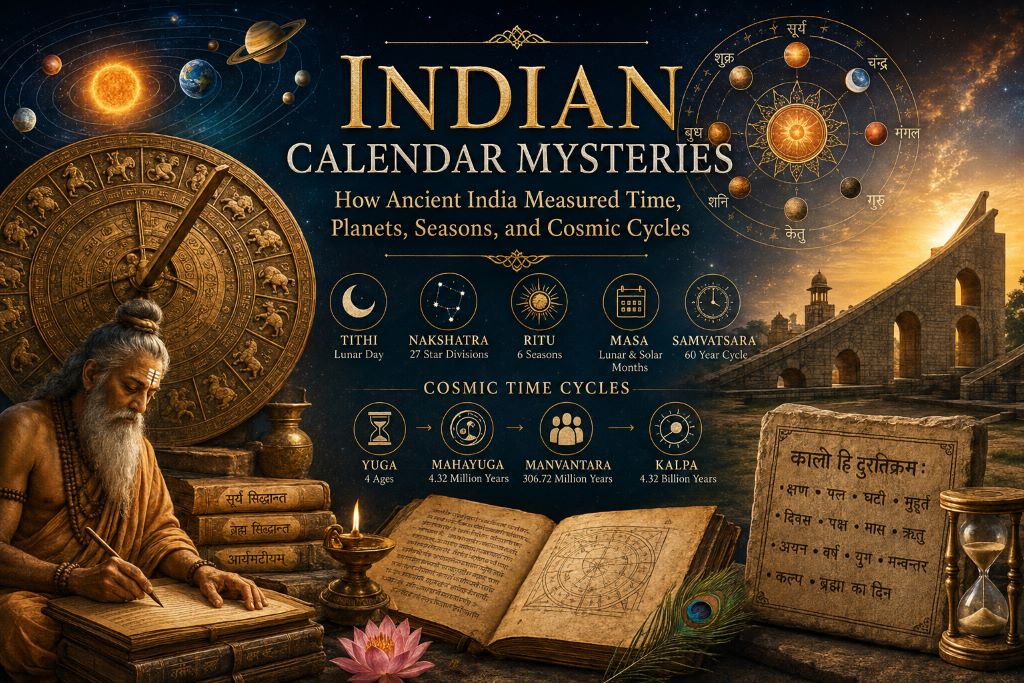
Part 1: The Origins of Indian Timekeeping and the Science Behind the Panchang
Introduction
Long before mechanical clocks, modern observatories, satellites, or digital calendars existed, scholars in ancient India were studying one of humanity's most difficult questions:
How can time be measured accurately?
They watched the rising and setting of the Sun. They followed the changing phases of the Moon. They observed stars moving across the night sky and noticed that certain constellations returned with the seasons. They tracked solstices, equinoxes, planetary movements, eclipses, monsoon patterns, and agricultural cycles.
From these observations emerged not one simple calendar, but an extraordinary family of timekeeping systems.
The Indian calendar tradition includes concepts such as:
- Tithi
- Nakshatra
- Paksha
- Masa
- Ritu
- Ayana
- Samvatsara
- Yuga
- Manvantara
- Kalpa
Some measure a fraction of a day. Others describe cycles so vast that they extend across millions or billions of years.
This extraordinary range makes the Indian understanding of time one of the most fascinating subjects in the history of calendars.
A modern calendar usually answers a simple question:
What is today's date?
A traditional Indian Panchang attempts to answer several questions at once:
- What lunar day is it?
- Where is the Moon in the sky?
- What is the relationship between the Sun and Moon?
- Which half of the lunar month is underway?
- What season is it?
- What solar month is it?
- When will sunrise occur?
- When will sunset occur?
- When does a particular astronomical period begin or end?
This is why the traditional Indian calendar can appear mysterious to someone familiar only with the Gregorian calendar.
India also does not have just one historical calendar.
Across the subcontinent, different regions developed systems such as:
- Vikram Samvat
- Shaka Era
- Bengali calendar
- Tamil calendar
- Malayalam calendar
- Odia calendar
- Telugu calendar
- Kannada calendar
- Assamese calendar
- Nepali Vikram Samvat
Some months begin with a new Moon. Others begin after a full Moon. Some regional calendars emphasize lunar calculations, while others follow the Sun more directly.
Festivals can move from one Gregorian date to another each year. Different regions may celebrate New Year at different times. An extra month can suddenly appear in the calendar. A lunar date can occasionally be skipped or repeated.
Behind these apparent mysteries lies a sophisticated attempt to keep several astronomical cycles synchronized.
This article explores how ancient India measured time, how the Panchang works, why Indian festivals move through the modern calendar, how leap months are calculated, why there are multiple Indian New Years, and how Indian thinkers imagined time on scales extending from the blink of an eye to the lifetime of the cosmos.
Why Is the Indian Calendar So Different?
The Gregorian calendar used internationally today is primarily a solar calendar.
Its main purpose is to keep the calendar year synchronized with Earth's journey around the Sun and, therefore, with the seasons.
It contains:
- 365 days in an ordinary year
- 366 days in a leap year
- 12 fixed months
The Moon does not determine the beginning of Gregorian months.
The traditional Indian calendar works differently because it attempts to preserve relationships among several natural cycles.
These include:
- The solar day
- The lunar phase cycle
- The Moon's position among the stars
- The solar year
- The changing seasons
Trying to combine all of these creates a more complex system.
A solar year is approximately 365.24 days.
A lunar phase cycle is approximately 29.5 days.
Twelve lunar months total only about 354 days.
This means a twelve-month lunar year is roughly 11 days shorter than a solar year.
That difference creates one of the greatest challenges in calendar design.
If nothing is done to correct it, lunar months gradually move through all the seasons.
Some calendars accept this movement.
The traditional Indian lunisolar system generally does not.
Instead, it periodically adds an extra month to keep lunar months connected with the solar year.
This is the famous:
Adhik Maas.
But before understanding the extra month, we need to understand how Indian ideas about time developed.
The Earliest Indian Understanding of Time
The history of Indian timekeeping reaches deep into antiquity.
Early communities throughout the Indian subcontinent depended on natural cycles for survival.
Agriculture required knowledge of:
- Rainfall
- Monsoons
- Seasonal temperature changes
- River cycles
- Planting periods
- Harvest seasons
The sky provided a natural system of measurement.
The daily motion of the Sun created day and night.
The Moon created a visible monthly rhythm.
The stars helped identify seasons.
Over generations, repeated observations became organized knowledge.
Time in Early Indian Thought
Ancient Indian traditions treated time as both practical and philosophical.
Time was necessary for organizing:
- Agriculture
- Rituals
- Festivals
- Travel
- Social activities
But Indian thinkers also asked much larger questions.
Does the universe have a beginning?
Does time move in a straight line?
Does history repeat?
How long can a cosmic cycle last?
These questions eventually produced an understanding of time that operated on two very different scales.
At one end were small units used to organize daily life.
At the other were enormous cosmic cycles.
This ability to move between ordinary human time and cosmic time is one of the most distinctive features of Indian intellectual history.
The Vedic Connection to Timekeeping
Early Indian literature contains numerous references to:
- The Sun
- The Moon
- Dawn
- Seasons
- Months
- Years
- Celestial cycles
Timekeeping was closely connected with ritual practice.
Ceremonies often had to occur at particular times.
This encouraged increasingly careful observation of the sky.
A ritual performed in the morning differed from one performed in the evening.
Seasonal ceremonies depended on the progression of the year.
Lunar phases influenced the timing of other observances.
The need to determine these periods encouraged the development of calendrical astronomy.
Vedanga Jyotisha and the Organization of Time
One of the most important early texts associated with Indian calendrical astronomy is the Vedanga Jyotisha.
Its purpose was closely connected with determining appropriate times for ritual activities.
It dealt with concepts involving:
- Lunar months
- Solar cycles
- Nakshatras
- Seasonal timing
- Calendar coordination
This demonstrates an important fact about the history of science:
Accurate astronomy often develops because society needs accurate timekeeping.
The same pattern appeared elsewhere in the world.
Ancient Egyptians studied the sky partly to anticipate seasonal changes connected with the Nile.
Babylonian scholars recorded the Moon and planets.
Maya astronomers developed complex calendars connected with ritual and agriculture.
In India, calendrical needs also encouraged generations of astronomical observation.
What Is a Panchang?
The word Panchang or Panchanga refers to a traditional Indian almanac.
The name is based on the idea of five limbs or components.
These are traditionally:
- Tithi
- Vara
- Nakshatra
- Yoga
- Karana
Together, these components describe the astronomical and calendrical character of a day.
This is one of the most important differences between a Panchang and an ordinary wall calendar.
A Gregorian calendar might say:
Monday, March 16
A Panchang can provide information about:
- The weekday
- The current lunar day
- The Moon's stellar position
- The angular relationship used to determine Yoga
- Half-tithi divisions
- Sunrise
- Sunset
- Moonrise
- Moonset
- Lunar month
- Solar month
- Paksha
Modern Panchangs may include even more information.
The First Limb: Tithi
The Tithi is one of the most important concepts in the Indian calendar.
It is often translated as a lunar day, but it is not the same as a fixed 24-hour day.
A Tithi is determined by the changing angular relationship between the Sun and the Moon.
As the Moon travels around Earth, its position relative to the Sun changes.
This changing relationship creates the familiar lunar phases.
The Indian system divides the complete Sun-Moon angular cycle into:
30 Tithis.
Each Tithi represents a 12-degree increase in the angular separation between the Sun and Moon.
Because the Moon does not move at a perfectly uniform apparent speed, a Tithi does not always last exactly 24 hours.
It can begin or end at different clock times.
This is why a festival determined by Tithi may not correspond to the same Gregorian date every year.
Why a Tithi Is Not a Normal Date
Imagine that a Tithi begins at:
3:20 PM on Monday
and ends at:
2:10 PM on Tuesday.
The next Tithi then begins immediately.
A Tithi therefore crosses the boundaries of ordinary civil dates.
This creates situations that seem unusual to people unfamiliar with the system.
A Tithi may:
- Begin in the morning
- Begin in the afternoon
- Begin at night
- Continue across two Gregorian dates
The calendar is following an astronomical relationship rather than midnight on a clock.
The Thirty Tithis
A lunar month contains thirty Tithis.
These are divided into two groups of fifteen.
The first half follows the Moon as it becomes increasingly illuminated.
The second follows it as illumination decreases.
These halves are called:
- Shukla Paksha
- Krishna Paksha
Shukla Paksha: The Waxing Half
Shukla Paksha begins around the new Moon and continues toward the full Moon.
During this period, the illuminated portion of the Moon gradually increases.
The sequence leads toward:
Purnima, the full Moon.
Many festivals occur during Shukla Paksha.
The growing Moon has often been associated symbolically with:
- Expansion
- Growth
- Light
- Development
Krishna Paksha: The Waning Half
Krishna Paksha follows the full Moon.
During this half of the lunar cycle, the visible illuminated portion of the Moon gradually decreases.
The sequence ends around:
Amavasya, the new Moon.
The two Pakshas together form the basic structure of the lunar month.
Why Indian Festival Dates Move Every Year
This is one of the most common questions about the Indian calendar.
Why does Diwali occur on one Gregorian date one year and another date the next?
Why does Holi move?
Why does Janmashtami change dates?
The answer is simple:
Many Indian festivals are determined by lunar calendar conditions rather than fixed Gregorian dates.
For example, the relevant calculation may depend on:
- A particular Tithi
- A particular lunar month
- Sometimes the Tithi prevailing during a specific part of the day
Because lunar and solar cycles do not align perfectly, the Gregorian date changes.
The festival is not moving randomly.
It is remaining connected to its traditional astronomical position.
Can a Tithi Be Skipped?
Yes, from the perspective of a sunrise-based calendar date, unusual situations can occur.
Because Tithis vary in length, one Tithi may begin after one sunrise and end before the next.
In such a case, it may not be present at sunrise on any civil day.
This is sometimes described as a skipped or lost Tithi.
Similarly, a longer Tithi can be present at two consecutive sunrises.
It may therefore appear repeated in the calendar.
This sounds strange only if we assume that a lunar day must behave like a fixed 24-hour civil date.
It does not.
A Tithi follows the Sun-Moon relationship.
The Second Limb: Vara
Vara refers to the weekday.
The familiar seven-day week is used:
- Sunday
- Monday
- Tuesday
- Wednesday
- Thursday
- Friday
- Saturday
Traditional names associate the weekdays with celestial bodies.
This reflects an old relationship between astronomy and the organization of the week.
The seven-day system became widespread across many civilizations and remains one of the world's most enduring timekeeping structures.
The Third Limb: Nakshatra
The Nakshatra system is one of the most fascinating elements of Indian astronomy.
The path of the Moon across the sky is divided into:
27 principal sections.
These sections are called Nakshatras.
They are often translated as:
- Lunar mansions
- Stellar divisions
The Moon completes its journey relative to the background stars in roughly 27.3 days.
This makes the Nakshatra system closely connected with the Moon's motion.
Why 27 Nakshatras?
As the Moon moves through the sky, it appears against different groups of stars.
Ancient observers could use these stellar regions to track its position.
Dividing the path into 27 sections created a practical astronomical framework.
Each Nakshatra covers approximately:
13 degrees and 20 minutes of the zodiacal path.
Twenty-seven such divisions complete the full 360-degree circle.
The 27 Nakshatras
The traditional sequence includes:
- Ashwini
- Bharani
- Krittika
- Rohini
- Mrigashira
- Ardra
- Punarvasu
- Pushya
- Ashlesha
- Magha
- Purva Phalguni
- Uttara Phalguni
- Hasta
- Chitra
- Swati
- Vishakha
- Anuradha
- Jyeshtha
- Mula
- Purva Ashadha
- Uttara Ashadha
- Shravana
- Dhanishtha
- Shatabhisha
- Purva Bhadrapada
- Uttara Bhadrapada
- Revati
The Moon's position among these divisions helps determine the Nakshatra for a particular time.
The Mystery of Abhijit
Some traditions also recognize:
Abhijit
as an additional Nakshatra.
This creates occasional references to a 28-Nakshatra system.
The relationship between 27- and 28-part systems is one of the interesting historical aspects of Indian stellar timekeeping.
The 27-part system became dominant for many calendrical calculations, while Abhijit retained importance in particular contexts.
Why Nakshatras Matter
Nakshatras were not merely names in a calendar.
They provided a framework for tracking:
- The Moon
- Monthly cycles
- Seasonal changes
- Astronomical observations
They also became deeply connected with cultural and traditional practices.
From a scientific perspective, their importance lies in the way they divide the Moon's apparent path into measurable sections.
This allowed observers to describe the Moon's position without modern coordinate systems.
The Fourth Limb: Yoga
The Panchang's fourth component is called Yoga.
In this context, the word does not refer to physical exercise.
It is an astronomical-calendrical quantity based on the combined positions of the Sun and Moon.
The full cycle is divided into:
27 Yogas.
As the apparent positions of the Sun and Moon change, the Yoga changes as well.
This adds another layer to the Panchang's description of time.
The Fifth Limb: Karana
A Karana is half of a Tithi.
Since a Tithi represents 12 degrees of angular separation between the Sun and Moon, a Karana corresponds to:
6 degrees.
Karana therefore divides the lunar cycle into smaller units.
This demonstrates how the Panchang does not simply label days.
It describes continuously changing astronomical relationships.
Why the Five Limbs Matter Together
The five Panchang elements provide different kinds of information.
Tithi describes the Sun-Moon angular relationship.
Vara identifies the weekday.
Nakshatra describes the Moon's stellar position.
Yoga uses the combined positions of the Sun and Moon.
Karana divides the Tithi into smaller units.
Together, they create a multidimensional description of time.
This is why a traditional Panchang can appear much more complex than a modern calendar.
It is not trying to perform the same job.
The Indian Day and the Importance of Sunrise
Modern civil dates begin at midnight.
Traditional calendrical practices often give sunrise special importance.
This can create confusion when comparing a Panchang with a standard digital calendar.
A Tithi may change during the day.
The Tithi at sunrise can therefore become important for assigning a calendrical date.
However, festival rules can be more specific.
A particular observance may depend on the Tithi prevailing during:
- Sunrise
- Noon
- Sunset
- Night
This is why simply looking at the Moon phase or Gregorian date may not be enough to determine every festival.
Why Panchang Calculations Depend on Location
Sunrise does not occur at the same moment everywhere.
It happens earlier in eastern locations and later in western locations.
Therefore, a Panchang prepared for one city may differ slightly from one prepared for another.
Important variables can include:
- Latitude
- Longitude
- Local sunrise
- Local sunset
- Time zone
This is especially important when a Tithi or Nakshatra ends near sunrise.
One city may experience one condition at sunrise, while another experiences the next.
The underlying astronomical event is the same.
The local calendar interpretation can differ because the observer's location differs.
The Lunar Month
A traditional Indian lunar month follows the cycle of the Moon.
However, India developed more than one method for determining when a lunar month begins and ends.
Two important systems are:
- Amanta
- Purnimanta
This is one reason Indian regional calendars can appear confusing.
The Amanta System
In the Amanta tradition, the lunar month ends with Amavasya, or the new Moon.
The next month begins after the new Moon.
This system is widely followed in many parts of southern and western India.
The Purnimanta System
In the Purnimanta tradition, the lunar month ends with Purnima, or the full Moon.
The next month begins after the full Moon.
This system has traditionally been important in parts of northern India.
How Can Both Systems Be Correct?
At first, the existence of two month systems may seem contradictory.
But both follow the same lunar cycle.
The main difference is where the boundary between months is placed.
Imagine a circular track.
Two observers can agree on the complete shape of the track but choose different points as the starting line.
Similarly, Amanta and Purnimanta traditions organize the same lunar sequence differently.
The Names of the Lunar Months
Traditional lunar month names include:
- Chaitra
- Vaishakha
- Jyeshtha
- Ashadha
- Shravana
- Bhadrapada
- Ashwin
- Kartika
- Margashirsha
- Pausha
- Magha
- Phalguna
These names remain deeply connected with Indian festivals and seasons.
For example:
- Holi is associated with Phalguna.
- Diwali is associated with Kartika in widely used traditions.
- Many monsoon festivals occur during Shravana.
The Great Calendar Problem: Moon Versus Sun
Now we reach one of the central mysteries of the Indian calendar.
Twelve lunar months total roughly:
354 days.
The solar year is about:
365.24 days.
The difference is approximately:
11 days per year.
After three years, the difference becomes about one month.
Without correction:
- Spring festivals would drift toward winter.
- Monsoon observances would move through the seasons.
- Agricultural timing would lose its seasonal relationship.
Ancient calendar makers needed a solution.
The Indian answer was:
Adhik Maas.
Adhik Maas: The Mysterious Extra Month
Adhik Maas is an additional lunar month inserted into the calendar when astronomical conditions require it.
It is sometimes loosely called a leap month.
Unlike the Gregorian leap year, which adds one day, the lunisolar system can add an entire month.
This is not an arbitrary correction.
It emerges from the relationship between:
- Lunar months
- Solar movement
The extra month helps bring the lunar calendar back into alignment with the solar year.
Why Adhik Maas Is So Important
Without Adhik Maas, the lunar calendar would drift through the seasons.
The extra month preserves the relationship among:
- Lunar phases
- Solar movement
- Seasons
- Festivals
This is one of the most elegant solutions to the ancient calendar problem.
Different civilizations solved the same challenge differently.
The Gregorian calendar adds leap days.
The traditional Chinese calendar uses leap months.
The Hebrew calendar also adds an extra month according to its lunisolar structure.
Indian calendars developed their own astronomical rules for intercalation.
Is Adhik Maas Added Every Three Years?
Not exactly.
People sometimes say it appears every three years because that is an easy approximation.
In reality, the timing follows astronomical conditions.
It generally occurs at intervals of roughly 32 to 33 months.
This means it does not simply follow a fixed rule such as:
"Add a month every third year."
The actual calendar depends on the relationship between lunar months and solar transitions.
What Is a Sankranti?
To understand Adhik Maas, we need another important concept:
Sankranti.
A Sankranti occurs when the Sun enters a new zodiacal sign in the traditional solar framework.
These solar transitions help define solar months.
Normally, a lunar month contains a Sankranti.
But occasionally, a lunar month passes without the Sun entering a new sign.
Such a month becomes an:
Adhik Maas.
This provides the correction needed to maintain lunisolar alignment.
Can a Month Ever Be Lost?
An even rarer calendrical phenomenon is associated with:
Kshaya Maas.
This can occur under unusual astronomical circumstances when two solar transitions fall within a lunar month, affecting the usual sequence of month names.
It is much rarer than Adhik Maas.
The existence of such phenomena demonstrates that the Indian calendar is not based on a simple repeating table.
It responds to actual astronomical relationships.
Why the Indian Calendar Feels Mysterious
Many features that seem mysterious have logical astronomical explanations.
A festival changes Gregorian dates because it follows a Tithi.
A date appears repeated because lunar days are not fixed at 24 hours.
A Tithi seems to disappear because it begins and ends between sunrises.
An extra month appears because lunar and solar years have different lengths.
Different cities can show slight timing differences because sunrise is local.
Different regions can use different month boundaries while observing the same Moon.
The system is complex because the sky itself contains overlapping cycles.
A Calendar Designed to Follow the Heavens
The traditional Indian calendar should not be understood simply as an older version of the Gregorian calendar.
Its purpose is broader.
It attempts to connect human life with:
- The Sun
- The Moon
- The stars
- The seasons
- Planetary cycles
That ambition produced one of the world's most intricate timekeeping traditions.
And we have only reached the beginning.
Part 2: From Ghatis and Muhurtas to Seasons, Solar Months, and India's Many New Years
How Did Ancient India Measure a Single Day?
The Indian calendar did not stop at months, lunar phases, and years.
Ancient Indian timekeeping traditions also divided the day into smaller units.
Long before modern clocks displayed:
- Hours
- Minutes
- Seconds
people needed practical ways to determine:
- When the day began
- When rituals should occur
- When work should start
- How much time had passed
- When astronomical observations should be made
Different texts and historical periods used different systems of time division. This is important because there was never one single unchanging list of units used everywhere in India for all of history.
However, several concepts became especially influential.
These include:
- Ahoratra
- Prahara
- Muhurta
- Ghati or Ghatika
- Pala
Together, they reveal a sophisticated approach to dividing the day.
Ahoratra: The Complete Day and Night
The Sanskrit concept Ahoratra refers broadly to a complete cycle of day and night.
In modern terms, this corresponds approximately to a 24-hour period.
The word itself reflects the joining of:
- Aha — day
- Ratri — night
This simple concept contains an important idea.
Time was often understood through natural cycles rather than through numbers displayed on a clock.
A complete day was the return of the Sun and sky to a repeating pattern.
Prahara: Dividing the Day and Night
One traditional system divided the full day and night into:
Eight Praharas.
Each Prahara lasted approximately:
Three modern hours.
Four Praharas belonged to the daytime, and four to the night.
A simplified structure would therefore look like this:
- First daytime Prahara
- Second daytime Prahara
- Third daytime Prahara
- Fourth daytime Prahara
- First nighttime Prahara
- Second nighttime Prahara
- Third nighttime Prahara
- Fourth nighttime Prahara
This division was useful because it connected time with recognizable parts of daily life.
Instead of saying:
"Meet me at 3:17 PM,"
people could organize activities according to broader periods of the day.
Why Prahara Was Practical
Before mechanical clocks became common, measuring every minute was unnecessary for most daily activities.
People needed to distinguish between:
- Early morning
- Late morning
- Midday
- Afternoon
- Evening
- Early night
- Midnight
- Pre-dawn
The Prahara system offered a practical way to organize these periods.
The exact interpretation could vary with tradition and context, but the underlying principle remained clear:
The full day could be divided into meaningful natural sections.
Muhurta: Thirty Divisions of the Day
One of the best-known traditional Indian time units is the:
Muhurta.
A full day and night can be divided into:
30 Muhurtas.
If the complete cycle is treated as 24 modern hours, one Muhurta equals approximately:
48 minutes.
The calculation is straightforward:
24 hours × 60 minutes = 1,440 minutes
1,440 ÷ 30 = 48 minutes
This gives us one of the most recognizable connections between traditional and modern time measurement.
Why the Muhurta Became Important
Muhurtas became associated with the timing of activities and ceremonies.
Different periods of the day could be considered appropriate for different purposes.
The concept reflects a broader feature of Indian calendrical thought:
Not every moment is treated as identical.
A time can be described through multiple overlapping factors, including:
- Tithi
- Vara
- Nakshatra
- Yoga
- Karana
- Position within the day
This makes traditional time selection much more complex than simply choosing an hour on a clock.
Brahma Muhurta
One of the most famous traditional periods is:
Brahma Muhurta.
It is associated with the time before sunrise and has traditionally been connected with:
- Meditation
- Study
- Reflection
- Spiritual practice
The exact clock time cannot be permanently fixed for every place and every season because sunrise changes.
This is another important difference between natural timekeeping and modern clock time.
A fixed clock might always show:
5:00 AM
But sunrise itself changes according to:
- Location
- Season
- Latitude
- Date
Traditional systems often remained connected with these changing natural events.
Ghati or Ghatika: A Traditional Unit of Time
Another important unit was the:
Ghati, also called Ghatika.
In a widely used traditional division:
One full day and night contained:
60 Ghatis.
Therefore, one Ghati equaled approximately:
24 modern minutes.
Two Ghatis made approximately one Muhurta.
This relationship created a structured time system.
From Ghati to the Modern Clock
Consider the relationship:
- 60 Ghatis = 24 hours
- 1 Ghati = 24 minutes
- 2 Ghatis = 48 minutes
- 2 Ghatis = 1 Muhurta
This allowed time to be expressed numerically without modern hours and minutes.
A traditional observer could describe how many Ghatis had passed since a reference event such as sunrise.
How Was a Ghati Measured?
This leads to one of the most interesting questions in Indian timekeeping.
How could anyone measure 24 minutes without a mechanical clock?
One important answer was:
The water clock.
The Ghati Yantra: Measuring Time with Water
Water clocks were among the most important timekeeping technologies of the ancient world.
Different forms appeared in several civilizations, including:
- India
- Egypt
- Greece
- China
- Mesopotamia
In Indian traditions, water-based instruments could be used to measure intervals of time.
A common principle involved a vessel and a controlled flow of water.
Depending on the design:
- Water flowed into a vessel
- Water flowed out through a small opening
- A floating or sinking vessel marked the passage of an interval
The rate of water movement provided a way to measure time.
Why Water Clocks Were Revolutionary
The Sun could help measure time during clear daylight.
But what happened:
- At night?
- Indoors?
- During cloudy weather?
A water clock offered an independent method.
It allowed people to measure intervals even when the Sun was not directly visible.
This was especially useful for:
- Astronomical observation
- Ritual timing
- Night watches
- Administrative activities
The technology was simple in principle but required careful calibration.
Could a Water Clock Be Perfectly Accurate?
No ancient water clock was comparable to a modern atomic clock.
Its performance could be affected by:
- Hole size
- Water pressure
- Vessel shape
- Temperature
- Impurities
- Manufacturing differences
However, it provided something extremely valuable:
A repeatable way to measure time.
That was a major technological achievement.
Pala and Smaller Units
Traditional systems further divided the Ghati into smaller units.
A commonly encountered relationship is:
1 Ghati = 60 Pala.
If one Ghati is treated as 24 modern minutes, one Pala corresponds approximately to:
24 seconds.
Some traditions and texts continued with even smaller subdivisions.
However, caution is necessary.
Different historical works sometimes used:
- Different names
- Different conversion relationships
- Different theoretical frameworks
Therefore, ancient Indian time units should not always be treated as one perfectly uniform system used identically across all regions and centuries.
Why Ancient India Needed Small Time Units
Small units were valuable for several reasons.
Astronomers needed precision when recording:
- Rising times
- Setting times
- Eclipses
- Planetary positions
- Lunar movements
Calendar makers needed to determine when:
- A Tithi ended
- A Nakshatra changed
- Sunrise occurred
- A solar transition took place
Increasingly precise astronomy required increasingly precise time measurement.
Time Was Both Observed and Calculated
This is an essential point.
Indian timekeeping did not depend only on looking at the sky.
It increasingly involved:
- Observation
- Mathematical calculation
- Tables
- Astronomical models
The goal was not simply to say:
"The Moon looks nearly full."
The calendar needed to determine more precisely:
- Which Tithi was underway
- When it would end
- Which Nakshatra the Moon occupied
- When a solar transition occurred
This transformed timekeeping into mathematical astronomy.
The Six Seasons of the Indian Calendar
Many modern calendars divide the year into four seasons:
- Spring
- Summer
- Autumn
- Winter
Traditional Indian systems commonly recognize:
Six seasons, called Ritus.
They are:
- Vasanta
- Grishma
- Varsha
- Sharad
- Hemanta
- Shishira
This six-season system reflects the climatic rhythms experienced across much of the Indian subcontinent.
Vasanta: The Spring Season
Vasanta is associated with spring.
It traditionally corresponds with a period of:
- New growth
- Flowering
- Moderate warmth
- Agricultural renewal
The season has strong cultural associations with:
- Color
- Celebration
- Renewal
Festivals connected with the spring period reflect the close relationship between the calendar and the natural environment.
Grishma: The Hot Season
Grishma represents the intense heat preceding the main monsoon period.
Across many parts of India, this can be a season of:
- High temperatures
- Dry landscapes
- Water stress
- Preparation for the rains
The climatic importance of this period explains why a simple four-season European model does not always describe Indian conditions effectively.
Varsha: The Rainy Season
Varsha is the monsoon or rainy season.
Few seasonal events have shaped Indian civilization as deeply as the monsoon.
Rainfall influences:
- Agriculture
- Rivers
- Food production
- Travel
- Water storage
- Economic life
For an agricultural civilization, understanding seasonal rainfall was essential.
The calendar therefore remained closely connected with the progression of the monsoon.
Sharad: The Clear Autumn Season
Sharad follows the main rains.
It is traditionally associated with:
- Clearer skies
- Changing agricultural conditions
- Important festivals
The transition from monsoon clouds to clearer skies created a distinct seasonal identity.
Hemanta: The Early Winter Season
Hemanta represents the cooler period before the deepest winter.
In many regions, this season is associated with:
- Harvest activities
- Cooler nights
- Changing vegetation
Its exact experience varies greatly across India's enormous geography.
Shishira: The Late Winter Season
Shishira represents the colder part of the traditional seasonal cycle.
After it, the year returns toward Vasanta.
The six seasons therefore create a repeating natural cycle:
Vasanta → Grishma → Varsha → Sharad → Hemanta → Shishira
and then back to Vasanta.
Why Six Seasons Instead of Four?
India's geography and climate differ greatly from those of Europe.
A four-season model based on:
- Spring
- Summer
- Autumn
- Winter
does not adequately describe the powerful role of:
- Pre-monsoon heat
- Monsoon rainfall
- Post-monsoon conditions
The six-Ritu system reflects a different environmental experience.
This shows how calendars are shaped by geography.
Civilizations do not simply observe time.
They organize time according to the world around them.
Months and Seasons
In a simplified traditional association, each Ritu spans approximately two months.
The exact relationship can depend on the calendar tradition and framework being used.
The important principle is that the year is divided into six major environmental phases.
This helped connect:
- Astronomy
- Agriculture
- Festivals
- Seasonal life
The Two Great Halves of the Solar Year
Beyond the six seasons, the year is also traditionally associated with two broad solar periods:
- Uttarayana
- Dakshinayana
These terms relate to the apparent movement of the Sun's position through the year.
What Is Uttarayana?
Uttarayana is associated with the Sun's apparent northward movement.
After reaching its southernmost seasonal position, the Sun's sunrise and sunset points gradually shift northward.
Days generally begin lengthening in the Northern Hemisphere after the winter solstice.
This solar progression became an important part of Indian calendrical thought.
What Is Dakshinayana?
Dakshinayana refers to the Sun's apparent southward movement.
After reaching its northern seasonal extreme, the Sun's apparent position gradually shifts southward.
This corresponds broadly with the half of the annual solar cycle following the northern turning point.
Is the Sun Really Moving North and South?
Not in the simple sense of the Sun physically orbiting north and south around Earth.
The apparent shift results from:
- Earth's orbit around the Sun
- Earth's axial tilt
From an observer's perspective on Earth, the position of sunrise and sunset changes along the horizon throughout the year.
Ancient observers could track this movement without telescopes.
The Solstice Problem and Calendar Drift
Here we encounter another fascinating historical issue.
Calendar traditions can preserve a date while astronomical events slowly shift relative to it.
Why?
One important reason is:
Precession.
Earth's rotational axis slowly changes orientation over very long periods.
This affects the relationship between:
- Seasonal points
- Stellar reference systems
As a result, discussions of traditional solar dates, zodiacal transitions, and actual solstices can become complex.
This is why modern readers should not automatically assume that every traditional calendar term maps perfectly onto one fixed modern astronomical date.
Solar Months in India
So far, we have focused heavily on lunar timekeeping.
But India also developed strong solar calendar traditions.
A solar month is generally connected with the Sun's movement from one zodiacal division to another.
The transition is called:
Sankranti.
There are twelve such major solar transitions in a full cycle.
What Does Sankranti Mean?
A Sankranti marks the Sun's entry into a new Rashi, or zodiacal sign, within the traditional framework.
The twelve Rashis are:
- Mesha
- Vrishabha
- Mithuna
- Karka
- Simha
- Kanya
- Tula
- Vrishchika
- Dhanu
- Makara
- Kumbha
- Meena
Each transition begins a new solar phase.
Makara Sankranti
The best-known Sankranti is:
Makara Sankranti.
It marks the Sun's transition into Makara in the traditional sidereal zodiac.
The festival is celebrated across India under different names and customs.
Regional celebrations include traditions associated with:
- Makara Sankranti
- Pongal
- Magh Bihu
- Uttarayan
This is an excellent example of one astronomical-calendar period producing multiple regional cultural expressions.
Solar and Lunar Calendars Existing Together
One of the most interesting features of Indian timekeeping is that solar and lunar traditions did not simply replace one another.
They continued side by side.
A person could encounter:
- A Gregorian civil date
- A Lunar Tithi
- A Solar month
- A Regional year
- A Festival date
all at the same time.
This sounds confusing, but each system serves a different purpose.
Why Does India Have So Many Calendars?
India is geographically vast and culturally diverse.
Over centuries, different regions developed their own ways of organizing time.
Factors included:
- Local kingdoms
- Languages
- Religious traditions
- Agricultural cycles
- Astronomical schools
- Regional customs
As a result, multiple calendars emerged and survived.
This is not evidence of failed standardization.
It is evidence of a long and diverse history.
The Mystery of India's Many New Years
In the Gregorian calendar, New Year begins on January 1.
India presents a completely different picture.
Different communities celebrate New Year at different times.
Examples include:
- Ugadi
- Gudi Padwa
- Vaisakhi
- Puthandu
- Vishu
- Pohela Boishakh
- Bohag Bihu
- Cheti Chand
- Bestu Varas
Why so many?
Because different calendar traditions define the beginning of the year differently.
Ugadi
Ugadi is celebrated as New Year in parts of southern India, especially in Telugu- and Kannada-speaking traditions.
It is associated with the beginning of a new year in the relevant lunisolar calendar tradition.
Because it follows lunar calculations, its Gregorian date changes.
Gudi Padwa
Gudi Padwa is celebrated prominently in Maharashtra.
It occurs around the same broad calendrical period as Ugadi but has its own regional traditions and cultural identity.
This demonstrates how a shared calendar framework can produce different local celebrations.
Vaisakhi
Vaisakhi is connected with the solar calendar and the seasonal cycle.
It holds major agricultural and religious importance.
Its position near the solar New Year period in several regional traditions reflects the importance of:
- Harvest
- Seasonal change
- Solar movement
Puthandu
Puthandu is the Tamil New Year.
It is based on the Tamil solar calendar.
Unlike lunar New Year systems, its timing is tied to the solar cycle.
Vishu
Vishu is an important festival in Kerala and is associated with the solar calendrical tradition.
Its customs differ from those of New Year celebrations elsewhere in India.
Again, the same broad astronomical cycle can be expressed through very different cultural traditions.
Pohela Boishakh
The Bengali New Year begins with the month of Boishakh.
It is celebrated in Bengali cultural regions and follows a solar calendar tradition.
The festival demonstrates how calendar systems become closely connected with:
- Language
- Regional identity
- Agriculture
- Commerce
Why There Is No Single Traditional Indian New Year
The answer lies in the coexistence of multiple systems.
A year can begin according to:
- A lunar month
- A lunisolar calculation
- A solar transition
- A regional calendar tradition
Therefore, asking:
"When is the Indian New Year?"
does not have one simple answer.
A better question is:
Which Indian calendar tradition are we discussing?
Vikram Samvat: Why Is the Year Number Different?
One of India's most famous historical eras is:
Vikram Samvat.
Its year numbering is approximately 56 or 57 years ahead of the Gregorian Common Era numbering, depending on the month and the specific comparison.
This often surprises people.
If the Gregorian year is 2026, why might a Vikram Samvat year be in the 2080s?
Because the two systems count years from different historical eras.
Why the Difference Is Not Always Exactly 57
The difference can appear as either 56 or 57 years because the calendars do not necessarily begin their years on the same date.
The Gregorian year begins on:
January 1.
A Vikram Samvat year can be reckoned according to a different calendar boundary.
Therefore, during part of a Gregorian year, the difference may appear one way, and during another part, another way.
This is similar to comparing the ages of two people whose birthdays occur in different months.
The numerical difference depends on the exact date of comparison.
Is Vikram Samvat One Single Calendar?
The term can refer to an era used with regional calendrical traditions.
Its practical expression is not identical everywhere.
Different regions may use:
- Different month conventions
- Different New Year points
- Lunar or solar frameworks
Therefore, the era number and the detailed calendar structure should not always be treated as exactly the same thing.
The Shaka Era
Another major historical era is the:
Shaka Era.
Its epoch is associated with 78 CE.
The Shaka year numbering therefore differs from the Gregorian year numbering.
This era became especially important in the development of India's official national calendar.
India's National Calendar
Independent India faced a practical problem.
The country contained numerous regional calendars.
For modern administration, communication, and national coordination, a standardized system was useful.
The Indian National Calendar, based on the Shaka Era, was adopted for official purposes alongside the Gregorian calendar.
It was introduced in:
1957.
Structure of the Indian National Calendar
The national calendar begins with:
Chaitra.
Its months are:
- Chaitra
- Vaisakha
- Jyaishtha
- Ashadha
- Shravana
- Bhadra
- Ashvina
- Kartika
- Agrahayana
- Pausha
- Magha
- Phalguna
The calendar is structured to align systematically with the Gregorian calendar.
When Does the Shaka Year Begin?
The Indian National Calendar normally begins on:
March 22
of the Gregorian calendar.
In a Gregorian leap year, it begins on:
March 21.
This makes the official calendar easier to coordinate with modern civil administration.
Why India Uses the Gregorian Calendar Too
The Gregorian calendar remains essential for:
- International communication
- Banking
- Travel
- Business
- Technology
- Education
- Global trade
The Indian National Calendar serves official and cultural functions, while regional calendars continue to determine many festivals and traditional observances.
India therefore operates within multiple layers of timekeeping.
One Day, Many Dates
Imagine a person in India checking the date.
The same moment might be described through:
- Gregorian date
- Shaka year
- Vikram Samvat year
- Lunar month
- Tithi
- Paksha
- Nakshatra
- Regional solar month
All of these can be valid.
They simply describe time from different systems.
Aryabhata and the Mathematical Study of Time
No discussion of Indian astronomy is complete without:
Aryabhata.
Born in 476 CE, Aryabhata became one of ancient India's most influential mathematicians and astronomers.
His work addressed subjects involving:
- Mathematics
- Planetary calculations
- Eclipses
- Earth's rotation
- Astronomical cycles
His achievements demonstrate how far Indian timekeeping had moved beyond simple observation.
It had become a mathematical science.
Aryabhata and Earth's Rotation
One of Aryabhata's most remarkable ideas concerned the apparent daily movement of the sky.
Rather than assuming that the stars physically raced around Earth every day, he explained the apparent movement in relation to Earth's rotation.
A famous analogy compares the experience to a person in a moving boat who sees stationary objects appearing to move backward.
This was an extraordinary insight.
Aryabhata and Eclipses
Eclipses were often surrounded by mythological interpretations in ancient cultures.
Aryabhata provided mathematical explanations based on shadows.
A lunar eclipse occurs when:
Earth's shadow falls on the Moon.
A solar eclipse occurs when:
The Moon blocks the Sun from the observer's perspective.
Understanding eclipses mathematically required knowledge of:
- Celestial positions
- Geometry
- Time
This was directly connected with calendar science.
Varahamihira and the Study of the Heavens
Another major scholar was:
Varahamihira.
Living in the sixth century CE, he contributed to the study of:
- Astronomy
- Calendrical science
- Natural phenomena
- Mathematical traditions
His works preserve evidence of a rich intellectual environment in which different astronomical ideas were studied and compared.
The Siddhanta Tradition
Indian astronomy developed a major tradition of mathematical astronomical works often associated with the term:
Siddhanta.
These works addressed calculations involving:
- Planetary motions
- Solar cycles
- Lunar cycles
- Eclipses
- Time measurement
- Calendar construction
They played an important role in the development of later Panchang calculations.
The Surya Siddhanta
The Surya Siddhanta is one of the best-known works associated with Indian mathematical astronomy.
The text exists through a long history of transmission and revision, so it should not be imagined as a single unchanged document created at one moment.
Its subject matter includes:
- Astronomical calculations
- Planetary motions
- Time divisions
- Eclipses
- Celestial measurements
Its importance lies in demonstrating the mathematical depth of Indian astronomical traditions.
Observation Versus Calculation
By this stage, calendar making involved two complementary methods.
The first was:
Observation.
Astronomers watched the sky.
The second was:
Calculation.
Mathematical models predicted celestial positions.
A successful calendar tradition needed both.
Observation checked the sky.
Mathematics extended knowledge beyond what could be seen at one moment.
Why Panchangs Can Differ
Even today, people sometimes notice that two Panchangs give slightly different timings.
Why?
Possible reasons include:
- Different calculation methods
- Different astronomical parameters
- Different locations
- Different sunrise times
- Different traditional conventions
Modern high-precision astronomical data can improve positional calculations, but traditional rules can still differ.
This is another reminder that a calendar is not only astronomy.
It is astronomy interpreted through a particular calendrical tradition.
The Deeper Mystery of Indian Time
So far, we have explored time on familiar scales:
- Minutes
- Muhurtas
- Days
- Tithis
- Months
- Seasons
- Years
But ancient Indian thought did not stop there.
It asked a much larger question:
How old can time itself become?
The answer produced some of the largest time cycles imagined in the ancient world.
These include:
- Yugas
- Mahayugas
- Manvantaras
- Kalpas
Some extend across millions or billions of years.
This is where Indian calendar history becomes cosmic.
Part 3: Yugas, Cosmic Time, Planetary Cycles, and the Ancient Indian Vision of the Universe
When the Calendar Becomes Cosmic
So far, we have explored Indian timekeeping on scales familiar to human life.
We have seen:
- Ghatis and Muhurtas
- Days and nights
- Tithis and Pakshas
- Lunar and solar months
- Six seasons
- Years and calendar eras
These systems helped organize everyday life.
They answered practical questions:
- When does a lunar day begin?
- When should crops be planted?
- When does a season change?
- When will an eclipse occur?
- When should a festival be observed?
But ancient Indian thought went much further.
It asked questions that ordinary calendars rarely attempt to answer:
How old is the universe?
Does time have a beginning?
Will the universe eventually end?
Can creation happen more than once?
What if human history is only a tiny moment inside a much larger cosmic cycle?
From these questions emerged one of the most extraordinary systems of cosmic time ever imagined.
Its units were not measured merely in days or centuries.
They extended across:
- Thousands of years
- Millions of years
- Billions of years
- Vast repeating cycles of creation and dissolution
The most famous of these concepts are:
- Yuga
- Mahayuga
- Manvantara
- Kalpa
To understand the mystery of Indian time, we must leave the scale of human history and enter the scale of the cosmos.
The Indian Idea of Cyclical Time
Modern historical thinking usually treats time as a line.
The sequence appears simple:
Past → Present → Future
An event happens once.
A civilization rises.
It flourishes.
It disappears.
History continues forward.
Many Indian philosophical and cosmological traditions developed a different view.
Time could be understood as:
Cyclical.
In this vision:
- Worlds appear.
- Worlds develop.
- Worlds decline.
- Worlds dissolve.
- New cycles begin.
Creation is not necessarily a unique event that happened only once.
It can be part of an enormous repeating process.
This does not mean every Indian philosophical school described time identically. India contains many traditions, texts, and interpretations.
However, the idea of vast repeating cosmic cycles became one of the most famous features of Indian cosmology.
Why Cycles?
The idea of cyclical time may have been inspired partly by nature.
Everywhere, ancient observers saw repetition.
The Sun:
- Rises
- Crosses the sky
- Sets
- Returns
The Moon:
- Disappears
- Grows
- Becomes full
- Shrinks
- Returns
The seasons:
- Arrive
- Change
- Depart
- Return
Plants:
- Germinate
- Grow
- Die
- Produce new life
Human generations:
- Are born
- Mature
- Age
- Die
- Are followed by new generations
To someone observing nature carefully, cycles appeared everywhere.
Indian cosmological thought expanded this pattern to the universe itself.
What Is a Yuga?
A Yuga is a great age or epoch within a much larger cosmic cycle.
The best-known traditional system contains four Yugas:
- Satya Yuga
- Treta Yuga
- Dvapara Yuga
- Kali Yuga
Together, these four ages form one:
Mahayuga, or great Yuga cycle.
The Yugas are not merely equal blocks of calendar time.
In traditional descriptions, they also represent changing conditions of the world.
The cycle moves from an age of greater balance and order toward periods of increasing difficulty and decline.
The Four-Yuga Ratio
The four Yugas are traditionally associated with the ratio:
4 : 3 : 2 : 1
This means:
- Satya Yuga is the longest.
- Treta Yuga is shorter.
- Dvapara Yuga is shorter still.
- Kali Yuga is the shortest.
Using the commonly cited traditional durations:
| Yuga | Duration |
| Satya Yuga | 1,728,000 years |
| Treta Yuga | 1,296,000 years |
| Dvapara Yuga | 864,000 years |
| Kali Yuga | 432,000 years |
Together, they total:
4,320,000 years.
That complete cycle is called a Mahayuga.
Satya Yuga: The Age of Truth
The first and longest age is:
Satya Yuga, also called Krita Yuga in many traditions.
Its traditional duration is:
1,728,000 years.
It is described as an age of:
- Truth
- Balance
- Wisdom
- Harmony
- Moral stability
A famous symbolic image compares Dharma, or cosmic and moral order, to a bull standing on four legs.
In Satya Yuga, all four legs remain strong.
The symbolism represents completeness and stability.
Why Is Satya Yuga the Longest?
The 4:3:2:1 ratio gives the first age the greatest duration.
Symbolically, the cycle begins in a state of greater order.
As the ages progress, balance gradually decreases.
This creates a pattern of decline rather than simple random change.
The concept resembles a cosmic season.
Just as spring, summer, autumn, and winter have different characteristics, each Yuga has its own quality.
Treta Yuga
The second age is:
Treta Yuga.
Its traditional duration is:
1,296,000 years.
In symbolic descriptions, Dharma now stands on three legs rather than four.
The world remains highly ordered, but the perfection associated with Satya Yuga has begun to decline.
Treta Yuga is strongly connected in traditional narratives with events associated with the Ramayana.
This creates an important relationship between:
- Cosmic chronology
- Sacred literature
- Cultural memory
Dvapara Yuga
The third age is:
Dvapara Yuga.
Its traditional duration is:
864,000 years.
The symbolic structure of Dharma has now declined further.
It stands on two legs.
The age is often described as a period of increasing:
- Conflict
- Complexity
- Division
- Moral uncertainty
Traditional chronology associates the end of Dvapara Yuga with events connected with the Mahabharata.
Kali Yuga
The fourth and shortest age is:
Kali Yuga.
Its traditional duration is:
432,000 years.
It is described as an age of:
- Conflict
- Confusion
- Material attachment
- Social disorder
- Declining moral balance
In the famous symbolic image, Dharma stands on only one remaining leg.
Are We Living in Kali Yuga?
According to a widely used traditional chronology:
Yes.
The beginning of Kali Yuga is traditionally placed in:
3102 BCE.
This date became important in some Indian astronomical and chronological traditions.
However, an important distinction is necessary.
The Yuga system belongs to traditional cosmology and sacred chronology.
It should not be confused with modern scientific methods of dating:
- Earth
- Human evolution
- Archaeological cultures
- Geological periods
Both systems discuss time, but they operate within different frameworks.
How Much of Kali Yuga Has Passed?
If the traditional starting point is placed in 3102 BCE, only a little over five thousand years have passed.
Compared with the traditional total of:
432,000 years,
this represents only a small fraction of the complete Kali Yuga.
This is one reason the scale of Indian cosmic chronology is so astonishing.
Recorded human history occupies only a tiny portion of one age.
The Number 432 Mystery
The number:
432
appears prominently in the Yuga system.
For example:
- Kali Yuga = 432,000 years
- Mahayuga = 4,320,000 years
This pattern has attracted enormous curiosity.
People sometimes attempt to connect 432 with:
- Astronomy
- Music
- Geometry
- Precession
- Other ancient cultures
Some comparisons are interesting.
Others are speculative.
A responsible historical approach should distinguish between:
- Relationships supported by texts and evidence
- Modern numerical coincidences
- Claims created much later
The importance of 432 within the traditional Yuga calculation is clear.
But not every modern mystery attached to the number has historical support.
What Is a Mahayuga?
One complete sequence of the four Yugas is called a:
Mahayuga.
Its total traditional duration is:
4,320,000 years.
The calculation is:
1,728,000
- 1,296,000
- 864,000
- 432,000 = 4,320,000 years
When Kali Yuga ends, the cosmic process does not simply stop.
Another cycle can begin.
This reflects the larger philosophy of repeating time.
Human History Inside a Mahayuga
Consider the scale.
Modern written history covers only several thousand years.
A Mahayuga spans:
4.32 million years.
Even the rise and fall of entire civilizations would occupy only a tiny fraction of such a cycle.
This dramatically changes the perspective of time.
Human life becomes extremely brief.
Empires become temporary.
Even long historical eras become small moments.
What Is a Manvantara?
The next major unit is the:
Manvantara.
The term is associated with a period connected with a Manu in traditional cosmology.
A Manvantara contains:
71 Mahayugas.
Since one Mahayuga lasts:
4.32 million years,
71 Mahayugas equal:
306.72 million years.
Traditional calculations can also include transitional periods associated with the boundaries between larger cycles.
The important point is the scale.
We have moved from millions to hundreds of millions of years.
Fourteen Manvantaras
A larger cosmic period contains:
14 Manvantaras.
These form part of an even greater cycle.
That cycle is called:
A Kalpa.
What Is a Kalpa?
A Kalpa is one of the most famous units in Indian cosmology.
It is traditionally described as a:
Day of Brahma.
One Kalpa equals:
1,000 Mahayugas.
Since one Mahayuga lasts:
4.32 million years,
the calculation becomes:
1,000 × 4.32 million
=
4.32 billion years.
This number is extraordinary.
A single cosmic day extends across billions of years.
The Astonishing Scale of 4.32 Billion Years
To understand how large this number is, compare it with familiar time scales.
A human life may last:
Around 70 to 100 years.
Recorded civilizations span:
Thousands of years.
A Kalpa spans:
4,320,000,000 years.
The human mind struggles to imagine such a duration.
That is part of what makes Indian cosmic time so fascinating.
Ancient thinkers were comfortable discussing scales vastly larger than ordinary human history.
A Day and Night of Brahma
The cosmic cycle does not end with the day.
A traditional night of Brahma has the same duration:
4.32 billion years.
Therefore:
- Day = 4.32 billion years
- Night = 4.32 billion years
Together:
8.64 billion years.
The day is associated with a period of cosmic manifestation.
The night is associated with a period of dissolution or rest within the traditional framework.
Afterward, another cycle can begin.
The Year of Brahma
The scale expands again.
A traditional year of Brahma contains:
360 such days and nights.
Using the traditional calculation:
8.64 billion × 360
=
3.1104 trillion years.
And the system does not stop there.
The Lifetime of Brahma
A traditional lifetime of Brahma is described as:
100 such years.
This produces a timescale of approximately:
311.04 trillion years.
The number is almost impossible to imagine.
Yet it appears within a structured hierarchy of cosmic time.
From a Human Day to Trillions of Years
The full conceptual ladder now looks astonishing.
Time can be measured through:
- Small daily units
- Ghatis
- Muhurtas
- Days
- Tithis
- Months
- Seasons
- Years
- Yugas
- Mahayugas
- Manvantaras
- Kalpas
- Cosmic lifetimes
Few ancient systems move so dramatically between human and cosmic scales.
Did Ancient Indians Know the Scientific Age of Earth?
This question requires careful wording.
Modern science estimates Earth's age using evidence from:
- Radiometric dating
- Geology
- Meteorites
- Physics
The scientific estimate is approximately:
4.54 billion years.
A Kalpa is traditionally:
4.32 billion years.
The numerical similarity attracts understandable curiosity.
However, it would be misleading to claim that ancient Indian cosmology scientifically measured Earth's geological age using modern methods.
The two numbers come from different intellectual frameworks.
One belongs to traditional cosmology.
The other comes from modern physical science.
The comparison is fascinating.
It is not proof that they represent the same calculation.
Why the Comparison Is Still Interesting
Even without making exaggerated claims, the Indian system remains remarkable.
Many ancient chronologies imagined the world in terms of:
- Hundreds of years
- Thousands of years
- Royal genealogies
Indian cosmological traditions were willing to think in:
- Millions
- Billions
- Trillions of years
That scale alone deserves attention.
The intellectual achievement lies not in claiming modern scientific equivalence, but in recognizing the extraordinary willingness to imagine deep time.
Linear Time Versus Cyclical Time
The difference between linear and cyclical time is one of the deepest themes in calendar history.
Linear Time
A simplified linear model looks like:
Beginning → History → Future → End
Each event occupies a unique point.
The sequence never repeats.
Cyclical Time
A cyclical model looks like:
Creation → Development → Decline → Dissolution → Renewal
The cycle continues.
Indian traditions often combine both ideas.
Events can move forward within one cycle while the larger cosmic pattern repeats.
Does Cyclical Time Mean Everything Repeats Exactly?
Not necessarily.
A cycle does not have to mean that every individual event repeats identically.
Consider the seasons.
Every year:
- Spring returns.
- Summer returns.
- Winter returns.
But no two summers are exactly the same.
A cyclical structure can repeat while individual events remain different.
This provides a useful way to understand the concept of cosmic cycles.
Why Cosmic Time Matters to a Calendar Article
At first, Yugas and Kalpas may seem unrelated to calendars.
But they represent the same fundamental human activity:
Organizing time into meaningful units.
A calendar divides:
- Days into months
- Months into years
Cosmic chronology divides:
- Ages into Mahayugas
- Mahayugas into larger periods
- Larger periods into cosmic days
The scale changes.
The intellectual goal remains similar.
Human beings create structures to understand duration.
From Cosmic Ages Back to the Night Sky
Indian timekeeping did not exist only in philosophical cosmology.
It also depended on practical observation of celestial objects.
Ancient and medieval Indian astronomers studied:
- The Sun
- The Moon
- Mercury
- Venus
- Mars
- Jupiter
- Saturn
- Eclipses
- Stellar positions
These observations helped support:
- Calendars
- Planetary tables
- Eclipse predictions
- Festival calculations
To understand this system, we need to examine the traditional idea of the:
Navagraha.
What Are the Navagraha?
The term Navagraha refers to nine important celestial or astronomical entities in traditional Indian thought.
They are:
- Surya
- Chandra
- Mangala
- Budha
- Brihaspati
- Shukra
- Shani
- Rahu
- Ketu
In familiar astronomical terms, these correspond broadly to:
- Sun
- Moon
- Mars
- Mercury
- Jupiter
- Venus
- Saturn
- Ascending lunar node
- Descending lunar node
The last two are especially mysterious to many readers.
Why Are the Sun and Moon Called Grahas?
Modern astronomy classifies objects into categories such as:
- Stars
- Planets
- Natural satellites
Traditional terminology follows a different conceptual system.
The word Graha should not simply be translated as "planet" in the modern scientific sense.
The Navagraha system includes objects or points that play important roles in traditional celestial calculations and interpretation.
Therefore:
- The Sun is included.
- The Moon is included.
- Rahu and Ketu are included.
This does not mean ancient scholars were using modern astronomical classification incorrectly.
They were using a different classification system for a different purpose.
The Five Visible Planets
Five planets are visible to the naked eye:
- Mercury
- Venus
- Mars
- Jupiter
- Saturn
Ancient observers could track them without telescopes.
Unlike stars, planets change position against the stellar background.
This wandering motion made them especially important.
Their movements could be followed over:
- Days
- Months
- Years
Long-term observations allowed astronomers to identify repeating cycles.
Shukra: The Brilliant Venus
Venus is one of the brightest objects in the sky.
It can appear as:
- Morning Star
- Evening Star
Its changing visibility made it important in many ancient civilizations.
Indian astronomers also studied its movement.
Because Venus remains relatively close to the Sun in the sky, it is seen mainly around:
- Dawn
- Dusk
Its repeated appearances create recognizable cycles.
Brihaspati: Jupiter and the Twelve-Year Cycle
Jupiter takes approximately:
11.86 Earth years
to orbit the Sun.
From an Earth-based traditional observational perspective, this creates a cycle close to twelve years.
Jupiter therefore became connected with longer calendrical and cultural cycles.
This is one example of how planetary observation can influence timekeeping beyond the ordinary year.
Shani: The Slow-Moving Saturn
Saturn moves much more slowly through the sky.
Its orbital period is approximately:
29.5 Earth years.
To ancient observers, Saturn's slow progress made it a natural marker of long periods.
A single human life might witness only a few complete Saturn cycles.
Rahu and Ketu: The Invisible Mystery
Rahu and Ketu are among the most misunderstood elements of the Navagraha system.
They are not physical planets.
Astronomically, they correspond to the two points where the Moon's orbital path intersects the apparent path of the Sun.
These points are called:
Lunar nodes.
The Moon's Orbit Is Tilted
The Moon does not orbit Earth in exactly the same plane as Earth's orbit around the Sun.
Its orbital plane is tilted.
Therefore, the Moon usually passes:
- Above the Sun
- Below the Sun
from our perspective.
But at two points, the orbital paths intersect.
These are the nodes.
The Ascending and Descending Nodes
The two lunar nodes are:
- Ascending node
- Descending node
In traditional Indian terminology, these are associated with:
- Rahu
- Ketu
They are opposite one another.
Although they are mathematical points rather than physical objects, they are extremely important for understanding eclipses.
Why Eclipses Do Not Happen Every Month
A new Moon occurs roughly once every month.
Why does a solar eclipse not occur every new Moon?
A full Moon also occurs every month.
Why does a lunar eclipse not occur every full Moon?
Because the Moon's orbit is tilted.
An eclipse requires the Sun, Earth, and Moon to align near one of the lunar nodes.
Therefore, the nodes are essential to eclipse calculation.
The Scientific Importance of Invisible Points
Rahu and Ketu provide an interesting example of how an invisible point can have real mathematical importance.
Modern astronomy also uses many abstract reference points.
For example:
- Orbital nodes
- Barycenters
- Coordinate intersections
- Lagrange points
Not every important astronomical location contains a physical object.
A point can matter because of geometry.
Mythology and Mathematical Astronomy
Traditional stories describe Rahu and Ketu through mythology.
Astronomical calculation describes them as nodes.
These two layers should not automatically be confused.
A civilization can preserve:
- Symbolic stories
- Mathematical methods
at the same time.
Understanding Indian timekeeping requires recognizing both without pretending they are identical.
How Were Eclipses Predicted?
Predicting an eclipse requires understanding several cycles.
Astronomers needed to consider:
- Lunar phase
- Position of the Moon
- Position of the Sun
- Lunar nodes
- Timing
A solar eclipse requires:
- New Moon
- Alignment near a node
A lunar eclipse requires:
- Full Moon
- Alignment near a node
Mathematical astronomy made increasingly accurate predictions possible.
Aryabhata's Explanation of Eclipses
As discussed in Part 2, Aryabhata explained eclipses through:
- Shadows
- Geometry
- Celestial alignment
A lunar eclipse occurs because:
Earth blocks sunlight from reaching the Moon.
A solar eclipse occurs because:
The Moon passes between Earth and the Sun.
These explanations are among the major achievements of Indian mathematical astronomy.
Calendar Making Required Planetary Mathematics
Why did astronomers need such detailed celestial knowledge?
Because a sophisticated calendar depends on knowing:
- Solar position
- Lunar position
- Lunar phase
- Stellar location
- Sunrise
- Seasonal progression
The Panchang therefore sits at the intersection of:
- Calendar science
- Mathematics
- Astronomy
It is not merely a list of festivals.
The Great Indian Mystery of Scale
Indian timekeeping presents an extraordinary contrast.
At one extreme:
A calendar maker may calculate the exact ending time of a Tithi.
At the other:
A cosmological system may describe a cycle lasting billions of years.
The same intellectual tradition became interested in both:
The precise moment
and
The almost unimaginable age.
This is perhaps one of the greatest mysteries of Indian time.
From the Moon to the Universe
The journey of Indian timekeeping can now be seen as a ladder.
It begins with:
- Sunrise
- Moon phases
- Stellar positions
It expands into:
- Months
- Seasons
- Years
Then:
- Planetary cycles
- Yugas
- Mahayugas
- Kalpas
The observer begins by watching the Moon.
The imagination ends at the scale of the cosmos.
Part 4: The 60-Year Cycle, Regional Calendars, Ancient Observatories, Modern Panchangs, Myths, Facts, and Conclusion
Beyond the Ordinary Year
In the previous parts, we explored an extraordinary range of Indian timekeeping traditions.
We began with the movement of the:
- Sun
- Moon
- Stars
We examined:
- Tithis
- Pakshas
- Nakshatras
- Lunar months
- Adhik Maas
We then moved through:
- Ghatis
- Muhurtas
- Praharas
- Six seasons
- Solar months
- Calendar eras
Finally, we entered the enormous world of:
- Yugas
- Mahayugas
- Manvantaras
- Kalpas
But one more important calendar mystery remains.
Ancient and traditional Indian timekeeping did not always treat years as isolated units.
Years themselves could belong to repeating named cycles.
One of the most fascinating is the:
60-year Samvatsara cycle.
What Is a Samvatsara?
The Sanskrit term Samvatsara is commonly associated with a year.
However, in traditional calendrical systems, individual years can also carry specific names.
A famous system contains:
60 named years.
After the sixtieth year, the sequence begins again.
This creates a repeating cycle.
The system remains important in several regional calendar traditions, particularly in southern India.
Why Sixty Years?
The number 60 has attracted considerable attention because of its relationship with long-term planetary cycles.
Two especially important planets are:
- Jupiter
- Saturn
Jupiter takes approximately:
11.86 years
to orbit the Sun.
Saturn takes approximately:
29.5 years.
From Earth's perspective, their long cycles create repeating relationships over extended periods.
A period of roughly 60 years provides a significant cycle in which their positions return to broadly similar configurations.
This astronomical relationship is often discussed in connection with the 60-year cycle.
Jupiter and the Twelve-Year Pattern
Jupiter moves through its orbit in nearly twelve years.
This means that a human observer can associate its movement with a roughly twelve-part cycle.
Five such twelve-year periods produce:
60 years.
This creates one possible way to understand the importance of sixty in long-term calendrical organization.
However, traditional calendar systems developed over long histories, so no single simplified explanation should be treated as the complete origin of every aspect of the cycle.
The Sixty Named Years
The traditional cycle begins with:
Prabhava
and continues through sixty names.
The sequence includes names such as:
- Prabhava
- Vibhava
- Shukla
- Pramoda
- Prajotpatti
- Angirasa
- Shrīmukha
- Bhava
- Yuva
- Dhata
and continues until the sixtieth year.
After the final year, the cycle returns to Prabhava.
Why Give Every Year a Name?
A named year provides more than a number.
It can help identify a position within a repeating traditional cycle.
This is similar to other calendar systems that use:
- Zodiac animals
- Era names
- Regnal years
- Numbered cycles
Different civilizations found different ways to give years cultural identities.
A Calendar Is More Than a Number
In the Gregorian system, a year is usually identified numerically:
2024
2025
2026
A traditional named-year system adds another layer.
The year can possess:
- A numerical position
- A name
- A place within a cycle
This reflects a broader Indian tendency to describe time through overlapping systems.
India's Regional Calendar Universe
One of the greatest mistakes people make when discussing the "Indian calendar" is assuming that a single traditional system has always been used throughout the country.
India is home to an enormous diversity of calendrical traditions.
These developed through interactions among:
- Geography
- Language
- Astronomy
- Religion
- Agriculture
- Political history
- Regional culture
As a result, the country contains a remarkable calendar landscape.
The Tamil Calendar
The Tamil calendar is primarily a solar calendar.
Its months include:
- Chithirai
- Vaikasi
- Aani
- Aadi
- Avani
- Purattasi
- Aippasi
- Karthigai
- Margazhi
- Thai
- Maasi
- Panguni
The year traditionally begins with:
Chithirai.
The Tamil New Year, known as Puthandu, occurs around the middle of April in the Gregorian calendar.
Why Does the Tamil New Year Occur in April?
The timing is connected with the solar calendar.
Unlike a lunar New Year, which can shift significantly across Gregorian dates, a solar New Year remains near the same seasonal period.
Several South and Southeast Asian calendar traditions celebrate New Year around this time.
This reflects historical relationships among:
- Solar calendars
- Seasonal cycles
- Astronomical traditions
The Malayalam Calendar
Kerala uses a distinctive regional calendar tradition known as the:
Kollam Era or Malayalam Era.
The Malayalam year begins with the month:
Chingam.
Its months include:
- Chingam
- Kanni
- Thulam
- Vrischikam
- Dhanu
- Makaram
- Kumbham
- Meenam
- Medam
- Edavam
- Mithunam
- Karkidakam
This is another strong example of India's solar calendar traditions.
The Mystery of Vishu and the Malayalam New Year
People sometimes assume that Vishu is simply the first day of the Malayalam civil year.
The situation is more nuanced.
The Malayalam calendar year begins with Chingam, while Vishu is associated with an important solar transition and carries strong New Year symbolism in cultural tradition.
This demonstrates why calendar terminology can be complicated.
A cultural New Year celebration and the first day of a regional civil calendar do not always have to be identical.
The Bengali Calendar
The Bengali calendar organizes the year into twelve months.
These include:
- Boishakh
- Joishtho
- Asharh
- Srabon
- Bhadro
- Ashwin
- Kartik
- Agrahayan
- Poush
- Magh
- Falgun
- Chaitra
The New Year begins with:
Pohela Boishakh.
The calendar has deep connections with:
- Agriculture
- Seasonal life
- Commerce
- Bengali culture
Calendars and Tax Collection
Calendars are not created only for astronomy or religion.
Governments need them too.
Historically, a reliable calendar could help organize:
- Tax collection
- Harvest records
- Land administration
- Markets
- Official documents
This is a recurring pattern in calendar history around the world.
The development and reform of regional calendars often involved practical administration as well as cultural tradition.
The Assamese Calendar
The Assamese calendar is closely connected with the regional solar year.
The New Year period is associated with:
Bohag Bihu or Rongali Bihu.
The festival celebrates:
- Seasonal renewal
- Agriculture
- Community life
Again, the calendar cannot be separated from the environment.
The Odia Calendar
Odisha maintains its own regional calendrical traditions.
The calendar is used to determine:
- Festivals
- Temple observances
- Seasonal events
The famous Jagannath tradition requires careful calendrical calculation.
Major events can depend on combinations of:
- Lunar months
- Tithis
- Astronomical conditions
The Telugu and Kannada Calendars
Telugu and Kannada calendar traditions are primarily lunisolar.
The New Year is celebrated as:
Ugadi.
The year begins in association with the month of Chaitra.
Because the system follows lunar calculations, the Gregorian date changes from year to year.
The 60-year Samvatsara cycle also plays an important role.
The Marathi Calendar Tradition
In Maharashtra, the traditional New Year is celebrated as:
Gudi Padwa.
It occurs around the same broad calendrical period as Ugadi.
Both traditions reflect related lunisolar principles while preserving distinct:
- Languages
- Customs
- Food
- Symbols
- Regional identities
The Gujarati Calendar
The Gujarati New Year follows a different annual boundary.
It is celebrated after Diwali.
This creates a striking example of how even closely related regional traditions can define the beginning of the year differently.
A person can therefore encounter multiple legitimate answers to the question:
When does the new year begin in India?
Why Regional Calendars Survived
Modern countries often prefer one standardized civil calendar.
Why did India's regional calendars survive?
Because calendars do more than organize dates.
They preserve:
- Festivals
- Languages
- Agricultural memory
- Religious traditions
- Regional identity
- Historical continuity
Replacing a calendar can mean changing the rhythm of an entire culture.
One Festival, Different Dates?
People sometimes become confused when a festival appears on different dates in different calendars or locations.
How can the same festival have two dates?
Several factors can contribute.
These include:
- Different regional traditions
- Different month systems
- Local sunrise times
- Different Panchang calculations
- Rules about which Tithi must prevail at a specific time
- Time-zone differences
The Importance of Local Sunrise
Imagine a Tithi ends shortly after sunrise in one location.
In a city farther east, sunrise may have occurred earlier.
In a city farther west, sunrise may occur later.
Therefore, the Tithi present at sunrise can differ between locations.
This can affect the calendar date assigned to an observance.
The Earth Is Round, but Calendars Are Local
A celestial event occurs within a global astronomical system.
But people observe it from specific locations.
Sunrise is local.
Sunset is local.
Moonrise is local.
Therefore, a sophisticated Panchang must consider location.
This is why a calendar calculated for Delhi should not automatically be assumed to provide identical local timings for:
- Mumbai
- Chennai
- London
- New York
- Sydney
Why Online Panchangs Sometimes Disagree
Modern users often compare two websites and ask:
"Why are the times different?"
Possible reasons include:
- Different geographic coordinates
- Different time zones
- Different astronomical algorithms
- Different ayanamsha conventions
- Different festival rules
- Rounding differences
A difference does not always mean one calendar is simply broken.
The calculation method must be examined.
The Sidereal and Tropical Zodiac Question
One of the more technical calendar mysteries involves two ways of measuring the zodiac.
These are broadly known as:
- Tropical
- Sidereal
The tropical system remains connected with seasonal points such as the equinox.
The sidereal system remains connected with stellar reference positions.
Because of Earth's axial precession, these reference systems gradually shift relative to one another.
What Is Precession?
Earth rotates like a spinning top.
But its rotational axis also slowly changes orientation.
This slow movement is called:
Axial precession.
A complete precessional cycle takes roughly:
26,000 years.
Because of precession, the relationship between:
- Seasons
- Equinoxes
- Background stars
changes gradually over centuries.
What Is Ayanamsha?
In Indian astronomical and calendrical contexts, the term:
Ayanamsha
is associated with the angular difference between certain tropical and sidereal reference frameworks.
Different calculation traditions can use slightly different values.
This can produce small differences in:
- Zodiacal positions
- Transition times
- Calendar calculations
For ordinary users, the mathematics may appear mysterious.
For astronomers and calendar makers, it is a technical reference problem.
Ancient Observatories of India
Indian astronomy was not confined to manuscripts.
It was also expressed through architecture.
One of the most spectacular examples is:
Jantar Mantar.
These observatories contain enormous instruments built to study:
- The Sun
- Time
- Celestial positions
- Astronomical coordinates
The Jantar Mantar Observatories
Maharaja Sawai Jai Singh II commissioned major observatories during the eighteenth century.
Important sites were constructed in cities including:
- Jaipur
- Delhi
- Ujjain
- Varanasi
- Mathura
The surviving instruments demonstrate the continuing importance of observational astronomy in India.
The Samrat Yantra
One of the most famous instruments is the:
Samrat Yantra.
It functions as an enormous sundial.
Its massive triangular structure casts a shadow onto graduated scales.
By observing the shadow, astronomers could determine solar time with remarkable precision.
Why Build Such a Huge Sundial?
A larger instrument can allow:
- Finer markings
- Easier observation
- Greater measurement precision
Instead of making a tiny device, Jai Singh's observatories turned architecture itself into scientific equipment.
The result is both:
- Monumental
- Functional
The Jai Prakash Yantra
Another fascinating instrument is the:
Jai Prakash Yantra.
Its bowl-shaped design helps represent celestial coordinates.
Observers could use it to study positions in the sky.
The instrument demonstrates a deep relationship among:
- Geometry
- Astronomy
- Architecture
The Ram Yantra
The:
Ram Yantra
was designed to measure the altitude and azimuth of celestial objects.
In simpler terms, it helped determine:
- How high an object appeared in the sky
- In which direction it was located
These are fundamental observational measurements.
Ujjain and Indian Astronomy
Ujjain became an important center of Indian astronomical tradition.
Its geographic and intellectual importance made it significant for:
- Astronomical calculation
- Meridian traditions
- Calendar making
The history of Indian calendars cannot be separated from centers where generations of scholars observed and calculated the sky.
From Stone Instruments to Computers
Modern Panchangs no longer require an astronomer to stand beside a giant sundial.
Today, calculations can use:
- Computers
- High-precision astronomical models
- Satellite-derived data
- Accurate geographic coordinates
- Digital time-zone databases
A computer can calculate years of Panchang data within seconds.
But the underlying questions remain ancient.
Where is the Moon?
What is the angular separation between the Sun and Moon?
When does the Tithi end?
When does the Sun enter the next solar division?
The technology changed.
The astronomical relationships remain.
The Panchang in the Digital Age
Today, traditional calendar information appears through:
- Websites
- Mobile apps
- Digital almanacs
- Smart notifications
- Festival calendars
A modern user can instantly check:
- Tithi
- Nakshatra
- Sunrise
- Sunset
- Moonrise
- Festival dates
This represents an extraordinary transformation.
Knowledge once calculated by specialized scholars is now available globally.
The Time-Zone Challenge
The global spread of Indian communities created a new problem.
How should festivals be calculated for people living outside India?
Consider someone living in:
- London
- Toronto
- New York
- Dubai
- Singapore
- Sydney
Their local sunrise differs from India.
The Moon and Sun may reach calendrical transitions at different local clock times.
Therefore, simply copying an Indian festival timetable may not always provide the correct local timing.
A Global Panchang Needs Location Data
A modern international Panchang should consider:
- Latitude
- Longitude
- Time zone
- Daylight saving time
- Local sunrise
- Local sunset
This is where ancient astronomy meets modern software engineering.
The traditional formulas are applied through:
- Algorithms
- Databases
- Geolocation
- Precise time conversion
Common Myths About the Indian Calendar
The complexity of Indian timekeeping has produced many exaggerated claims.
Separating historical evidence from modern mythology makes the real achievements more impressive, not less.
Myth 1: Ancient India Used One Perfect Calendar
Reality:
India developed multiple calendar traditions across different regions and historical periods.
Diversity is one of the system's defining characteristics.
Myth 2: Every Traditional Number Is a Scientific Prediction
Reality:
Traditional cosmology, symbolic numbers, and modern scientific measurements belong to different frameworks.
Interesting numerical similarities should be discussed carefully.
Myth 3: A Tithi Is Just Another Word for Date
Reality:
A Tithi is based on the angular relationship between the Sun and Moon.
Its length is not fixed at 24 hours.
Myth 4: Adhik Maas Is Random
Reality:
The extra month results from the mismatch between lunar and solar cycles and is determined through calendrical astronomical rules.
Myth 5: Rahu and Ketu Are Physical Planets
Reality:
In astronomical interpretation, they correspond to the lunar nodes—the points where orbital paths intersect.
Myth 6: Every Indian New Year Should Occur on the Same Date
Reality:
Different regional calendars use different:
- Solar rules
- Lunar rules
- Year boundaries
Multiple New Year dates are therefore expected.
Myth 7: Traditional Calendars Are No Longer Relevant
Reality:
Millions of people continue using them for:
- Festivals
- Cultural events
- Regional New Years
- Traditional observances
Digital technology has made them more accessible than ever.
What Makes the Indian Calendar Scientifically Interesting?
Its greatest strength is not one mysterious prediction.
It is the integration of multiple cycles.
The system attempts to organize:
- Solar movement
- Lunar phases
- Stellar positions
- Seasons
- Local sunrise
- Long-term planetary cycles
Each cycle has a different duration.
Keeping them connected is mathematically difficult.
The Calendar Problem Is Universal
Every civilization faced the same basic challenge.
The day, month, and year do not divide neatly into one another.
A lunar month is not exactly 30 days.
A solar year is not exactly 365 days.
Twelve lunar months do not equal one solar year.
Calendar history is therefore the history of different solutions to an astronomical problem.
India's answer was one of the world's most complex.
Indian Calendar Versus Gregorian Calendar
The two systems were designed with different priorities.
The Gregorian calendar is excellent for:
- Civil administration
- International coordination
- Business
- Fixed annual dates
Traditional Indian lunisolar calendars are designed to preserve relationships among:
- Moon phases
- Solar movement
- Seasons
- Traditional observances
Neither should be judged solely by the purpose of the other.
Indian Calendar Versus Islamic Calendar
The Islamic Hijri calendar is a pure lunar calendar.
Its months move through the seasons.
Traditional Indian lunisolar calendars generally use intercalation to keep lunar months connected with the solar year.
The difference illustrates two valid solutions:
One allows seasonal drift.
The other corrects it.
Indian Calendar Versus Chinese Calendar
Both traditional Indian and Chinese systems are broadly lunisolar.
Both must solve the mismatch between:
- Lunar months
- Solar years
Both can add leap months.
However, their detailed rules, month structures, traditions, and cultural applications differ.
Indian Calendar Versus Maya Calendar
The Indian and Maya traditions developed independently.
Yet both reveal a fascination with:
- Multiple simultaneous calendars
- Astronomy
- Mathematics
- Large cycles
- Sacred time
The comparison demonstrates something universal about humanity.
Different civilizations looked at the same sky and created remarkably different systems for understanding it.
Fascinating Indian Calendar Facts
Here are some of the most interesting facts about Indian timekeeping:
- A Tithi does not have a fixed 24-hour length.
- A Tithi can appear to be skipped between two sunrises.
- A long Tithi can be associated with two consecutive sunrise dates.
- The Moon's path is divided into 27 principal Nakshatras.
- Some traditions also recognize Abhijit as an additional Nakshatra.
- A full day can be divided into 30 Muhurtas.
- One Muhurta is approximately 48 modern minutes.
- One Ghati is approximately 24 modern minutes in a common traditional system.
- The traditional year contains six Ritus.
- Lunar and solar calendars continue to coexist.
- Adhik Maas adds an entire month rather than one leap day.
- India has multiple traditional New Years.
- Vikram Samvat and Shaka use different historical epochs.
- The Indian National Calendar officially uses the Shaka Era.
- The 60-year Samvatsara cycle gives individual years names.
- A Mahayuga traditionally lasts 4.32 million years.
- A Kalpa traditionally lasts 4.32 billion years.
- The full traditional cosmic hierarchy extends into trillions of years.
- Rahu and Ketu correspond astronomically to lunar nodes.
- Local sunrise can affect Panchang calculations.
- Modern software can calculate ancient calendrical relationships for almost any location on Earth.
Frequently Asked Questions
What is the Indian calendar?
The term "Indian calendar" can refer to a broad family of solar, lunar, and lunisolar calendar traditions developed and used across India.
There is no single historical calendar that represents every region.
What is a Panchang?
A Panchang is a traditional Indian almanac based on five principal elements:
- Tithi
- Vara
- Nakshatra
- Yoga
- Karana
Modern Panchangs often provide additional astronomical and festival information.
Why do Indian festival dates change every year?
Many festivals follow:
- Lunar months
- Tithis
- Nakshatras
- Specific astronomical conditions
These do not align permanently with Gregorian dates.
What is a Tithi?
A Tithi is a lunar calendar unit based on each 12-degree increase in the angular separation between the Sun and Moon.
It does not have a fixed 24-hour duration.
What is Adhik Maas?
Adhik Maas is an additional lunar month inserted periodically to keep the lunar calendar aligned with the solar year.
It occurs because twelve lunar months are shorter than one solar year.
Why does India have so many calendars?
India's calendar diversity developed from its:
- Vast geography
- Regional cultures
- Languages
- Kingdoms
- Astronomical traditions
- Religious practices
What is Vikram Samvat?
Vikram Samvat is a historical era used with several regional calendar traditions.
Its year number is generally about 56 or 57 years ahead of the Gregorian year, depending on the date and calendar convention.
What is the Shaka Calendar?
The Shaka-based Indian National Calendar is India's official national calendar and is used alongside the Gregorian calendar.
Why are there multiple Indian New Years?
Different calendar traditions begin the year according to different:
- Lunar months
- Solar transitions
- Regional customs
Therefore, India has multiple New Year celebrations.
What are the six Indian seasons?
The traditional six Ritus are:
- Vasanta
- Grishma
- Varsha
- Sharad
- Hemanta
- Shishira
What are the four Yugas?
The traditional four-Yuga sequence consists of:
- Satya Yuga
- Treta Yuga
- Dvapara Yuga
- Kali Yuga
Together, they form a Mahayuga.
How long is a Mahayuga?
In the widely known traditional calculation, one Mahayuga lasts:
4.32 million years.
How long is a Kalpa?
A Kalpa traditionally contains 1,000 Mahayugas and lasts:
4.32 billion years.
Did ancient India scientifically calculate the age of Earth?
Traditional Indian cosmological time cycles and modern scientific estimates come from different methods and intellectual frameworks.
Numerical comparisons can be interesting, but they should not be treated as evidence that the systems performed the same calculation.
What are Rahu and Ketu?
Astronomically, Rahu and Ketu correspond to the two lunar nodes.
These are the points where the Moon's orbital path intersects the relevant solar path framework.
They are important for understanding eclipse geometry.
Why can two Panchangs show different timings?
Differences can result from:
- Location
- Sunrise time
- Calculation method
- Astronomical parameters
- Traditional rules
The source and location settings should always be checked.
Conclusion: India's Extraordinary Journey Through Time
The history of Indian calendars is not the story of one calendar.
It is the story of an entire civilization trying to understand time at every possible scale.
Ancient observers watched:
- Sunrise
- Moon phases
- Stars
- Seasons
- Planets
From these observations emerged systems capable of describing:
- A fraction of a day
- A lunar phase
- A month
- A season
- A year
- A sixty-year cycle
- A cosmic age lasting billions of years
The Panchang demonstrates the complexity of combining several astronomical cycles.
Tithi follows the changing relationship between the Sun and Moon.
Nakshatra tracks the Moon against the stellar background.
Solar months follow the Sun.
Adhik Maas corrects the mismatch between lunar and solar years.
Regional calendars adapt these principles to different cultural traditions.
The result is not one simple calendar but a vast timekeeping ecosystem.
Indian astronomers such as Aryabhata and Varahamihira helped transform observation into mathematical science. Astronomical traditions developed increasingly sophisticated methods for studying planetary movements and eclipses. Centuries later, the monumental instruments of Jantar Mantar demonstrated that the desire to measure the heavens remained alive.
Perhaps the most extraordinary feature of Indian timekeeping is its scale.
It can focus on the exact moment when a Tithi ends.
Then it can expand outward to imagine a Kalpa lasting 4.32 billion years.
Few traditions move so easily between the immediate and the infinite.
The Indian calendar is therefore more than a way to identify dates.
It is a record of humanity's attempt to understand:
- The rhythm of the Moon
- The journey of the Sun
- The movement of planets
- The arrival of seasons
- The rise and fall of ages
- The place of human life within cosmic time
From a water clock measuring Ghatis to a cosmic cycle measured in billions of years, the history of Indian timekeeping tells one continuous story:
Human beings looked at the sky, discovered patterns, created mathematics, and tried to understand their place within the universe.
That is the true mystery of the Indian calendar—and the reason it remains one of the most fascinating timekeeping traditions in the world.
Comments
No comments yet.