Introduction
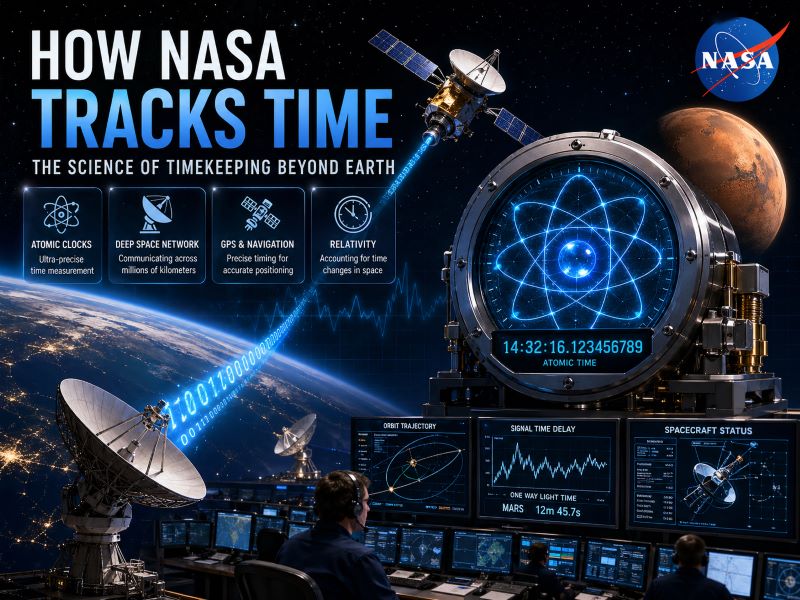
Timekeeping on Earth is already a remarkable achievement of science and engineering. Systems such as atomic clocks, global synchronization networks, and standards like Coordinated Universal Time (UTC) allow billions of people and technologies to function in harmony. However, when human activity extends beyond Earth—into orbit, deep space, and other planetary environments—the concept of time becomes far more complex.
For NASA, time is not simply a measurement—it is a mission-critical system. Every spacecraft maneuver, communication signal, navigation calculation, and scientific experiment depends on precise timing. In space, even microsecond-level inaccuracies can lead to mission failure.
Understanding how NASA tracks time also highlights a deeper reality: time is the invisible infrastructure behind modern science, technology, and exploration. If you want to understand how global time systems evolved, you can explore why time zones exist and how they were created.
This article explores NASA’s timekeeping systems in depth, including atomic clocks, relativistic effects, deep-space communication, interplanetary navigation, and the future of time in space exploration.
Why Timekeeping Is Critical for NASA
Precision in Mission Operations
Space missions require extreme precision because spacecraft operate at high velocities in environments where there is no room for error.
For example:
- Orbital insertion must occur at an exact moment
- Landing sequences are timed down to milliseconds
- Docking with space stations requires perfect synchronization
A small timing error can result in:
- Missing a planetary orbit
- Crashing into a surface
- Losing communication permanently
Time acts as the central control system for every mission phase.
Global Synchronization Across Systems
NASA operates a vast and complex network:
- Mission control centers
- Satellites and space telescopes
- Deep-space probes
- Astronaut crews
All of these systems must remain synchronized despite being separated by millions of kilometers. Time serves as the universal reference that keeps everything aligned.
Atomic Clocks: The Foundation of Space Timekeeping
How Atomic Clocks Work
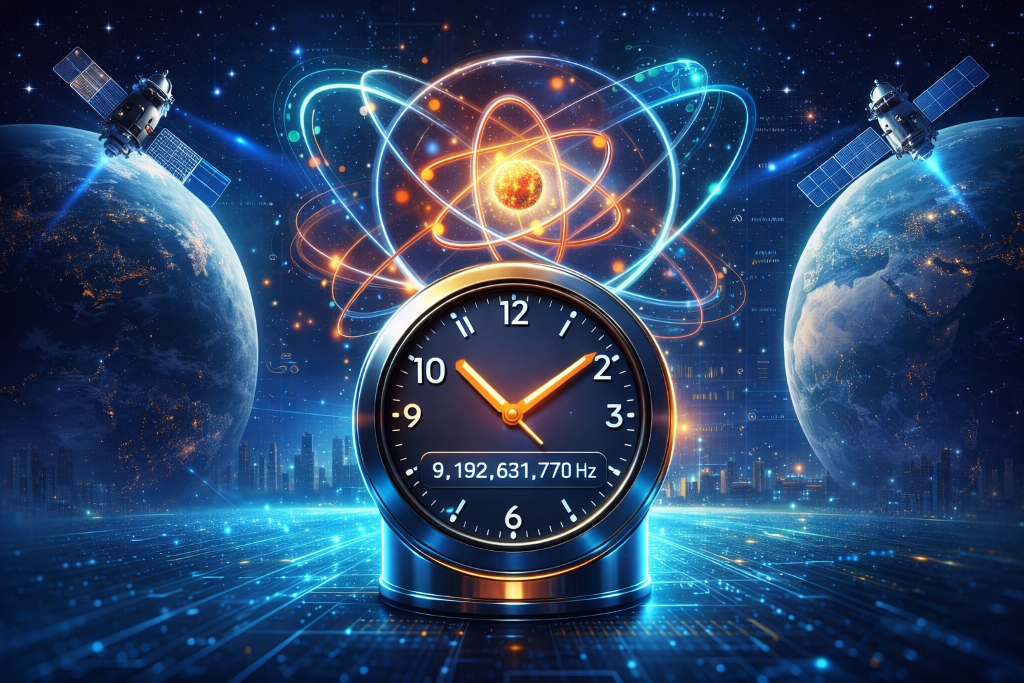
NASA relies on atomic clocks, which measure time using the natural vibration of atoms such as cesium or rubidium. These vibrations are extremely stable and predictable, making atomic clocks far more accurate than mechanical or quartz clocks.
Modern technologies—including GPS and global communication systems—depend on this precision.
Extreme Accuracy
Atomic clocks can:
- Lose less than one second over millions of years
- Measure time at nanosecond precision
This level of accuracy is essential for:
- Navigation
- Communication
- Scientific measurements
Without atomic clocks, space exploration would not be possible.
NASA’s Time Standards
NASA uses multiple time systems depending on mission requirements:
- UTC (Coordinated Universal Time) – global reference for Earth-based operations
- SCET (Spacecraft Event Time) – actual time an event occurs on a spacecraft
- Ephemeris Time (ET) – based on celestial motion
- Barycentric Dynamical Time (TDB) – used for deep-space navigatio
Deep Space Network (DSN)
NASA’s Deep Space Network is a global communication system with antennas in:
- United States
- Spain
- Australia
This system allows continuous communication with spacecraft as Earth rotates.
Why Timing Matters in DSN
Signals travel at the speed of light, so timing determines:
- Distance measurement
- Spacecraft position
- Communication accuracy
Even tiny timing errors can lead to incorrect navigation.
Communication Delays and Predictive Time
Signal Delay in Space
Unlike Earth, space communication is not instantaneous:
- Moon: ~1.3 seconds
- Mars: 4–24 minutes
- Deep space: hours
Real-World Example
During Mars missions, NASA engineers send commands that may take up to 20 minutes to reach a rover. This means:
- The rover must act autonomously
- Decisions are based on predicted conditions
- Real-time control is impossible
Time becomes predictive rather than real-time.
Relativity and Time Dilation
Einstein’s Theory in Practice
According to relativity:
- Time slows at high speeds
- Time slows near massive objects
Impact on NASA Systems
NASA must account for time dilation in:
- Satellites
- Deep-space missions
- Navigation systems
Without corrections, systems like GPS would quickly become inaccurate.
GPS and Satellite Timekeeping
GPS satellites use atomic clocks to transmit time signals. Receivers calculate position based on signal timing differences.
Relativity Corrections
Satellite clocks run faster than Earth clocks due to weaker gravity. NASA applies continuous corrections to maintain accuracy.
Without these corrections:
- GPS errors would grow rapidly
- Navigation systems would fail
Timekeeping for Astronauts
Astronauts aboard the International Space Station follow UTC-based schedules.
However, they experience:
- 16 sunrises and sunsets per day
- Disrupted biological rhythms
NASA manages this through:
- Controlled lighting
- Structured routines
- Sleep scheduling
Timekeeping is both a technical and human challenge.
Planetary Time Systems
Time on Mars
Mars has a day (sol) of approximately 24 hours 39 minutes.
NASA missions:
- Use Mars time for rover operations
- Adjust Earth schedules accordingly
This creates unique operational challenges, as mission teams must adapt to shifting time cycles.
Launch Windows and Orbital Timing
Launch timing depends on planetary alignment.
Missing a launch window can:
- Delay missions by months or years
- Increase fuel requirements
Precise timing ensures efficient interplanetary travel.
Scientific Data and Time Stamps
Every piece of NASA data is timestamped.
This allows:
- Accurate analysis
- Event sequencing
- Cross-system synchronization
Time ensures that scientific discoveries are reliable and verifiable.
🚀 Advanced Concepts in NASA Timekeeping
Multi-Spacecraft Synchronization
Modern missions involve multiple spacecraft working together.
Examples:
- Satellite constellations
- Formation flying missions
Even microsecond differences can cause:
- Data mismatches
- Navigation errors
NASA uses synchronized atomic clocks to maintain alignment.
Time in Interplanetary Navigation
Navigation in space is based on predicting where objects will be in the future.
NASA calculates:
- Planetary positions
- Travel time
- Orbital insertion timing
Time is a core variable in navigation equations.
Autonomous Spacecraft and Time Systems
Future spacecraft will:
- Use onboard atomic clocks
- Make independent decisions
- Reduce reliance on Earth
This is essential for deep-space exploration.
Timekeeping in Extreme Environments
Space conditions include:
- Radiation
- Temperature extremes
- Microgravity
NASA designs systems that are:
- Durable
- Redundant
- Highly reliable
Human Perception of Time in Space
Astronauts experience time differently due to:
- Isolation
- Lack of natural cycles
- Altered sleep patterns
NASA studies this to improve performance and well-being.
Time in Space Observatories
Space telescopes rely on precise timing to:
- Observe distant galaxies
- Track cosmic events
- Analyze light patterns
Accurate timekeeping enables advanced scientific discoveries.
Interplanetary Time Coordination
Future missions may require:
- New time standards
- Planet-specific systems
- Autonomous synchronization
This will be critical for multi-planet exploration.
The Future of Time in Space Exploration
As humanity expands into space:
- Timekeeping systems will evolve
- AI will enhance synchronization
- Autonomous systems will dominate
Time will remain the foundation of space exploration.
Conclusion
NASA’s timekeeping systems represent one of the most advanced achievements in modern science. By combining atomic clocks, relativistic physics, and global communication networks, NASA ensures precise synchronization across vast distances.
Time in space is not constant—it is dynamic, influenced by motion, gravity, and distance. It governs navigation, communication, and discovery.
As humanity ventures deeper into the universe, mastering time will remain essential. Ultimately, NASA’s work shows that understanding time is key to exploring space itself.
Comments
No comments yet.