Introduction
Time has always been one of humanity's greatest mysteries. Long before mechanical clocks, atomic clocks, and smartphones, ancient people needed a reliable way to measure the passing of days, months, and years. Farmers wanted to know when to plant crops, kings needed to schedule festivals and collect taxes, merchants relied on predictable seasons for trade, and religious leaders required accurate dates for ceremonies and rituals. These practical needs gave birth to one of humanity's most remarkable inventions—the calendar.
A calendar is much more than a collection of dates. It is a reflection of astronomy, mathematics, culture, religion, politics, and scientific understanding. Every civilization developed its own method of organizing time based on what it observed in the sky. Some civilizations followed the Moon, others followed the Sun, while many created systems that combined both.
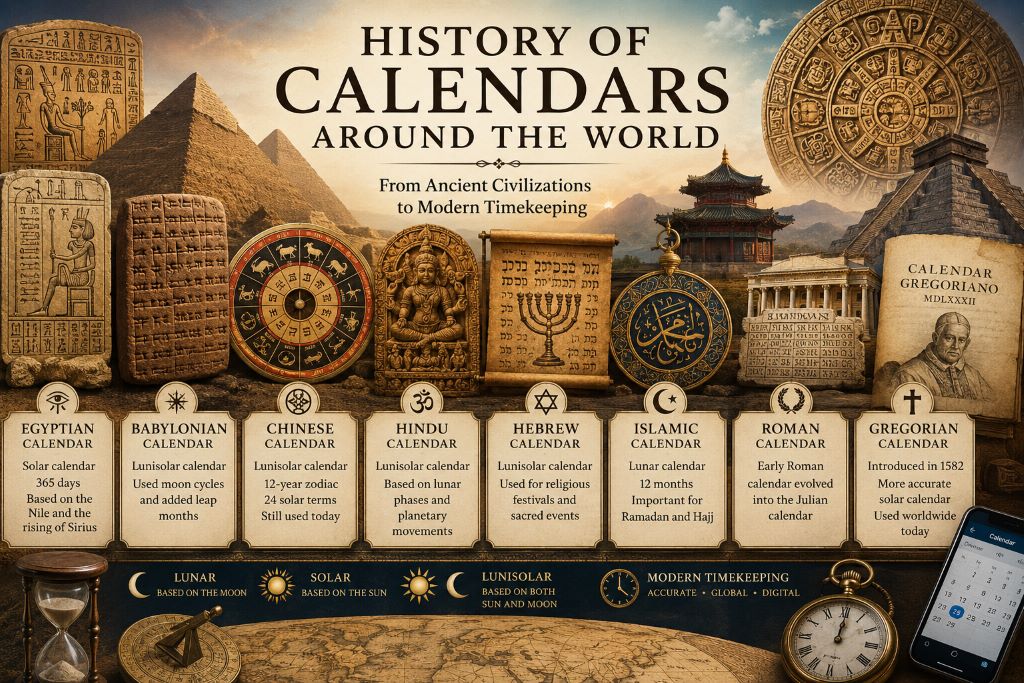
Today, most of the world uses the Gregorian Calendar, introduced in the sixteenth century. However, dozens of other calendars continue to be used for religious, cultural, and governmental purposes. The Chinese Calendar determines the Lunar New Year, the Islamic Hijri Calendar establishes the dates of Ramadan and Hajj, the Hebrew Calendar governs Jewish festivals, and Hindu calendars determine countless celebrations across India.
The story of calendars is also the story of human civilization itself. As societies grew more advanced, their calendars became increasingly accurate. Ancient astronomers carefully tracked the movements of the Sun, Moon, planets, and stars, gradually refining timekeeping methods that would influence future generations.
This article explores the fascinating history of calendars around the world, beginning with humanity's earliest attempts to understand time and continuing through the great calendar systems of ancient civilizations.
What Is a Calendar?
A calendar is a structured system for organizing days into weeks, months, and years. It allows people to measure long periods of time and coordinate activities across communities and civilizations.
Unlike a clock, which measures hours, minutes, and seconds, a calendar measures larger cycles based on astronomical events.
Most calendars rely on one or more of the following natural cycles:
- Earth's rotation creates the day.
- The Moon's orbit creates the month.
- Earth's revolution around the Sun creates the year.
Different civilizations chose different astronomical cycles as the foundation of their calendars.
For example:
- Solar calendars follow the Earth's journey around the Sun.
- Lunar calendars follow the phases of the Moon.
- Lunisolar calendars combine both solar and lunar cycles.
Each approach has its own advantages and challenges.
Why Did Humans Create Calendars?
Modern life depends on calendars, but ancient people had equally important reasons for developing them.
The earliest humans were hunters and gatherers who depended heavily on seasonal changes. Knowing when winter would arrive or when animals migrated could determine whether a community survived.
As agriculture developed around 10,000 years ago, calendars became even more essential.
Farmers needed to know:
- When to prepare fields
- When rivers would flood
- When rainy seasons would begin
- When to plant seeds
- When to harvest crops
A mistake of only a few weeks could ruin an entire harvest.
Calendars also became important for religion. Many ancient cultures believed celestial events carried spiritual meaning. Solstices, equinoxes, eclipses, and full moons often marked sacred festivals.
Governments also relied on calendars to:
- Collect taxes
- Organize military campaigns
- Schedule public events
- Record historical events
- Track royal successions
Over time, calendars evolved into powerful tools that shaped every aspect of civilization.
The Earliest Ways Humans Measured Time
Long before written calendars existed, humans observed nature.
They noticed patterns that repeated regularly.
These included:
- Sunrise and sunset
- Moon phases
- Changing seasons
- Animal migrations
- River floods
- Appearance of certain stars
These repeating events became nature's first calendar.
Watching the Moon
The Moon was probably humanity's first natural clock.
Unlike the Sun, whose appearance changes little each day, the Moon visibly changes shape every night.
Ancient people observed:
- New Moon
- Waxing Crescent
- First Quarter
- Full Moon
- Waning Moon
A complete lunar cycle lasts approximately 29.5 days.
Many early calendars therefore divided months according to lunar phases.
Even today, the word "month" originates from the word "moon."
The Importance of Seasons
While the Moon provided monthly cycles, agriculture depended more heavily on seasons.
Communities carefully observed:
- Spring blossoms
- Summer heat
- Autumn harvests
- Winter snowfall
The changing position of the sunrise along the horizon helped people predict seasonal changes.
These observations became increasingly accurate over generations.
Entire civilizations eventually built monuments specifically designed to observe the Sun.
Ancient Monuments as Calendars
Some of humanity's earliest calendars were not written—they were built from stone.
Several prehistoric monuments appear aligned with important astronomical events.
Stonehenge
Located in England, Stonehenge dates back approximately 5,000 years.
Many archaeologists believe it functioned partly as a solar calendar.
During the summer solstice, the Sun rises precisely over the Heel Stone.
Thousands of visitors still gather every year to witness this alignment.
Although Stonehenge's exact purpose remains debated, it clearly demonstrates that ancient societies carefully tracked the movement of the Sun.
Nabta Playa
Long before Stonehenge, people living in what is now southern Egypt created one of the world's oldest known astronomical sites.
Nabta Playa contains carefully arranged stones that appear aligned with the summer solstice.
These alignments may have helped predict seasonal rainfall.
Göbekli Tepe
Located in modern-day Turkey, Göbekli Tepe is over 11,000 years old.
Researchers believe some of its stone structures may have astronomical significance.
Although debate continues, it illustrates humanity's early fascination with the sky.
The First Recorded Calendars
As writing developed around 5,000 years ago, civilizations began recording dates.
This allowed calendars to become much more sophisticated.
The earliest written calendars appeared in:
- Mesopotamia
- Egypt
- China
These civilizations combined astronomical observation with mathematics.
Their innovations would influence calendars for thousands of years.
Lunar Calendars: Humanity's First Calendar System
The earliest organized calendars were almost certainly lunar.
Why?
Because the Moon is easy to observe.
Unlike calculating the Earth's orbit around the Sun, anyone can watch the Moon change shape every night.
A lunar month lasts:
29.53 days
Twelve lunar months total:
Approximately 354 days
This creates a problem.
A lunar year is about 11 days shorter than the solar year.
Over time, seasons drift.
For agricultural societies, this was a serious issue.
Some civilizations solved it by occasionally adding an extra month.
Others ignored seasonal drift entirely.
Solar Calendars: Following the Sun
As astronomy improved, civilizations recognized that agriculture depended more on the Sun than the Moon.
The solar year lasts approximately:
365.2422 days
Tracking the Sun allowed farmers to predict:
- Flood seasons
- Planting seasons
- Harvest periods
Solar calendars became especially important in regions with predictable annual flooding, such as ancient Egypt.
Lunisolar Calendars: Combining Two Systems
Some civilizations wanted the best of both worlds.
They wished to preserve lunar months while keeping festivals aligned with seasons.
This led to the development of lunisolar calendars.
These calendars:
- Follow Moon phases for months.
- Add leap months to stay synchronized with the Sun.
Examples include:
- Chinese Calendar
- Hebrew Calendar
- Traditional Hindu Calendars
Many of these systems remain in use today.
Ancient Egypt: The Birth of the 365-Day Year
Among all ancient civilizations, Egypt made one of the greatest contributions to calendar history.
Life in Egypt depended entirely on the Nile River.
Every year, the Nile flooded surrounding farmland, depositing fertile soil essential for agriculture.
Predicting this flood became a matter of survival.
Egyptian priests noticed an important astronomical event.
Just before the annual flooding began, the bright star Sirius appeared in the eastern sky shortly before sunrise.
This event is known as the heliacal rising of Sirius.
Over many years, Egyptians realized this event repeated approximately every 365 days.
This discovery allowed them to create one of history's first solar calendars.
Structure of the Egyptian Calendar
The Egyptian civil calendar contained:
- 12 months
- 30 days per month
This totaled:
360 days
To match the solar year more closely, five additional festival days were added at the end of the year.
Total:
365 days
Although this calendar ignored the extra quarter day that creates leap years, it represented an extraordinary scientific achievement for its time.
For centuries, it remained one of the world's most accurate calendars.
Three Egyptian Seasons
The Egyptian year was divided into three agricultural seasons.
Akhet
The flooding season.
Fields were underwater while farmers repaired tools and prepared for planting.
Peret
The growing season.
Crops emerged as floodwaters receded.
Shemu
The harvest season.
Farmers gathered grain before the next flood cycle.
This close relationship between astronomy, agriculture, and timekeeping became a defining feature of Egyptian civilization.
Why the Egyptian Calendar Was Revolutionary
The Egyptian calendar introduced several ideas that influenced later civilizations.
It demonstrated that:
- A year contains approximately 365 days.
- Solar observation could predict seasons.
- Civil administration benefited from fixed dates.
- Astronomy could improve agriculture.
These principles later inspired Greek and Roman astronomers, eventually contributing to the Julian and Gregorian calendars used today.
The Egyptian calendar represents one of humanity's earliest scientific attempts to understand the rhythm of our planet and organize society around it.
The Babylonian Calendar: The Foundation of Many Modern Calendars
While the Egyptians perfected the solar calendar, another civilization in Mesopotamia created one of history's most influential lunisolar calendars. The Babylonians, who flourished between approximately 1900 BCE and 500 BCE in present-day Iraq, became pioneers of astronomical observation and mathematical timekeeping.
Unlike Egypt, where agriculture depended mainly on the Nile River, Babylonian society relied heavily on observing both the Moon and the Sun. Their priests and astronomers recorded celestial movements with remarkable precision, producing one of the most advanced calendar systems of the ancient world.
Many later calendars—including the Hebrew, Greek, and even aspects of the Islamic calendar—were influenced by Babylonian methods.
How the Babylonian Calendar Worked
The Babylonian calendar followed the phases of the Moon.
Each month began when observers first spotted the thin crescent Moon shortly after sunset.
Months alternated between:
- 29 days
- 30 days
This resulted in a lunar year of approximately 354 days.
However, the Babylonians quickly recognized a major problem.
A lunar year is roughly 11 days shorter than the solar year.
Without correction, important agricultural festivals would slowly drift through every season.
The Invention of Leap Months
Instead of adding leap days like modern calendars, the Babylonians introduced something revolutionary:
Leap months.
Every few years they inserted an additional lunar month.
This kept:
- Planting seasons consistent
- Harvest festivals in the correct season
- Religious celebrations synchronized with nature
This innovation became one of the greatest achievements in ancient calendar science.
Babylonian Astronomy
Babylonian astronomers kept detailed records of:
- Solar eclipses
- Lunar eclipses
- Planetary movements
- Moon phases
- Equinoxes
- Solstices
Their observations eventually helped Greek astronomers such as Hipparchus and Ptolemy improve astronomical calculations.
Many historians consider Babylonian astronomy the beginning of scientific observational astronomy.
The Seven-Day Week
One of Babylon's greatest contributions survives today.
The seven-day week.
Although its exact origins remain debated, Babylonians associated seven days with seven visible celestial bodies:
- Sun
- Moon
- Mercury
- Venus
- Mars
- Jupiter
- Saturn
This concept eventually spread across:
- Persia
- Greece
- Rome
- Europe
- The modern world
Today almost every country still follows the seven-day week.
The Ancient Chinese Calendar
China developed one of the world's longest continuously used calendar traditions.
Chinese calendar history stretches back more than 4,000 years, combining astronomy, philosophy, agriculture, and imperial administration.
Unlike purely solar or lunar systems, the Chinese calendar is lunisolar.
It tracks both:
- Moon phases
- Earth's orbit around the Sun
This combination allows traditional festivals to remain tied to both lunar cycles and seasonal changes.
Structure of the Chinese Calendar
The Chinese calendar contains:
- 12 lunar months
- Months of either 29 or 30 days
A normal year totals:
354 days
To stay synchronized with the solar year, an extra leap month is added roughly every three years.
This keeps important festivals aligned with the correct seasons.
Chinese New Year
Perhaps the best-known event determined by the Chinese calendar is the Chinese New Year.
Unlike January 1st on the Gregorian calendar, Chinese New Year changes every year.
It usually falls between:
January 21 and February 20.
The exact date depends on:
- New Moon timing
- Solar position
This makes Chinese New Year one of the world's largest moving holidays.
Hundreds of millions of people celebrate it across Asia and beyond.
The Chinese Zodiac
The Chinese calendar is also famous for its twelve-year zodiac cycle.
Each year is associated with an animal.
The twelve zodiac animals are:
- Rat
- Ox
- Tiger
- Rabbit
- Dragon
- Snake
- Horse
- Goat
- Monkey
- Rooster
- Dog
- Pig
According to tradition, each animal symbolizes different personality traits.
The zodiac remains an important cultural tradition today.
Twenty-Four Solar Terms
Another remarkable Chinese innovation is the system of 24 Solar Terms.
Instead of dividing the year only into months, Chinese astronomers divided Earth's orbit into 24 equal seasonal markers.
Examples include:
- Beginning of Spring
- Grain Rain
- Summer Solstice
- Autumn Equinox
- Major Snow
These helped farmers know exactly when to:
- Plant crops
- Irrigate fields
- Harvest grain
The system remains influential in East Asian agriculture today.
The Hindu Calendar System
India developed one of the world's most diverse calendar traditions.
Rather than using one national calendar throughout history, different kingdoms and regions developed multiple calendar systems.
Most traditional Hindu calendars are lunisolar.
They combine:
- Lunar months
- Solar years
- Planetary movements
- Zodiac positions
These calendars determine the dates of major Hindu festivals.
Multiple Hindu Calendars
Several important Hindu calendars exist today.
These include:
- Vikram Samvat
- Shaka Calendar
- Tamil Calendar
- Bengali Calendar
- Malayalam Calendar
- Telugu Calendar
- Kannada Calendar
Each has regional variations but shares many astronomical principles.
Hindu Months
Months usually begin according to Moon phases.
Examples include:
- Chaitra
- Vaishakha
- Jyeshtha
- Ashadha
- Shravana
- Bhadrapada
- Ashwin
- Kartika
- Margashirsha
- Pausha
- Magha
- Phalguna
These months determine countless religious observances across India.
Hindu Festivals and the Calendar
Many famous festivals depend entirely on astronomical calculations.
Examples include:
- Diwali
- Holi
- Navratri
- Raksha Bandhan
- Janmashtami
- Maha Shivaratri
Their dates change every year because they follow lunar cycles rather than fixed Gregorian dates.
This makes the Hindu calendar one of the most mathematically sophisticated traditional calendars still actively used.
The Hebrew Calendar
The Hebrew calendar has guided Jewish life for over two thousand years.
Like the Chinese and Hindu calendars, it is lunisolar.
Its purpose is to keep religious festivals synchronized with both:
- Moon phases
- Agricultural seasons
This is especially important because many biblical festivals are tied to harvest cycles.
Structure of the Hebrew Calendar
The Hebrew calendar normally contains:
- 12 lunar months
Every few years:
- A 13th month is added.
This leap month prevents important festivals from drifting into the wrong seasons.
Important Jewish Holidays
The Hebrew calendar determines:
- Passover
- Rosh Hashanah
- Yom Kippur
- Hanukkah
- Sukkot
- Purim
Each begins at sunset because Jewish days traditionally start in the evening rather than at midnight.
Counting Years
Unlike the Gregorian calendar, the Hebrew calendar counts years from the traditional date of the Creation described in Jewish scripture.
This produces year numbers much larger than Gregorian years.
For example:
While the Gregorian calendar may show 2026, the Hebrew calendar shows a completely different year based on its own historical chronology.
The Persian Calendar
Another highly accurate calendar emerged in ancient Persia.
Today's Iranian calendar traces its roots to sophisticated astronomical observations dating back centuries.
The modern Persian Solar Hijri Calendar is widely considered one of the most accurate calendars ever created.
Unlike the Gregorian calendar, which uses a simple leap-year rule, the Persian calendar determines the New Year using direct astronomical observations of the March Equinox.
Nowruz
The Persian New Year is called Nowruz.
It begins precisely at the moment of the spring equinox.
This means the New Year starts based on Earth's actual position relative to the Sun rather than a fixed date.
Nowruz remains one of the oldest continuously celebrated festivals in the world.
Why These Calendars Matter
Each ancient civilization solved the same challenge differently:
How can humans organize time accurately?
Their answers reflected their environment.
Egypt relied on the Nile.
Babylon relied on lunar observation.
China combined astronomy with philosophy.
India connected calendars to religion and planetary motion.
The Hebrew tradition balanced scripture with agriculture.
Persia pursued extraordinary astronomical precision.
Although their methods differed, all sought to understand the same cosmic rhythms.
Scientific Legacy
Many ideas introduced by these ancient calendars remain part of modern life.
Examples include:
- The seven-day week
- Leap years
- Leap months
- Solar observations
- Lunar months
- Seasonal festivals
- Astronomical calculations
Modern astronomers now use atomic clocks and sophisticated computer models, but the basic principles of observing the Sun, Moon, and stars began thousands of years ago.
Ancient calendar makers laid the foundation for modern astronomy, mathematics, navigation, and scientific timekeeping.
The Roman Calendar: The Beginning of the Modern Calendar System
While civilizations in Egypt, Mesopotamia, China, India, and Persia were developing sophisticated calendars, another calendar was evolving in Europe that would eventually become the foundation of the modern international calendar.
The Roman calendar underwent several major transformations before becoming the system we recognize today. Early Roman calendars were far from perfect, often causing confusion in agriculture, government, religion, and military planning.
Over several centuries, Roman leaders introduced reforms that eventually led to the creation of the Julian Calendar and, later, the Gregorian Calendar used throughout most of the world today.
The Earliest Roman Calendar
According to Roman tradition, the first Roman calendar was introduced by Romulus, the legendary founder of Rome, around the eighth century BCE.
This early calendar contained only 10 months.
The Roman year began in March, not January.
The months were:
- Martius (March)
- Aprilis (April)
- Maius (May)
- Junius (June)
- Quintilis
- Sextilis
- September
- October
- November
- December
This calendar totaled approximately 304 days.
Winter was not assigned to any month because agricultural activity largely stopped during that season.
As a result, the calendar gradually drifted away from the natural seasons.
The Addition of January and February
Rome's second king, Numa Pompilius, is traditionally credited with improving the calendar.
He introduced two additional months:
- January
- February
This increased the year to approximately 355 days.
Although the calendar became more complete, it still followed the lunar cycle and remained shorter than the solar year.
To keep seasons aligned, Roman officials occasionally inserted an extra month called Mercedonius.
Unfortunately, this system depended on political decisions rather than scientific observation.
Officials sometimes manipulated the calendar for political advantage, extending or shortening the terms of government leaders.
Over time, the calendar became increasingly inaccurate.
The Need for Calendar Reform
By the first century BCE, Rome's calendar had drifted significantly from the seasons.
Religious festivals no longer occurred during their traditional agricultural periods.
Military campaigns became difficult to schedule.
Tax collection and government administration also suffered from inconsistent dates.
A more accurate calendar had become essential for managing one of the largest empires in history.
This challenge would be solved by one of Rome's most famous leaders.
Julius Caesar and the Julian Calendar
In 46 BCE, Julius Caesar introduced one of history's most influential calendar reforms.
Working with the Alexandrian astronomer Sosigenes, Caesar replaced the unreliable Roman calendar with a new system based primarily on the solar year.
The Julian Calendar contained:
- 365 days
- An additional leap day every four years
This produced an average year length of:
365.25 days
For the first time, Rome possessed a stable, predictable calendar suitable for governing a vast empire.
The Julian Calendar quickly spread throughout Roman territories and remained the dominant calendar in Europe for more than 1,600 years.
The Introduction of Leap Years
One of the Julian Calendar's greatest innovations was the leap year.
Astronomers knew that Earth's orbit around the Sun takes slightly longer than 365 days.
Without correction, the calendar would slowly drift.
Caesar solved this problem by adding one extra day every four years.
This leap day was placed in February.
The idea remains part of modern calendars today, although the leap-year rules have since been refined.
Why July Is Named After Julius Caesar
Originally, the fifth Roman month was called Quintilis, meaning "fifth month."
After Julius Caesar's death, the Roman Senate renamed it Julius in his honor.
Over time, this became July.
Similarly, the following month, Sextilis, was renamed August after Emperor Augustus.
These names remain part of today's calendar.
The Julian Calendar's Success
The Julian Calendar represented an enormous improvement over earlier systems.
It offered several advantages:
- Fixed month lengths
- Predictable leap years
- Stable agricultural planning
- Easier tax collection
- Reliable religious festivals
- Better international administration
For centuries, it served Europe remarkably well.
However, it contained one small error.
Although tiny, that error gradually accumulated over hundreds of years.
The Julian Calendar's Hidden Problem
The Julian Calendar assumed the solar year lasted:
365.25 days.
Modern astronomy shows the true tropical year is approximately:
365.2422 days.
The difference appears insignificant.
However, the calendar gained roughly:
11 minutes every year.
Over centuries, those minutes became days.
By the sixteenth century, the calendar had drifted approximately 10 days from the actual seasons.
The spring equinox, important for calculating the date of Easter, was occurring earlier than expected.
Another calendar reform became necessary.
Pope Gregory XIII and Calendar Reform
In 1582, Pope Gregory XIII introduced a new calendar designed to correct the accumulated error.
This became known as the Gregorian Calendar.
Instead of simply adding a leap year every four years, the Gregorian system introduced more precise rules.
A year is a leap year if:
- It is divisible by 4.
However:
- Years divisible by 100 are not leap years.
Exception:
- Years divisible by 400 are leap years.
For example:
- 1600 → Leap Year
- 1700 → Not Leap Year
- 1800 → Not Leap Year
- 1900 → Not Leap Year
- 2000 → Leap Year
- 2100 → Not Leap Year
These rules reduced the calendar's long-term error dramatically.
Removing Ten Days
Correcting the accumulated error required an unusual solution.
When the Gregorian Calendar was introduced in October 1582:
Thursday,
October 4
was immediately followed by:
Friday,
October 15
Ten calendar days simply disappeared.
No actual time was lost.
The change merely realigned calendar dates with Earth's true position around the Sun.
Why Countries Adopted the Gregorian Calendar Slowly
Not every country accepted the Gregorian Calendar immediately.
Catholic countries adopted it first.
These included:
- Italy
- Spain
- Portugal
- Poland
Protestant and Orthodox nations delayed adoption for political and religious reasons.
Examples include:
Britain:
1752
Sweden:
1753
Japan:
1873
Russia:
1918
Greece:
1923
This means historical documents sometimes contain different dates depending on which calendar a country used at the time.
The Calendar Used Today
Today, the Gregorian Calendar serves as the international civil calendar.
It is used for:
- Government administration
- International trade
- Scientific research
- Aviation
- Banking
- Education
- Technology
- Space missions
Although many countries continue using traditional calendars for religious or cultural events, the Gregorian Calendar provides a common global standard.
Why Are There Twelve Months?
Many people wonder why the year contains twelve months rather than ten or thirteen.
The answer lies in astronomy.
There are approximately:
12.37 lunar cycles in one solar year.
Ancient civilizations found that twelve months provided a practical balance between lunar observations and seasonal changes.
Although month lengths vary today, the twelve-month structure has survived for thousands of years.
Why Does February Have Only 28 Days?
February's unusual length is another legacy of Roman history.
When the calendar was reorganized, February became the shortest month.
During leap years, one additional day is added, giving February:
29 days.
Although several legends explain this arrangement, the modern structure reflects centuries of Roman calendar reforms rather than a single historical decision.
How Leap Years Keep Calendars Accurate
Earth does not orbit the Sun in exactly 365 days.
Without leap years:
- Seasons would gradually shift.
- Summer would slowly move into different months.
- Agricultural planning would become unreliable.
The Gregorian leap-year system keeps the calendar closely aligned with Earth's orbit.
Its error is extremely small—only about one day every 3,300 years.
This makes it one of the most accurate civil calendars ever created.
Calendars Beyond Earth
As humanity prepares for future space exploration, scientists are already discussing new calendar systems.
Mars presents unique challenges.
A Martian year lasts:
687 Earth days.
A Martian day, called a sol, lasts approximately:
24 hours, 39 minutes, and 35 seconds.
Future astronauts may eventually use entirely new calendars designed specifically for life on Mars.
This demonstrates that calendars continue to evolve alongside human civilization.
Why Calendar History Still Matters
Although digital devices now display dates automatically, the principles behind calendars remain deeply important.
Every calendar reflects centuries of:
- Astronomical observation
- Mathematical calculation
- Cultural tradition
- Religious practice
- Political reform
- Scientific discovery
The calendar hanging on a wall today is the result of thousands of years of human effort to understand the movements of Earth, the Moon, and the Sun.
Other Remarkable Calendar Systems Around the World
Although the Gregorian Calendar is now the world's most widely used civil calendar, many fascinating calendar systems continue to exist. These calendars preserve centuries of cultural, religious, and scientific traditions and remain an important part of daily life for millions of people.
Let's explore some of the most remarkable calendar systems that continue to influence human civilization.
The Maya Calendar
The Maya civilization, which flourished across present-day Mexico, Guatemala, Belize, Honduras, and El Salvador, developed one of history's most sophisticated calendar systems.
Unlike many ancient civilizations, the Maya used multiple calendars simultaneously.
Their calendar system included:
- The Tzolk'in (260-day ritual calendar)
- The Haab' (365-day solar calendar)
- The Long Count Calendar
Together, these systems allowed the Maya to track:
- Religious ceremonies
- Agricultural seasons
- Political events
- Astronomical observations
- Historical records spanning thousands of years
The Haab' Calendar
The Haab' calendar contained:
- 18 months
- 20 days per month
This totaled:
360 days
Five additional days, known as Wayeb', were added to complete the 365-day year.
These five days were often considered spiritually dangerous or unlucky, and many Maya communities avoided important activities during this period.
The Long Count Calendar
Perhaps the most famous Maya calendar is the Long Count.
Unlike repeating yearly calendars, the Long Count measured the continuous passage of time over thousands of years.
It used units such as:
- Kin (1 day)
- Uinal (20 days)
- Tun (360 days)
- Katun (7,200 days)
- Baktun (144,000 days)
The Long Count attracted worldwide attention in 2012 when many people mistakenly believed the calendar predicted the end of the world.
In reality, it simply marked the completion of one major cycle and the beginning of another.
The Aztec Calendar
The Aztec civilization inherited and expanded many calendar concepts developed by earlier Mesoamerican cultures.
Like the Maya, the Aztecs used two primary calendars.
The Tonalpohualli
A 260-day ritual calendar used for:
- Religious ceremonies
- Divination
- Naming children
- Choosing important dates
The Xiuhpohualli
A 365-day solar calendar used for:
- Agriculture
- Government
- Seasonal festivals
The famous Aztec Sun Stone, often called the Aztec Calendar Stone, symbolizes this sophisticated understanding of time and cosmology.
The Ethiopian Calendar
Ethiopia continues to use its own national calendar alongside the Gregorian Calendar.
The Ethiopian Calendar has several unique features.
It contains:
- 12 months of 30 days each
- One additional month called Pagume
Pagume contains:
- 5 days
- 6 days during leap years
This produces a year of:
365 or 366 days.
Why Is the Ethiopian Year Different?
The Ethiopian Calendar follows a different calculation for the birth of Jesus Christ.
As a result, Ethiopia is approximately seven to eight years behind the Gregorian Calendar.
For example, while much of the world may celebrate the year 2026, Ethiopia observes a different year number.
Despite this difference, both calendars function accurately within their own historical traditions.
The Islamic (Hijri) Calendar
The Islamic Calendar is unique because it is a pure lunar calendar.
Unlike lunisolar systems, it does not attempt to remain synchronized with the seasons.
The Islamic year contains:
- 12 lunar months
- Approximately 354 days
Because it is shorter than the solar year, Islamic months gradually move through every season over a period of about 33 years.
Important Islamic Months
The Hijri calendar determines the dates of many important religious observances, including:
- Ramadan
- Eid al-Fitr
- Eid al-Adha
- Hajj pilgrimage
- Islamic New Year
The beginning of each month traditionally depends on observing the new crescent Moon.
Although astronomical calculations are increasingly used, many communities continue to rely on physical moon sightings.
Solar, Lunar, and Lunisolar Calendars Compared
Throughout history, civilizations have relied on three major calendar types.
Solar Calendars
Solar calendars follow Earth's orbit around the Sun.
Examples:
- Gregorian Calendar
- Julian Calendar
- Persian Calendar
Advantages:
- Seasons remain fixed.
- Excellent for agriculture.
- Easy international coordination.
Lunar Calendars
Lunar calendars follow the phases of the Moon.
Example:
- Islamic Hijri Calendar
Advantages:
- Easy to observe.
- Simple month calculations.
Disadvantages:
- Seasons gradually shift.
Lunisolar Calendars
Lunisolar calendars combine the Moon and the Sun.
Examples:
- Chinese Calendar
- Hebrew Calendar
- Traditional Hindu Calendars
Advantages:
- Festivals follow lunar phases.
- Seasons remain relatively stable.
Disadvantages:
- More complex calculations.
Each system reflects different priorities, environments, and cultural traditions.
How Modern Science Improved Calendars
Ancient astronomers relied primarily on careful observation.
Today, scientists use:
- Telescopes
- Satellites
- Spacecraft
- Atomic clocks
- Computers
- GPS technology
Modern astronomy measures Earth's orbital period with extraordinary precision.
Scientists now know that the tropical year lasts approximately:
365.242189 days.
These measurements help maintain accurate calendars for navigation, communications, and scientific research.
Calendars in the Digital Age
Today, calendars are no longer limited to paper.
Digital calendars have transformed how people organize their lives.
Applications such as:
- Google Calendar
- Microsoft Outlook
- Apple Calendar
allow users to:
- Schedule meetings
- Receive reminders
- Coordinate across time zones
- Share events instantly
Artificial intelligence is increasingly helping users optimize schedules automatically.
Although technology has changed, the fundamental purpose of calendars remains the same as it was thousands of years ago—organizing time.
Will Humanity Need New Calendars?
As space exploration advances, entirely new calendars may become necessary.
Future settlements on:
- Mars
- The Moon
cannot simply copy Earth's calendar.
For example:
A Martian year lasts approximately:
687 Earth days.
A Martian day (called a sol) lasts:
24 hours, 39 minutes, and 35 seconds.
Scientists have already proposed several Mars calendar systems for future astronauts and colonies.
This demonstrates that calendar development is still an ongoing process.
Fascinating Calendar Facts
Here are some interesting facts about calendars:
- The Gregorian Calendar is used by most countries as the international civil calendar.
- Ancient Egyptians were among the first to use a 365-day solar year.
- The seven-day week originated in ancient civilizations thousands of years ago.
- February is the shortest month because of Roman calendar reforms.
- Leap years prevent the calendar from drifting away from Earth's seasons.
- The Islamic Calendar is approximately 11 days shorter than the Gregorian year.
- China has used calendar systems continuously for more than four millennia.
- Ethiopia celebrates New Year on a different date from most of the world.
- The Maya developed one of history's most accurate ancient calendar systems.
- Modern atomic clocks can measure time far more precisely than any ancient calendar makers could have imagined.
Frequently Asked Questions
What is the oldest known calendar?
Some of the earliest known calendars date back more than 10,000 years and include prehistoric lunar markings and astronomical monuments such as Nabta Playa and Stonehenge. Written calendar systems later emerged in ancient Egypt and Mesopotamia.
Why are there 12 months in a year?
Twelve months closely approximate the number of lunar cycles that occur during one solar year. Ancient civilizations adopted this structure because it balanced astronomy with practical timekeeping.
Why does February have only 28 days?
February inherited its length through Roman calendar reforms. When Julius Caesar introduced the Julian Calendar, February became the month that received the extra leap day every four years.
What is the difference between the Julian and Gregorian calendars?
The Julian Calendar adds a leap year every four years without exception.
The Gregorian Calendar improves accuracy by skipping leap years in most century years unless they are divisible by 400.
This correction keeps the calendar closely aligned with Earth's orbit around the Sun.
Which calendar is used internationally?
The Gregorian Calendar is the international civil standard used by governments, businesses, education systems, aviation, banking, and scientific organizations throughout most of the world.
Are traditional calendars still used?
Yes.
Many traditional calendars remain active for religious and cultural purposes, including:
- Chinese Calendar
- Hindu Calendars
- Hebrew Calendar
- Islamic Hijri Calendar
- Ethiopian Calendar
- Persian Calendar
These calendars continue to determine important festivals and ceremonies.
Conclusion
The history of calendars is the history of humanity's relationship with time. From prehistoric communities observing the changing phases of the Moon to modern scientists using atomic clocks and satellites, every generation has sought more accurate ways to measure the passage of days, months, and years.
Ancient civilizations such as Egypt, Babylon, China, India, Rome, Persia, and the Maya each contributed remarkable innovations that shaped the evolution of calendars. Some focused on the Moon, others on the Sun, while many developed sophisticated systems that combined both. Their work influenced agriculture, religion, government, navigation, trade, and scientific discovery.
Today, the Gregorian Calendar provides a common international framework for civil life, while many traditional calendars continue to preserve the cultural and spiritual heritage of communities around the world. At the same time, advances in astronomy and space exploration are inspiring discussions about entirely new calendar systems for future settlements on the Moon and Mars.
The story of calendars reminds us that measuring time is not simply about counting days. It is about understanding our place in the universe, adapting to the rhythms of nature, and creating systems that help societies organize, remember, celebrate, and plan for the future. As humanity continues to explore beyond Earth, the evolution of calendars is certain to continue, linking the achievements of ancient civilizations with the challenges of tomorrow.
Comments
No comments yet.