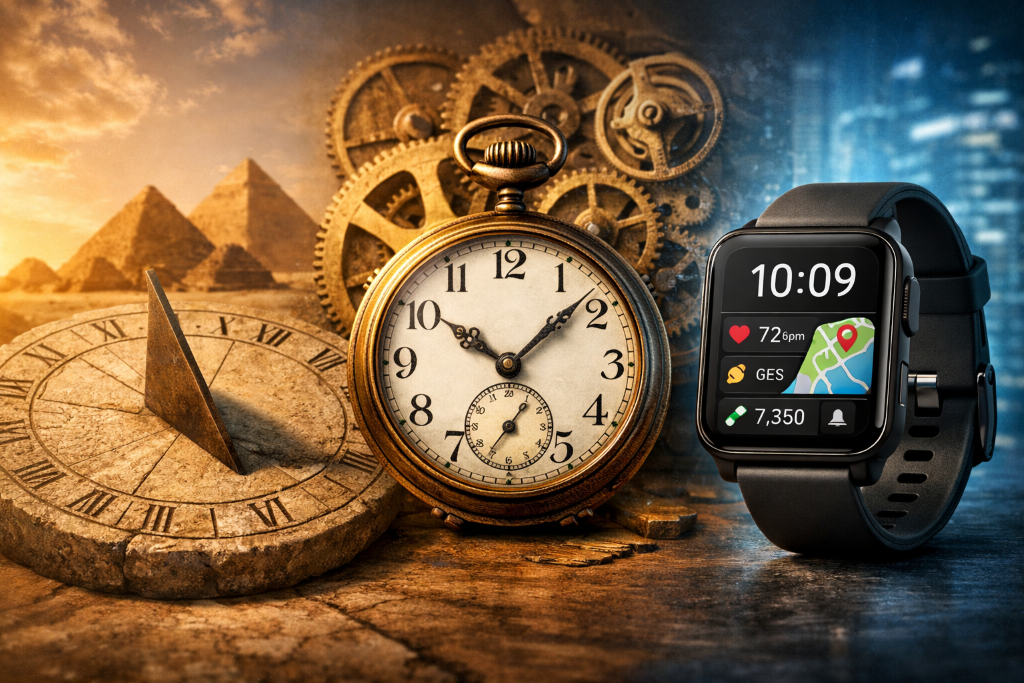
Imagine a world without clocks, watches, smartphones, alarms, or digital calendars. There would be no exact 9:00 AM meetings, train timetables, school periods, or countdowns to important events. People would still experience day and night, but measuring and coordinating time would be far less precise.
For thousands of years, humans have looked to nature to understand the passage of time. The rising and setting Sun, changing shadows, phases of the Moon, and movement of the stars provided some of the earliest clues. As civilizations became larger and daily life became more organized, however, people needed increasingly reliable ways to measure shorter periods of time.
This need led to an extraordinary technological journey. Sundials gave way to water clocks, mechanical clocks transformed public life, watches made time portable, quartz technology dramatically improved accuracy, and digital devices eventually turned timekeeping into one feature of a much larger technological ecosystem.
Today, a smartwatch can do far more than tell the hour. It can synchronize with global time standards, communicate with satellites, display notifications, provide navigation, and connect timekeeping with a wide range of digital services.
The evolution of timekeeping is therefore more than a history of clocks. It is a story about astronomy, engineering, transportation, communication, science, and the human desire to measure the world with increasing precision.
1. Timekeeping Begins With Nature
Before humans built clocks, nature was the primary timekeeper.
The most obvious indicator was the Sun. Its apparent movement across the sky provided a natural way to divide the day into recognizable periods. People could observe sunrise, midday, sunset, and the changing position of shadows.
The Moon provided another useful cycle. Its phases repeat over approximately a month and helped ancient societies track longer periods such as lunar months.
The stars also played an important role. Their positions and apparent movement across the night sky could help people identify seasons and navigate over long distances.
Human biological rhythms provided an additional, less precise form of timekeeping. People naturally developed routines around daylight, darkness, work, meals, and sleep.
Early timekeeping therefore depended heavily on astronomical cycles:
- Sun: helped identify the passage of a day.
- Moon: helped track longer monthly cycles.
- Stars: helped identify seasons and support navigation.
- Seasons: helped organize agricultural activities.
- Biological rhythms: influenced daily routines.
These natural systems were useful, but they had an important limitation: they did not provide a convenient, standardized measurement of short intervals.
As societies developed agriculture, religion, trade, government, and transportation, greater precision became increasingly valuable.
2. Ancient Sundials: Measuring Time With Shadows
One of humanity's earliest approaches to measuring time was the sundial.
Sundials use the apparent movement of the Sun to create a changing shadow. A raised object called a gnomon casts the shadow, while markings on a surface indicate different positions corresponding to different times.
Ancient Egyptians and other civilizations developed sophisticated methods of using shadows to divide the day. Over centuries, sundials appeared in many different forms and were refined by Greek, Roman, Islamic, Indian, Chinese, and other scientific traditions.
The basic principle was simple:
- The Sun appears to move across the sky.
- The position of the shadow changes.
- The shadow falls across a marked surface.
- Its position provides an estimate of the time.
Sundials were an important technological step because they converted an astronomical observation into a physical measurement.
However, they had obvious limitations.
A sundial could not normally be used at night, and clouds could make the shadow difficult or impossible to observe. The apparent motion of the Sun also changes with the seasons, meaning that historical systems of sundial time did not always correspond directly to the uniform clock time used today.
Despite these limitations, the sundial established a fundamental idea that would remain central to timekeeping: a predictable physical process can be used as a reference for measuring time.
3. Water Clocks and Other Early Timekeepers
Because sundials depended on sunlight, civilizations developed alternative methods for measuring time.
One of the most important was the water clock, also known as a clepsydra.
A water clock measures time through the movement of water into or out of a container. Markings on the container allow the changing water level to indicate the passage of time.
Water clocks were used in several ancient civilizations, including Egypt, Greece, China, and the Islamic world. Some were relatively simple, while others incorporated elaborate mechanical features.
Their major advantage was that they could operate:
- Indoors
- At night
- In conditions where sunlight was unavailable
Water clocks were particularly useful for activities requiring a measured interval rather than simply observing the position of the Sun.
Other devices also helped people measure elapsed time. Sand-filled hourglasses, for example, allowed a relatively simple interval to be measured as sand passed from one chamber to another.
These devices were especially useful for measuring duration rather than determining an exact modern clock time.
4. The Development of Mechanical Clocks
A major transformation occurred with the development of mechanical clocks in medieval Europe.
By the late Middle Ages, large mechanical clocks were appearing in churches, public buildings, and town centers. Instead of relying directly on sunlight or flowing water, these clocks used mechanical components to regulate the movement of hands or other indicators.
Early mechanical clocks commonly used:
- Weights as a source of energy
- Gears to transmit motion
- An escapement to regulate movement
- Bells to announce the hour
The escapement was particularly important because it allowed the clock's stored energy to be released in controlled increments.
Early mechanical clocks were not as accurate as modern clocks, but their social importance was enormous.
A public clock allowed an entire community to share a common reference for time. Bells could announce religious services, working hours, market activities, and other important events.
One famous example is the Prague Astronomical Clock, installed in the early 15th century and subsequently modified over time. It demonstrates how clockmaking became connected not only with simple time display but also with astronomy and public culture.
Mechanical clocks gradually became smaller and more sophisticated. Improvements in engineering eventually made portable clocks and watches possible.
5. From Public Clocks to Portable Watches
For centuries, accurate mechanical clocks were relatively large and expensive. Eventually, advances in miniature mechanical components allowed timekeeping devices to become portable.
By the 16th century, spring-powered portable clocks and early watches were being developed in Europe.
These early watches were very different from modern wristwatches.
They were often:
- Expensive
- Mechanically complicated
- Decorative
- Owned primarily by wealthy individuals
- Less accurate than modern watches
Many early watches did not even provide the detailed minute and second display that people now expect.
Nevertheless, portable timekeeping changed the relationship between people and clocks. Time was no longer something that had to be read from a church tower or public clock.
It could travel with the individual.
6. John Harrison and the Challenge of Navigation
Accurate timekeeping became especially important for navigation.
Determining latitude at sea was comparatively manageable using astronomical observations, but determining longitude was historically much more difficult.
One important approach was to compare local solar time with the time at a known reference location. Because Earth rotates approximately 15 degrees of longitude per hour, an accurate clock could provide valuable information about east-west position.
British clockmaker John Harrison made major contributions to marine timekeeping during the 18th century. His marine chronometers demonstrated that highly accurate portable clocks could be built for navigation.
This was a crucial moment in the history of timekeeping because it showed that better clocks could directly solve practical scientific and transportation problems.
Timekeeping was becoming not merely a way to organize daily life, but a precision technology with global consequences.
7. Wristwatches Become Practical
Wristwatches existed before the 20th century, but their widespread popularity grew substantially in the early 1900s.
One important reason was practicality.
A wristwatch could be checked quickly without removing a pocket watch. This made it particularly convenient for activities where both hands were needed.
Military use during World War I helped increase the popularity and practicality of wristwatches. After the war, wristwatches increasingly became everyday accessories.
Over time, watch design expanded beyond pure functionality.
Watches became associated with:
- Fashion
- Personal identity
- Craftsmanship
- Status
- Military and professional use
- Everyday convenience
Mechanical watchmaking also became a highly sophisticated engineering field, with manufacturers developing increasingly precise movements and complications.
8. The Quartz Revolution
The next major transformation came from electronics.
Quartz crystal technology made it possible to create highly accurate clocks using the predictable vibration of a quartz crystal when subjected to an electrical voltage.
The principle is known as the piezoelectric effect. Quartz can vibrate at a stable frequency, allowing electronic circuits to use those vibrations as a timing reference.
Quartz clocks became dramatically more accurate than many inexpensive mechanical watches while also being easier to mass-produce.
A typical quartz wristwatch may deviate by only around several seconds per month, although actual performance varies by model, temperature, and other conditions. Mechanical watches can commonly vary by several seconds per day.
The quartz revolution had several major effects:
- Timekeeping became more affordable.
- Watches became highly accurate for everyday use.
- Electronic clocks became widespread.
- Battery-powered timepieces became common.
- Mechanical watches faced intense competition.
Quartz technology fundamentally changed the consumer watch industry.
9. Digital Clocks and Electronic Timekeeping
Quartz technology also contributed to the rise of digital clocks.
Instead of moving physical hands, digital clocks could convert electronic timing signals into numerical displays.
Digital time displays appeared in:
- Alarm clocks
- Radios
- Cars
- Microwaves
- Computers
- Telephones
- Industrial equipment
Timekeeping was increasingly becoming an electronic process.
This development also made it easier for devices to synchronize time with other systems. Computers and communication networks eventually required increasingly precise and coordinated clocks.
10. Atomic Clocks: Measuring Time With Atoms
For applications requiring extreme precision, quartz oscillators are not enough.
Modern scientific timekeeping uses atomic clocks, which derive their frequency from highly stable transitions in atoms.
The SI second is defined using the frequency of a specific transition in the cesium-133 atom:
9,192,631,770 cycles per second.
Atomic clocks are extraordinarily stable and form the foundation of modern international timekeeping.
They are important for systems such as:
- Global navigation
- Telecommunications
- Computer networks
- Scientific experiments
- Electrical power systems
- Financial infrastructure
- International time standards
Atomic clocks are not usually what you directly see on your wrist. Instead, they provide highly precise reference signals that can be distributed through communication systems.
This marks another important shift in the evolution of timekeeping: the most accurate clocks are no longer designed primarily for telling people what hour it is. They support the infrastructure that allows modern technology to function.
11. Global Time and Synchronization
As transportation and communication networks became global, countries and organizations needed ways to coordinate clocks over long distances.
This contributed to the development and widespread use of standardized time zones and international time scales.
Today, Coordinated Universal Time (UTC) serves as the principal international reference for civil timekeeping.
Many computer systems, servers, telecommunications networks, and scientific instruments synchronize their clocks against highly accurate reference sources.
This means that modern timekeeping operates at several levels:
- A physical reference provides a stable frequency.
- National and international systems maintain official time.
- Network services distribute time.
- Computers and devices synchronize their internal clocks.
- Users see the result on watches, phones, computers, and other displays.
The clock on a smartphone may look simple, but behind it is a sophisticated global infrastructure.
12. Smartphones Change How We Read Time
The smartphone introduced another major change.
A phone does not need to be primarily a clock to display accurate time. It is a communication and computing device that happens to include a time display among many other functions.
Smartphones can combine:
- Network synchronization
- GPS or other positioning technologies
- Internet connectivity
- Operating-system time services
- Time-zone databases
- Automatic daylight-saving rules where applicable
This allows the same device to display local time while traveling between countries and time zones.
The result is that people rarely need to manually adjust their clocks anymore.
13. Smartwatches: Time Meets Computing
Smartwatches represent the latest major stage in the evolution described in this article.
A modern smartwatch combines timekeeping with computing, communications, sensors, and wireless connectivity.
Depending on the model, a smartwatch may provide:
- Time and date
- Alarms and timers
- Notifications
- Calls and messages
- Navigation
- Weather information
- Music controls
- Fitness measurements
- Sleep-related tracking
- Contactless payment features
- Apps and voice assistants
The watch has therefore changed from a device whose primary purpose was measuring and displaying time into a device that uses time as one component of a broader digital experience.
A smartwatch can also automatically adjust the displayed time when the user changes time zones, provided its software and connectivity support the necessary information.
14. From Accuracy to Connectivity
An important theme in the history of timekeeping is that progress has not always meant simply making clocks more accurate.
Early humans needed to know approximately when daylight began or ended.
Ancient civilizations needed reliable intervals for agriculture, religion, administration, and daily activities.
Mechanical clocks provided communities with shared public time.
Portable watches gave individuals access to personal time.
Quartz clocks dramatically improved affordable everyday accuracy.
Atomic clocks created extremely precise scientific and technological references.
Smartphones and smartwatches added another dimension: connectivity.
Modern timekeeping is therefore about both precision and synchronization.
A device can display an extremely precise time, but its usefulness also depends on whether that time agrees with the systems around it.
15. Why Accurate Time Matters Today
Accurate time may seem like a simple convenience, but modern infrastructure depends heavily on synchronization.
Consider financial systems. Transactions may need reliable timestamps so that events can be ordered correctly.
Telecommunication networks also depend on timing for coordination between systems.
Navigation systems use precise timing signals to calculate position.
Computer networks use synchronized clocks for logging, security, troubleshooting, and distributed operations.
Scientific experiments may require extremely precise timing to compare measurements.
Even electrical grids can use synchronized timing to monitor and coordinate large systems.
This means that the evolution of timekeeping has moved far beyond clocks and watches.
Modern civilization itself depends on accurate time.
16. What Comes After Smartwatches?
The future of timekeeping may not involve simply making smaller or more advanced watches.
Researchers are developing increasingly precise optical clocks and other advanced timing technologies. These systems can measure extremely small differences in the passage of time and may eventually contribute to new scientific applications.
Future timekeeping could become increasingly integrated with:
- Advanced navigation
- Scientific measurement
- Distributed computing
- High-speed communications
- Space exploration
- Precision sensing
- Augmented and mixed reality
- Wearable computing
Rather than asking only, “What time is it?”, future systems may use precise time as a fundamental data layer for understanding location, motion, communication, and physical processes.
17. The Long Journey From Shadows to Smart Devices
The evolution of timekeeping can be viewed as a series of increasingly sophisticated reference systems:
Sun → Sundial → Water Clock → Mechanical Clock → Watch → Quartz Clock → Atomic Clock → Connected Smart Device
Each stage solved problems created by the limitations of the previous one.
Sundials provided a practical way to use the Sun.
Water clocks allowed time intervals to be measured without direct sunlight.
Mechanical clocks provided repeatable motion and public timekeeping.
Portable watches brought clocks to individuals.
Quartz technology made accurate electronic timekeeping inexpensive.
Atomic clocks provided an exceptionally stable scientific reference.
Smartphones and smartwatches connected timekeeping to the digital world.
The technology changed dramatically, but the fundamental human need remained the same: to understand, measure, organize, and coordinate time.
Frequently Asked Questions
When did humans first start measuring time?
Humans have observed natural cycles such as day, night, lunar phases, and seasons since prehistoric times. Organized mechanical timekeeping came much later, with ancient civilizations developing devices such as sundials and water clocks.
What was the first type of clock?
There was no single universally accepted “first clock.” Ancient civilizations developed several early timekeeping devices, including sundials and water clocks. These systems measured time using different physical processes.
How did sundials measure time?
A sundial used a raised object, called a gnomon, to cast a shadow. As the Sun appeared to move across the sky, the shadow changed position across marked areas, providing an indication of the time.
Why were mechanical clocks important?
Mechanical clocks provided a repeatable method for measuring time without relying directly on sunlight or flowing water. Public clocks also helped communities coordinate activities using a shared reference.
Why was John Harrison important to timekeeping?
John Harrison developed highly accurate marine chronometers in the 18th century. His work demonstrated how precise portable clocks could help solve the difficult problem of determining longitude at sea.
Why are quartz clocks so accurate?
Quartz clocks use the stable vibration of a quartz crystal as an electronic frequency reference. This allows them to maintain time much more consistently than many traditional mechanical watches.
What makes atomic clocks different?
Atomic clocks use extremely stable atomic transitions as their frequency reference. They provide much greater precision and stability than ordinary mechanical or quartz clocks.
Are smartwatches atomic clocks?
Usually, no. A smartwatch generally does not contain a laboratory-style atomic clock. Instead, it can obtain or synchronize time through electronic systems, networks, satellites, or other reference sources depending on the device.
Why is accurate time important for GPS?
GPS positioning depends on extremely precise timing. Small timing errors in signals from satellites can translate into significant position errors, which is why precise clocks are fundamental to satellite navigation.
How has timekeeping changed human civilization?
Accurate timekeeping has influenced agriculture, religion, transportation, navigation, science, industry, communication, commerce, and computing. As clocks became more precise and portable, societies became increasingly dependent on synchronized schedules.
Conclusion
The history of timekeeping is a history of human innovation.
People began by watching shadows and celestial cycles. They developed sundials to turn sunlight into measurable intervals, water clocks to measure time without direct sunlight, and mechanical clocks to create increasingly standardized measurements.
Portable watches brought personal timekeeping into everyday life. Quartz technology then transformed accuracy and affordability, while atomic clocks established the extraordinarily precise standards required by modern science and technology.
Today, smartwatches and smartphones represent another transformation. Time is no longer an isolated measurement displayed by a dedicated clock. It is integrated into communication, navigation, computing, transportation, and countless other systems.
From the movement of a shadow to the behavior of atoms and the synchronization of connected devices, the evolution of timekeeping shows how deeply humans have sought to understand one of the most fundamental dimensions of existence.
The next time you check the time on a watch, phone, or computer, remember that the simple number on the screen represents thousands of years of observation, experimentation, engineering, and scientific progress.
Comments
good
2026-01-06 09:52:47