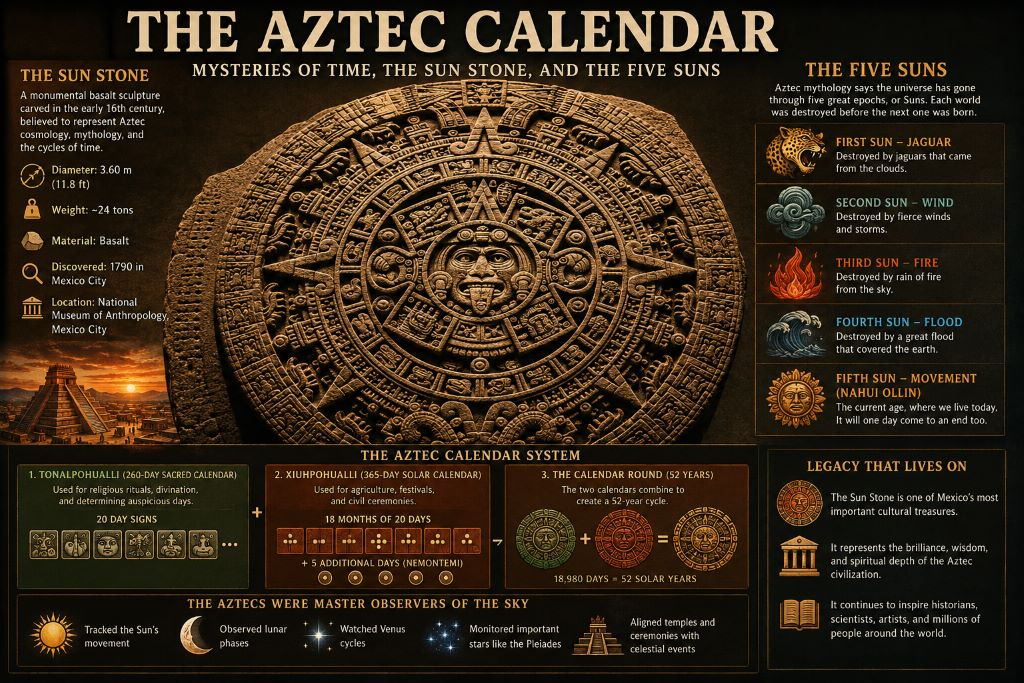
Part 1: Introduction — Unlocking One of History's Greatest Timekeeping Mysteries
"Long before mechanical clocks, satellites, or atomic timekeeping, ancient civilizations looked to the heavens to understand the passage of time. Among them, the Aztecs created one of the world's most remarkable calendar systems—one that blended astronomy, mathematics, mythology, religion, and philosophy into a single vision of the universe. More than five centuries after the fall of their empire, the Aztec calendar continues to inspire historians, archaeologists, and curious minds around the globe."
Time: Humanity's Oldest Obsession
From the earliest farming communities to today's digital world, every civilization has searched for reliable ways to measure time.
Ancient Egyptians observed the annual flooding of the Nile to predict agricultural seasons. Babylonian astronomers tracked the Moon and planets with extraordinary precision. In India, scholars developed complex lunar and solar calendars that still influence festivals today. The Romans gradually transformed their calendar into the system that eventually evolved into the modern Gregorian calendar used across much of the world.
Yet among these remarkable achievements stands another system that remains both scientifically impressive and deeply mysterious—the Aztec calendar.
Unlike modern calendars, which primarily organize schedules and dates, the Aztec calendar reflected an entire worldview. It was a system designed not only to measure time but also to explain humanity's relationship with nature, the gods, and the cosmos itself.
For the Aztecs, every day possessed meaning.
Every season reflected divine order.
Every cycle connected the Earth with the heavens.
Time was not merely counted—it was experienced as a sacred force.
More Than Just a Calendar
Most people recognize the enormous circular monument commonly known as the Aztec Calendar Stone.
Its intricate carvings have appeared in history books, documentaries, museum exhibitions, and even Mexican currency. Because of its appearance, many assume it functioned as a giant stone calendar.
Modern archaeology tells a different story.
Although the monument contains important calendar symbols, researchers now understand that it represents far more than a practical method of counting days. It combines mythology, astronomy, religion, political symbolism, and sacred philosophy into a single masterpiece.
For this reason, many scholars now prefer the name Sun Stone, emphasizing that the monument represents the Aztec understanding of the universe rather than serving as an everyday calendar.
Understanding the Aztec calendar therefore requires looking beyond the stone itself and exploring the civilization that created it.
A Civilization That Measured Time Differently
Modern societies generally think of time as moving in a straight line.
Yesterday becomes today.
Today becomes tomorrow.
The future stretches endlessly ahead.
The Aztecs imagined something very different.
By observing the changing seasons, the movement of the Sun, the phases of the Moon, and the recurring appearance of stars, they concluded that nature moves in cycles.
Every sunrise follows night.
Every rainy season follows drought.
Every harvest follows planting.
Life itself is built upon repetition and renewal.
This philosophy became the foundation of the Aztec calendar.
Rather than measuring time as an endless line, the Aztecs understood it as a series of repeating cycles—some lasting days, others years, and some spanning entire ages of the universe.
The Universe According to the Aztecs
Perhaps the most extraordinary aspect of Aztec thought was the belief that humanity was not living in the first world.
According to their creation mythology, four previous worlds had already existed.
Each ended in catastrophe.
Each was replaced by another age of creation.
The present world belongs to the Fifth Sun, an era sustained through harmony between the gods, nature, and humanity.
This belief shaped nearly every aspect of Aztec society.
It influenced:
- Religious ceremonies
- Agricultural festivals
- Political authority
- Astronomy
- Calendar calculations
- Artistic expression
The famous Sun Stone reflects this worldview, placing the Fifth Sun at its center and surrounding it with symbols representing earlier cosmic ages.
A Blend of Science and Spirituality
To modern readers, astronomy and religion often seem like separate subjects.
For the Aztecs, they were inseparable.
Priests observed the movement of celestial bodies not simply to satisfy curiosity but to understand the natural order of the universe.
The annual path of the Sun determined agricultural seasons.
The appearance of important stars helped guide ceremonial events.
Mathematical patterns revealed the repeating rhythms of sacred time.
These observations eventually produced one of the most sophisticated systems of timekeeping in ancient Mesoamerica.
Far from relying on superstition alone, the Aztec calendar reflects centuries of careful observation combined with a rich spiritual tradition.
Why the Aztec Calendar Still Matters
The Aztec Empire fell to Spanish forces in 1521, but its intellectual achievements did not disappear.
The rediscovery of the Sun Stone in 1790 sparked worldwide interest in Aztec civilization.
Today, archaeologists continue to study its carvings using technologies such as:
- 3D laser scanning
- Digital reconstruction
- Archaeoastronomy
- Geological analysis
Each new discovery reveals fresh insights into how the Aztecs understood time, nature, and the cosmos.
The calendar remains important because it demonstrates that sophisticated scientific observation existed in the Americas long before European contact.
It also reminds us that different civilizations developed different—but equally fascinating—ways of understanding the passage of time.
Part 2: The Rise of the Aztecs and the Birth of Their Calendar
"The Aztec calendar was not created overnight by a single civilization. It was the result of more than 1,500 years of observation, experimentation, and cultural exchange across ancient Mesoamerica. By the time the Aztecs founded their capital in the fourteenth century, they had inherited one of humanity's oldest traditions of measuring time."
A Calendar Built Across Centuries
One of the biggest misconceptions about the Aztec calendar is that the Aztecs invented it entirely on their own.
Modern archaeological research tells a more fascinating story.
The calendar used by the Aztecs represented the culmination of centuries of intellectual development across Mesoamerica—a vast cultural region extending through present-day central and southern Mexico, Guatemala, Belize, and parts of Honduras and El Salvador.
Long before the Aztecs became an empire, generations of astronomers, priests, farmers, and mathematicians carefully observed the natural world.
They watched:
- The annual path of the Sun.
- The changing phases of the Moon.
- The appearance of bright planets such as Venus.
- Seasonal rainfall.
- The movement of stars across the night sky.
Over many centuries, these observations evolved into increasingly sophisticated systems for measuring time.
The Aztecs inherited this knowledge and refined it into the remarkable calendar system that survives today.
Mesoamerica: A Cradle of Timekeeping
Unlike Egypt, Mesopotamia, or China, Mesoamerica was not a single kingdom.
Instead, it was a region where many civilizations flourished over thousands of years while sharing religious ideas, artistic traditions, scientific knowledge, and trade networks.
Among the most influential civilizations were:
- The Olmecs
- The Zapotecs
- The builders of Teotihuacan
- The Maya
- The Toltecs
- The Aztecs (Mexica)
Although each civilization had its own language and political system, they exchanged ideas continuously.
Calendar knowledge was one of the most valuable traditions passed from one generation to the next.
Rather than replacing earlier systems, each civilization improved and adapted what it inherited.
The Olmecs: The Earliest Foundations
The earliest major civilization of Mesoamerica was the Olmec civilization, which flourished between approximately 1500 BCE and 400 BCE along the Gulf Coast of present-day Mexico.
The Olmecs are best known today for their enormous stone heads, some weighing more than twenty tons.
However, their intellectual contributions may have been even more significant.
Archaeological evidence suggests that the Olmecs:
- Built ceremonial centers aligned with celestial events.
- Carefully observed seasonal changes.
- Developed early symbolic writing.
- Established religious traditions linked to recurring cycles of time.
Although no complete Olmec calendar survives, many scholars believe they laid the foundations for the sacred calendar traditions that later spread throughout Mesoamerica.
For this reason, historians often describe the Olmecs as one of the earliest pioneers of Mesoamerican civilization.
The Zapotec Contribution
Several centuries later, another important civilization emerged in the Valley of Oaxaca.
The Zapotecs, whose capital was Monte Albán, became leaders in writing, mathematics, and ceremonial planning.
Many historians believe they were among the first civilizations to organize the 260-day sacred calendar into a formal system.
This calendar eventually became one of the defining features of both Maya and Aztec civilization.
The Zapotec calendar helped determine:
- Religious ceremonies
- Sacred festivals
- Naming rituals
- Divination
- Agricultural observances
Although later civilizations introduced their own symbols and interpretations, the underlying structure remained remarkably consistent for centuries.
Teotihuacan: The City of the Gods
One of the greatest influences on the Aztecs came from the mysterious city of Teotihuacan.
Located northeast of present-day Mexico City, Teotihuacan flourished between approximately 100 BCE and 550 CE.
At its peak, it was among the largest cities in the ancient world.
Its enormous pyramids, broad ceremonial avenues, and carefully planned urban layout reflected an advanced understanding of engineering and astronomy.
By the time the Aztecs arrived centuries later, however, the city had already been abandoned.
No one knew who had built it.
Believing such magnificent structures could only have been created by divine beings, the Aztecs called it:
Teotihuacan — "The Place Where the Gods Were Born."
According to Aztec mythology, it was here that the gods sacrificed themselves to create the Fifth Sun, making the city one of the holiest places in their religious tradition.
The Maya: Masters of Astronomy
No discussion of ancient Mesoamerican calendars would be complete without mentioning the Maya civilization.
Beginning around 2000 BCE and reaching its height during the Classic Period (250–900 CE), the Maya developed one of the world's most advanced systems of astronomy and calendar calculation.
Maya astronomers carefully recorded:
- Solar movements
- Lunar cycles
- The changing position of Venus
- Eclipse patterns
They also developed:
- The 260-day Tzolk'in
- The 365-day Haab'
- The famous Long Count Calendar
Although the Aztecs never adopted the Long Count system, they inherited many of the earlier calendar traditions shared across Mesoamerica.
The similarities between the Aztec and Maya calendars reflect a common intellectual heritage rather than direct imitation.
The Toltecs: Guardians of Tradition
Following the decline of Teotihuacan, the Toltecs became one of the dominant civilizations of central Mexico.
Their capital, Tula, flourished between the tenth and twelfth centuries.
To later generations, the Toltecs represented the ideal of civilization.
The Aztecs admired them as great architects, artists, priests, and scholars.
Many Aztec traditions describe the Toltecs as keepers of ancient wisdom, including religious ceremonies and calendar knowledge.
Whether these accounts are entirely historical or partly legendary, they illustrate the deep respect the Aztecs held for earlier cultures.
Rather than viewing themselves as inventors, the Aztecs saw themselves as heirs to a long tradition of sacred knowledge.
The Rise of the Mexica
The people we know today as the Aztecs called themselves the Mexica.
According to their traditions, they migrated from a legendary homeland called Aztlán.
Historians continue to debate whether Aztlán was an actual place or a symbolic origin story.
After years of migration, the Mexica reached the Valley of Mexico.
Their patron deity, Huitzilopochtli, instructed them to establish a city wherever they witnessed an extraordinary sign:
An eagle perched on a cactus while holding a serpent.
According to tradition, they found this vision on an island in Lake Texcoco.
There, in 1325 CE, they founded Tenochtitlan.
Today, this iconic image remains at the center of the Mexican national flag.
Tenochtitlan: A City Governed by Time
Within less than two centuries, Tenochtitlan became one of the largest and most sophisticated cities in the world.
Spanish chroniclers described:
- Grand temples rising above the city.
- Wide causeways connecting the island to the mainland.
- Canals that served as transportation routes.
- Busy markets filled with merchants from across the empire.
- Advanced aqueducts supplying fresh water.
- Productive floating gardens known as chinampas.
Managing such a vast city required careful organization.
The calendar became essential for coordinating:
- Agricultural production
- Religious festivals
- Tribute collection
- Government administration
- Military campaigns
- Public ceremonies
Timekeeping was therefore not simply a religious activity—it was central to the functioning of the empire itself.
An Inheritance of Knowledge
By the fifteenth century, the Aztecs possessed one of the most sophisticated systems of timekeeping in the ancient world.
Their achievement was built upon centuries of accumulated knowledge.
Each civilization contributed something valuable:
- The Olmecs laid early cultural foundations.
- The Zapotecs helped develop sacred calendar traditions.
- Teotihuacan demonstrated the importance of astronomical alignment.
- The Maya refined mathematical and astronomical observation.
- The Toltecs preserved and transmitted religious traditions.
The Aztecs brought these influences together into a calendar that united astronomy, religion, agriculture, mathematics, and government.
It was not merely a tool for organizing days.
It was a framework for understanding the universe.
Part 3: The Sun Stone Mystery — Was It Really a Calendar?
"Few archaeological discoveries have captured the world's imagination like the Aztec Sun Stone. For more than two centuries, it has been called the 'Aztec Calendar Stone,' appearing in textbooks, museums, documentaries, and popular culture. Yet modern archaeology has revealed a far more fascinating truth. The Sun Stone was never just a calendar—it was a monumental expression of the Aztec understanding of time, creation, political power, and the universe itself."
The Most Recognizable Symbol of the Aztec World
When people think about the Aztec civilization, one image usually comes to mind before anything else—a gigantic circular stone carved with mysterious symbols.
Known today as the Aztec Sun Stone, it has become one of the most recognizable archaeological treasures in the Americas.
Its image appears on:
- History books
- Museum exhibitions
- Educational materials
- Cultural festivals
- Commemorative coins
- Tourism campaigns
For generations, it was widely known as the Aztec Calendar Stone, leading many to believe it functioned like a giant version of today's calendar.
That interpretation, however, tells only part of the story.
Modern research shows that while the monument contains important calendar symbols, it also represents Aztec mythology, astronomy, religious beliefs, and imperial authority. It was designed not simply to count days, but to communicate an entire philosophy of the universe.
Lost After the Spanish Conquest
When Spanish forces conquered Tenochtitlan in 1521, they destroyed much of the ceremonial heart of the Aztec capital.
Temples were dismantled.
Religious sculptures were removed.
Ancient buildings were replaced with colonial churches, government offices, and public squares.
During this transformation, the Sun Stone disappeared.
For nearly three centuries, it remained hidden beneath the growing city that would become modern Mexico City.
Its disappearance meant that one of the greatest monuments of the Aztec world was almost forgotten.
Ironically, being buried beneath the ground may have saved it from destruction.
Rediscovered Beneath Mexico City
The story of the Sun Stone took a dramatic turn on 17 December 1790.
Workers repairing the Zócalo, the main square of Mexico City, uncovered a massive circular stone buried beneath the surface.
Scholars immediately recognized that they had found something extraordinary.
The monument measured approximately:
- 3.58 metres (11.8 feet) in diameter
- Nearly 1 metre (3.2 feet) thick
- Around 24 metric tons in weight
Even after centuries underground, its carvings remained remarkably sharp.
The rediscovery marked the beginning of serious archaeological interest in the Aztec civilization.
Today, the Sun Stone is displayed in the National Museum of Anthropology in Mexico City, where it remains one of the museum's most visited exhibits.
A Masterpiece of Ancient Engineering
The Sun Stone is carved from a single block of basalt, a dense volcanic rock found in central Mexico.
Creating such a monument presented enormous challenges.
The Aztecs had:
- No iron tools.
- No steel chisels.
- No wheeled vehicles for heavy transport.
- No horses or oxen to pull massive loads.
Yet they successfully quarried, transported, shaped, and carved a stone weighing about 24 tons.
The precision of the carving is equally remarkable.
Hundreds of intricate symbols fit together in perfectly balanced circular patterns.
Every ring has a specific purpose.
Every figure contributes to the monument's larger story.
The Sun Stone demonstrates not only artistic brilliance but also sophisticated planning, geometry, and engineering.
Why It Is Called the Sun Stone
Early European scholars assumed the monument functioned as a calendar because they recognized familiar calendar symbols carved into its surface.
As archaeological research advanced, however, a more accurate interpretation emerged.
Today, most historians prefer the name Sun Stone because it better reflects the monument's true purpose.
Rather than serving as a practical calendar, it symbolized:
- The origin of the universe.
- The passage of sacred time.
- The Five Suns creation myth.
- Divine authority.
- The relationship between humanity and the gods.
The calendar symbols are important—but they represent only one layer of a much larger message.
The Face at the Center
The most striking feature of the Sun Stone is the large face carved at its centre.
Its intense eyes gaze directly outward.
Its tongue is shaped like a sacrificial flint blade.
Its elaborate headdress emphasizes its divine status.
Most scholars identify this figure as Tonatiuh, the Aztec Sun God and ruler of the Fifth Sun, the present age of the universe.
The flint-blade tongue has often been misunderstood.
Rather than symbolizing violence alone, it reflects one of the central ideas of Aztec religion:
The universe survives through sacrifice and renewal.
According to Aztec mythology, the gods sacrificed themselves so that the Sun could begin its journey across the sky.
The central image reminds viewers of that cosmic responsibility.
The Four Previous Worlds
Surrounding the central figure are four rectangular panels.
These represent the Four Earlier Suns—the previous worlds that existed before the present age.
According to Aztec mythology:
- The First Sun ended when jaguars destroyed humanity.
- The Second Sun ended in devastating hurricanes.
- The Third Sun was consumed by a rain of fire.
- The Fourth Sun disappeared beneath a great flood.
Humanity now lives beneath the Fifth Sun, represented by the central image of Tonatiuh.
This arrangement transforms the monument into a visual history of the Aztec universe.
It reminds viewers that creation and destruction are recurring parts of cosmic existence.
The Ring of Sacred Day Signs
One of the most recognizable features of the monument is the ring surrounding the central figure.
It contains 20 sacred day signs, the same symbols used in the Tonalpohualli, the Aztec 260-day sacred calendar.
These include familiar symbols such as:
- Crocodile
- Wind
- House
- Serpent
- Deer
- Water
- Monkey
- Jaguar
- Eagle
- Rain
- Flower
Combined with the sacred numbers 1 to 13, these day signs produced the 260 unique days of the Tonalpohualli.
Their presence explains why early scholars mistakenly interpreted the monument as a practical calendar.
In reality, these symbols celebrate the sacred rhythm of time rather than providing a system for reading everyday dates.
Fire Serpents and the Flow of Time
The outer ring of the Sun Stone is dominated by two enormous Fire Serpents, known in Nahuatl as Xiuhcoatl.
Their bodies curve around the edge of the monument before meeting at the bottom.
In Aztec belief, these serpents symbolized:
- Fire
- Solar energy
- Time
- Transformation
- Renewal
They frame the entire monument, suggesting that time itself is constantly moving, just as fire is always changing.
The Fire Serpents reinforce one of the monument's central messages:
Nothing in the universe remains still. Everything moves in cycles.
Religion, Politics, and Power
The Sun Stone was more than a religious monument.
It also projected the authority of the Aztec state.
Most historians believe it was commissioned during the reign of Motecuhzoma II (Moctezuma II) in the early sixteenth century.
Positioned within the ceremonial centre of Tenochtitlan, it communicated powerful political ideas.
It reminded people that:
- The gods protected the empire.
- The emperor ruled with divine legitimacy.
- Religious ceremonies maintained cosmic balance.
- Tenochtitlan stood at the centre of the known world.
Like many monumental works throughout history, the Sun Stone blended spiritual belief with political symbolism.
A Mystery That Still Fascinates Researchers
More than 230 years after its rediscovery, the Sun Stone continues to inspire debate.
Researchers still discuss questions such as:
- Was it displayed vertically or horizontally?
- Did it function as a ceremonial altar?
- Was it connected to specific religious rituals?
- What do some lesser-known glyphs represent?
- How should certain symbols be interpreted?
Modern technologies—including 3D laser scanning, digital imaging, and microscopic analysis—have answered some questions while raising new ones.
This combination of knowledge and mystery is one reason the Sun Stone remains one of the world's most fascinating archaeological monuments.
More Than a Calendar
Calling the monument the Aztec Calendar Stone is not entirely wrong—but it is incomplete.
The Sun Stone certainly contains calendar symbols.
Yet it also tells stories about:
- Creation.
- Destruction.
- Renewal.
- Divine sacrifice.
- The movement of the heavens.
- The place of humanity within the cosmos.
It is simultaneously:
- A masterpiece of sculpture.
- A work of religious art.
- A political monument.
- A record of mythology.
- A celebration of sacred time.
Few objects in world history combine so many ideas into a single work of art.
More than five centuries after it was carved, the Sun Stone continues to remind us that the Aztecs measured far more than days—they sought to understand the rhythm of the universe itself.
Part 4: The Two Aztec Calendars — The Sacred Science of Time
"To the Aztecs, one calendar was not enough. The natural world followed the rhythm of the Sun, while the spiritual world followed a sacred cycle that could not be explained by the seasons alone. Instead of choosing one system, the Aztecs combined two calendars into an elegant framework that governed religion, agriculture, government, and daily life. Together, these calendars became one of the most sophisticated achievements in the history of ancient timekeeping."
Why Did the Aztecs Need Two Calendars?
Today, most countries rely on a single calendar to organize everything from holidays to business meetings.
The Aztecs viewed time very differently.
They believed that life unfolded on two interconnected levels.
The first was the physical world, governed by the annual movement of the Sun and the changing seasons.
This determined:
- Agriculture
- Harvests
- Public festivals
- Government administration
- Trade
- Construction
The second was the sacred world, governed by divine forces and spiritual cycles.
It influenced:
- Religious ceremonies
- Naming newborn children
- Marriage dates
- Coronations
- Military campaigns
- Personal destiny
Because these two dimensions followed different rhythms, the Aztecs created two complementary calendars, each with its own purpose.
The Tonalpohualli: The Sacred Calendar
The first calendar was called the Tonalpohualli, meaning "The Counting of Days."
It was the spiritual heart of Aztec society.
Unlike a solar calendar, the Tonalpohualli did not track seasons or years.
Instead, it followed a repeating cycle of 260 days, with every day believed to possess its own unique spiritual character.
To the Aztecs, no day was ordinary.
Each carried:
- Sacred energy
- Symbolic meaning
- Divine associations
- Fortunate or challenging qualities
Priests used this calendar to guide religious life, interpret omens, and determine the most favorable times for important events.
How the 260-Day Cycle Worked
The brilliance of the Tonalpohualli lies in its simple but elegant mathematical design.
It combined two independent sequences.
The First Sequence: Twenty Day Signs
The first cycle consisted of 20 sacred symbols, each representing a different aspect of nature, society, or the cosmos.
These included:
- Crocodile
- Wind
- House
- Lizard
- Serpent
- Death
- Deer
- Rabbit
- Water
- Dog
- Monkey
- Grass
- Reed
- Jaguar
- Eagle
- Vulture
- Movement
- Flint
- Rain
- Flower
Each symbol carried its own religious significance and was associated with particular deities, natural forces, or spiritual qualities.
The Second Sequence: Thirteen Sacred Numbers
Running alongside the day signs was another repeating sequence of 13 numbers.
The numbers progressed continuously:
1 → 2 → 3 → … → 13
After reaching thirteen, the count returned to one while the sequence of day signs continued uninterrupted.
Because the two cycles repeated at different intervals, every possible combination appeared only once before the pattern restarted.
The result was:
20 × 13 = 260 unique sacred days
This elegant structure became one of the defining features of Mesoamerican calendar science.
What Was the Tonalpohualli Used For?
The Tonalpohualli influenced nearly every important decision in Aztec life.
Priests consulted it when determining:
- Religious festivals
- Temple ceremonies
- Coronations
- Marriage dates
- Naming ceremonies for newborn children
- Military expeditions
- Ritual offerings
Many Aztecs believed that the day of a person's birth could influence aspects of their personality, abilities, and future.
Rather than predicting an unchangeable destiny, the calendar was viewed as a guide that revealed the spiritual qualities associated with each day.
Why 260 Days?
One of the greatest mysteries surrounding the Aztec calendar is the origin of the 260-day cycle.
No surviving Aztec text explains exactly why this number was chosen.
Modern researchers have proposed several theories.
Some scholars believe the cycle may relate to an important stage of human pregnancy, linking the calendar symbolically to birth and renewal.
Others argue that it reflects agricultural cycles, particularly the growing season of maize in parts of Mesoamerica.
Another possibility is that the number emerged from centuries of astronomical observation, particularly the relationship between the movements of the Sun and Venus.
Although no single explanation has been universally accepted, historians agree that the calendar had already been used for many centuries before the rise of the Aztec Empire.
Its exact origin remains one of ancient America's enduring mysteries.
The Xiuhpohualli: The Solar Calendar
While the Tonalpohualli governed sacred time, everyday life required a calendar that followed the annual movement of the Sun.
This second calendar was called the Xiuhpohualli, meaning "The Counting of the Years."
Unlike the Tonalpohualli, it closely reflected the Earth's seasonal cycle.
The Xiuhpohualli contained:
- 18 months
- 20 days in each month
This produced a total of 360 days.
To complete the year, the Aztecs added five additional days, creating a calendar of 365 days.
Although developed independently from the Gregorian calendar, its total length closely matches the solar year.
The Eighteen Ceremonial Months
Each of the eighteen months was associated with specific:
- Gods
- Religious festivals
- Agricultural activities
- Seasonal ceremonies
Rather than being simple units of time, the months reflected the changing relationship between humanity and nature.
Throughout the year, different festivals celebrated:
- Rainfall
- Planting
- Harvest
- Fertility
- Fire
- Renewal
- Warfare
- Community life
The calendar therefore linked practical activities with religious observance.
Agriculture and spirituality were never separated.
Nemontemi: The Five Transitional Days
After the eighteenth month came a short period known as Nemontemi.
These five additional days completed the 365-day year.
Historical sources describe them as a time of transition rather than celebration.
Many families avoided:
- Beginning new projects
- Holding weddings
- Starting long journeys
- Making major political decisions
Instead, these days were often devoted to:
- Reflection
- Rest
- Household cleaning
- Preparing for the new yearly cycle
Although later writers sometimes described Nemontemi as "unlucky days," many modern historians interpret them more accurately as a symbolic pause between one year and the next.
Organizing an Empire
The Xiuhpohualli was essential to the administration of the Aztec Empire.
Officials relied upon it to coordinate:
- Agricultural production
- Tribute collection
- Public festivals
- Construction projects
- Market activities
- Military campaigns
Farmers also depended upon the calendar to identify the most suitable periods for planting and harvesting.
Without a reliable solar calendar, managing an empire that stretched across central Mexico would have been far more difficult.
Two Calendars Working Together
Although the Tonalpohualli and Xiuhpohualli served different purposes, they operated simultaneously.
Every single day possessed:
- A sacred identity from the Tonalpohualli.
- A solar identity from the Xiuhpohualli.
Imagine two large gears turning at different speeds.
One completes a full revolution every 260 days.
The other completes one every 365 days.
As they rotate together, they produce a unique combination every day.
Only after many years do both gears return to the exact same starting position.
This interaction created one of the most remarkable cycles in ancient mathematics.
The Beginning of the Calendar Round
When the 260-day sacred calendar and the 365-day solar calendar completed their cycles together, the same date combination returned.
This happened only once every:
18,980 days
or approximately
52 solar years.
The Aztecs regarded this moment as one of profound cosmic importance.
It marked the completion of the Calendar Round, a cycle celebrated through the spectacular New Fire Ceremony.
For the Aztecs, this was not simply the beginning of another year.
It symbolized the renewal of time itself.
The Calendar Round became one of the defining achievements of Mesoamerican civilization and remains one of history's most elegant examples of cyclical timekeeping.
Part 5: The 52-Year Calendar Round and the New Fire Ceremony
"For the Aztecs, time did not simply move forward—it returned. Every fifty-two years, the two great calendars aligned once again, marking the end of one cosmic cycle and the beginning of another. This extraordinary moment inspired one of the most dramatic ceremonies in the ancient Americas, when every fire in the empire was extinguished and thousands waited in darkness to see whether the Sun would rise again."
When Two Calendars Became One
By themselves, the Tonalpohualli and Xiuhpohualli were remarkable systems of timekeeping.
Their true brilliance, however, appeared when they worked together.
Every day in Aztec society had:
- A sacred date from the 260-day Tonalpohualli.
- A solar date from the 365-day Xiuhpohualli.
Because these calendars progressed at different speeds, the same combination of sacred and solar dates almost never repeated.
Only after a long interval did both calendars return to the exact same starting position.
That interval was:
18,980 days, or approximately 52 solar years.
This repeating period became known as the Calendar Round, one of the greatest mathematical and cultural achievements of ancient Mesoamerica.
A Remarkable Mathematical Pattern
The Calendar Round can be understood through a simple analogy.
Imagine two giant wheels turning side by side.
- One wheel completes a full revolution every 260 days.
- The other completes a revolution every 365 days.
Since they rotate at different speeds, they rarely align.
Only after 18,980 days do both wheels return to their original positions.
Today, mathematicians describe this using the concept of the least common multiple (LCM).
The Aztecs, however, discovered this repeating pattern centuries before modern mathematical notation existed.
Their achievement was based not on abstract equations but on generations of careful observation and record-keeping.
Why Fifty-Two Years Mattered
To modern people, fifty-two years may seem like an arbitrary number.
For the Aztecs, it carried profound meaning.
It was roughly equivalent to the span of a human life.
Many people experienced only one complete Calendar Round.
Completing a 52-year cycle therefore represented more than the passing of time.
It symbolized:
- The end of one generation.
- The beginning of another.
- The renewal of society.
- The continuation of the universe.
Rather than celebrating a single New Year's Day, the Aztecs celebrated the completion of an entire cosmic era.
Time as a Living Cycle
The Calendar Round reflected one of the central ideas of Aztec philosophy:
Everything in nature moves in cycles.
The Aztecs observed this principle everywhere.
- Day followed night.
- The Moon waxed and waned.
- Rain returned with the seasons.
- Crops grew, died, and grew again.
Nothing remained permanent.
Even the universe itself was believed to pass through repeating ages.
According to the Five Suns creation story, four earlier worlds had already disappeared before the present age began.
If previous worlds had ended, could the Fifth Sun also come to an end?
This question gave enormous spiritual significance to the completion of every Calendar Round.
The "Binding of the Years"
The Aztecs called the completion of each Calendar Round:
Xiuhmolpilli
The name is commonly translated as "The Binding of the Years."
The ceremony symbolized the joining together of one completed cycle and the beginning of another.
Rather than viewing time as something lost forever, the Aztecs believed that every completed cycle strengthened the continuity of the universe.
It was a moment of renewal, reflection, and hope.
A Night of Uncertainty
As the final days of the 52-year cycle approached, preparations began across the empire.
Historical accounts describe a remarkable transformation.
Families extinguished the fires in their homes.
Temples allowed their sacred flames to go out.
Cooking ceased.
Ceremonial activities paused.
Across cities and villages, darkness spread.
For one night, the Aztec world became silent.
The absence of fire carried deep symbolic meaning.
Without light, the future remained uncertain.
Would another cycle begin?
Would the Sun continue its journey across the heavens?
Or had the Fifth Sun reached its final day?
Watching the Heavens
While the empire waited, priests climbed Huixachtlan, often translated as the Hill of the Star.
There they watched one of the most important celestial objects in Aztec astronomy:
The Pleiades
The Pleiades are a compact cluster of bright stars located in the constellation Taurus.
Visible to the naked eye, they have been used for timekeeping by cultures around the world for thousands of years.
For the Aztecs, the movement of the Pleiades served as a sign that the heavens remained in order.
Historical sources describe priests carefully observing the stars as they crossed the night sky.
If everything appeared as expected, it meant the universe remained stable.
The Fifth Sun would continue.
The Lighting of the New Fire
Once the celestial signs confirmed that cosmic order had been preserved, the ceremony reached its climax.
A new sacred fire was kindled on the ceremonial hill.
This flame represented:
- The rebirth of the Sun.
- The continuation of time.
- The renewal of the universe.
- The beginning of another 52-year cycle.
Messengers then carried the sacred flame throughout the empire.
Temple fires were relit.
Community fires burned once more.
Families rekindled the hearths in their homes.
Darkness gave way to light.
The world had entered a new cycle.
Fire as a Symbol of Life
Fire occupied a central place in Aztec thought.
It provided:
- Warmth
- Light
- Protection
- The ability to cook food
- The center of family life
More importantly, it symbolized the power of the Sun itself.
By extinguishing every fire and then relighting them from a single sacred source, the Aztecs emphasized that all life ultimately depended on cosmic harmony.
The New Fire Ceremony therefore celebrated not simply the beginning of another year but the continuation of existence itself.
A Ceremony That United an Empire
Unlike many religious rituals performed only by priests, the New Fire Ceremony involved the entire population.
Across the empire, people participated through:
- Prayer
- Fasting
- Household preparation
- Community gatherings
- Ceremonial observances
From emperors and nobles to farmers and craftsmen, everyone shared the same hope:
That the Sun would continue to rise and another great cycle of life would begin.
The ceremony reinforced a sense of unity throughout the empire, reminding every community that they were part of a larger cosmic order.
What Modern Historians Say
Our knowledge of the New Fire Ceremony comes from several sources:
- Indigenous codices created during the early colonial period.
- Spanish chroniclers who recorded Aztec traditions.
- Archaeological discoveries.
- Comparative studies of Mesoamerican religion.
Although some details remain debated, historians broadly agree that:
- The 52-year Calendar Round was one of the most important ceremonial events in Aztec society.
- The New Fire Ceremony symbolized renewal rather than destruction.
- Astronomical observation—especially of the Pleiades—played an essential role.
- The ceremony reflected the Aztec belief that maintaining harmony between humanity and the cosmos was necessary for the continuation of life.
A Bridge Between Science and Belief
The Calendar Round demonstrates how the Aztecs combined careful observation with spiritual meaning.
Mathematics explained when the calendars aligned.
Astronomy confirmed that the heavens continued their expected movements.
Religion provided the symbolic framework through which society understood those events.
Rather than existing as separate disciplines, science, philosophy, and spirituality worked together to create a unified understanding of time.
This integration remains one of the defining achievements of Aztec civilization.
Part 6: The Five Suns — The Aztec Story of Creation, Destruction, and Renewal
"Long before modern science explored the origins of the universe, the Aztecs developed one of the world's most extraordinary creation stories. According to their beliefs, the present world was not the first. Four earlier worlds had already existed, each ending in catastrophe before a new age began. Humanity now lives beneath the Fifth Sun—a fragile era sustained by cosmic balance, divine sacrifice, and the endless cycle of renewal."
A Universe That Was Created More Than Once
Nearly every civilization has developed a story explaining how the world began.
Ancient Egyptians believed the world emerged from the waters of chaos.
Greek mythology described the rise of the Olympian gods after the defeat of the Titans.
In Hindu philosophy, the universe passes through immense cosmic cycles spanning billions of years.
The Aztecs imagined something equally remarkable.
Rather than believing the world was created only once, they taught that the universe had been created and destroyed repeatedly.
Each age was known as a Sun, representing an entire era of existence rather than the physical star visible in the sky.
Every Sun had:
- A ruling deity.
- A unique form of humanity.
- Different natural laws.
- A dramatic ending.
The present world is the Fifth Sun, following four earlier creations that no longer exist.
This belief formed the philosophical foundation of the Aztec calendar.
Why the Myth of the Five Suns Matters
To modern readers, the Five Suns story may appear to be simply an ancient legend.
For the Aztecs, however, it explained nearly everything.
It answered questions such as:
- Why does the Sun rise every morning?
- Why do seasons change?
- Why must religious ceremonies continue?
- Why is sacrifice considered sacred?
- Why does time move in repeating cycles?
The myth shaped their understanding of history, religion, astronomy, and even political authority.
Without understanding the Five Suns, it is impossible to fully understand the meaning of the Sun Stone or the Aztec calendar.
Teotihuacan: Where the Gods Created the Fifth Sun
According to Aztec tradition, after the destruction of the Fourth Sun, the universe fell into complete darkness.
Without sunlight, life could not continue.
The gods gathered at the ancient city of Teotihuacan, a place the Aztecs called:
"The Place Where the Gods Were Born."
Today, Teotihuacan is one of Mexico's most famous archaeological sites, known for the magnificent Pyramid of the Sun and Pyramid of the Moon.
To the Aztecs, however, it was far more than an abandoned city.
It was the sacred location where the fate of the universe was decided.
The gods agreed that one of them must sacrifice himself to become the new Sun.
The Choice of Two Gods
According to the legend, two deities volunteered.
The first was Tecuciztecatl.
He was wealthy, proud, and adorned with precious jewels and fine clothing.
The second was Nanahuatzin.
Unlike his rival, Nanahuatzin was humble, poor, and physically afflicted.
His body was covered with sores, and he possessed none of the outward qualities usually associated with greatness.
The contrast between these two gods forms one of the most important moral lessons in Aztec mythology.
The Courage of Nanahuatzin
A great ceremonial fire was prepared.
The gods declared that whoever entered the flames would become the new Sun.
Tecuciztecatl approached first.
Despite his confidence, he hesitated.
Four times he tried to leap into the fire.
Four times fear stopped him.
Then Nanahuatzin stepped forward.
Without hesitation, he entered the flames.
His act of complete self-sacrifice transformed him into the brilliant new Sun.
Ashamed of his hesitation, Tecuciztecatl followed him into the fire.
He became the Moon.
The story teaches that true greatness comes not from wealth or appearance, but from courage, humility, and selflessness.
Why Does the Moon Have a Rabbit?
According to Aztec tradition, both the new Sun and the new Moon initially shone with equal brilliance.
The gods believed this would disturb the balance of the heavens.
To reduce the Moon's brightness, one of the gods threw a rabbit toward its face.
The rabbit's outline remained visible forever.
Even today, many people in Mexico and other parts of Mesoamerica see the shape of a rabbit on the Moon, rather than the "Man in the Moon" familiar in many European traditions.
This ancient legend continues to influence Mexican folklore.
The Sun Refused to Move
Although Nanahuatzin had become the Sun, another problem remained.
The Sun stood motionless in the sky.
Without movement:
- There could be no day or night.
- The seasons would never change.
- Crops could not grow.
- Life could not continue.
The universe remained incomplete.
According to the myth, the other gods realized that one sacrifice alone was not enough.
They too sacrificed themselves so that the Sun could begin its daily journey across the heavens.
Only then did time itself begin to flow.
This powerful story became the spiritual foundation of Aztec religion.
The Four Earlier Suns
The Sun Stone preserves the memory of the four worlds that existed before the present age.
Each ended through a different natural catastrophe.
The First Sun — Nahui Ocelotl (Four Jaguar)
The First Sun was ruled by Tezcatlipoca, one of the most powerful gods in Aztec mythology.
Its inhabitants were said to be giants.
Eventually, enormous jaguars emerged and devoured humanity.
The First World came to an end.
For the Aztecs, this represented the destructive power of nature and the temporary nature of every age.
The Second Sun — Nahui Ehecatl (Four Wind)
The Second Sun belonged to Quetzalcoatl, the Feathered Serpent.
This world ended when violent hurricanes swept across the Earth.
According to tradition, many survivors were transformed into monkeys.
The myth reflects the immense power of wind and storms in shaping the natural world.
The Third Sun — Nahui Quiahuitl (Four Rain)
The Third Sun was associated with Tlaloc, the god of rain.
Instead of life-giving showers, however, the heavens unleashed a devastating rain of fire.
Burning stones and volcanic eruptions destroyed the world.
Some traditions say that the surviving people became birds, escaping into the sky.
The Fourth Sun — Nahui Atl (Four Water)
The Fourth Sun belonged to Chalchiuhtlicue, goddess of rivers, lakes, and flowing water.
A catastrophic flood submerged the Earth.
Mountains disappeared beneath the water.
Humanity was transformed into fish.
Flood myths appear in many ancient civilizations around the world, although historians generally interpret them as independent cultural traditions rather than evidence of a single historical event.
The Fifth Sun — Our Present World
According to Aztec belief, humanity now lives beneath the Fifth Sun, known in Nahuatl as:
Nahui Ollin — Four Movement
The word Ollin means:
- Movement
- Motion
- Change
- Earthquake
Unlike the previous worlds, the Fifth Sun is defined by constant transformation.
Nothing remains permanent.
Mountains rise.
Rivers change course.
Civilizations flourish and disappear.
Even the Earth itself is always moving.
The Aztecs believed this age would eventually end through powerful earthquakes.
Importantly, no surviving Aztec source predicts when this will occur.
The story describes a future cosmic transformation—not a dated prophecy.
The Five Suns on the Sun Stone
The famous Sun Stone tells this entire story through symbolism.
At its center stands Tonatiuh, representing the Fifth Sun.
Around him appear four rectangular panels representing the earlier worlds.
Together they form a visual history of creation.
| Cosmic Age | Traditional Ending |
| First Sun | Destroyed by Jaguars |
| Second Sun | Destroyed by Hurricanes |
| Third Sun | Destroyed by Rain of Fire |
| Fourth Sun | Destroyed by Flood |
| Fifth Sun | Present Age (Four Movement) |
This arrangement reminds viewers that every ending eventually leads to another beginning.
A Philosophy of Renewal
Modern readers often interpret stories of destruction as pessimistic.
The Aztecs understood them differently.
Nature constantly demonstrates that renewal follows loss.
Forests regenerate after fires.
Fields produce new crops after harvest.
Rain follows drought.
Spring follows winter.
The Five Suns myth expresses the same principle on a cosmic scale.
The universe survives because it continually renews itself.
This philosophy also explains why the Aztec calendar focused on cycles rather than straight lines.
For the Aztecs, time never truly ended.
It simply began again.
Myth, Meaning, and Modern Scholarship
Historians do not interpret the Five Suns story as a literal historical record.
Instead, they view it as a sophisticated expression of Aztec philosophy.
The myth reveals how the Aztecs understood:
- Change.
- Nature.
- Time.
- Sacrifice.
- Renewal.
- Humanity's place within the universe.
Its importance lies not in whether the events happened exactly as described, but in the worldview it represents.
Like many great creation stories, it seeks to answer timeless questions about existence through symbolism rather than scientific explanation.
Part 7: Religion, Rituals, and Human Sacrifice — Separating History from Myth
"Few aspects of Aztec civilization have attracted as much fascination—or as many misconceptions—as human sacrifice. Popular culture often portrays the Aztecs as a society defined solely by bloodshed. Modern archaeology and historical research tell a far more balanced story. While ritual sacrifice did exist, it formed only one part of a complex religious system centered on gratitude, renewal, agriculture, and maintaining harmony between humanity and the cosmos."
Looking Beyond the Stereotypes
Mention the Aztecs today, and many people immediately think of towering pyramids, fierce warriors, and ritual sacrifice.
This image has been reinforced by:
- Adventure films
- Television documentaries
- Historical novels
- Video games
- Popular myths
Although human sacrifice was a genuine part of Aztec religion, reducing an entire civilization to that single practice ignores its remarkable achievements.
The Aztecs also excelled in:
- Urban planning
- Engineering
- Agriculture
- Astronomy
- Mathematics
- Medicine
- Art
- Education
Their capital, Tenochtitlan, amazed Spanish visitors with its clean streets, canals, aqueducts, marketplaces, and monumental temples.
To understand Aztec religion fairly, it must be viewed within the broader context of their civilization rather than through modern stereotypes.
Religion Shaped Every Aspect of Life
In modern societies, religion is often separated from government, education, or science.
For the Aztecs, these boundaries barely existed.
Religion influenced nearly every part of daily life, including:
- Farming
- Politics
- Warfare
- Trade
- Family ceremonies
- Public festivals
- Education
The calendar organized this religious life.
Every month included ceremonies honoring particular gods, celebrating seasonal changes, or giving thanks for successful harvests.
Rather than being occasional events, religious festivals formed the rhythm of the entire year.
The Calendar Guided Sacred Festivals
The 365-day Xiuhpohualli divided the year into 18 ceremonial months, each lasting twenty days.
Every month was dedicated to specific deities and natural events.
Throughout the year, communities celebrated:
- The arrival of rain
- Planting seasons
- Harvest festivals
- Fertility rites
- Military victories
- Seasonal transitions
These festivals brought together people from every level of society.
Many included:
- Music
- Dancing
- Processions
- Flower offerings
- Incense
- Public feasts
- Ritual prayers
The calendar ensured that these ceremonies remained closely connected with the natural cycle of the seasons.
The Principle of Reciprocity
At the heart of Aztec religion was an idea that historians often describe as reciprocity.
According to the Five Suns creation story, the gods had sacrificed themselves so that the Sun could move across the sky and life could continue.
Humanity therefore owed a sacred debt.
People believed they should express gratitude through offerings and ceremonies that helped maintain harmony between humans, nature, and the divine.
These offerings took many different forms.
They included:
- Flowers
- Food
- Precious stones
- Incense
- Music
- Prayer
- Personal acts of devotion
Human sacrifice represented only one expression of this much broader religious philosophy.
Human Sacrifice in Historical Context
Archaeological discoveries and historical documents confirm that human sacrifice was practiced in Aztec society.
However, modern historians emphasize that understanding its context is essential.
It was not an everyday event carried out randomly.
Instead, sacrifices were associated with specific religious ceremonies and major festivals.
Many rituals had entirely different purposes and involved no human sacrifice at all.
For example, ceremonies frequently focused on:
- Agricultural blessings
- Seasonal celebrations
- Community gatherings
- Offerings of food and flowers
- Sacred music and dance
The religious life of the Aztecs was therefore much more diverse than popular culture often suggests.
Autosacrifice: A Forgotten Practice
One aspect of Aztec religion that receives far less attention is autosacrifice.
Rather than offering another person's life, individuals offered small amounts of their own blood.
Priests, rulers, nobles, and sometimes ordinary people performed this ritual using:
- Obsidian blades
- Maguey thorns
- Stingray spines
The act symbolized:
- Humility
- Gratitude
- Personal discipline
- Spiritual devotion
Historical evidence suggests that autosacrifice was a common form of religious practice and played a far greater role in everyday worship than the dramatic ceremonies often portrayed in films.
The Gods of the Aztec World
The Aztec religion honored a large number of deities, each associated with different aspects of nature and society.
Huitzilopochtli
The patron god of the Mexica people, Huitzilopochtli represented the Sun, warfare, and the protection of the empire.
His festivals celebrated courage, renewal, and the continuation of cosmic order.
Tlaloc
Tlaloc governed rain, mountains, rivers, and agricultural fertility.
Because successful harvests depended upon rainfall, he became one of the most widely worshipped gods throughout central Mexico.
Quetzalcoatl
The Feathered Serpent symbolized wisdom, knowledge, creation, wind, and learning.
Unlike popular portrayals that focus only on warfare, Quetzalcoatl represented civilization itself.
He became closely associated with priests, education, astronomy, and cultural development.
Xipe Totec
Xipe Totec embodied agricultural renewal and regeneration.
His symbolism reflected the cycle of seeds, which disappear beneath the soil before new plants emerge.
Like many Aztec deities, he represented transformation rather than permanence.
Agriculture and Sacred Time
The Aztecs lived in an agricultural society where survival depended on understanding seasonal change.
Farmers watched crops:
- Germinate
- Grow
- Mature
- Die
- Return the following year
This yearly cycle reinforced the belief that life itself depended upon continual renewal.
Religious festivals celebrated these natural transitions.
The calendar connected farming with spirituality, reminding people that successful harvests depended not only on human effort but also on maintaining harmony with nature.
What Archaeology Reveals
Modern archaeology has transformed our understanding of Aztec religion.
Excavations at the Templo Mayor in Mexico City have uncovered thousands of ritual objects, including:
- Ceremonial knives
- Incense burners
- Sculptures
- Jade ornaments
- Shells
- Animal remains
- Offerings of food
- Human skeletal remains associated with ritual contexts
These discoveries confirm that human sacrifice occurred.
At the same time, they also demonstrate that Aztec religious life included a wide variety of ceremonial practices far beyond sacrifice alone.
The archaeological record is far richer and more complex than many early historical accounts suggested.
Were the Numbers Exaggerated?
One of the most controversial questions concerns the number of people sacrificed during major ceremonies.
Some Spanish chroniclers described astonishingly large figures, particularly during the dedication of the Templo Mayor.
Modern historians approach these reports with caution.
Several reasons explain why.
- Different eyewitness accounts often disagree.
- Colonial writers sometimes exaggerated events to emphasize the need for Christian conversion.
- Archaeological evidence does not always support the largest reported numbers.
Today, most scholars accept that sacrifice formed an important part of Aztec religion while remaining cautious about dramatic numerical claims that cannot be independently verified.
Understanding the Past Without Judging It
Modern historians aim to understand the Aztecs within the historical context of the fifteenth and early sixteenth centuries.
Practices that seem unfamiliar—or disturbing—today existed in many ancient civilizations in different forms.
Recognizing this context does not require approving of those practices.
Instead, it allows us to study history more accurately and fairly.
The Aztecs created one of the world's most sophisticated urban civilizations while also holding religious beliefs very different from those of the modern world.
Understanding both realities gives a more complete picture of their society.
Religion, Time, and the Cosmos
For the Aztecs, religion was inseparable from time itself.
The calendar determined:
- When festivals took place.
- Which gods were honored.
- When crops were planted.
- When communities gathered.
- When ceremonies of renewal occurred.
Every day carried both practical and spiritual meaning.
This close relationship between the calendar and religious life explains why the Aztec system of timekeeping was so much more than a method of counting days.
It became a way of maintaining harmony between humanity, nature, and the universe.
Part 8: Astronomy and Mathematics — The Science Behind the Aztec Calendar
"To the Aztecs, the sky was not merely a beautiful sight—it was a living clock. Every sunrise, every phase of the Moon, every appearance of Venus, and every movement of the stars carried meaning. Long before telescopes or mechanical clocks existed, Aztec astronomer-priests transformed careful observations of the heavens into one of the ancient world's most sophisticated systems of measuring time."
The Sky Was Their Observatory
Modern astronomers rely on telescopes, satellites, and powerful computers to study the universe.
The Aztecs had none of these technologies.
Instead, they depended on the most reliable observatory available to every ancient civilization:
The open sky.
For generations, priest-astronomers carefully watched:
- The daily path of the Sun.
- The changing phases of the Moon.
- The appearance and disappearance of Venus.
- Seasonal constellations.
- The annual movement of stars.
These observations were repeated year after year.
Patterns were recorded, remembered, and passed from one generation to the next.
Over centuries, this accumulated knowledge became the scientific foundation of the Aztec calendar.
Why Astronomy Was Essential
For the Aztecs, astronomy was not simply an intellectual pursuit.
It was essential for survival.
The empire depended heavily on agriculture, with its principal crops including:
- Maize (corn)
- Beans
- Squash
- Amaranth
- Chili peppers
- Tomatoes
Knowing exactly when to prepare fields, plant seeds, and harvest crops could determine whether communities prospered or faced shortages.
Without weather satellites or meteorological forecasts, the movements of celestial bodies became the most reliable guide to seasonal change.
Astronomy therefore served practical as well as religious purposes.
The Sun: The Great Timekeeper
Among all celestial objects, none was more important than the Sun.
The annual movement of the Sun formed the basis of the Xiuhpohualli, the Aztec 365-day solar calendar.
Priests carefully observed:
- The changing point where the Sun rose on the horizon.
- The position where it set each evening.
- The length of daylight throughout the year.
These gradual changes allowed them to recognize seasonal transitions and organize agricultural activities.
The Sun was also central to Aztec religion.
It represented Tonatiuh, the deity associated with the Fifth Sun.
Every sunrise symbolized the continuation of cosmic order.
Every sunset reminded people that the cycle of renewal would begin again the following morning.
Tracking the Seasons
As the Earth travels around the Sun, the Sun appears to move north and south along the horizon during the year.
This movement creates important seasonal events such as:
- The Summer Solstice
- The Winter Solstice
- The Spring Equinox
- The Autumn Equinox
Although surviving Aztec records do not describe these events in the same mathematical detail found in some Maya texts, archaeological research indicates that several ceremonial buildings in central Mexico were deliberately aligned with significant solar positions.
Such alignments helped priests recognize the arrival of changing seasons and maintain the accuracy of the agricultural calendar.
Venus: The Brilliant Morning Star
After the Sun, Venus was one of the most carefully observed celestial bodies in Mesoamerica.
Because Venus appears alternately as the Morning Star and the Evening Star, it follows a distinctive and highly predictable cycle.
Its brilliant appearance made it impossible to ignore.
The Aztecs associated Venus with Quetzalcoatl, the Feathered Serpent, although its symbolism varied depending on the religious context.
Long before the Aztecs, Maya astronomers had recorded Venus's movements with remarkable precision.
The Aztecs inherited this broader Mesoamerican tradition of planetary observation and incorporated it into their own understanding of sacred time.
The Moon and the Rhythm of Nature
The Moon also played an important role in Aztec astronomy.
Unlike the Sun, which changes its position gradually throughout the year, the Moon transforms continuously through its familiar phases.
Ancient observers watched:
- New Moons
- Waxing crescents
- Full Moons
- Waning phases
- Lunar eclipses
These repeating patterns reinforced one of the central ideas of Aztec philosophy:
Nature is built upon cycles.
Although the Xiuhpohualli was a solar calendar, lunar observations remained valuable for ceremonial life and seasonal awareness.
The Pleiades and the Renewal of the World
Among the countless stars visible in the night sky, one cluster held exceptional importance:
The Pleiades
Located in the constellation Taurus, the Pleiades appear as a small group of bright stars easily visible without a telescope.
For the Aztecs, this cluster became closely connected with the New Fire Ceremony.
At the end of every 52-year Calendar Round, priests climbed Huixachtlan, the Hill of the Star, to observe the Pleiades.
Historical accounts describe them watching as the cluster crossed the night sky.
Its expected movement reassured them that cosmic order remained intact.
Only after this observation was a new sacred fire lit, symbolizing the continuation of the Fifth Sun and the beginning of another great cycle.
Mathematics Behind the Calendar
Astronomy alone could not create such an advanced calendar.
The Aztecs also relied on mathematics.
Like many other Mesoamerican civilizations, they used a base-20 (vigesimal) numbering system rather than the base-10 system familiar today.
Important numerical units included:
- 1
- 20
- 400 (20 × 20)
- 8,000 (20 × 20 × 20)
This system allowed officials and priests to record large quantities efficiently.
Mathematics supported:
- Calendar calculations.
- Tribute records.
- Trade.
- Land measurement.
- Government administration.
It formed the invisible framework behind the calendar's elegant structure.
The Mathematics of Cycles
Perhaps the greatest mathematical achievement of the Aztec calendar was its ability to combine multiple repeating cycles into one unified system.
For example:
- 20 sacred day signs
- 13 sacred numbers
- 260-day Tonalpohualli
- 365-day Xiuhpohualli
- 52-year Calendar Round
Each cycle repeated independently.
Together, however, they created a highly organized pattern that governed both sacred and everyday life.
Although the Aztecs did not express these relationships using modern mathematical formulas, they understood their practical significance through careful observation and long-term record keeping.
Architecture as an Astronomical Instrument
Many Aztec ceremonial structures were designed with the sky in mind.
Modern researchers studying archaeoastronomy have identified alignments associated with:
- Seasonal sunrises.
- Mountain peaks.
- Cardinal directions.
- Important celestial events.
Rather than building separate observatories, the Aztecs often incorporated astronomical knowledge directly into the design of temples, plazas, and ceremonial spaces.
Architecture became another way of recording time.
Science and Religion Worked Together
Modern society often separates science from religion.
The Aztecs did not.
For them, observing the heavens was both:
- A scientific activity.
- A sacred responsibility.
Priests studied celestial movements to understand the natural world, but also to ensure that ceremonies remained synchronized with the rhythms of the cosmos.
Astronomy, mathematics, agriculture, and religion formed a single integrated system.
The calendar was the practical expression of that knowledge.
What Modern Research Reveals
Although many original Aztec manuscripts were destroyed after the Spanish conquest, modern technology continues to improve our understanding of Aztec astronomy.
Researchers now use:
- High-resolution satellite imagery.
- 3D laser scanning.
- Geographic Information Systems (GIS).
- Digital reconstructions.
- Archaeoastronomical analysis.
These methods help identify temple alignments, ceremonial landscapes, and patterns that were previously impossible to detect.
New discoveries continue to demonstrate that Aztec astronomy was based on careful observation rather than superstition.
A Legacy of Scientific Curiosity
The Aztec calendar reminds us that scientific thinking does not depend upon modern technology.
It begins with observation.
Generation after generation, Aztec astronomers watched the sky with extraordinary patience.
They recognized recurring celestial patterns, connected them with the changing seasons, and transformed those observations into a practical system capable of organizing one of the largest civilizations in pre-Columbian America.
Their methods differed from those of modern science, but their curiosity about the universe was remarkably similar.
More than five centuries later, that curiosity continues to inspire historians, archaeologists, astronomers, and anyone fascinated by humanity's enduring quest to understand time.
Part 9: Legacy, Aztec vs. Maya, and the 2012 Myth
"Empires may disappear, but ideas often outlive the civilizations that created them. More than five centuries after the fall of Tenochtitlan, the Aztec calendar continues to captivate historians, archaeologists, astronomers, and travelers alike. At the same time, it has also become the subject of some of history's greatest misconceptions—particularly its frequent confusion with the Maya calendar and the famous 2012 'end-of-the-world' prediction. Understanding the true legacy of the Aztec calendar reveals not only the brilliance of its creators but also why it remains relevant in the modern world."
The Fall of an Empire, Not the End of Its Knowledge
In 1521, Spanish forces led by Hernán Cortés, together with thousands of Indigenous allies, captured Tenochtitlan, bringing the Aztec Empire to an end.
Many temples were destroyed.
Libraries of painted manuscripts, known as codices, were burned.
Religious monuments were dismantled.
As Christianity spread across New Spain, many traditional ceremonies gradually disappeared.
Yet Aztec knowledge did not vanish completely.
Much of it survived through:
- Indigenous oral traditions.
- Colonial-era manuscripts.
- Archaeological remains.
- Surviving monuments such as the Sun Stone.
Today, these sources allow historians to reconstruct much of the Aztec understanding of time and astronomy.
The Remarkable Survival of the Sun Stone
Among all surviving Aztec monuments, none has had a greater impact than the Sun Stone.
After the Spanish conquest, it disappeared beneath the growing streets of Mexico City.
There it remained for almost 270 years before being rediscovered in 1790.
Its survival was extraordinary.
Many other monuments were broken apart and reused as construction material.
The Sun Stone escaped this fate largely because it remained hidden beneath the ground.
Today, it stands in the National Museum of Anthropology in Mexico City, where millions of visitors admire it every year.
Far from being merely an archaeological artifact, it has become one of the most recognizable symbols of Mexico's Indigenous heritage.
A National Symbol of Mexico
The influence of the Sun Stone extends far beyond museums.
Its image appears in:
- History textbooks.
- Museum exhibitions.
- Educational publications.
- Cultural festivals.
- Commemorative coins.
- Postage stamps.
- Tourism campaigns.
For modern Mexico, the monument represents:
- Indigenous identity.
- Scientific achievement.
- Artistic excellence.
- Cultural continuity.
It reminds the world that the history of Mexico did not begin with European colonization but stretches back through thousands of years of remarkable civilizations.
Aztec Calendar vs. Maya Calendar
One of the most common misconceptions is that the Aztec and Maya calendars are identical.
In reality, they are closely related but not the same.
Both civilizations inherited a shared Mesoamerican tradition, which explains many similarities.
However, each developed its own distinctive approach to measuring time.
Shared Features
Both civilizations used:
- A 260-day sacred calendar.
- A 365-day solar calendar.
- A 52-year Calendar Round created by combining the two.
Both also relied on:
- Careful astronomical observation.
- Base-20 mathematics.
- Religious ceremonies linked to seasonal cycles.
These similarities reflect centuries of shared cultural development across Mesoamerica.
The Biggest Difference
The greatest distinction lies in the Long Count Calendar.
The Maya created a numerical system capable of recording historical dates over thousands of years.
Its major units included:
- Kin (1 day)
- Uinal (20 days)
- Tun (360 days)
- Katun (7,200 days)
- Baktun (144,000 days)
This system allowed Maya scribes to record precise historical events across vast periods of time.
The Aztecs, by contrast, did not use the Long Count.
Instead, they focused primarily on:
- The Tonalpohualli.
- The Xiuhpohualli.
- The 52-Year Calendar Round.
Their emphasis was less on recording distant history and more on organizing religious, agricultural, and political life through recurring cycles.
The Truth About the 2012 Myth
Perhaps no misunderstanding has done more to confuse people than the belief that an ancient calendar predicted the end of the world in 2012.
In the years leading up to 21 December 2012, books, television programs, and internet articles claimed that both the Maya and the Aztecs had foreseen a global catastrophe.
This claim has no historical basis.
What Actually Happened?
For the Maya, 21 December 2012 marked the completion of the 13th Baktun in the Long Count Calendar.
It represented the end of one chronological cycle and the beginning of another—much like the transition from one century to the next.
No authentic Maya inscription predicts the destruction of the world on that date.
Did the Aztecs Predict 2012?
The answer is simple:
No.
The Aztec calendar contains:
- No Long Count system.
- No reference to the year 2012.
- No prophecy assigning a modern calendar date to the end of the Fifth Sun.
Although Aztec mythology teaches that the present world will eventually end, it never specifies when this will happen.
Linking the Aztec calendar to the 2012 apocalypse is therefore historically inaccurate.
Which Calendar Was More Advanced?
This question often appears in discussions of ancient civilizations.
The answer depends on what is being measured.
The Maya excelled in:
- Long-term chronology.
- Mathematical astronomy.
- Precise historical record-keeping.
The Aztecs excelled in:
- Integrating calendars into everyday life.
- Organizing imperial administration.
- Combining religion, agriculture, and astronomy.
- Expressing cosmology through monumental art such as the Sun Stone.
Rather than competing, the two calendars demonstrate different solutions to the same challenge: understanding time.
Each reflects the unique priorities of its civilization.
Why the Aztec Calendar Still Fascinates Researchers
Modern scholars continue to study the Aztec calendar because it reveals the remarkable intellectual achievements of ancient Mesoamerica.
Using technologies such as:
- 3D laser scanning.
- Digital mapping.
- Archaeoastronomy.
- Microscopic analysis.
- Geographic Information Systems (GIS).
Researchers are uncovering new details about:
- Temple alignments.
- Calendar symbolism.
- Monument construction.
- Religious ceremonies.
- Urban planning.
Every discovery strengthens our understanding of how deeply astronomy, mathematics, and philosophy were woven into Aztec society.
A Legacy That Transcends Time
The Aztec calendar is more than a historical curiosity.
It represents one of humanity's earliest attempts to understand the relationship between:
- Nature.
- Time.
- Society.
- The heavens.
It reminds us that sophisticated scientific observation existed in the Americas centuries before European contact.
It also demonstrates that ancient civilizations developed different—but equally valid—ways of interpreting the rhythms of the natural world.
The Sun Stone, standing silently in Mexico City today, continues to inspire millions of visitors each year.
More than five hundred years after it was carved, it still tells the same timeless story:
That time is not merely something we measure.
It is something we live.
Final Thoughts
The Aztec calendar stands among the greatest achievements in the history of human timekeeping.
Built upon centuries of astronomical observation, mathematical reasoning, religious belief, and artistic excellence, it reveals a civilization that viewed the universe as an interconnected system of recurring cycles.
The Sun Stone, the Tonalpohualli, the Xiuhpohualli, the Calendar Round, and the Five Suns creation story all express a single profound idea:
Life, nature, and the cosmos are bound together through the endless rhythm of time.
Even in the twenty-first century, this ancient philosophy continues to resonate.
While technology has transformed the way humanity measures time, the Aztecs remind us that understanding time has always been about more than clocks and calendars.
It is also about understanding our place in the universe.
Frequently Asked Questions (FAQs)
1. What is the Aztec Calendar?
The Aztec Calendar was a sophisticated system of timekeeping that combined the 260-day Tonalpohualli (sacred calendar) and the 365-day Xiuhpohualli (solar calendar). Together, they governed religion, agriculture, festivals, and public life.
2. Is the Aztec Sun Stone really a calendar?
Not exactly. Although it contains important calendar symbols, most historians believe the Sun Stone was a ceremonial monument representing Aztec cosmology, the Five Suns creation myth, and sacred time rather than a practical calendar.
3. Why did the Aztecs use two calendars?
The Aztecs believed that life had both a spiritual and a physical dimension. The Tonalpohualli guided religious ceremonies and sacred events, while the Xiuhpohualli organized agriculture, seasonal festivals, and government activities.
4. What was the 52-Year Calendar Round?
The Calendar Round was created by combining the 260-day and 365-day calendars. The same combination of dates repeated every 52 years, marking one of the most important ceremonial events in Aztec society.
5. What are the Five Suns?
The Five Suns are the five cosmic ages described in Aztec mythology. According to the tradition, four previous worlds ended in different catastrophes, and humanity currently lives beneath the Fifth Sun, known as Nahui Ollin (Four Movement).
6. Did the Aztecs predict the end of the world?
No. There is no historical evidence that the Aztecs predicted a specific date for the end of the world. Their mythology describes repeating cycles of creation and renewal rather than a dated apocalypse.
7. Did the Aztec Calendar predict the 2012 apocalypse?
No. The 2012 myth was based on modern misunderstandings of the Maya Long Count Calendar, not the Aztec calendar. The Aztecs had no prophecy connected to the year 2012.
8. What is the difference between the Aztec and Maya calendars?
Both civilizations used a 260-day sacred calendar, a 365-day solar calendar, and recognized the 52-year Calendar Round. However, only the Maya developed the Long Count Calendar, which recorded dates over thousands of years.
9. Where can I see the original Aztec Sun Stone?
The original Sun Stone is displayed at the National Museum of Anthropology in Mexico City, where it is one of the museum's most famous exhibits.
10. Why is the Aztec Calendar still important today?
The Aztec Calendar remains important because it demonstrates the remarkable achievements of ancient Mesoamerican civilizations in astronomy, mathematics, engineering, religion, and timekeeping. It continues to be studied by researchers and admired by millions of visitors from around the world.
Comments
No comments yet.