Introduction
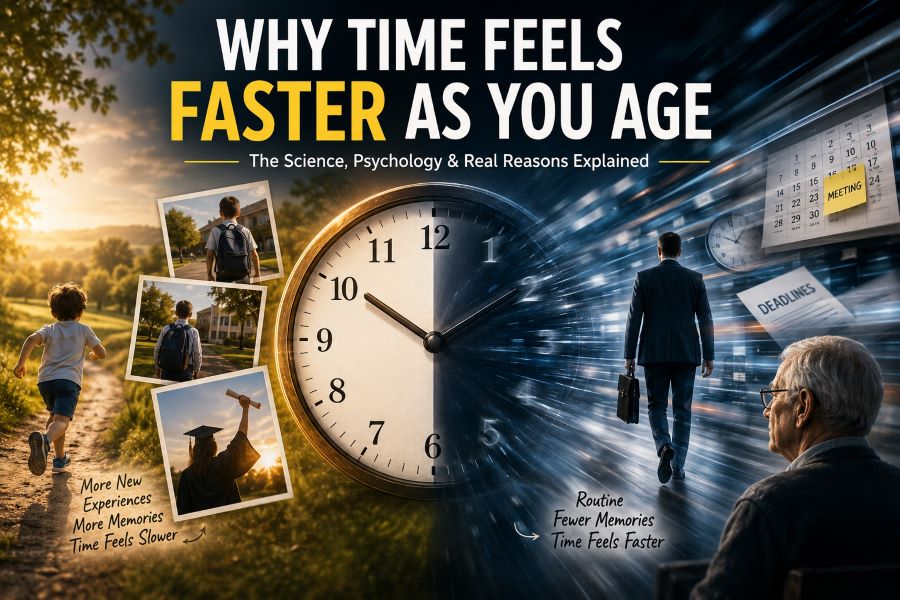
Almost everyone has experienced the strange feeling that time seems to move faster as they grow older. Childhood summers once felt endless, school years appeared long, and waiting for birthdays or holidays could feel almost unbearable. Yet for many adults, entire years seem to pass in the blink of an eye. A person may suddenly realize that a decade has gone by much faster than expected.
This phenomenon is one of the most fascinating aspects of human psychology and perception. Although clocks measure time consistently and objectively, the human brain does not experience time in the same way. Our perception of time changes dramatically throughout life due to biological, psychological, emotional, neurological, and social factors.
The feeling that time accelerates with age is not merely imagination or nostalgia. Scientists, psychologists, neuroscientists, philosophers, and sociologists have all explored why this occurs. Research suggests that memory formation, routine, emotional experiences, attention, stress, aging brains, and even modern technology all influence how humans perceive the passage of time.
In this comprehensive article, we explore:
- Why time feels slower in childhood
- Why adulthood seems to accelerate
- The psychology of memory and perception
- The role of the brain in time perception
- How emotions affect our experience of time
- Cultural and technological influences
- Scientific theories explaining temporal acceleration
- Ways to psychologically “slow down” time
Understanding why time feels faster as we age reveals profound insights into human consciousness, memory, and the nature of life itself.
Understanding Time Perception
Objective Time vs Subjective Time
There are two fundamentally different ways of understanding time:
Objective Time
Objective time is measured by clocks, calendars, and atomic standards. One minute always contains sixty seconds regardless of who experiences it.
Subjective Time
Subjective time is psychological. It reflects how long time feels to a person.
For example:
- A boring lecture may feel endless
- A joyful vacation may feel short
- Waiting in anxiety may stretch seconds into minutes
The brain does not simply record time like a clock. Instead, it interprets experiences, emotions, memories, and attention to construct the sensation of time passing.
Why Childhood Feels Longer
One of the most important explanations for why time speeds up with age lies in childhood experiences.
1. Novelty and New Experiences
Children encounter new experiences constantly:
- First day of school
- Learning language
- Meeting new people
- Discovering the world
- Developing skills
Because the brain is processing so much unfamiliar information, experiences become densely encoded into memory.
Memory Density Theory
The brain measures time partly based on how many memories are created during a period.
More memories = longer perceived time.
Childhood is rich in memory formation, making those years appear expansive and slow in retrospect.
2. Greater Attention to the Present
Children tend to live in the moment. They are highly attentive to immediate experiences.
Adults, however:
- Multitask constantly
- Focus on future responsibilities
- Operate on autopilot
Reduced present-moment awareness contributes to the feeling that time disappears quickly.
3. Smaller Time Proportions
A year represents a much larger proportion of a child’s life.
For example:
- To a 5-year-old, one year equals 20% of life experience
- To a 50-year-old, one year equals only 2%
This proportional theory suggests time feels shorter relative to accumulated lifetime experience.
The Psychology of Time Acceleration
Routine and Repetition
As people age, life often becomes more repetitive:
- Same job
- Same commute
- Similar routines
- Predictable schedules
Routine reduces memory distinctiveness.
When days become similar, the brain forms fewer unique memories, causing long periods to blur together.
Autopilot Living
Adults frequently operate automatically:
- Driving without noticing the journey
- Repeating habits unconsciously
- Performing routine tasks without awareness
This reduces cognitive engagement and compresses time perception.
The Role of Attention
Attention strongly influences perceived time.
When Attention Slows Time
Time feels slower when:
- Waiting anxiously
- Facing danger
- Experiencing boredom
The brain becomes hyper-aware of time passing.
When Attention Speeds Time
Time feels faster during:
- Enjoyable experiences
- Flow states
- Deep concentration
Attention shifts away from time itself.
The Neuroscience of Time Perception
How the Brain Processes Time
There is no single “time center” in the brain. Instead, multiple regions contribute:
- Basal ganglia
- Cerebellum
- Prefrontal cortex
- Hippocampus
These areas process duration, sequence, rhythm, and memory.
Dopamine and Internal Timing
Dopamine affects internal timekeeping.
Higher dopamine levels can alter perceived duration.
For example:
- Excitement may make time feel fast
- Depression may slow subjective time
Aging Brain and Cognitive Speed
As humans age:
- Neural processing slows
- Attention shifts
- Memory encoding changes
This affects how experiences are perceived and remembered.
Memory and the Illusion of Fast Time
Retrospective vs Present Perception
Humans perceive time differently in the moment versus in memory.
In the Moment
Novel experiences may feel overwhelming and long.
In Retrospect
Periods rich in memories feel longer when recalled later.
Why Routine Years Feel Short
Routine periods create fewer memorable events.
As a result:
- Months blur together
- Years feel compressed
- Life seems accelerated
Emotional Influence on Time
Fear and Danger
Fear often slows perceived time.
Examples:
- Car accidents
- Extreme sports
- Emergencies
The brain increases information processing during threats.
Happiness and Enjoyment
Positive experiences often feel short while occurring but rich in memory afterward.
Stress and Anxiety
Modern life creates constant mental pressure:
- Deadlines
- Notifications
- Financial concerns
- Information overload
Stress alters time awareness and contributes to accelerated life perception.
Technology and Modern Time Compression
Digital Life and Attention Fragmentation
Technology constantly divides attention:
- Smartphones
- Social media
- Notifications
- Streaming platforms
This reduces mindful awareness.
Instant Gratification Culture
Modern technology speeds everything:
- Instant messaging
- Fast entertainment
- Same-day delivery
This changes human expectations of time itself.
The “Always Busy” Lifestyle
Many adults feel trapped in constant productivity.
This creates:
- Reduced reflection
- Less emotional processing
- Blurred life experiences
Cultural Differences in Time Perception
Different cultures experience time differently.
Western societies often see time as:
Linear Time Cultures
- Sequential
- Measurable
- Productivity-focused
Cyclical Time Cultures
Some cultures emphasize:
- Natural cycles
- Seasons
- Spiritual rhythms
This may influence subjective time experience.
Philosophical Perspectives on Time
Ancient Philosophy
Greek philosophers debated:
- Whether time exists independently
- Whether time is mental perception
Saint Augustine’s View
Augustine argued:
“What then is time? If no one asks me, I know. If I wish to explain it, I do not know.”
Modern Existential Thought
Many philosophers connect accelerated time perception with awareness of mortality.
As humans age:
- Future time appears limited
- Awareness of aging increases
- Life seems faster psychologically
Scientific Theories Explaining Why Time Feels Faster as We Age
Scientists, psychologists, neuroscientists, and philosophers have proposed several theories to explain why time appears to accelerate as people grow older. Although no single theory fully explains the phenomenon, together they provide deep insight into how the human brain perceives the passage of time.
1. Proportional Theory
One of the oldest and most widely discussed explanations is the Proportional Theory. This theory suggests that as humans age, each passing year represents a smaller proportion of their total life experience, causing time to feel subjectively shorter.
For a young child, even a short period feels extremely significant because it makes up a large portion of their life. For example:
- To a 5-year-old child, one year represents 20% of their entire life.
- To a 10-year-old, one year equals 10% of life experience.
- To a 50-year-old adult, one year represents only 2% of life experience.
Because the brain evaluates time relative to accumulated experiences, years seem to shrink psychologically over time.
This theory helps explain why childhood summers once felt endless while adult years appear to pass rapidly. During early life, every year feels comparatively large and meaningful. As life progresses, identical periods appear smaller in proportion to total lived experience.
The proportional theory also connects to how humans emotionally value time. Younger people often perceive future events as distant, while older adults may feel that decades pass surprisingly quickly.
Although the theory is mathematically simple, it captures an important psychological truth: human beings do not perceive time absolutely, but relatively.
2. Memory Compression Theory
The Memory Compression Theory focuses on how memories are formed and stored in the brain. According to this theory, time feels faster when fewer distinct memories are created.
Human perception of time depends heavily on memory density. The brain reconstructs the sensation of past duration by evaluating how many memorable events occurred during a particular period.
Childhood and Rich Memory Formation
Childhood is filled with:
- New experiences
- Learning
- Exploration
- Emotional discoveries
- First-time events
Because the brain is constantly processing unfamiliar situations, childhood generates dense and vivid memories. As a result, those years appear longer when remembered later.
Adulthood and Routine Compression
Adult life often becomes repetitive:
- Similar work schedules
- Repeated routines
- Familiar environments
- Predictable habits
When experiences become repetitive, the brain stores fewer unique memories. Days begin to blend together, and months or years seem compressed in retrospect.
For example, a person may vividly remember a unique vacation from ten years ago but struggle to distinguish ordinary workdays from the previous month.
This theory suggests that time itself does not accelerate. Instead, memory becomes less detailed, creating the illusion that time passed quickly.
3. Neural Processing Speed Theory
The Neural Processing Speed Theory proposes that changes in the aging brain affect how quickly humans process information, altering their perception of time.
During childhood, the brain processes enormous amounts of new sensory information:
- New sounds
- New environments
- Language learning
- Visual discoveries
- Social understanding
Because children process so much unfamiliar data, experiences appear rich, detailed, and extended.
Brain Aging and Slower Processing
As people age:
- Neural pathways become more efficient but less flexible
- Cognitive processing speed gradually declines
- Familiar experiences require less mental attention
The adult brain becomes highly optimized for routine tasks, reducing the amount of information consciously processed.
This creates the sensation that time is moving faster because the brain records fewer perceptual details from everyday experiences.
Some neuroscientists compare this to watching a movie at higher playback speed. The brain effectively processes familiar experiences more quickly, compressing subjective time.
The theory also relates to dopamine levels, attention systems, and neurological aging, all of which influence internal timing mechanisms.
4. Attention Theory
The Attention Theory argues that time perception depends heavily on where human attention is directed.
When people pay close attention to time itself, moments often feel slower. However, when attention is distracted or divided, time appears to pass quickly.
Situations That Slow Time
Time often feels slower during:
- Fear
- Anxiety
- Boredom
- Emergencies
- Waiting situations
In these moments, the brain becomes highly aware of each passing second.
For example:
- Waiting for medical results may feel endless
- Standing in a long queue may feel slow
- Experiencing danger may create “slow motion” sensations
Situations That Accelerate Time
Time feels faster during:
- Enjoyable activities
- Entertainment
- Deep concentration
- Busy routines
- Flow states
Adults often become occupied with responsibilities, multitasking, and constant mental activity. Because attention is fragmented, less awareness is devoted to the actual passage of time.
Modern technology intensifies this effect through:
- Smartphones
- Social media
- Notifications
- Continuous digital stimulation
As a result, entire days may seem to disappear quickly without strong conscious awareness.
The attention theory highlights a powerful insight: human time perception is closely connected to mindfulness and awareness.
Combining the Theories
These theories are not mutually exclusive. In reality, the feeling that time speeds up with age is likely caused by a combination of factors:
- Relative life proportions
- Reduced novelty
- Memory compression
- Brain aging
- Attention patterns
- Routine lifestyles
Together, they create the universal human experience of accelerated time perception.
Understanding these theories also provides practical lessons. Research suggests that people can psychologically slow down time by:
- Seeking new experiences
- Traveling
- Learning new skills
- Practicing mindfulness
- Breaking routines
- Reducing digital distractions
- Building emotionally meaningful memories
Ultimately, the sensation that time moves faster with age reveals how deeply human consciousness depends on memory, attention, emotion, and awareness.
How Modern Society Intensifies Time Acceleration
Modern human life is dramatically different from the way people lived in previous centuries. Technological advancement, industrialization, urbanization, and digital connectivity have transformed how humans work, communicate, learn, and experience daily life. While these changes have improved convenience and productivity, they have also altered how people psychologically perceive time.
Many scientists and psychologists believe that modern society intensifies the sensation that life is moving faster than ever before. The rapid pace of contemporary living creates an environment where attention is fragmented, memories become compressed, and meaningful pauses disappear.
Information Overload
One of the defining characteristics of modern society is the overwhelming amount of information humans consume every day.
In earlier centuries, people experienced slower flows of information. News traveled gradually through letters, newspapers, or direct conversation. Today, however, humans are exposed to continuous streams of digital content through:
- Smartphones
- Social media
- Emails
- News platforms
- Streaming services
- Notifications
- Online advertisements
The average person now processes far more information in a single day than people in previous generations encountered in weeks or even months.
Cognitive Saturation
The brain has limited attentional capacity. Constant information exposure forces the brain to rapidly switch focus between tasks and stimuli.
This phenomenon is known as attention fragmentation.
For example, many people simultaneously:
- Check messages while working
- Watch videos while eating
- Browse social media during conversations
- Respond to notifications throughout the day
As attention becomes divided, experiences are processed more superficially. The brain forms fewer deep and distinct memories, causing time periods to blur together psychologically.
The “Scroll Effect”
Social media platforms intensify this effect through endless scrolling systems designed to continuously stimulate attention.
Hours may disappear quickly because:
- Content changes rapidly
- Attention constantly shifts
- The brain receives continuous novelty without meaningful reflection
This creates a distorted sense of time passage where large portions of the day feel mentally compressed.
Reduced Downtime
Another major factor accelerating time perception is the disappearance of downtime.
Historically, humans experienced regular periods of:
- Silence
- Reflection
- Rest
- Nature exposure
- Unstructured thinking
Modern life, however, minimizes these moments.
The Loss of Mental Pause
Today many people fill every idle moment with stimulation:
- Checking phones while waiting
- Listening to podcasts constantly
- Watching videos before sleep
- Browsing social media during breaks
As a result, the brain rarely enters states of quiet reflection.
Yet reflection is important because it helps humans:
- Process experiences
- Consolidate memories
- Recognize the passage of time
- Create emotional meaning
Without reflective pauses, days become psychologically compressed.
Busyness as Identity
Modern culture often glorifies busyness and productivity. Many individuals feel pressure to remain constantly occupied.
People frequently describe themselves as:
- “Too busy”
- “Always working”
- “Running out of time”
This perpetual urgency creates the sensation that life is accelerating uncontrollably.
Constant Connectivity
Digital communication has fundamentally changed humanity’s relationship with time.
In the past, communication involved natural delays:
- Letters took days or weeks
- Long-distance communication was limited
- Responses required patience
Today communication is nearly instantaneous.
Elimination of Natural Pauses
Modern digital systems eliminate waiting periods through:
- Instant messaging
- Real-time notifications
- Video calls
- Continuous online presence
Humans now expect immediate responses and constant accessibility.
This constant connectivity reduces opportunities for anticipation, patience, and psychological transition between activities.
Work-Life Boundary Collapse
Technology has also blurred the boundaries between work and personal life.
People now receive:
- Emails after work hours
- Weekend notifications
- Constant updates
- Continuous digital obligations
As a result, many individuals experience life as one uninterrupted stream of activity.
This uninterrupted mental engagement contributes significantly to accelerated time perception.
The Role of Milestones
Human memory often organizes life into meaningful milestones. These events create psychological “chapters” that help distinguish different periods of life.
Childhood and Frequent Milestones
Childhood and adolescence contain many transformative experiences:
- Learning to walk
- Starting school
- Making friends
- Graduations
- First achievements
- Emotional discoveries
- Identity development
Because these events are emotionally significant and highly memorable, they create strong temporal markers in memory.
This makes childhood years appear rich, detailed, and expansive.
Adulthood and Routine Stability
In adulthood, life often becomes more stable and repetitive:
- Similar work routines
- Repeated schedules
- Familiar responsibilities
- Predictable environments
Although stability provides security, it also reduces the number of major psychological milestones.
Without strong memory segmentation, years can blend together more easily.
For example, many adults struggle to distinguish one work year from another because the experiences become highly similar.
Memory Segmentation and Time Perception
Psychologists believe the brain measures life partly through distinct memory clusters.
More milestones create:
- Stronger memory separation
- Richer recall
- Slower subjective time
Fewer milestones create:
- Memory blending
- Compressed recollection
- Faster perceived time passage
This explains why major life changes—such as travel, career shifts, or moving to new places—often make periods feel longer and more memorable.
Can Time Perception Be Slowed Down?
Although humans cannot slow objective clock time, research suggests it is possible to psychologically slow the subjective experience of time.
The key lies in increasing awareness, novelty, memory formation, and emotional engagement.
Scientists have identified several effective strategies.
Ways to Make Time Feel Slower
1. Seek Novel Experiences
Novelty is one of the strongest factors influencing time perception.
New experiences force the brain to process unfamiliar information more deeply, increasing memory formation.
Examples include:
- Traveling to new places
- Learning new skills
- Meeting different people
- Exploring unfamiliar cultures
- Trying creative activities
Novel experiences create richer mental encoding, making time periods appear longer and more meaningful in retrospect.
Why Travel Often Feels Longer
Vacations often feel psychologically expansive because:
- Environments are unfamiliar
- Attention becomes heightened
- More sensory information is processed
- Memory density increases
This is why even short trips can feel surprisingly long and memorable.
2. Practice Mindfulness
Mindfulness involves consciously focusing attention on the present moment.
Modern life constantly pulls attention toward:
- Future worries
- Past regrets
- Digital distractions
Mindfulness reverses this tendency by strengthening awareness of immediate experience.
Scientific Effects of Mindfulness
Research suggests mindfulness can:
- Improve attention regulation
- Increase emotional awareness
- Enhance memory encoding
- Reduce autopilot behavior
As awareness deepens, experiences become richer and more detailed, slowing subjective time perception.
Mindfulness practices include:
- Meditation
- Deep breathing
- Conscious observation
- Reflective journaling
3. Reduce Autopilot Living
Many adults spend large portions of life operating automatically.
Examples include:
- Driving familiar routes unconsciously
- Performing routines without awareness
- Repeating habits daily
Autopilot reduces conscious engagement with experiences.
Breaking Routine
Even small changes can increase temporal awareness:
- Taking different routes
- Rearranging schedules
- Trying new hobbies
- Changing environments
When the brain encounters variation, it pays closer attention, creating stronger memories and richer perception.
4. Limit Digital Overload
Digital technology continuously competes for human attention.
Excessive screen exposure can create:
- Attention fragmentation
- Reduced focus
- Mental fatigue
- Compressed memory formation
Reducing digital overload helps restore deeper awareness of time.
Helpful Strategies
People may improve time perception by:
- Limiting social media use
- Turning off notifications
- Scheduling screen-free periods
- Spending time in nature
- Reading without multitasking
These activities encourage sustained attention and richer experience processing.
5. Build Emotional Experiences
Emotion strongly influences memory and time perception.
Experiences associated with strong emotions are remembered more vividly and distinctly.
Examples include:
- Meaningful conversations
- Celebrations
- Challenges overcome
- Deep relationships
- Personal achievements
Emotionally meaningful events create stronger psychological anchors in memory, making life feel fuller and less compressed.
Time Perception in Different Life Stages
Human perception of time changes significantly across different stages of life.
Childhood
Childhood is often experienced as slow, expansive, and highly detailed.
Several factors contribute:
- Constant novelty
- Rapid learning
- Emotional intensity
- Strong curiosity
- Frequent milestones
Children experience the world with heightened attention because nearly everything is new.
As a result, time feels broad and extended.
Teenage Years
Adolescence is emotionally intense and memory-rich.
Teenagers often experience:
- Identity formation
- Social development
- Emotional highs and lows
- Important life transitions
Because emotions amplify memory formation, teenage years are often remembered vividly.
Young Adulthood
Young adulthood contains rapid transitions:
- Higher education
- Career beginnings
- Relationships
- Independence
- Personal growth
These years often feel dynamic and transformative.
However, increasing responsibilities may also introduce stress and time pressure.
Middle Age
Middle age is frequently associated with accelerated time perception.
Common reasons include:
- Routine work schedules
- Family responsibilities
- Repeated obligations
- Reduced novelty
People may feel that years pass quickly because daily life becomes highly structured and predictable.
Old Age
Older adults often become more reflective about the passage of time.
Awareness of mortality increases psychological sensitivity to time.
At the same time, retirement or slower lifestyles may sometimes restore opportunities for reflection and mindfulness.
Many older individuals place greater value on:
- Relationships
- Memories
- Meaningful experiences
- Emotional fulfillment
This stage often brings deeper philosophical awareness of life’s temporary nature.
The Relationship Between Memory and Identity
Memories define personal identity.
If fewer memories are formed, life may feel psychologically shorter.
Time, Mortality, and Human Awareness
Humans uniquely understand mortality.
This awareness shapes how time is perceived emotionally.
As people age:
- Time becomes more valuable
- Awareness of finite life increases
- Time appears to accelerate
The Importance of Living Intentionally
Understanding time perception can improve life quality.
Intentional living involves:
- Presence
- Meaningful experiences
- Reflection
- Emotional engagement
Future Research on Time Perception
Scientists continue exploring:
- Brain timing mechanisms
- AI and time perception
- Aging and cognition
- Virtual reality effects on time
Frequently Asked Questions
Does time actually move faster as we age?
No. Objective time remains constant. Perception changes psychologically.
Why did summers feel longer as a child?
Because childhood contains more novelty and memory formation.
Can stress make time feel faster?
Yes. Chronic stress reduces mindful awareness.
Can mindfulness slow time perception?
Studies suggest mindfulness increases present-moment awareness, making time feel richer and slower.
Conclusion
The feeling that time moves faster as we grow older is one of the most profound and universal aspects of human existence. Although clocks continue to measure seconds, minutes, and years with perfect consistency, the human experience of time is far more complex. Time is not lived through numbers alone—it is shaped by memory, attention, emotion, awareness, and the depth of our experiences.
Childhood often feels expansive because every moment is filled with discovery, learning, imagination, and first experiences. The world appears larger, slower, and more detailed because the brain is constantly absorbing new information and creating powerful memories. As adulthood arrives, however, routines, responsibilities, repetition, and digital distractions gradually compress our perception of time. Days become structured, years blend together, and life can begin to feel as though it is accelerating beyond our control.
Modern society intensifies this phenomenon even further. Constant connectivity, information overload, fast-paced lifestyles, and endless digital stimulation leave little room for reflection and presence. Many people spend so much time planning the future or managing daily obligations that they rarely pause to fully experience the present moment. As a result, life may feel increasingly shorter—not because time itself changes, but because our awareness of it changes.
Yet understanding the psychology and neuroscience of time perception also reveals something hopeful. While we cannot slow the movement of clocks, we can profoundly influence how richly we experience our lives. Novel experiences, meaningful relationships, creativity, mindfulness, travel, learning, emotional connection, and intentional living all expand the mind’s perception of time. The more deeply we engage with life, the fuller and more memorable it becomes.
Ultimately, the question is not simply why time feels faster as we age. The deeper question is how we choose to spend the limited time we are given. Human life is measured not only in years, but in moments of awareness, purpose, emotion, and meaning. By living more consciously and embracing experiences that truly matter, we can make time feel less like something slipping away—and more like something genuinely lived.
Comments
No comments yet.