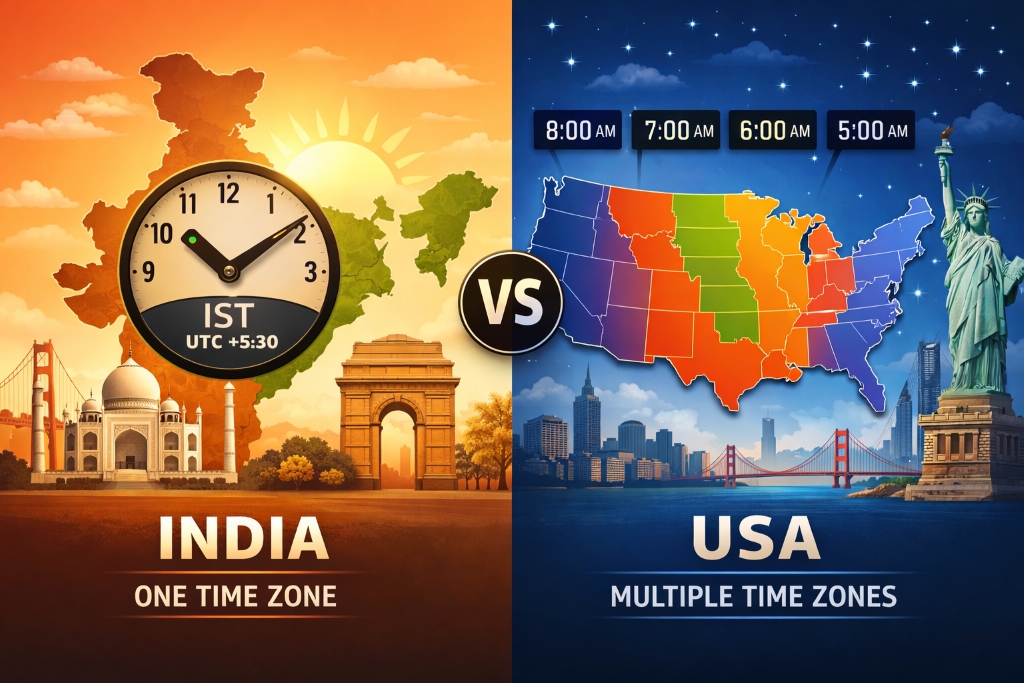
Why India Has One Time Zone While the United States Has Many
Time is universal, but the way we measure it varies widely across the world. One of the most intriguing facts about global timekeeping is that India, despite its vast land area and huge population, follows only one time zone, while the United States uses multiple time zones.
Why does this difference exist? The answer lies in a combination of geography, politics, history, and administrative priorities. Let’s explore the reasons behind this fascinating contrast.
Understanding Time Zones
A time zone is a region of the Earth that observes the same standard time. Since the Earth rotates 360 degrees in 24 hours, it is theoretically divided into 24 time zones, each covering 15 degrees of longitude.
However, real-world time zones do not strictly follow longitude lines. Instead, they are often shaped by:
- Political boundaries
- National borders
- Administrative convenience
- Economic and social factors
This is why time zones differ from country to country.
Why India Has Only One Time Zone (IST)
India follows Indian Standard Time (IST), which is UTC +5:30. Whether you are in Arunachal Pradesh in the east or Gujarat in the west, the same time applies across the entire nation.
✅ Reasons for a Single Time Zone in India
1. Political Unity and National Integration
After independence in 1947, India’s leadership chose a single time zone to promote national unity. Having one standard time symbolized oneness and cohesion in a newly independent and diverse nation.
2. Colonial Legacy
During British rule, India used multiple local times such as:
- Bombay Time
- Calcutta Time
This caused confusion in railways and administration. After independence, India adopted IST to eliminate inconsistency and simplify governance.
3. Central Meridian Selection
IST is based on the 82.5° East longitude, passing near Mirzapur (Uttar Pradesh)—a location considered geographically central to India. This helped balance time differences between eastern and western regions.
4. Administrative and Communication Simplicity
A single time zone ensures:
- Smooth railway and airline schedules
- Uniform TV and radio broadcasting
- Consistent office and school timings
- Easier nationwide coordination
Managing one official time is far simpler for a country with over 1.4 billion people.
5. Population and Economic Distribution
Most of India’s population and economic activity is concentrated in the central and western regions, where IST aligns reasonably well with daylight hours. This reduces the overall inconvenience caused by early sunrise in the northeast.
Why the United States Has Multiple Time Zones
The United States stretches nearly 4,500 kilometers (2,800 miles) from east to west, making multiple time zones practically unavoidable.
Official Time Zones in the U.S.
The U.S. uses six standard time zones:
- Eastern
- Central
- Mountain
- Pacific
- Alaska
- Hawaii–Aleutian
✅ Reasons for Multiple Time Zones in the U.S.
1. Vast Geographic Width
The wide longitudinal spread means sunrise and sunset times vary dramatically. Multiple time zones allow people to:
- Start work after sunrise
- Align daily life with natural daylight
2. Economic and Regional Decentralization
Major economic hubs such as:
- New York
- Chicago
- Denver
- Los Angeles
operate independently. Separate time zones allow businesses to function efficiently according to local conditions.
3. Federal System of Governance
The U.S. has a decentralized federal structure, giving states more control over policies. This includes:
- Time zone boundaries
- Daylight Saving Time decisions
This flexibility suits a country with diverse regional needs.
Does India Need a Second Time Zone?
This question has sparked ongoing debate in India.
The Case for a Second Time Zone
India’s northeastern states, such as Assam and Arunachal Pradesh, experience:
- Sunrise as early as 4:00 AM
- Sunset by 4:00–4:30 PM
A second time zone could:
- Save electricity
- Improve productivity
- Better align work hours with daylight
Challenges of Multiple Time Zones in India
Despite potential benefits, several challenges exist:
- Confusion in train and flight schedules
- Increased administrative complexity
- Higher risk of missed deadlines
- Coordination problems across states
For now, India continues to prioritize simplicity and uniformity.
India vs United States: A Comparison
| Aspect | India | United States |
|---|---|---|
| Number of Time Zones | 1 | 6 |
| Governance Style | Centralized | Federal |
| Geographic Width | Moderate | Very wide |
| Priority | Unity & simplicity | Local convenience |
| Daylight Alignment | Compromised in northeast | Well-aligned |
Conclusion
The difference in time zone usage between India and the United States reflects far more than geography. It highlights political choices, administrative priorities, and cultural approaches to governance.
India values national unity and operational simplicity, while the U.S. emphasizes regional autonomy and natural day–night alignment. As globalization and energy concerns grow, discussions around time zones will continue—seeking the right balance between efficiency and regional needs.
Comments
No comments yet.