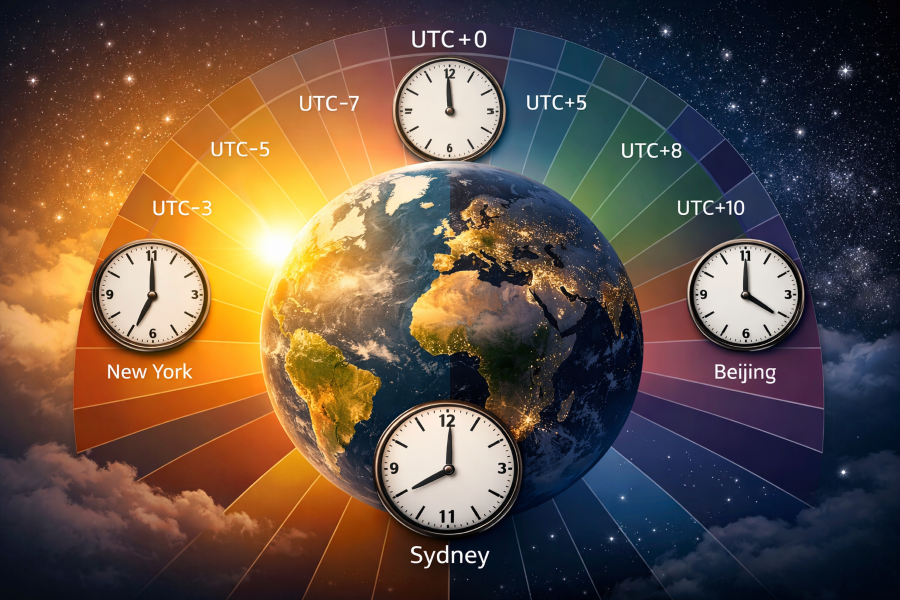
A Global Perspective on How the World Organizes Time
Time is one of humanity’s most fundamental shared experiences. Every society, regardless of culture, geography, or history, organizes life around the passage of time—days and nights, seasons, work hours, and rest. Yet despite this universal reliance on time, the world does not operate on a single clock. Instead, the planet is divided into multiple time zones, each reflecting a balance between natural cycles and human decision-making.
Why do different countries have different time zones? The answer is not simple. It is shaped by astronomy, geography, science, history, economics, politics, culture, and global cooperation. Time zones are not merely technical divisions; they are a global system designed to respect local daylight while enabling international coordination.
This article explores time zones from a truly global perspective—recognizing every country’s role, needs, and choices in shaping how time is measured and shared across the world.
1. The Natural Origin of Time: Earth and the Sun
The foundation of time zones begins with the Earth itself. Our planet rotates on its axis once approximately every 24 hours. As it rotates, different regions face the Sun at different moments, creating the cycle of day and night.
When the Sun reaches its highest point in the sky at a particular location, that moment is known as solar noon. However, solar noon does not occur simultaneously across the globe. As one region experiences midday, another is entering morning, evening, or night.
Because of this natural phenomenon, a single global local time would not make practical sense. If the entire world followed one clock, some countries would have sunrise at midnight and midday darkness, disrupting daily life. Time zones exist to align human activity with daylight as closely as possible.
2. Longitude and the Scientific Model of Time Zones
The Earth is divided by imaginary lines called longitudes, running from the North Pole to the South Pole. There are 360 degrees of longitude around the Earth. Since the Earth rotates 360 degrees in about 24 hours, it rotates roughly 15 degrees per hour.
From a purely scientific standpoint, this allows the Earth to be divided into 24 time zones, each approximately 15 degrees wide, with each zone differing by one hour. This model provides the basic framework for timekeeping, but it does not fully account for how people live, govern, and interact.
In reality, time zones are shaped by human needs just as much as by mathematical precision.
3. Time Before Time Zones: A Local World
For most of human history, standardized time zones did not exist. Communities measured time locally using the Sun, stars, and natural rhythms. Noon was simply when the Sun stood overhead in that particular place.
This approach worked well in a world where travel was slow and communication limited. Differences of a few minutes or even half an hour between towns were rarely important. Societies were largely self-contained, and timekeeping reflected local life.
However, as civilizations grew more interconnected, local timekeeping became increasingly impractical.
4. The Industrial Revolution and the Need for Global Coordination
The 19th century marked a turning point in how humans related to time. The Industrial Revolution transformed transportation, communication, and trade. Railways allowed people and goods to move faster than ever before. Telegraph systems enabled messages to cross vast distances almost instantly.
These innovations revealed a major problem: without standardized time, coordination was difficult and sometimes dangerous. Train schedules became confusing. Missed connections and accidents occurred because towns followed slightly different clocks.
This challenge was not limited to any one country. It was a global issue affecting all industrializing nations. A shared system of time became essential for safety, efficiency, and cooperation.
5. The Birth of a Global Time System
In response to these challenges, international cooperation emerged. In 1884, representatives from many countries gathered at the International Meridian Conference. The goal was to establish a common reference point for global timekeeping.
The conference selected the Prime Meridian at Greenwich, England, as the zero-degree longitude line. From this reference point, global time could be calculated. This decision was not about political dominance but about practicality, as Greenwich was already widely used in navigation.
Over time, this system evolved into what we now know as Coordinated Universal Time (UTC), which serves as the global standard reference for all time zones.
6. Time Zones as a Global Agreement
Time zones are one of the most widely accepted global agreements in human history. Almost every country in the world follows the UTC-based system, adjusting local time according to geographic location and national needs.
This shared framework enables:
- International travel and aviation
- Global trade and financial markets
- Scientific research and data exchange
- Diplomatic coordination
- Digital communication and internet infrastructure
Despite cultural and political differences, time zones represent a rare example of near-universal cooperation.
7. Why Time Zones Do Not Follow Straight Lines
Although time zones are based on longitude, they rarely appear as straight vertical lines on a map. Instead, they often bend, curve, or zigzag. This is intentional and reflects respect for national borders, population centers, and economic regions.
Countries generally prefer to keep a single official time or as few time zones as possible to simplify governance, education, healthcare, and commerce. Adjusting time zones to match borders reduces confusion and supports national unity.
This approach respects the sovereignty of all countries, allowing each nation to decide how time best serves its people.
8. Different Countries, Different Time Zone Choices
Every country approaches time zones based on its geography, population, and priorities.
- Large countries may adopt multiple time zones to reflect their vast size.
- Others choose a single time zone for administrative simplicity.
- Island nations often follow time zones that best match their regional location.
There is no single “correct” approach. Each decision reflects a balance between natural daylight patterns and human organization.
9. The Role of Politics and Governance
Time zones are established through national decisions. Governments determine official time to support economic stability, public welfare, and international relations.
Political factors that influence time zones include:
- National unity and identity
- Alignment with neighboring countries
- Trade and business relationships
- Administrative efficiency
These decisions are made by countries of all sizes and regions, each exercising its right to manage time in a way that benefits its society.
10. Cultural and Social Considerations
Time is deeply connected to culture. Daily routines, work schedules, religious practices, and social customs all depend on how time is structured.
Some societies prioritize early mornings aligned with sunrise, while others favor later schedules. Time zones help preserve these cultural rhythms by keeping daylight aligned with daily life.
Respecting time zones means respecting how different cultures experience and value time.
11. Half-Hour and Quarter-Hour Time Zones
Not all time zones differ by whole hours. Several countries use half-hour or 45-minute offsets from UTC. These choices reflect thoughtful compromises rather than irregularities.
Such offsets help ensure that solar noon occurs closer to midday for the majority of the population. They demonstrate that the global time system is flexible enough to accommodate local needs.
These time zones are equally valid and respected within the global framework.
12. Daylight Saving Time: A Shared but Diverse Practice
Daylight Saving Time (DST) is used by some countries to shift clocks seasonally, extending evening daylight during certain months. The practice aims to align waking hours with daylight.
However, DST is not universal:
- Some countries use it nationwide
- Others use it regionally
- Many countries do not use it at all
Each approach reflects local climate, latitude, and social preferences. There is no global mandate, only national choice.
13. Time Zones and the Global Economy
Modern economies operate across borders and time zones. Financial markets open and close in different regions, creating a continuous global trading cycle.
Time zones enable:
- International business coordination
- Global supply chains
- Customer support across regions
- Real-time collaboration between countries
Understanding time differences is essential for fair and efficient global commerce.
14. Technology and Digital Timekeeping
In the digital age, time zones are embedded into technology. Computers, smartphones, servers, satellites, and global networks rely on precise time synchronization.
UTC serves as the backbone for:
- Internet infrastructure
- Cloud computing
- GPS and navigation systems
- Scientific research and space exploration
This technological reliance highlights how time zones support not just daily life, but the very systems that connect the modern world.
15. International Travel and Transportation
Time zones are essential for global travel. Airlines, shipping companies, and logistics providers rely on standardized time to ensure safety and reliability.
Without time zones:
- Flight schedules would be confusing
- International travel planning would be difficult
- Border crossings would be less predictable
Time zones allow travelers to move confidently between countries while maintaining a shared understanding of time.
16. Education, Healthcare, and Public Services
National time standards support essential services such as education, healthcare, and emergency response. Schools, hospitals, and government institutions rely on consistent local time to function effectively.
By choosing time zones that suit their populations, countries ensure that public services remain accessible and reliable.
17. Respecting All Countries in the Global Time System
No country’s time zone is more “correct” or “important” than another’s. Each represents a thoughtful decision shaped by geography, history, and social needs.
The global time system works because it respects diversity while maintaining coordination. Every country contributes to this balance by participating in a shared framework while exercising local choice.
18. Challenges and Ongoing Discussions
As societies evolve, discussions about time zones continue. Some countries debate adjusting time zones to improve well-being, reduce energy use, or support economic growth.
These discussions are part of a healthy global dialogue. They reflect changing lifestyles, technology, and environmental awareness. Any changes are made thoughtfully, with consideration for both national and international impact.
19. The Future of Time Zones
While technology enables instant communication, time zones remain essential. Humans still live according to daylight, and societies still depend on shared schedules.
Future developments may refine how time zones are managed, but the core principle—aligning human activity with the natural cycle of the Earth—will remain unchanged.
20. Time Zones as a Symbol of Global Cooperation
Time zones are more than lines on a map. They are a symbol of how humanity organizes itself on a shared planet. Despite differences in language, culture, and politics, countries around the world agree on a common time framework.
This system allows the world to function as a connected whole, while still honoring local identity and needs.
Conclusion: One Planet, Many Times, Shared Respect
Different countries have different time zones because the world is both diverse and interconnected. Time zones respect the Earth’s natural rhythms while accommodating the needs of human societies.
They are shaped by science, guided by history, refined by culture, and sustained by cooperation. Every country, regardless of size or location, plays an equal role in this global system.
In a world where communication crosses borders instantly, understanding and respecting time zones is essential. They remind us that while we may live at different hours of the day, we all share the same planet—and the same passage of time.
Comments
good article.
2026-01-29 12:01:36FranChoice
2026-07-09 06:42:427500 Flying Cloud Drive,
#600 Eden Prairie
MN 55344, United Ѕtates
952-345-8400
franchise business ownership responsibilities growth strategies