Introduction
Time is one of the most familiar aspects of human existence, yet it remains one of the greatest mysteries in science. Every moment of our lives is shaped by time. We use it to organize daily schedules, celebrate birthdays, record historical events, and understand the evolution of the universe. Time influences everything from the growth of living organisms to the movement of galaxies across the cosmos.
Despite its importance, defining time is surprisingly difficult. People experience time continuously, but explaining exactly what time is has challenged philosophers, scientists, and mathematicians for thousands of years.
What exactly is time?
Is it a fundamental feature of reality? Is it simply a method humans created to organize events? Does time flow like a river, carrying everything from the past into the future? Or is the sensation of time's passage created by the human mind?
These questions have fascinated humanity since the earliest civilizations. Ancient astronomers tracked celestial movements to create calendars. Philosophers debated whether time existed independently of human perception. Modern physicists use sophisticated theories and experiments to investigate the nature of time itself.
Today, science suggests that time is far more complex than our everyday experience suggests. Modern physics reveals that time is connected to space, influenced by gravity, affected by motion, and potentially even emergent from deeper physical processes.
Understanding time is essential because nearly every process in nature unfolds through it. Whether examining the life cycle of stars, the evolution of species, or the expansion of the universe, time provides the framework through which change occurs.
The study of time lies at the intersection of physics, cosmology, mathematics, philosophy, and even neuroscience. Exploring time means exploring some of the deepest questions humanity has ever asked about reality itself.
Why Time Matters in Physics
Physics seeks to understand how the universe operates. Almost every physical process involves time in some way.
Examples include:
- The rotation of Earth
- The orbit of planets around the Sun
- Chemical reactions
- Radioactive decay
- Biological evolution
- Weather systems
- Stellar formation
- Galaxy evolution
- Expansion of the universe
Without time, concepts such as motion, change, growth, and causality would lose meaning.
Imagine trying to describe a moving object without referring to time. Motion requires a comparison between positions at different moments. Similarly, understanding how a star evolves requires knowledge of how it changes over millions or billions of years.
When physicists describe an event, they usually answer three questions:
- Where did it happen?
- When did it happen?
- How did it happen?
The second question introduces time as a fundamental coordinate of reality.
In modern physics, time is not simply a tool for measurement. It is one of the dimensions used to describe the structure of the universe itself.
Time also allows scientists to make predictions. By understanding how systems evolve over time, physicists can forecast planetary motions, predict chemical reactions, and model the future evolution of stars and galaxies.
Without time, physics would be unable to explain change, and without change, much of reality would become incomprehensible.
Humanity's Earliest Understanding of Time
Long before clocks existed, humans observed recurring patterns in nature.
Early civilizations noticed:
- Sunrise and sunset
- Phases of the Moon
- Seasonal changes
- Movements of stars and planets
These patterns provided the earliest methods for tracking time.
The changing seasons helped determine planting and harvesting schedules. Lunar cycles influenced religious ceremonies and calendars. The apparent motion of stars guided navigation and timekeeping.
Over thousands of years, humans transformed these observations into increasingly sophisticated systems for measuring time.
Ancient Egypt
The ancient Egyptians were among the first civilizations to develop formal methods of timekeeping.
Their society depended heavily on the annual flooding of the Nile River. Predicting these cycles required careful observation of astronomical events.
Egyptians developed:
- Sundials
- Shadow clocks
- Water clocks
Sundials measured time using the movement of shadows cast by the Sun. Water clocks used the controlled flow of water to mark the passage of time, allowing measurements during cloudy conditions and at night.
These inventions helped regulate agriculture, government administration, and religious practices.
Babylonian Contributions
The Babylonians made extraordinary contributions to mathematics and astronomy.
One of their most enduring legacies is the base-60 numerical system.
This system eventually influenced:
- 60 seconds in a minute
- 60 minutes in an hour
- 360 degrees in a circle
Thousands of years later, modern timekeeping still relies on Babylonian mathematics.
Babylonian astronomers also created detailed records of celestial movements, laying foundations for future scientific developments.
Ancient China
Ancient Chinese civilizations developed highly sophisticated calendars and astronomical observations.
Chinese astronomers carefully recorded:
- Solar eclipses
- Lunar eclipses
- Planetary motions
- Seasonal cycles
Timekeeping played a crucial role in agriculture, governance, and cultural traditions.
Chinese innovations contributed significantly to humanity's growing understanding of time and celestial cycles.
Ancient India
Ancient Indian scholars developed remarkably advanced concepts related to time and astronomy.
Indian texts described:
- Planetary motions
- Lunar cycles
- Solar years
- Large cosmological timescales
Some ancient Indian philosophies viewed time as cyclical rather than linear, a perspective that continues to influence philosophical discussions today.
Across different civilizations, measuring time became essential for organizing society and understanding nature.
Philosophical Views of Time
Before physics emerged as a formal science, philosophers attempted to understand the meaning of time itself.
Their questions remain surprisingly relevant today.
Plato
Plato viewed time as a moving image of eternity.
According to Plato, the physical world constantly changes, while a deeper realm of eternal truths remains unchanged.
Time reflected this relationship between the changing world and timeless reality.
Aristotle
Aristotle proposed that time measures change and motion.
He argued that without change, there would be no meaningful concept of time.
This idea influenced scientific thought for centuries.
Many modern discussions of time still reference Aristotle's insight that time and change appear fundamentally connected.
Saint Augustine
One of history's most famous reflections on time came from Saint Augustine.
He wrote:
"If nobody asks me what time is, I know. If I wish to explain it, I do not."
This statement captures the paradox of time.
Everyone experiences time directly, yet defining it precisely remains difficult.
Saint Augustine also explored the relationship between memory, consciousness, and temporal experience—topics that continue to interest modern scientists and philosophers.
How Clocks Changed Human Understanding of Time
As societies became more complex, accurate timekeeping became increasingly important.
Clocks transformed time from an abstract concept into something measurable and standardized.
Sundials
Sundials were among the earliest mechanical methods of measuring time.
By tracking shadows cast by sunlight, they allowed people to divide the day into segments.
However, sundials had limitations:
- They required sunlight.
- They could not function at night.
- Weather conditions affected accuracy.
Water Clocks
Water clocks offered a solution.
These devices measured time using the controlled flow of water.
They functioned regardless of weather or daylight conditions.
Water clocks became widely used throughout the ancient world.
Mechanical Clocks
The invention of mechanical clocks during the Middle Ages revolutionized society.
For the first time:
- Work schedules became standardized.
- Commerce became more organized.
- Transportation became more coordinated.
- Cities synchronized activities.
Mechanical clocks helped establish the disciplined schedules that characterize modern life.
Atomic Clocks
Today, the world's most accurate clocks are atomic clocks.
Unlike earlier devices, atomic clocks do not rely on gears, shadows, or flowing water.
Instead, they measure extremely precise vibrations within atoms.
Modern atomic clocks are so accurate that they would lose less than one second over millions of years.
Atomic clocks play a critical role in:
- GPS navigation
- Telecommunications
- Scientific research
- Financial systems
- International time standards
The development of atomic clocks transformed humanity's ability to measure time with unprecedented precision.
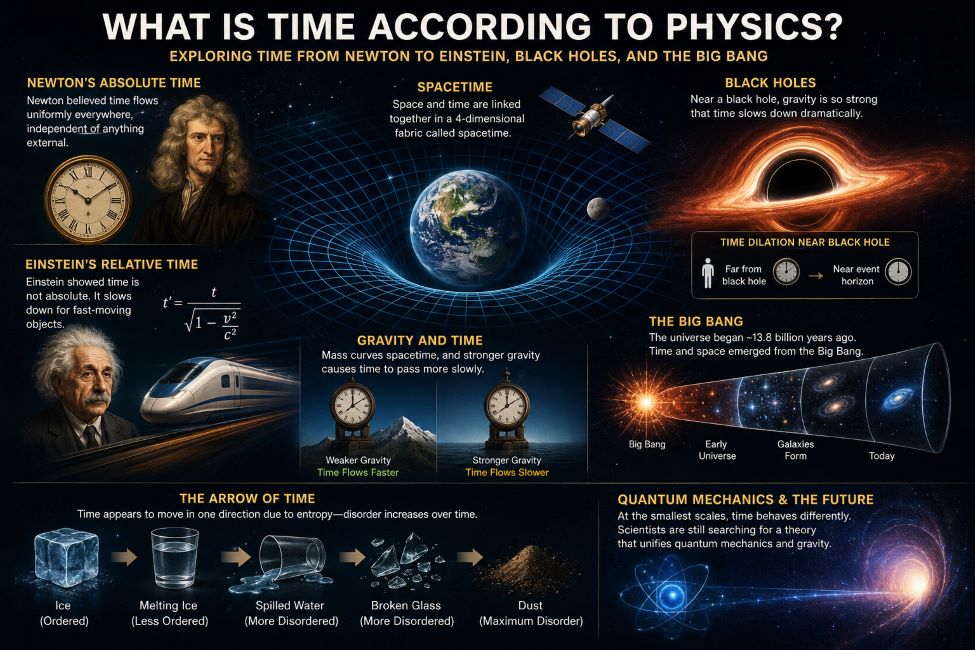
Newton's Concept of Absolute Time
The first major scientific theory of time emerged during the Scientific Revolution.
In the seventeenth century, Sir Isaac Newton transformed physics through his laws of motion and universal gravitation.
According to Newton:
- Time flows uniformly everywhere.
- Time exists independently of matter.
- Every observer experiences the same universal clock.
Newton referred to this concept as:
Absolute Time
Under this framework:
A second on Earth is identical to a second anywhere else in the universe.
Time operates independently of events occurring within it.
Newton imagined the universe as a vast cosmic clockwork mechanism governed by precise mathematical laws.
For more than two centuries, this model successfully explained countless natural phenomena and formed the foundation of classical physics.
The Limits of Newtonian Time
By the nineteenth century, scientists began discovering phenomena that Newton's model could not fully explain.
Research into:
- Electricity
- Magnetism
- Light
revealed inconsistencies.
The most famous challenge came from a groundbreaking experiment that would eventually transform physics.
The Michelson-Morley Experiment
Scientists expected Earth's motion through space to affect the speed of light.
In 1887, Albert Michelson and Edward Morley conducted an experiment designed to detect this effect.
Instead, they found something astonishing:
The speed of light remained constant.
This result contradicted existing theories and suggested that something fundamental about space and time was misunderstood.
The foundations of classical physics were beginning to crack.
A scientific revolution was approaching.
Einstein Changes Everything
In 1905, a young physicist named Albert Einstein published a paper that would permanently transform humanity's understanding of reality.
His Theory of Special Relativity introduced a revolutionary idea:
Time is not absolute.
Instead:
- Different observers can experience time differently.
- Motion affects the passage of time.
- Space and time are deeply interconnected.
This concept contradicted centuries of scientific thinking.
Yet experiments repeatedly confirmed Einstein's predictions.
The discovery marked the beginning of modern physics and laid the foundation for our current understanding of time, space, gravity, and the universe itself.
The next stage of the story would reveal that time can slow down, stretch, and behave in ways that once seemed impossible.
Einstein Revolutionizes Time
When Albert Einstein published his Theory of Special Relativity in 1905, he fundamentally changed humanity's understanding of time. Until that point, scientists believed that time flowed uniformly throughout the universe. Newton's concept of absolute time suggested that every observer experienced the same universal clock.
Einstein demonstrated that this assumption was incorrect.
According to Special Relativity, time is not fixed or universal. Instead, time depends on the observer's motion. Two people moving at different speeds may experience time differently.
This idea was revolutionary because it challenged centuries of scientific thinking and contradicted everyday intuition. Yet countless experiments have confirmed Einstein's predictions with extraordinary accuracy.
Einstein's discoveries transformed time from a simple background measurement into an active component of reality itself.
The Two Principles of Special Relativity
Special Relativity is built upon two fundamental principles.
The Laws of Physics Are Universal
The first principle states that the laws of physics are the same for all observers moving at constant speeds.
Whether someone is:
- Standing still
- Riding a bicycle
- Traveling in an airplane
- Flying aboard a spacecraft
the fundamental laws of nature remain unchanged.
This principle ensures that no observer occupies a privileged position in the universe.
The Speed of Light Is Constant
The second principle is even more surprising.
Einstein proposed that the speed of light remains constant for all observers regardless of their motion.
The speed of light in a vacuum is approximately:
299,792,458 meters per second
No matter how fast someone travels, they will always measure light moving at this speed.
This simple statement has extraordinary consequences for space and time.
Why the Speed of Light Changes Everything
In everyday life, speeds usually add together.
For example:
- A train moves at 100 kilometers per hour.
- A passenger throws a ball forward at 20 kilometers per hour.
An observer standing beside the track sees the ball moving at 120 kilometers per hour.
Scientists originally expected light to behave similarly.
Instead, experiments consistently showed that light's speed remains constant.
To preserve this constant speed, nature adjusts something else:
- Time
- Distance
- Simultaneity
This realization led directly to Einstein's theory.
Time Dilation: Time Can Slow Down
One of the most famous consequences of Special Relativity is:
Time Dilation
Time dilation means that moving clocks run slower relative to stationary observers.
This is not a flaw in the clock.
Time itself passes more slowly.
The faster an object moves, the more significant the effect becomes.
At everyday speeds, the difference is extremely small.
Near the speed of light, however, the effect becomes dramatic.
Understanding Time Dilation
Imagine two identical clocks.
Clock A
Remains on Earth.
Clock B
Travels aboard a spacecraft moving near the speed of light.
After the spacecraft returns, the clocks are compared.
Clock B shows less elapsed time.
From Earth's perspective, the moving clock ran slower.
This phenomenon has been verified repeatedly through experiments.
The Twin Paradox
One of the most famous illustrations of time dilation is the Twin Paradox.
Imagine identical twins.
Twin A
Remains on Earth.
Twin B
Travels through space at extremely high speed.
After returning from the journey:
Twin B is younger than Twin A.
Although this sounds impossible, it follows directly from Einstein's equations.
The traveling twin experiences less elapsed time.
The paradox is not a true contradiction. Relativity fully explains why the twins age differently.
Experimental Proof of Time Dilation
Einstein's theory is not merely theoretical.
Scientists have confirmed time dilation through numerous experiments.
Atomic Clocks
Highly accurate atomic clocks have been flown aboard aircraft and satellites.
When compared with clocks that remained on Earth, measurable differences appear.
These differences match Einstein's predictions precisely.
Particle Accelerators
Subatomic particles moving near the speed of light survive much longer than expected.
Their internal clocks effectively slow down.
Particle accelerators around the world observe this effect regularly.
Astronauts in Space
Astronauts aboard spacecraft experience tiny amounts of time dilation.
Although the differences are small, they are measurable.
In a technical sense, astronauts travel slightly into Earth's future.
Travel Into the Future
Because of time dilation, future-directed time travel is scientifically possible.
An astronaut traveling close to light speed could experience only a few years while decades pass on Earth.
Upon returning:
The astronaut would effectively arrive in Earth's future.
Current technology cannot achieve such speeds for human travelers, but the principle is firmly supported by modern physics.
Space and Time Become Spacetime
Einstein's discoveries inspired mathematician Hermann Minkowski to develop one of the most important concepts in modern physics.
He proposed that:
Space and time are not separate entities.
Instead, they form a unified structure known as:
Spacetime
This idea transformed the way physicists describe reality.
The Four Dimensions of Reality
According to spacetime theory, reality consists of four dimensions.
Three Spatial Dimensions
- Length
- Width
- Height
One Temporal Dimension
- Time
Every event in the universe requires all four coordinates.
For example, a concert cannot be fully described without specifying:
- Where it occurred
- When it occurred
Time therefore functions as a dimension alongside space.
General Relativity: Einstein's Greatest Achievement
In 1915, Einstein introduced his Theory of General Relativity.
This theory expanded upon Special Relativity and completely changed our understanding of gravity.
According to Newton:
Gravity is a force.
According to Einstein:
Gravity is the curvature of spacetime itself.
This idea remains one of the most elegant and successful theories in scientific history.
How Gravity Curves Spacetime
Imagine placing a heavy bowling ball on a stretched rubber sheet.
The ball creates a depression.
Smaller balls rolling nearby naturally move toward it.
Although spacetime is not literally a rubber sheet, this analogy helps illustrate Einstein's idea.
Massive objects such as:
- The Sun
- Earth
- Neutron stars
- Black holes
curve spacetime around them.
Planets orbit stars because they move along these curved paths.
Gravitational Time Dilation
One of General Relativity's most astonishing predictions is:
Gravity Affects Time
The stronger the gravitational field:
The slower time passes.
This effect is called:
Gravitational Time Dilation
As gravity increases, time itself slows down.
Time on Earth Is Not Identical Everywhere
Even on Earth, time passes at slightly different rates.
Consider two atomic clocks.
Clock One
Located at sea level.
Clock Two
Located on a mountaintop.
Because gravity is slightly weaker at higher altitude, the mountaintop clock runs slightly faster.
The difference is tiny but measurable.
Modern atomic clocks can detect these variations with extraordinary precision.
GPS and Modern Timekeeping
One of the most practical applications of Einstein's theories is GPS.
Global Positioning System satellites orbit Earth approximately 20,000 kilometers above the surface.
Because satellites experience:
- High speeds
- Different gravitational conditions
their clocks do not run at the same rate as clocks on Earth.
Engineers must continuously apply relativistic corrections.
Without these corrections:
GPS errors would accumulate by several kilometers every day.
Every smartphone navigation system relies on Einstein's understanding of time.
How NASA Tracks Time
Precise timekeeping is essential for space exploration.
Organizations such as NASA depend on highly accurate timing systems for:
- Spacecraft navigation
- Scientific measurements
- Deep-space communication
- Planetary exploration
Even tiny timing errors can create major navigation problems.
Atomic Clocks in Space Exploration
NASA relies heavily on atomic clocks because they provide extraordinary precision.
These clocks help determine:
- Spacecraft positions
- Orbital trajectories
- Signal timing
- Navigation accuracy
Modern space missions would be impossible without advanced atomic timekeeping.
Deep Space Communication
Communication across space introduces unique challenges.
Because light travels at a finite speed:
Signals require time to travel between Earth and spacecraft.
For example:
- A signal traveling between Earth and the Moon takes about 1.3 seconds.
- Communication with Mars may require several minutes.
- Signals from distant spacecraft can take hours.
Mission controllers must account for these delays when operating spacecraft.
Time therefore plays a central role in every space mission.
Why Relativity Matters Today
Einstein's theories are not merely scientific curiosities.
They influence technologies used by billions of people every day.
Applications include:
- GPS navigation
- Telecommunications
- Satellite systems
- Space exploration
- Scientific research
Relativity transformed our understanding of time from a universal clock into a dynamic feature of reality.
Motion affects time.
Gravity affects time.
Space and time form a unified structure known as spacetime.
These discoveries laid the foundation for modern cosmology and revealed that reality is far stranger than earlier generations imagined.
Yet even Einstein's theories do not answer every question.
To fully understand time, we must explore some of the most extreme environments in the universe—black holes, entropy, and the mysterious arrow of time.
Black Holes: The Ultimate Laboratories of Time
Einstein's Theory of General Relativity revealed that gravity affects time. Nowhere is this effect more dramatic than near black holes, some of the most extreme objects in the universe.
Black holes are regions of spacetime where gravity becomes so powerful that nothing—not even light—can escape once it crosses a certain boundary.
These extraordinary objects provide scientists with natural laboratories for studying how time behaves under extreme conditions.
Understanding black holes has transformed modern physics and deepened humanity's understanding of time itself.
What Is a Black Hole?
A black hole forms when a massive star exhausts its nuclear fuel and collapses under its own gravity.
As the star collapses:
- Density increases enormously.
- Gravity becomes stronger.
- Spacetime becomes increasingly distorted.
Eventually, gravity becomes so intense that escape becomes impossible.
The result is a black hole.
Despite popular misconceptions, black holes are not cosmic vacuum cleaners that consume everything nearby. They obey the same gravitational laws as other objects, but their mass is compressed into an extraordinarily small region.
The Event Horizon
Every black hole possesses a boundary known as:
The Event Horizon
The event horizon is often called the "point of no return."
Once an object crosses this boundary:
- Escape becomes impossible.
- Light cannot return.
- Information becomes hidden from outside observers.
The event horizon plays a central role in understanding how time behaves near black holes.
Time Near a Black Hole
According to General Relativity:
The stronger the gravitational field, the slower time passes.
Near a black hole, gravity becomes incredibly powerful.
As a result:
Time slows dramatically.
This phenomenon is known as:
Extreme Gravitational Time Dilation
It represents one of the most remarkable predictions of modern physics.
A Thought Experiment
Imagine two observers.
Observer A
Remains safely far from a black hole.
Observer B
Travels toward the event horizon carrying an accurate clock.
As Observer B approaches the black hole:
Observer A sees B's clock ticking more slowly.
The closer B gets to the event horizon:
The slower the clock appears to run.
Near the horizon:
Time appears almost frozen.
From Observer A's perspective, the traveler seems to slow down dramatically.
What Does the Traveler Experience?
Interestingly, Observer B experiences something very different.
To the traveler:
- The clock appears normal.
- Time feels normal.
- Physical processes continue normally.
This illustrates one of relativity's most important ideas:
Different observers can experience time differently.
There is no universal clock shared by everyone.
Supermassive Black Holes
Not all black holes are identical.
Many galaxies contain:
Supermassive Black Holes
These objects can contain millions or even billions of times the Sun's mass.
The Milky Way contains a supermassive black hole known as:
Sagittarius A*
located at its center.
Scientists believe most large galaxies contain similar objects.
Time Near Supermassive Black Holes
Near a supermassive black hole, relativistic effects become even more dramatic.
A person spending several hours close to such an object could theoretically return to find that years or decades had passed elsewhere.
This concept became widely known through the film Interstellar.
Although fictional, the movie's depiction of gravitational time dilation was based on real scientific calculations.
Stephen Hawking and Black Hole Time
Physicist Stephen Hawking made one of the most important discoveries involving black holes.
For many years, scientists believed black holes were completely black.
Hawking showed that quantum effects allow black holes to emit tiny amounts of radiation.
This phenomenon became known as:
Hawking Radiation
According to Hawking's theory:
- Black holes slowly lose energy.
- Their mass gradually decreases.
- They may eventually evaporate.
This discovery linked:
- Gravity
- Quantum mechanics
- Thermodynamics
- Time
and remains one of the most influential ideas in modern physics.
Wormholes and Time Travel
Another fascinating prediction of General Relativity involves:
Wormholes
A wormhole is a hypothetical tunnel connecting two distant regions of spacetime.
If wormholes exist, they could potentially allow:
- Faster-than-normal travel
- Shortcuts across the universe
- Unusual temporal effects
Some theoretical models suggest wormholes might connect different moments in time.
However:
- No wormholes have been observed.
- Their stability remains uncertain.
- Practical time travel remains speculative.
Nevertheless, wormholes continue to inspire scientific research and public imagination.
The Arrow of Time
One of the deepest mysteries in physics concerns the direction of time.
Humans experience time as moving from:
Past → Present → Future
We remember yesterday.
We do not remember tomorrow.
Why?
This question is known as:
The Arrow of Time
Why Physics Finds This Strange
Many fundamental laws of physics are:
Time-Symmetric
This means the equations often work equally well whether time moves forward or backward.
For example:
A video showing planets orbiting the Sun may appear plausible when played in reverse.
Yet everyday experience clearly distinguishes between past and future.
Something must create this asymmetry.
Entropy: The Key to the Arrow of Time
The leading explanation involves:
Entropy
Entropy measures disorder or randomness within a system.
The Second Law of Thermodynamics states:
In an isolated system, entropy tends to increase over time.
This simple principle may explain why time appears to move forward.
Understanding Entropy
Imagine a perfectly organized deck of cards.
There are relatively few organized arrangements.
There are vastly more disorganized arrangements.
As systems evolve naturally:
They tend to move toward more probable states.
This usually means increasing disorder.
Everyday Examples of Entropy
Entropy appears throughout daily life.
Ice Melting
Ice naturally melts into water.
The reverse rarely occurs spontaneously.
Hot Coffee Cooling
A hot cup of coffee gradually cools to room temperature.
It does not spontaneously become hotter.
Buildings Aging
Structures slowly deteriorate over time.
They do not naturally rebuild themselves.
Metal Rusting
Rust forms naturally.
Rust does not spontaneously disappear.
All of these processes involve increasing entropy.
Why We Remember the Past
Many physicists believe entropy explains why humans remember the past rather than the future.
Memory formation involves physical processes that increase entropy.
As a result:
- We possess records of past events.
- We do not possess records of future events.
This may help explain the psychological direction of time.
The Thermodynamic Arrow of Time
The entropy-based direction of time is called:
The Thermodynamic Arrow of Time
Many scientists consider this the strongest explanation for why time appears to move forward.
Without increasing entropy:
The distinction between past and future might disappear.
Time and the Expanding Universe
Time also plays a central role in cosmology.
Observations reveal that:
The universe is expanding.
Galaxies are moving away from one another.
Space itself is growing.
This discovery transformed humanity's understanding of cosmic history.
The Discovery of Cosmic Expansion
In the 1920s, astronomer Edwin Hubble observed something extraordinary.
Distant galaxies appeared to be moving away from Earth.
Moreover:
The farther away a galaxy was, the faster it appeared to recede.
This observation suggested:
The universe itself is expanding.
It became one of the foundations of modern cosmology.
Cosmic Time
Cosmologists often use:
Cosmic Time
This measures the age of the universe since the Big Bang.
According to current observations:
The universe is approximately:
13.8 billion years old
Cosmic time provides a timeline for understanding the history of the cosmos.
The Timeline of the Universe
Using cosmic time, scientists have reconstructed major events in cosmic history.
Immediately After the Big Bang
Fundamental particles formed.
Hundreds of Thousands of Years Later
Atoms emerged.
Hundreds of Millions of Years Later
The first stars ignited.
Billions of Years Later
Galaxies evolved and merged.
Approximately 4.5 Billion Years Ago
Earth formed.
Today
Human civilization studies the universe and its history.
Time connects all of these events into a coherent narrative.
The Cosmological Arrow of Time
The expansion of the universe creates another direction known as:
The Cosmological Arrow of Time
The universe today differs significantly from the universe billions of years ago.
Stars evolve.
Galaxies change.
Cosmic structures grow.
These changes contribute to our understanding of temporal direction.
Dark Energy and the Future of Time
One of modern cosmology's greatest mysteries is:
Dark Energy
Observations suggest that cosmic expansion is accelerating.
Scientists do not yet know why.
Dark energy appears to make up most of the universe's total energy content.
Understanding dark energy may ultimately help reveal the long-term future of the cosmos.
Possible Futures of the Universe
Several possibilities remain under investigation.
Endless Expansion
The universe continues expanding forever.
Heat Death
Stars eventually burn out.
Entropy reaches maximum levels.
The universe becomes cold and dark.
Alternative Scenarios
Some theories propose:
- Cyclic universes
- Big Bounce models
- New phases of cosmic evolution
The ultimate fate of the universe remains one of science's greatest unanswered questions.
Looking Beyond Relativity
Black holes reveal that time can slow dramatically under extreme gravity.
Entropy explains why time appears to move forward.
The expansion of the universe provides a cosmic timeline stretching back billions of years.
Yet even these discoveries do not fully explain time.
To answer the deepest questions, physicists must venture into the strange world of quantum mechanics, investigate the origin of the universe, and explore whether time itself is truly fundamental.
These mysteries form the next chapter in humanity's search to understand reality.
Quantum Mechanics and Time
While Einstein's theories revolutionized our understanding of gravity, motion, and spacetime, another scientific revolution was unfolding simultaneously.
This revolution became known as:
Quantum Mechanics
Quantum mechanics describes the microscopic world of:
- Atoms
- Electrons
- Photons
- Molecules
- Subatomic particles
Today, quantum physics forms the foundation of modern technology, including:
- Computers
- Smartphones
- Lasers
- Semiconductors
- MRI scanners
- Quantum computing research
Despite its extraordinary success, quantum mechanics presents a major challenge when it comes to understanding time.
How Quantum Physics Treats Time
In Einstein's theories:
Time is dynamic.
It can:
- Slow down
- Speed up
- Stretch
- Respond to gravity
In quantum mechanics:
Time is usually treated as a fixed background.
The equations assume that time flows uniformly while particles evolve within it.
This creates one of the biggest conflicts in modern science.
General Relativity says:
Time is flexible.
Quantum Mechanics says:
Time is fixed.
Both theories are incredibly successful, yet they describe time differently.
Reconciling these views remains one of physics' greatest challenges.
The Search for Quantum Gravity
Physicists believe the solution may lie in a future theory known as:
Quantum Gravity
Quantum Gravity aims to unify:
- General Relativity
- Quantum Mechanics
into a single framework capable of describing all physical phenomena.
Such a theory would explain:
- Black holes
- The Big Bang
- The earliest moments of the universe
- The true nature of spacetime
Most importantly:
It may finally reveal what time actually is.
The Problem of Time
Researchers working on quantum gravity encounter a fascinating issue known as:
The Problem of Time
Some mathematical descriptions of the universe work surprisingly well without treating time as a fundamental variable.
This raises a startling possibility:
Time may not be fundamental.
Instead, time might emerge from deeper physical processes.
An analogy often used is temperature.
Temperature feels fundamental in everyday life.
However, temperature actually emerges from the collective motion of countless atoms.
Some physicists suspect time may emerge in a similar way.
If this idea is correct, time could be a consequence of more fundamental structures hidden beneath reality.
Loop Quantum Gravity
One proposed approach to quantum gravity is:
Loop Quantum Gravity
This theory suggests that spacetime itself is quantized.
Rather than being smooth and continuous, space and time may consist of incredibly small discrete units.
According to this view:
- Space is made of tiny loops.
- Spacetime has a microscopic structure.
- Continuity is an illusion at extremely small scales.
Near the smallest possible distances, the smooth flow of time may disappear entirely.
Although Loop Quantum Gravity remains unproven, it represents one of the most serious attempts to understand spacetime at the quantum level.
String Theory and Time
Another major candidate for unifying physics is:
String Theory
According to String Theory:
Fundamental particles are not tiny points.
Instead:
They are vibrating strings.
Different vibrations produce different particles.
String Theory introduces:
- Extra dimensions
- Higher-dimensional spacetime
- New mathematical descriptions of reality
Some versions require:
- Ten dimensions
- Eleven dimensions
Time remains an essential component of these models, although its ultimate role remains uncertain.
If String Theory is correct, our everyday experience of time may be only a small part of a much larger multidimensional reality.
Did Time Begin With the Big Bang?
One of the most profound questions in science is:
Did time have a beginning?
Modern cosmology indicates that the observable universe originated approximately:
13.8 billion years ago
during an event known as:
The Big Bang
The Big Bang marks the earliest stage of cosmic history currently understood by science.
Understanding the Big Bang
The Big Bang was not an explosion occurring in space.
Instead:
Space itself expanded.
At the earliest observable moment:
- Temperatures were extraordinarily high.
- Matter was compressed into an incredibly dense state.
- Physical laws behaved differently than they do today.
As expansion continued:
- Fundamental particles formed.
- Atoms emerged.
- Stars ignited.
- Galaxies evolved.
Everything in the observable universe developed from this early state.
What Happened Before the Big Bang?
This question naturally follows.
If the universe began 13.8 billion years ago:
What came before?
Surprisingly, modern physics suggests the question may not have a meaningful answer.
Why?
Because time itself may have begun with the Big Bang.
If time did not exist before the universe:
There may be no "before."
Stephen Hawking's Perspective
Physicist Stephen Hawking provided a famous analogy.
He asked:
"What is north of the North Pole?"
The question has no meaningful answer because the North Pole is already the northernmost point.
Similarly:
If time began at the Big Bang, asking what happened before may be like asking what lies north of the North Pole.
This remains one of the leading scientific interpretations.
Alternative Cosmological Models
Although the Big Bang remains the dominant theory, scientists continue exploring alternatives.
Cyclic Universe Models
The universe repeatedly expands and contracts.
Each cycle may create a new cosmic era.
Big Bounce Theories
A previous universe collapsed before triggering a new expansion.
The Big Bang becomes a transition rather than an absolute beginning.
Quantum Cosmology Models
The universe emerges from quantum processes without requiring a conventional starting point.
These ideas remain speculative but demonstrate how much remains unknown.
The Block Universe Theory
One of the most fascinating ideas inspired by relativity is:
The Block Universe
According to this interpretation:
Past, present, and future all exist simultaneously.
The universe is viewed as a complete four-dimensional structure.
Every event:
- Has happened
- Is happening
- Will happen
exists somewhere within spacetime.
Does Time Really Flow?
Humans experience time as flowing.
We feel ourselves moving through moments.
However, some physicists argue that time itself does not flow.
Instead:
The entire history of the universe simply exists.
Our consciousness experiences different moments sequentially, creating the sensation of motion through time.
This remains one of the most debated questions in modern science.
Eternalism vs Presentism
Philosophers and physicists often debate two competing views.
Presentism
Only the present exists.
The past is gone.
The future does not yet exist.
Eternalism
Past, present, and future are equally real.
All moments exist within spacetime.
Many interpretations of relativity appear more compatible with Eternalism because observers can disagree about which events are occurring "now."
The debate remains unresolved.
Is Time Real?
This question lies at the heart of modern physics.
Several possibilities exist.
Time Is Fundamental
Time is a basic feature of reality.
It cannot be reduced to anything simpler.
Time Is Emergent
Time arises from deeper physical processes.
Time Is Informational
Time emerges from relationships between information and entropy.
Time Is an Illusion
Some interpretations suggest temporal flow exists only within conscious experience.
Currently:
No definitive answer exists.
Consciousness and Time
Human experience adds another layer to the mystery.
Our brains continuously process:
- Memories
- Emotions
- Expectations
- Sensory information
These processes help create our perception of temporal flow.
Without memory, distinguishing between past and future would become extremely difficult.
For this reason, some researchers investigate connections between:
- Consciousness
- Memory
- Time perception
Understanding one may help explain the others.
Psychological Time
There is an important distinction between:
Physical Time
Measured by clocks.
Governed by physical laws.
Psychological Time
Experienced by conscious beings.
Psychological time can feel:
- Faster
- Slower
- Distorted
depending on circumstances.
A pleasant vacation may seem to pass quickly.
A stressful experience may feel much longer.
The clock measures both equally.
The mind does not.
Why Time Feels Faster as We Age
One of the most universal human experiences is the feeling that time accelerates with age.
Several theories attempt to explain this phenomenon.
Memory Compression Theory
Routine experiences generate fewer distinct memories.
Years seem shorter because fewer memorable events are stored.
Proportional Theory
For a ten-year-old:
One year represents 10% of life.
For a fifty-year-old:
One year represents only 2%.
This changes perception.
Attention Theory
Novel experiences demand greater attention and create richer memories.
Routine experiences create fewer temporal markers.
As a result:
Time appears to pass more quickly.
The Future of Time Research
Scientists continue investigating some of the deepest questions in existence.
Major areas of research include:
- Quantum gravity
- Black hole physics
- Consciousness studies
- Cosmology
- Information theory
- Emergent spacetime
Future discoveries may completely transform our understanding of time.
Just as Einstein revolutionized Newton's view of reality, future breakthroughs may reveal entirely new ways of understanding the universe.
Frequently Asked Questions
What is time according to physics?
Physics generally describes time as a dimension used to organize events and measure change. Modern theories show that time is connected to space and influenced by gravity and motion.
Can time slow down?
Yes. According to relativity, time slows for objects moving at high speeds or experiencing strong gravitational fields.
Is time real?
Scientists do not yet know. Some theories treat time as fundamental, while others suggest it emerges from deeper physical processes.
Why does time move forward?
The leading explanation involves entropy. Increasing disorder creates the arrow of time that distinguishes past from future.
Did time begin with the Big Bang?
Many cosmologists believe time began approximately 13.8 billion years ago during the Big Bang.
Can humans travel through time?
Travel into the future is possible through relativistic effects. Travel into the past remains theoretical and unproven.
How do atomic clocks measure time?
Atomic clocks measure highly consistent vibrations within atoms, usually cesium atoms. These vibrations provide the most accurate method of timekeeping ever developed.
Conclusion
Time is one of the most familiar aspects of human life and one of the greatest mysteries in science. Ancient civilizations measured time through celestial cycles, philosophers debated its meaning, Newton described it as absolute, and Einstein revealed it to be flexible and intertwined with space itself.
Modern physics shows that time is not universal, constant, or independent. It bends, stretches, slows, and responds to gravity and motion. Time influences everything from GPS satellites and atomic clocks to black holes and the expansion of the universe.
Quantum mechanics introduces even deeper questions, suggesting that time may not be as fundamental as it appears. Theories of quantum gravity, cosmology, and consciousness continue pushing the boundaries of knowledge.
Despite centuries of remarkable progress, many questions remain unanswered:
- What is time fundamentally?
- Why does time move forward?
- Did time begin with the Big Bang?
- Can relativity and quantum mechanics be unified?
- Is temporal flow real or an illusion?
The quest to understand time is ultimately the quest to understand reality itself.
Every discovery—from Newton's laws to Einstein's relativity and modern quantum physics—has revealed that time is far stranger than human intuition suggests.
Whether time is a fundamental dimension, an emergent phenomenon, or something not yet understood, it remains one of science's greatest frontiers. As humanity continues exploring black holes, quantum gravity, and the origins of the cosmos, future discoveries may not only change how we measure time but also transform our understanding of existence itself.
The mystery of time remains one of the most fascinating scientific journeys ever undertaken—and the next breakthrough may redefine everything we think we know about the universe.
Comments
No comments yet.