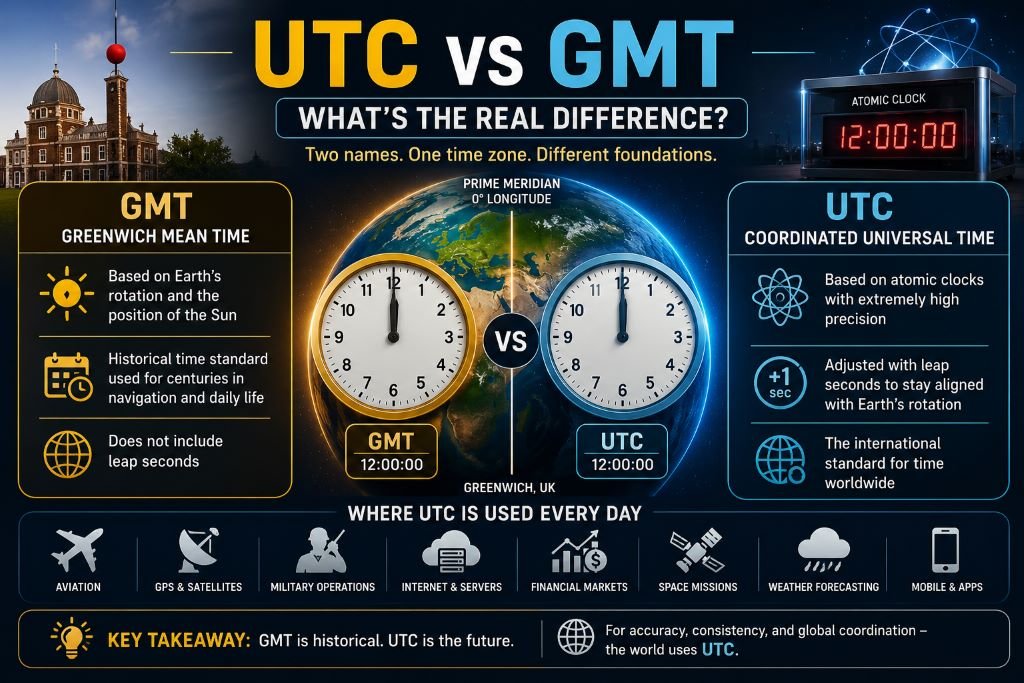
Part 1. UTC vs GMT: What's the Real Difference?
Understanding the World's Two Most Important Time Standards
Time is one of the few systems that connects every country on Earth. Whether you're booking an international flight, hosting a global business meeting, tracking financial markets, developing software, or simply checking the current time in another country, you've probably encountered the terms UTC and GMT.
Many people use these two abbreviations interchangeably. News channels announce events in "GMT." Websites display timestamps in "UTC." Airlines rely on UTC, while weather forecasts often reference GMT. This widespread usage naturally raises an important question:
Are UTC and GMT actually the same thing?
The short answer is almost—but not exactly.
Although UTC (Coordinated Universal Time) and GMT (Greenwich Mean Time) usually display the same clock time, they are based on completely different principles. One is a modern scientific time standard maintained by atomic clocks, while the other is a historical astronomical standard based on the Earth's rotation.
Understanding the distinction between UTC and GMT is more than a matter of terminology. It affects aviation, maritime navigation, telecommunications, financial markets, satellite systems, software development, cybersecurity, scientific research, and international coordination.
This guide explores the complete story behind UTC and GMT—from their fascinating history to their modern applications—and explains why the world officially uses UTC while GMT continues to appear in everyday life.
What is the difference between UTC and GMT?
| UTC | GMT |
|---|---|
| Coordinated Universal Time | Greenwich Mean Time |
| Based on atomic clocks | Based on the Earth's rotation |
| International scientific time standard | Historical civil time standard |
| Used worldwide for technology, aviation, GPS, internet, and science | Commonly used in the UK and everyday communication |
| Does not observe Daylight Saving Time | May refer to UK winter time |
| Maintained by international time laboratories | Originated from the Royal Observatory in Greenwich |
In everyday use
For most people, UTC and GMT display exactly the same hour and minute.
For example:
- 12:00 UTC = 12:00 GMT
- 18:30 UTC = 18:30 GMT
- 03:15 UTC = 03:15 GMT
However, the way these times are defined and maintained is fundamentally different.
Why This Difference Matters
If you're wondering why anyone cares about the distinction, consider these examples.
International Flights
Airlines publish schedules using UTC to avoid confusion across time zones and Daylight Saving Time changes.
GPS Satellites
Satellite navigation systems synchronize with UTC-based timing to achieve remarkable accuracy.
Financial Markets
Global stock exchanges coordinate trading systems using UTC timestamps.
Computer Networks
Servers around the world synchronize their clocks using UTC to ensure secure communication, accurate logging, and reliable transactions.
Scientific Research
Astronomers, physicists, meteorologists, and space agencies rely on UTC because it provides an internationally consistent reference.
Without a universal standard like UTC, international communication would become significantly more complex.
Understanding Time Standards
Before comparing UTC and GMT, it's important to understand what a time standard actually is.
A time standard is a globally accepted reference used to measure and synchronize time consistently across different regions.
Imagine every country using its own independent clock without any universal reference.
International travel would become confusing.
Banking systems would fail to synchronize transactions.
Internet servers couldn't agree on timestamps.
Global communication would become unreliable.
A universal time standard solves these problems by giving the world one common reference.
Today, that reference is UTC.
Historically, it was GMT.
The Origins of Greenwich Mean Time (GMT)
To understand GMT, we need to travel back several centuries.
Before standardized time existed, every city kept its own local solar time.
When the Sun reached its highest point in the sky, it was considered noon.
This worked reasonably well when people rarely traveled far.
However, the Industrial Revolution changed everything.
Railways connected cities.
Steamships crossed oceans.
International trade expanded rapidly.
Telegraph networks enabled nearly instant communication across continents.
Suddenly, having hundreds of different local times created enormous confusion.
Why Greenwich?
During the 18th and 19th centuries, Britain became one of the world's leading maritime powers.
Ships required accurate navigation to determine longitude.
In 1675, King Charles II established the Royal Observatory in Greenwich, London, specifically to improve navigation.
Astronomers at the observatory carefully measured the positions of stars and the movement of the Sun.
These observations became the foundation for a standard reference meridian.
Eventually, the longitude passing through Greenwich became known as the Prime Meridian (0° longitude).
Once the Prime Meridian was established, measuring time from Greenwich became the natural choice.
Thus, Greenwich Mean Time was born.
What Does "Mean Time" Mean?
The word "Mean" in Greenwich Mean Time often confuses people.
It does not mean "average" in the everyday sense.
Instead, it refers to the average position of the Sun throughout the year.
The Earth's orbit is not perfectly circular.
Its axis is tilted.
Because of these factors, the apparent solar day varies slightly during different seasons.
Astronomers solved this problem by calculating the mean solar day, an average value over the year.
GMT therefore represents mean solar time at the Prime Meridian.
How GMT Became the World's Time Standard
As global trade expanded during the 1800s, countries needed a common reference.
The turning point came in 1884.
The International Meridian Conference
Representatives from 25 countries gathered in Washington, D.C.
Their mission was to establish:
- A universal Prime Meridian
- A global reference for longitude
- A standard time system
- Consistent navigation methods
After extensive discussion, the conference selected the Greenwich Meridian as the world's official Prime Meridian.
This decision transformed GMT into the world's primary reference for international timekeeping.
The Expansion of Time Zones
Once Greenwich became the international reference point, countries could create standardized time zones.
Instead of every city keeping its own solar time, nations adopted offsets from Greenwich.
Examples included:
- GMT−5
- GMT+1
- GMT+8
- GMT+10
This system dramatically simplified:
- Railway schedules
- International shipping
- Postal services
- Telegraph communications
- Government administration
- International business
The concept remains the foundation of modern time zones, even though UTC has largely replaced GMT as the official reference.
Why GMT Was Revolutionary
It is difficult to overstate how transformative GMT was for the modern world.
Before GMT:
- Every town could keep a different local time.
- Train timetables were inconsistent.
- International navigation was difficult.
- Global communication lacked synchronization.
After GMT:
- Countries could coordinate transportation.
- Navigation became far more accurate.
- International trade became more efficient.
- Scientific collaboration improved.
- Global time zones became possible.
GMT laid the groundwork for the interconnected world we know today.
Interesting Fact
Did you know?
Before standardized time, the United States had more than 300 different local times based on individual cities. Railroad companies eventually introduced standardized time zones because operating trains with hundreds of local clocks was impractical and unsafe.
Key Takeaways
- GMT stands for Greenwich Mean Time.
- It originated from the Royal Observatory in Greenwich, England.
- GMT is based on the Earth's average rotation relative to the Sun.
- The Prime Meridian (0° longitude) passes through Greenwich.
- GMT became the world's primary time reference after the International Meridian Conference of 1884.
- Modern global timekeeping has largely transitioned from GMT to UTC, although GMT remains widely recognized.
Part 2. The Birth of UTC: Why the World Needed a More Accurate Time Standard
By the late 19th century, Greenwich Mean Time (GMT) had become the world's primary reference for timekeeping. Railways, shipping companies, governments, and scientific institutions all relied on it. For decades, GMT served the world remarkably well.
However, as technology advanced during the 20th century, scientists discovered a fundamental problem:
The Earth is not a perfectly accurate clock.
This realization changed global timekeeping forever and ultimately led to the creation of Coordinated Universal Time (UTC)—the precise international time standard used today.
The Problem with Earth's Rotation
GMT is based on the Earth's rotation relative to the Sun. In theory, one complete rotation equals one day, or 24 hours.
In reality, the Earth's rotation is not perfectly constant.
Our planet speeds up and slows down by tiny amounts due to several natural factors.
These variations are usually only a few milliseconds, but for modern technology, even a millisecond can matter.
Why Doesn't the Earth Rotate Perfectly?
Several forces continually influence Earth's rotational speed.
1. The Moon's Gravitational Pull
The Moon creates ocean tides through its gravitational force.
As tidal waters move around the planet, they generate friction with the Earth's surface. Over millions of years, this tidal friction gradually slows Earth's rotation.
Scientists estimate that the average length of a day increases by about 1.7 milliseconds per century.
2. Earthquakes
Large earthquakes can redistribute Earth's mass.
When mass shifts closer to or farther from the Earth's axis, the planet's rotation changes slightly—similar to how a spinning figure skater changes speed by moving their arms.
For example, the 2011 Tōhoku earthquake in Japan slightly shortened the length of the day by a fraction of a microsecond.
3. Melting Ice Sheets
Climate-related changes also affect Earth's rotation.
As glaciers and polar ice melt, enormous amounts of water move toward the oceans, altering the distribution of Earth's mass.
This redistribution causes tiny but measurable changes in rotational speed.
4. Atmospheric Changes
Powerful winds and seasonal changes in atmospheric pressure influence how quickly the Earth rotates.
The atmosphere and the solid Earth constantly exchange momentum, causing slight fluctuations in day length.
5. Movements Inside the Earth
The Earth's liquid outer core and molten mantle are always in motion.
These internal movements subtly affect the planet's rotation over long periods.
Why Tiny Changes Matter
For everyday life, a difference of a few milliseconds is unnoticeable.
Your wristwatch, smartphone, or wall clock will never reveal these tiny variations.
However, precision systems operate on vastly smaller timescales.
Examples include:
- GPS navigation
- Satellite communication
- Space exploration
- Internet infrastructure
- High-frequency financial trading
- Scientific experiments
- Military navigation
- Deep-space observation
For these applications, even a millionth of a second can be significant.
Scientists therefore needed a time standard that never depended on Earth's changing rotation.
The Search for a Better Clock
For centuries, humanity measured time using natural phenomena.
Examples include:
- Sundials
- Water clocks
- Mechanical clocks
- Pendulum clocks
- Quartz clocks
Each generation brought greater accuracy.
But every traditional clock ultimately depended—directly or indirectly—on Earth's motion or on mechanical systems that could drift over time.
The next breakthrough came from an entirely different field:
Atomic physics.
The Revolution of Atomic Clocks
During the mid-20th century, physicists discovered that atoms vibrate at extraordinarily stable frequencies.
Unlike the Earth's rotation, these atomic vibrations are remarkably consistent under controlled conditions.
This made atoms the ideal foundation for a universal clock.
What Is an Atomic Clock?
Despite its name, an atomic clock does not tick like a traditional clock.
Instead, it measures the natural frequency of electromagnetic radiation emitted or absorbed when electrons in certain atoms change energy levels.
The most commonly used element is cesium-133.
Scientists found that cesium atoms always oscillate at exactly the same frequency under identical conditions.
This consistency is extraordinary.
The Official Definition of One Second
Today, the International System of Units (SI) defines one second as:
The duration of 9,192,631,770 periods of the radiation corresponding to the transition between two hyperfine energy levels of the ground state of the cesium-133 atom.
Although this definition sounds highly technical, the key idea is simple:
- Earth's rotation varies.
- Cesium atoms do not (within extremely small margins).
That makes atomic clocks vastly more reliable than astronomical observations for measuring precise time.
How Accurate Are Atomic Clocks?
Modern atomic clocks are astonishingly precise.
Approximate comparison:
| Clock Type | Typical Accuracy |
|---|---|
| Mechanical clock | May drift several seconds per day |
| Quartz clock | May drift several seconds per month |
| Standard atomic clock | Around one second in millions of years |
| Advanced optical atomic clock | May remain accurate for billions of years under ideal laboratory conditions |
This level of precision transformed science and technology.
The Birth of UTC
By the 1950s and 1960s, scientists recognized that neither pure astronomical time nor pure atomic time alone met every need.
They required a system that offered:
- Atomic precision
- Global consistency
- Practical alignment with the Earth's day-night cycle
The solution became Coordinated Universal Time (UTC).
Why Is It Called "UTC" Instead of CUT?
The abbreviation often puzzles people.
In English, the logical abbreviation would seem to be CUT for Coordinated Universal Time.
However, French is also an official language in many international scientific organizations.
The French name is:
Temps Universel Coordonné
Its natural abbreviation would be TUC.
To avoid favoring either language, international organizations agreed on the neutral abbreviation:
UTC
This compromise is now recognized worldwide.
Who Maintains UTC?
UTC is not controlled by a single country or government.
Instead, it is maintained through international cooperation.
Key organizations include:
International Bureau of Weights and Measures (BIPM)
Collects timing data from national laboratories and calculates the official UTC reference.
International Earth Rotation and Reference Systems Service (IERS)
Monitors Earth's rotation and determines when adjustments, such as leap seconds, are necessary.
National Timing Laboratories
Countries operate their own highly accurate atomic clocks.
Examples include laboratories in:
- United States
- United Kingdom
- Germany
- France
- Japan
- India
- Canada
- Australia
- China
These laboratories continuously compare measurements to produce one coordinated global time standard.
UTC Is Based on Hundreds of Atomic Clocks
Many people imagine that a single master clock somewhere determines UTC.
In reality, no single clock controls global time.
Instead:
- Hundreds of atomic clocks operate worldwide.
- Their measurements are compared continuously.
- Statistical methods combine these measurements.
- The resulting average becomes International Atomic Time (TAI).
- UTC is then derived from TAI while remaining closely aligned with Earth's rotation.
This distributed approach makes UTC exceptionally stable and resilient.
What Is TAI?
Before understanding UTC completely, it's helpful to know about International Atomic Time (TAI).
TAI is a continuous time scale based entirely on atomic clocks.
Unlike UTC:
- TAI never includes leap seconds.
- TAI does not attempt to stay synchronized with Earth's rotation.
- It simply counts atomic seconds continuously.
UTC is created by adjusting TAI whenever necessary so that civil time stays close to the position of the Sun in the sky.
Leap Seconds: Keeping UTC and Earth in Sync
Even though UTC is based on atomic clocks, people still expect noon to occur when the Sun is roughly highest in the sky.
Since Earth's rotation gradually drifts relative to atomic time, a correction is occasionally required.
This correction is called a leap second.
A leap second is an extra second added to UTC (or, in theory, removed) to prevent UTC from drifting too far from Earth's actual rotation.
For example, the clock can briefly display:
23:59:59 → 23:59:60 → 00:00:00
This additional second allows atomic time and astronomical time to remain closely aligned.
Leap seconds are rare and are announced in advance by the International Earth Rotation and Reference Systems Service (IERS).
Why Don't We Simply Ignore Earth's Rotation?
One might ask why we don't use atomic time alone.
The reason is practical.
Civil time is tied to human experience:
- Sunrise in the morning
- Noon around midday
- Sunset in the evening
If atomic time were allowed to drift indefinitely without adjustment, these familiar relationships would gradually shift over centuries.
UTC preserves atomic precision while ensuring that our clocks remain closely connected to the natural day.
UTC in the Modern World
Today, UTC is the official reference for countless global systems, including:
- International aviation
- Maritime navigation
- Space missions
- GPS and satellite navigation
- Internet servers
- Cloud computing
- Telecommunications
- Financial trading
- Meteorology
- Scientific research
- Emergency response coordination
- Cybersecurity and digital certificates
Whenever you see a timestamp ending with "Z" (Zulu Time) in aviation, defense, or computing, it usually refers to UTC.
Expert Insight
One of UTC's greatest strengths is that it is both scientifically precise and globally practical. Atomic clocks provide unmatched stability, while occasional leap-second adjustments ensure that civil time remains closely aligned with Earth's rotation. This balance has made UTC the universal standard for international coordination.
Key Takeaways
- Earth's rotation is not perfectly constant, making GMT unsuitable for high-precision scientific applications.
- Atomic clocks measure time using the stable oscillations of cesium-133 atoms.
- The SI second is defined by 9,192,631,770 cesium oscillations.
- UTC (Coordinated Universal Time) combines atomic precision with alignment to Earth's rotation.
- The abbreviation UTC was chosen as a language-neutral compromise between English and French.
- UTC is maintained through the collaboration of international timing laboratories and scientific organizations.
- Leap seconds are occasionally added to keep UTC synchronized with the Earth's changing rotation.
- Today, UTC underpins the operation of the internet, GPS, aviation, financial systems, telecommunications, and modern scientific research.
Part 3. UTC vs GMT: The Key Differences Explained
By now, we've learned that Greenwich Mean Time (GMT) and Coordinated Universal Time (UTC) often display the same clock time but are based on entirely different systems.
For most people, the distinction doesn't affect daily life. However, for scientists, engineers, pilots, software developers, financial institutions, and global organizations, understanding the difference is essential.
This section provides a detailed comparison between UTC and GMT, explains when the differences matter, and clears up some of the most common misconceptions.
UTC vs GMT at a Glance
| Feature | UTC (Coordinated Universal Time) | GMT (Greenwich Mean Time) |
|---|---|---|
| Full Name | Coordinated Universal Time | Greenwich Mean Time |
| Introduced | 1960s (officially adopted in 1972) | 19th century |
| Based On | Atomic clocks | Mean solar time |
| Accuracy | Extremely precise | Depends on Earth's rotation |
| Scientific Standard | Yes | No |
| Used by GPS | Yes | No |
| Used by Aviation | Yes | Rarely |
| Used by Internet Servers | Yes | No |
| Uses Leap Seconds | Yes | No (astronomical reference) |
| International Standard | Yes | Mainly historical and civil use |
| Daylight Saving Time | Never | UK uses GMT only during winter |
| Maintained By | International atomic clock network | Historically linked to Greenwich Observatory |
The Biggest Difference
Although UTC and GMT usually show the same hour and minute, they are created in completely different ways.
GMT measures Earth's rotation.
UTC measures atomic vibrations.
That single difference changes everything.
GMT answers: "Where is the Earth pointing relative to the Sun?"
UTC answers: "What do the world's most accurate atomic clocks measure?"
Difference 1: Their Origins
GMT
GMT originated in the 1800s.
Astronomers at the Royal Observatory in Greenwich observed the movement of the Sun across the sky and calculated the average solar day.
This astronomical approach made GMT the world's first global time reference.
UTC
UTC emerged nearly a century later.
Scientists realized that Earth's rotation was slightly irregular and unsuitable for modern technology.
Instead of relying on astronomy alone, UTC uses atomic clocks synchronized across laboratories worldwide.
Difference 2: The Science Behind Them
GMT: Astronomy-Based
GMT depends on Earth's rotation.
As Earth spins, the Sun appears to move across the sky.
When the Sun reaches its highest point over Greenwich, it represents local noon.
Because Earth's rotation is not perfectly constant, GMT is not perfectly constant either.
UTC: Physics-Based
UTC is rooted in quantum physics.
It measures the highly stable oscillations of cesium-133 atoms.
These oscillations remain consistent regardless of:
- Weather
- Seasons
- Earthquakes
- Ocean tides
- Climate changes
- Planetary motion
This makes UTC far more stable than any astronomical standard.
Difference 3: Precision
Imagine two clocks.
Clock A gains or loses tiny fractions of a second because the planet itself changes speed.
Clock B never changes because it relies on atomic physics.
GMT is similar to Clock A.
UTC resembles Clock B.
Modern atomic clocks are so accurate that they may lose only about one second over millions—or even billions—of years, depending on the technology used.
For applications requiring extreme precision, UTC is the only practical choice.
Difference 4: International Recognition
Today, virtually every international technical organization uses UTC.
Examples include:
- International Civil Aviation Organization (ICAO)
- International Telecommunication Union (ITU)
- International Organization for Standardization (ISO)
- Internet Engineering Task Force (IETF)
- Space agencies
- Meteorological organizations
- Financial exchanges
GMT, by contrast, remains widely recognized in everyday language but is rarely used as the official technical standard.
Difference 5: Technology
Modern digital infrastructure depends on UTC.
Examples include:
Internet
Every website, email, cloud server, and online transaction relies on UTC timestamps behind the scenes.
Smartphones
Your phone internally stores time using UTC before converting it to your local time zone.
Cloud Computing
Distributed servers in different countries synchronize using UTC to ensure data consistency.
GPS
Navigation satellites transmit highly precise timing information based on atomic clocks closely aligned with UTC for civil applications.
Without UTC, GPS location errors would grow rapidly.
Difference 6: Navigation
Historically, sailors navigated using GMT because it was linked to the Prime Meridian.
Today:
- Aircraft use UTC.
- Ships generally use UTC.
- Spacecraft use UTC for many operational activities.
- Scientific expeditions use UTC.
GMT's historical role has largely been replaced.
Difference 7: Time Zones
GMT is sometimes treated as a time zone.
UTC is a time standard.
This distinction is important.
UTC
UTC never changes.
It is always UTC+00:00.
GMT
GMT can refer to the standard time used in the United Kingdom during winter.
In summer, the UK switches to British Summer Time (BST), which is UTC+1.
Therefore:
- Winter → GMT (UTC+0)
- Summer → BST (UTC+1)
UTC itself never changes with the seasons.
Difference 8: Daylight Saving Time
UTC does not observe Daylight Saving Time.
No matter where you are:
- UTC remains UTC+0
- Every day of the year
- Every hour
- Every minute
GMT, as used in the UK, applies only during winter months.
This is one reason UTC is preferred for international scheduling.
Difference 9: Leap Seconds
One of the most misunderstood topics is the leap second.
UTC occasionally inserts a leap second to remain closely synchronized with Earth's rotation.
GMT, being based on Earth's rotation itself, does not use leap seconds in the same operational sense.
Most people never notice leap seconds because they occur very rarely and affect only highly precise systems.
Difference 10: Legal vs Scientific Use
Many countries define their legal time using UTC offsets.
Examples:
- India → UTC+5:30
- Japan → UTC+9
- Australia has multiple UTC-based time zones.
- Canada and the United States use several UTC offsets.
In everyday conversation, however, people may still casually say "GMT+5" or "GMT-4," even though the technically correct expression is "UTC+5" or "UTC-4."
Why Do UTC and GMT Usually Show the Same Time?
This is probably the most common question.
Although they are based on different principles, UTC is intentionally kept very close to Earth's rotation through leap seconds.
As a result:
- 08:00 UTC = 08:00 GMT
- 15:30 UTC = 15:30 GMT
- 22:45 UTC = 22:45 GMT
For everyday use, there is effectively no visible difference.
Only highly precise scientific measurements reveal the distinction.
Analogy: Two Different Ways to Measure Distance
Imagine two people measuring the length of a bridge.
The first uses a traditional measuring tape.
The second uses a laser measurement system.
Both report 100 meters.
The result is the same.
The measurement method is different.
GMT is like the measuring tape.
UTC is like the laser.
Both may produce the same practical answer, but one is far more precise and reliable.
Common Misconceptions
Myth 1: UTC is just the new name for GMT.
Reality: UTC replaced GMT as the international scientific standard, but they are not the same system.
Myth 2: UTC is always different from GMT.
Reality: They almost always display the same hour and minute.
Myth 3: GMT is outdated and never used.
Reality: GMT is still widely used in media, weather reports, education, and everyday conversation, particularly in the United Kingdom.
Myth 4: UTC changes during summer.
Reality: UTC never changes. Local time zones may observe Daylight Saving Time, but UTC remains constant.
Myth 5: Every country uses GMT.
Reality: Most countries define their official time using UTC offsets, not GMT.
Real-World Examples
Example 1: Aviation
A flight departs Tokyo at 14:00 UTC.
Pilots, air traffic controllers, and operations teams across multiple countries all use the same UTC reference to avoid confusion caused by local time zones.
Example 2: Software Development
A user in New York submits a form at 09:00 local time.
Another user in Berlin submits a form at 15:00 local time.
The server stores both events in UTC, ensuring accurate ordering regardless of location.
Example 3: Financial Markets
Global stock exchanges record trades using UTC timestamps so that transactions can be synchronized across continents.
Example 4: Space Missions
Space agencies coordinate launches, orbital maneuvers, and communications using UTC because it provides a single, stable reference for teams around the world.
Expert Insight
While GMT remains an important historical and cultural reference, UTC is the foundation of modern global timekeeping. Every smartphone, internet server, satellite, financial exchange, and international transport network ultimately depends on UTC to maintain accurate and consistent time across borders.
Key Takeaways
- GMT is based on the Earth's average rotation relative to the Sun.
- UTC is based on highly accurate atomic clocks.
- UTC is the official international time standard.
- GMT is primarily a historical and civil time reference.
- UTC never observes Daylight Saving Time.
- GMT is used as UK standard time during winter, while the UK switches to BST in summer.
- UTC and GMT usually display the same clock time because UTC is kept closely aligned with Earth's rotation.
- Modern technologies—including GPS, cloud computing, aviation, finance, and telecommunications—depend on UTC rather than GMT.
Part 4. How UTC Is Used Around the World: Aviation, Navigation, GPS, the Internet, and Global Communication
Although most people only think about time when checking a clock or planning a meeting, Coordinated Universal Time (UTC) quietly powers nearly every major global system.
Every day, billions of devices—from smartphones and satellites to airplanes, banking systems, and cloud servers—depend on UTC to remain synchronized.
Meanwhile, Greenwich Mean Time (GMT) continues to appear in everyday language, media broadcasts, weather reports, and historical references, especially in the United Kingdom.
This section explores how UTC and GMT are used across industries and why UTC has become the universal language of international coordination.
Why the World Needs One Universal Time
Imagine if every country used only its local time when communicating internationally.
A meeting scheduled for 10:00 AM would mean different things in New York, London, Tokyo, Sydney, and Dubai.
International aviation would become chaotic.
Global financial markets could not accurately timestamp transactions.
Computer servers would struggle to determine the correct order of events.
Satellite navigation systems would lose synchronization.
Instead of converting between hundreds of local clocks, the world relies on one universal reference:
UTC acts as the world's master clock.
Every local time zone is simply an offset from UTC.
Examples include:
| Region | Standard Time |
|---|---|
| London (Winter) | UTC+0 |
| Paris | UTC+1 |
| Cairo | UTC+2 |
| Dubai | UTC+4 |
| India | UTC+5:30 |
| Thailand | UTC+7 |
| China | UTC+8 |
| Japan | UTC+9 |
| Sydney (Standard Time) | UTC+10 |
| New York (Standard Time) | UTC−5 |
Local clocks may change because of Daylight Saving Time, but UTC itself never changes.
UTC in Aviation
One of the earliest industries to adopt UTC universally was aviation.
Thousands of aircraft cross international borders every hour.
Each country has its own:
- Local time
- Daylight Saving rules
- Time zone abbreviations
Using local time would create enormous confusion.
Instead, every flight plan, weather report, air traffic control schedule, and navigation system uses UTC.
Why Pilots Never Use Local Time
Imagine a flight traveling:
Tokyo → Dubai → London → New York
If each airport used only local time:
- Departure times
- Arrival schedules
- Fuel planning
- Crew shifts
- Air traffic coordination
would become extremely complicated.
Using UTC eliminates this problem.
Everyone works from the same clock regardless of location.
What Is "Zulu Time"?
If you've listened to aviation communications or military operations, you've probably heard the term:
Zulu Time
Zulu Time is simply another name for UTC.
The name comes from the NATO phonetic alphabet, where:
Z = Zulu
Because UTC corresponds to the zero-hour time zone (UTC+00:00), aviation and military organizations use the suffix "Z".
Examples:
- 0800Z
- 1430Z
- 2200Z
All represent UTC.
For example:
- 14:00Z = 14:00 UTC
Aviation Example
A flight departs:
Singapore: 02:00 UTC
Arrives:
Frankfurt: 14:30 UTC
Although passengers see different local times, pilots and air traffic controllers coordinate everything using UTC.
This greatly reduces the risk of scheduling errors.
UTC in Maritime Navigation
Long before airplanes existed, ships depended on GMT for navigation.
Today, commercial shipping has transitioned almost entirely to UTC.
Modern vessels use UTC for:
- Navigation systems
- Voyage planning
- Satellite communication
- Weather forecasting
- Emergency coordination
- International reporting
A cargo ship crossing multiple oceans never needs to adjust its operational records when changing time zones.
Everything remains referenced to UTC.
UTC in GPS
Perhaps the most impressive application of UTC is Global Positioning System (GPS) technology.
Millions of people use GPS every day without realizing that accurate positioning depends on incredibly precise timing.
Why Timing Matters
GPS satellites continuously transmit signals toward Earth.
Your smartphone measures how long each signal takes to arrive.
Because radio waves travel at the speed of light:
Even a tiny timing error produces a significant location error.
For example:
| Timing Error | Approximate Position Error |
|---|---|
| 1 millisecond | Hundreds of kilometers |
| 1 microsecond | About 300 meters |
| 1 nanosecond | Around 30 centimeters |
This demonstrates why precise timekeeping is absolutely essential.
GPS Atomic Clocks
Each GPS satellite carries multiple atomic clocks.
These clocks provide extraordinary precision.
Ground control stations continuously monitor satellite timing and apply corrections so that civil positioning remains closely aligned with UTC.
Without atomic timing, modern GPS navigation would be impossible.
UTC in Space Exploration
Space agencies coordinate missions involving:
- Satellites
- Space telescopes
- Lunar missions
- Mars rovers
- Deep-space probes
Mission control centers may be located on different continents.
Scientists therefore use UTC as the common operational reference.
Examples include:
- Rocket launches
- Orbital corrections
- Docking procedures
- Scientific observations
- Communication windows
A universal time reference prevents misunderstandings during complex missions where every second matters.
UTC and the Internet
Every time you:
- Send an email
- Upload a photo
- Watch a video
- Make an online purchase
- Post on social media
- Join a video meeting
UTC is working behind the scenes.
Why Internet Servers Store UTC
Suppose two users submit data.
One is in Brazil.
The other is in Japan.
If the server stored only local times:
- Sorting records
- Detecting fraud
- Resolving conflicts
- Creating backups
would become difficult.
Instead, servers record events internally using UTC.
When you view the information, software converts UTC into your local time zone automatically.
Example
A server stores:
2026-07-28 12:00 UTC
Users may see:
| Location | Displayed Time |
|---|---|
| London | 12:00 |
| New York | 08:00 (during daylight time) |
| Delhi | 17:30 |
| Tokyo | 21:00 |
| Sydney | 22:00 (depending on season) |
The stored timestamp never changes.
Only the display changes.
UTC in Cloud Computing
Major cloud providers operate data centers across multiple continents.
To synchronize:
- Databases
- Virtual machines
- Containers
- Logs
- Security events
they use UTC.
Without a common time reference, distributed computing would become unreliable.
UTC in Cybersecurity
Accurate timestamps are critical for:
- Login records
- Security monitoring
- Digital certificates
- Malware detection
- Incident investigations
- Compliance audits
Imagine investigating a cyberattack across servers in five countries.
UTC ensures investigators know exactly when each event occurred.
UTC in Financial Markets
Financial systems execute millions of transactions every second.
Examples include:
- Stock exchanges
- Foreign exchange markets
- Cryptocurrency platforms
- Payment processors
- Banking networks
Every trade receives an accurate UTC timestamp.
This prevents disputes about transaction order and improves transparency.
Example
A trader in:
London buys shares.
Another trader in:
Singapore sells them.
UTC allows exchanges to determine the exact sequence of events regardless of local time.
UTC in Telecommunications
International communication networks rely heavily on synchronization.
Examples include:
- Mobile phone networks
- Fiber-optic systems
- Internet backbone infrastructure
- Television broadcasting
- Satellite television
Network equipment uses UTC to coordinate data transmission efficiently.
Even small timing errors can reduce network performance.
UTC in Weather Forecasting
Meteorologists collect observations from thousands of locations worldwide.
Weather balloons, satellites, ships, aircraft, and observation stations all report data using UTC.
This allows scientists to compare measurements taken at the same moment across different continents.
Without UTC, creating accurate global weather models would be far more difficult.
UTC in Scientific Research
Many scientific disciplines require precise timing.
Examples include:
- Astronomy
- Geophysics
- Climate science
- Oceanography
- Seismology
- Particle physics
- Radio astronomy
Researchers from multiple countries can compare observations because they all reference UTC.
Where GMT Is Still Used
Although UTC dominates scientific and technical applications, GMT remains important.
1. Everyday Conversation
People frequently say:
- "Meeting at 3 PM GMT."
- "Broadcast starts at 8 GMT."
- "Winter time in London."
In many cases, they simply mean UTC+0.
2. The United Kingdom
During winter:
United Kingdom = GMT
During summer:
United Kingdom = British Summer Time (BST)
BST = UTC+1
This seasonal change often causes confusion among international visitors.
3. Broadcasting
International broadcasters have historically announced schedules using GMT.
Although many organizations now use UTC, GMT remains familiar to global audiences.
4. Historical References
Older books, maps, navigation records, and scientific documents frequently reference GMT because UTC did not exist when they were created.
Why Software Uses UTC Instead of GMT
Software developers almost always choose UTC because it is:
- Unambiguous
- Internationally standardized
- Independent of local laws
- Unaffected by Daylight Saving Time
- Easy to convert into any local time zone
Programming languages, databases, cloud platforms, and APIs commonly store timestamps in UTC before converting them for display.
Expert Insight
Modern civilization depends on precise synchronization. While GMT remains culturally significant and historically influential, UTC has become the invisible infrastructure behind global technology. From smartphones and satellites to banking systems and cloud computing, billions of operations every day rely on UTC to ensure that the world functions as one coordinated network.
Interesting Facts
Did You Know?
- Every GPS satellite carries multiple atomic clocks to maintain extremely accurate timing.
- More than 100 national timing laboratories contribute to international timekeeping, helping produce the official UTC reference.
- Most websites and mobile apps store timestamps internally in UTC, even if they display local time to users.
- Air traffic controllers and pilots worldwide communicate using Zulu Time (UTC) to avoid confusion across time zones.
- Weather observations around the world are synchronized using UTC, allowing meteorologists to build consistent global forecast models.
Key Takeaways
- UTC is the universal operational time standard used across technology, science, transportation, and communications.
- Aviation, maritime navigation, GPS, space exploration, cloud computing, and financial systems all rely on UTC.
- Zulu Time is simply another name for UTC in aviation and military contexts.
- Internet servers store timestamps in UTC and convert them to local time for users.
- GMT remains important for historical references, broadcasting, and winter civil time in the United Kingdom.
- UTC's consistency makes it the foundation of today's interconnected digital world.
Part 5. UTC, GMT, Daylight Saving Time, and Time Zones: Clearing Up the Biggest Confusion
If there is one topic that causes more confusion than the difference between UTC and GMT, it is Daylight Saving Time (DST).
Many people ask questions like:
- Is GMT always the same as UTC?
- Does UTC change in summer?
- Why is London sometimes UTC+0 and sometimes UTC+1?
- What does UTC+5:30 actually mean?
- Why don't all countries follow the same time?
These questions are understandable because the relationship between UTC, GMT, and local time zones can seem complicated.
Fortunately, the concepts become much clearer once you understand one simple principle:
UTC never changes. Local time zones do.
This section explains how Daylight Saving Time works, why UTC remains constant, and how countries create their official time zones.
What Is a Time Zone?
A time zone is a geographical region that observes the same standard time.
Instead of every city using its own local solar time, countries generally divide themselves into one or more standard time zones based on UTC offsets.
For example:
| Time Zone | UTC Offset |
|---|---|
| UTC | UTC+0 |
| India Standard Time (IST) | UTC+5:30 |
| Japan Standard Time (JST) | UTC+9 |
| Eastern Standard Time (EST) | UTC−5 |
| Pacific Standard Time (PST) | UTC−8 |
| Australian Eastern Standard Time (AEST) | UTC+10 |
The offset tells you how many hours and minutes to add to or subtract from UTC to obtain local time.
Understanding UTC Offsets
Imagine UTC is 12:00 (noon).
Using different offsets:
| UTC | Offset | Local Time |
|---|---|---|
| 12:00 | UTC+1 | 13:00 |
| 12:00 | UTC+3 | 15:00 |
| 12:00 | UTC+5:30 | 17:30 |
| 12:00 | UTC+8 | 20:00 |
| 12:00 | UTC−5 | 07:00 |
| 12:00 | UTC−8 | 04:00 |
UTC itself always stays at 12:00.
Only local clocks change.
Why Doesn't Every Country Use UTC?
At first glance, it might seem simpler if everyone used UTC directly.
However, human activities are closely tied to daylight.
People generally expect:
- Sunrise in the morning
- Noon around midday
- Sunset in the evening
If the entire world used UTC without local adjustments:
- London might have lunch at 12:00.
- India might begin work at 03:30 UTC.
- Japan could finish work around 09:00 UTC.
- California might celebrate midnight while the Sun is still high in the sky according to the clock.
Local time zones keep daily life aligned with the natural cycle of daylight.
What Is Daylight Saving Time (DST)?
Daylight Saving Time is the practice of moving clocks forward, usually by one hour during part of the year, to make better use of evening daylight.
The idea is simple:
Instead of sunlight arriving very early in the morning when many people are asleep, the extra hour of daylight is shifted to the evening.
Typically:
- Spring → Clocks move forward by one hour.
- Autumn → Clocks move back by one hour.
Not every country observes DST, and those that do may follow different schedules.
Why Was DST Introduced?
Daylight Saving Time became popular in the early 20th century.
The primary goals included:
- Reducing energy consumption
- Extending evening daylight
- Supporting outdoor activities
- Improving productivity during longer summer days
Whether DST still provides significant energy savings is widely debated, and several countries have discontinued or reconsidered its use.
Does UTC Observe Daylight Saving Time?
No.
This is one of the most important facts about UTC.
UTC:
- Never moves forward.
- Never moves backward.
- Never changes with the seasons.
- Never observes DST.
It remains UTC+0 throughout the year.
This consistency is exactly why it serves as the world's reference time.
Does GMT Observe Daylight Saving Time?
This question requires careful wording.
Greenwich Mean Time (GMT) itself does not observe Daylight Saving Time.
However, the United Kingdom uses GMT only during the winter.
In summer, the UK changes to:
British Summer Time (BST)
BST = UTC+1
Therefore:
| Season | UK Civil Time |
|---|---|
| Winter | GMT (UTC+0) |
| Summer | BST (UTC+1) |
This is one reason people sometimes mistakenly believe that GMT changes.
In reality:
- GMT remains GMT.
- The UK's legal civil time changes from GMT to BST during summer.
Visual Example
Imagine UTC is always fixed at the center.
Winter

UTC = 12:00

London (GMT) = 12:00

Paris = 13:00

Delhi = 17:30

Tokyo = 21:00
Now summer arrives.
Summer

UTC = 12:00

London (BST) = 13:00

Paris = 14:00

Delhi = 17:30

Tokyo = 21:00
Notice something important:
UTC never changed.
Only countries observing Daylight Saving Time adjusted their local clocks.
Countries That Do Not Observe DST
Many nations keep the same official time throughout the year.
Examples include:
- India
- China
- Japan
- Singapore
- South Africa
- Indonesia (most regions)
- Iceland (stays on UTC year-round despite its location)
These countries avoid the complexity of changing clocks twice a year.
Countries That Commonly Observe DST
Several regions still adjust clocks seasonally, although policies continue to evolve.
Examples include parts of:
- United States
- Canada
- United Kingdom
- Ireland
- Germany
- France
- Spain
- Italy
- Australia (only some states)
- New Zealand
Importantly, not every state or territory within these countries necessarily follows DST.
Why UTC Makes International Scheduling Easier
Imagine organizing an online meeting involving participants from:
- New York
- London
- Berlin
- Dubai
- Delhi
- Singapore
- Sydney
If everyone referred only to local time, confusion would be inevitable—especially during the weeks when different countries begin or end DST on different dates.
Instead, organizers often schedule meetings in UTC.
Example:
Meeting Time: 14:00 UTC
Each participant converts that single reference into their local time.
This approach avoids misunderstandings.
Why Software Stores UTC Instead of Local Time
Suppose an online store records an order at:
10:00 AM
Without additional information, that timestamp is incomplete.
Is it:
- London?
- New York?
- Tokyo?
- Delhi?
- Sydney?
Instead, systems record:
2026-07-28 10:00 UTC
When users view the order history, the application converts the timestamp to the appropriate local time zone.
This ensures consistency across countries.
Countries with Multiple Time Zones
Large countries often use several UTC offsets because of their geographical width.
Examples include:
United States
- UTC−5
- UTC−6
- UTC−7
- UTC−8
- UTC−9
- UTC−10
(depending on the region and season)
Canada
Canada spans six primary time zones, ranging from Pacific Time to Newfoundland Time.
Australia
Australia typically uses three main standard time zones:
- AWST (UTC+8)
- ACST (UTC+9:30)
- AEST (UTC+10)
Some states also observe Daylight Saving Time, while others do not.
Russia
Russia is the world's largest country by area and spans 11 time zones, making UTC offsets essential for national coordination.
Countries with Unusual UTC Offsets
Not every time zone uses whole hours.
Several countries and territories use half-hour or even quarter-hour offsets.
Examples:
| Region | UTC Offset |
|---|---|
| India | UTC+5:30 |
| Sri Lanka | UTC+5:30 |
| Iran (standard time) | UTC+3:30 |
| Afghanistan | UTC+4:30 |
| Nepal | UTC+5:45 |
| Australian Central Standard Time | UTC+9:30 |
| Chatham Islands (New Zealand) | UTC+12:45 |
These unique offsets often reflect historical, geographical, or political decisions.
Why Time Zone Boundaries Don't Always Follow Longitude
In theory, every 15 degrees of longitude corresponds to one hour.
In practice, political and social considerations often override geography.
Countries adjust their time zones to:
- Keep businesses on the same schedule.
- Simplify government administration.
- Align with major trading partners.
- Avoid splitting cities or provinces across different times.
As a result, actual time zone boundaries frequently zigzag rather than follow straight meridian lines.
Common Myths About UTC and Time Zones
Myth 1: UTC changes during summer.
Reality: UTC is constant all year.
Myth 2: GMT and UTC always mean different times.
Reality: They usually display the same clock time.
Myth 3: Every country observes Daylight Saving Time.
Reality: Most countries do not use DST.
Myth 4: Time zones always follow longitude exactly.
Reality: Political and practical considerations often shape time zone boundaries.
Myth 5: Half-hour and quarter-hour time zones are mistakes.
Reality: These offsets are intentional and officially recognized.
Real-World Example
Suppose a webinar is scheduled for:
16:00 UTC
Participants will join at different local times:
| City | Local Time |
|---|---|
| London (Winter) | 16:00 |
| London (Summer) | 17:00 |
| New York (depending on season) | Varies by DST |
| Delhi | 21:30 |
| Dubai | 20:00 |
| Tokyo | 01:00 (next day) |
| Sydney | Depends on standard time or DST |
The webinar itself never changes.
Only the displayed local time changes.
Expert Insight
One of the greatest strengths of UTC is that it remains stable while the world around it changes. Governments may revise time zone boundaries, adopt or abolish Daylight Saving Time, or redefine legal time, but UTC continues to provide a constant global reference. This stability is why international organizations, software platforms, airlines, financial markets, and scientific institutions all depend on UTC for accurate coordination.
Key Takeaways
- UTC never observes Daylight Saving Time.
- Local time zones are created by applying UTC offsets.
- GMT itself is a standard time reference; the United Kingdom switches to British Summer Time (BST) during summer.
- Many countries—including India, China, and Japan—do not observe DST.
- Large countries often use multiple time zones, while some regions use half-hour or quarter-hour UTC offsets.
- Modern software stores timestamps in UTC and converts them into local time only when displaying information.
- UTC provides a stable reference that makes international scheduling, travel, and digital communication far more reliable.
Part 6. Should You Use UTC or GMT? A Practical Guide for Travelers, Developers, Businesses, and Global Organizations
After exploring the history, science, and technology behind UTC (Coordinated Universal Time) and GMT (Greenwich Mean Time), one practical question remains:
Which one should you actually use?
The answer depends on your purpose.
If you're writing software, coordinating international flights, or managing cloud infrastructure, the answer is almost always UTC.
If you're discussing winter time in the United Kingdom or referring to historical events, GMT may still be appropriate.
This section explains when to use each standard, who relies on them, and the common mistakes people should avoid.
The Short Answer
For nearly all modern technical, scientific, and international applications:
Use UTC.
For historical references, everyday conversation, or discussing UK winter time:
GMT is acceptable.
Although both usually display the same clock time, UTC is the internationally recognized standard for precision and global coordination.
Who Uses UTC?
UTC is the default time standard for countless industries.
1. Software Developers
Software engineers almost always store timestamps in UTC.
Examples include:
- Web applications
- Mobile apps
- Cloud platforms
- APIs
- Databases
- Authentication systems
- Logging services
- Distributed systems
Why?
Because users may live anywhere in the world.
Instead of storing local times, developers store UTC and convert it when displaying information.
Example:
Database stores:
2026-07-28T14:30:00ZDisplayed to users as:
- London: 14:30
- Delhi: 20:00
- New York: 10:30 (depending on DST)
- Tokyo: 23:30
One timestamp works everywhere.
Best Practice for Developers
✔ Store all timestamps in UTC.
✔ Convert only for display.
❌ Never permanently store local time without also storing the associated time zone.
2. Airlines
International aviation relies entirely on UTC.
Pilots do not change operational clocks every time they cross a border.
Instead:
- Flight plans
- Navigation charts
- Weather reports
- Air traffic communications
all reference UTC.
This eliminates confusion caused by:
- Time zones
- Daylight Saving Time
- Local government changes
3. Military Organizations
Armed forces worldwide commonly use:
Zulu Time (UTC)
Military operations often involve personnel across multiple countries.
Using UTC ensures everyone follows the same timeline.
Example:
Mission begins:
1800Z
Every participating unit understands the exact start time regardless of location.
4. Space Agencies
Organizations such as national space agencies coordinate:
- Rocket launches
- Satellite operations
- Scientific observations
- Deep-space communication
using UTC.
A spacecraft orbiting Earth does not care about local civil time.
A single international reference simplifies mission planning.
5. Meteorologists
Weather agencies collect observations from:
- Satellites
- Aircraft
- Ships
- Ocean buoys
- Ground stations
- Weather balloons
using UTC.
This allows scientists to compare data collected simultaneously across continents.
6. Financial Institutions
Banks and exchanges process millions of transactions every day.
UTC helps:
- Timestamp trades
- Prevent ordering disputes
- Synchronize markets
- Support regulatory compliance
Without UTC, comparing financial events across countries would be much more difficult.
7. Internet Infrastructure
Every major internet service depends on UTC.
Examples include:
- Search engines
- Email providers
- Cloud storage
- Social media platforms
- Streaming services
- Online games
- Payment gateways
UTC enables consistent event ordering regardless of users' locations.
When Should You Use GMT?
Although UTC dominates modern technology, GMT still has legitimate uses.
Discussing UK Winter Time
During winter:
United Kingdom = GMT
Example:
"The office opens at 9:00 GMT."
This statement is correct during the UK's winter period.
Historical Events
Events that occurred before UTC became the international standard are often described using GMT.
Examples include:
- Historical navigation records
- Early scientific observations
- World War II documentation
- Classic maritime logs
Everyday Conversation
Many people casually say:
"Call me at 6 PM GMT."
In most situations, everyone understands this to mean UTC+0.
Although UTC would be technically more precise, GMT remains widely recognized.
UTC vs GMT by Profession
| Profession | Preferred Standard | Why? |
|---|---|---|
| Software Developer | UTC | Consistent timestamps |
| Pilot | UTC | International coordination |
| Air Traffic Controller | UTC | Global safety |
| Ship Captain | UTC | Navigation |
| Scientist | UTC | Precision |
| Astronomer | UTC | Standardized observations |
| Financial Trader | UTC | Accurate transaction timing |
| Cloud Engineer | UTC | Distributed systems |
| Cybersecurity Analyst | UTC | Event correlation |
| Journalist | UTC or GMT | Depends on audience and context |
| Historian | GMT | Historical accuracy |
| General Public | Either | Usually interchangeable in daily conversation |
Decision Guide
Use UTC if you are:
✔ Building software
✔ Creating APIs
✔ Managing servers
✔ Writing technical documentation
✔ Scheduling international meetings
✔ Running cloud infrastructure
✔ Coordinating scientific research
✔ Managing satellite systems
✔ Working in aviation
✔ Recording global events
Use GMT if you are:
✔ Referring to UK winter time
✔ Discussing historical events
✔ Quoting older navigation records
✔ Writing about the history of timekeeping
✔ Using familiar terminology for a general audience
Why Developers Prefer UTC
Imagine a social media platform with users in 180 countries.
If every post were stored in local time:
- Sorting posts becomes difficult.
- Debugging becomes confusing.
- Daylight Saving changes create ambiguity.
- Time zone conversions increase complexity.
Instead, platforms store UTC.
Example:
2026-07-28T09:15:42ZEvery device converts this to local time automatically.
This approach is simple, scalable, and reliable.
Why Databases Should Never Store Local Time Alone
Consider an order placed at:
09:30
Without additional information, the timestamp is incomplete.
Questions immediately arise:
- Which country?
- Which city?
- Which time zone?
- Was DST active?
- Was the clock changed that day?
Instead, store:
2026-07-28T09:30:00Zor
2026-07-28T09:30:00+05:30Both formats preserve the necessary context.
Common Mistakes
Mistake 1
Writing:
"GMT+5:30"
Technically, modern standards recommend:
UTC+5:30
because UTC is the official international reference.
Mistake 2
Assuming GMT changes during summer.
It does not.
The United Kingdom changes from GMT to BST.
GMT itself remains unchanged.
Mistake 3
Using local server time.
Servers should generally operate internally on UTC.
Local time should be applied only when displaying information to users.
Mistake 4
Ignoring Daylight Saving Time.
Applications that schedule meetings or reminders must account for DST where applicable.
UTC simplifies this by remaining constant.
Mistake 5
Hardcoding UTC offsets.
Governments occasionally change time zone policies.
Modern applications should use time zone databases (such as the IANA Time Zone Database) rather than fixed offsets whenever possible.
Real-World Scenarios
Scenario 1: International Webinar
Participants:
- London
- Toronto
- Delhi
- Singapore
- Sydney
Instead of sending different local times to each participant, the organizer announces:
15:00 UTC
Each attendee converts the reference into their local time.
Scenario 2: Website Analytics
A website receives visitors from:
- Canada
- Brazil
- Germany
- India
- Australia
Analytics systems record every event in UTC.
Reports are later converted into local time zones when viewed.
Scenario 3: Online Banking
Money transfers occur between banks in different countries.
UTC timestamps ensure that the exact order of transactions is preserved, even when local clocks differ.
Scenario 4: Server Logs
A security incident affects servers in three regions.
All systems record logs in UTC, allowing investigators to reconstruct the timeline accurately without worrying about local time differences or DST transitions.
Expert Recommendations
For Developers
- Store timestamps in UTC.
- Convert to local time only in the user interface.
- Use standard formats like ISO 8601.
- Use the IANA Time Zone Database for conversions.
For Businesses
- Schedule international events using UTC.
- Clearly display local time conversions for participants.
- Avoid ambiguous abbreviations like "EST," which can have multiple interpretations.
For Travelers
- Confirm whether tickets display local time or UTC.
- Be aware of Daylight Saving Time differences.
- Use world clock tools before traveling across multiple time zones.
For Website Owners
If your website serves an international audience:
- Display local time automatically when possible.
- Mention the UTC offset for scheduled events.
- Use UTC internally for all backend operations.
- Provide a time zone converter for global users.
Why UTC Will Continue to Dominate
As technology becomes more connected, the need for a single global time standard will only increase.
Emerging technologies such as:
- Artificial Intelligence
- Autonomous vehicles
- Smart cities
- Internet of Things (IoT)
- Global cloud computing
- Real-time financial systems
- Satellite internet
- Space exploration
all depend on precise and consistent synchronization.
UTC provides the stable foundation these systems require.
Expert Insight
While GMT remains an important part of the history of timekeeping, UTC represents the future. Its atomic-clock precision, international governance, and compatibility with modern technology make it indispensable for today's interconnected world. For anyone building software, managing infrastructure, coordinating across borders, or working with global data, UTC is the recommended standard.
Key Takeaways
- UTC is the preferred standard for technology, science, aviation, finance, cloud computing, and international coordination.
- GMT is still appropriate for historical references, UK winter time, and some everyday communication.
- Developers should store timestamps in UTC and convert them only for display.
- Avoid relying on fixed UTC offsets because time zone rules can change.
- Use standardized formats like ISO 8601 together with UTC for reliable data exchange.
- International meetings, APIs, databases, and server logs are easier to manage when UTC is the single reference point.
- As global technology evolves, UTC will remain the backbone of accurate worldwide timekeeping.
Frequently Asked Questions (FAQs)
One of the reasons UTC (Coordinated Universal Time) and GMT (Greenwich Mean Time) continue to confuse people is that they often appear interchangeable in everyday life. Search engines receive millions of queries every year about time zones, UTC offsets, Daylight Saving Time, and Zulu Time.
This FAQ section answers the most common questions with clear, concise, and technically accurate explanations.
1. Is UTC the same as GMT?
Short answer: Almost, but not exactly.
For everyday use, UTC and GMT usually display the same clock time.
However:
- GMT is based on the Earth's average rotation relative to the Sun.
- UTC is based on highly accurate atomic clocks and is occasionally adjusted with leap seconds to stay closely aligned with Earth's rotation.
Although they generally show the same hour and minute, they are different time standards.
2. Which is more accurate: UTC or GMT?
UTC is significantly more accurate.
GMT depends on Earth's rotation, which changes slightly over time due to natural factors such as tidal forces, earthquakes, and movements within the Earth.
UTC is maintained using atomic clocks that are vastly more precise and stable.
For this reason, modern science and technology rely on UTC.
3. Why was UTC created if GMT already existed?
GMT worked well for navigation and civil timekeeping, but it was not precise enough for modern technologies.
The invention of atomic clocks made it possible to measure time much more accurately.
UTC was introduced to combine:
- Atomic-clock precision
- International consistency
- Close alignment with Earth's rotation
4. Why isn't UTC called CUT?
This is one of the most frequently asked questions.
In English:
Coordinated Universal Time
would logically become CUT.
In French:
Temps Universel Coordonné
would become TUC.
To avoid favoring either language, international organizations agreed on the neutral abbreviation:
UTC
5. Does UTC ever change?
No.
UTC always remains:
UTC+0
It never observes:
- Daylight Saving Time
- Seasonal clock changes
- National time adjustments
This stability makes UTC the world's reference time.
6. Does GMT change during summer?
GMT itself does not change.
However, the United Kingdom changes its legal civil time.
During winter:
United Kingdom = GMT
During summer:
United Kingdom = British Summer Time (BST)
BST = UTC+1
Many people mistakenly think GMT changes, but in reality the UK switches to a different time standard during summer.
7. What is Zulu Time?
Zulu Time is another name for UTC.
The term comes from the NATO phonetic alphabet.
The letter:
Z = Zulu
represents the zero-hour time zone (UTC+0).
Zulu Time is widely used in:
- Aviation
- Military operations
- Emergency services
- Navigation
8. Why do pilots use UTC?
Aircraft often cross multiple time zones during a single flight.
Using local times would create unnecessary confusion.
Instead, pilots use UTC for:
- Flight plans
- Weather briefings
- Air traffic control
- Navigation
- Flight logs
A single global time reference improves safety and coordination.
9. Why do websites store time in UTC?
Most websites serve users from many countries.
Instead of storing local time, they store UTC.
When users access the website, UTC is automatically converted into the user's local time zone.
This approach:
- Prevents ambiguity
- Simplifies programming
- Handles Daylight Saving Time correctly
- Keeps records consistent
10. What is a UTC offset?
A UTC offset indicates how far a local time zone is ahead of or behind UTC.
Examples:
| Time Zone | UTC Offset |
|---|---|
| UTC | UTC+0 |
| India Standard Time | UTC+5:30 |
| Japan Standard Time | UTC+9 |
| Eastern Standard Time | UTC−5 |
| Pacific Standard Time | UTC−8 |
Offsets are used to calculate local time from UTC.
11. Why does India use UTC+5:30?
India follows a half-hour offset rather than a whole hour.
The country's official time is based on the longitude near 82.5° East, which passes close to Mirzapur in Uttar Pradesh.
Using UTC+5:30 provides a practical compromise for the entire country.
12. Why do some countries use half-hour or quarter-hour time zones?
Time zones are determined by governments, not only by geography.
Some countries chose unique offsets to better match their:
- Geography
- History
- Political boundaries
- Economic needs
Examples include:
- India → UTC+5:30
- Nepal → UTC+5:45
- Afghanistan → UTC+4:30
- Australian Central Standard Time → UTC+9:30
13. Why don't all countries use the same time zone?
Earth rotates once every 24 hours.
As different parts of the planet face the Sun, daylight occurs at different times.
If every country used UTC directly, local noon would occur during the night in many places.
Time zones keep daily life aligned with daylight.
14. Which countries have multiple time zones?
Large countries often use several time zones.
Examples include:
- United States
- Canada
- Australia
- Russia
- Brazil
These countries span such large east-west distances that one local time would be impractical.
15. Which country has the most time zones?
France has the highest number of time zones when its overseas territories are included.
It spans 12 official time zones.
Among countries located primarily on one continuous landmass, Russia spans 11 time zones.
16. Does GPS use UTC?
GPS satellites maintain their own continuous time scale known as GPS Time, which does not include leap seconds.
However, GPS receivers apply the published offset between GPS Time and UTC so that users see civil time based on UTC.
17. What is a leap second?
A leap second is an extra second occasionally added to UTC to keep it closely synchronized with Earth's slightly irregular rotation.
Instead of:
23:59:59
00:00:00
A leap second produces:
23:59:59
23:59:60
00:00:00
Leap seconds are rare and mainly affect systems requiring extremely precise timing.
18. Can leap seconds affect computers?
Yes.
Some software systems have experienced issues during leap-second events.
Large technology companies have developed techniques such as:
- Leap smearing
- Gradual clock adjustments
- Specialized synchronization methods
Modern systems are generally well prepared for leap-second handling.
19. Is GMT obsolete?
Not entirely.
GMT remains important for:
- UK winter time
- Historical references
- Education
- Broadcasting
- Everyday conversation
However, UTC has replaced GMT as the international scientific and technical standard.
20. Which should programmers use?
Programmers should almost always use:
UTC
Best practices include:
- Store timestamps in UTC.
- Convert to local time only when displaying information.
- Use ISO 8601 date-time formats.
- Use the IANA Time Zone Database for conversions.
21. Why do computers prefer UTC?
UTC offers several advantages:
- No Daylight Saving changes
- International consistency
- Accurate event ordering
- Easier debugging
- Reliable synchronization across servers
These benefits make UTC ideal for distributed computing.
22. Can UTC ever be replaced?
At present, UTC is the globally accepted civil time standard.
While scientists continue researching even more accurate optical clocks, any future improvements are expected to enhance the underlying measurement of time rather than replace UTC itself.
23. Is GMT a time zone or a time standard?
Historically, GMT is a time standard based on mean solar time at the Prime Meridian.
In everyday usage, people often refer to GMT as a time zone, particularly when describing the United Kingdom's winter time (UTC+0).
24. Why do news channels still say GMT?
Many broadcasters continue using GMT because:
- The term is familiar to audiences.
- It has been used for over a century.
- Many viewers recognize GMT more readily than UTC.
Increasingly, however, international organizations and technical publications prefer UTC.
25. Which one should I use in daily life?
For most people:
- Either term is usually understood when referring to UTC+0.
For technical, professional, or international work:
- Use UTC.
For discussions about UK winter time or historical context:
- GMT is appropriate.
Quick Reference Summary
| Question | Answer |
|---|---|
| Are UTC and GMT identical? | No, but they usually display the same time. |
| Which is more accurate? | UTC |
| Which is used in aviation? | UTC |
| Which is used by software? | UTC |
| Which is used by GPS-based civil time? | UTC (via GPS Time conversion) |
| Does UTC observe DST? | No |
| Does GMT observe DST? | No, but the UK switches to BST in summer. |
| Which is better for programming? | UTC |
| Which is better for history? | GMT |
| Which is the international standard? | UTC |
Common Search Queries Answered
This guide has addressed many of the questions users commonly search for, including:
- What is the difference between UTC and GMT?
- Is UTC the same as GMT?
- Why is UTC not called CUT?
- What is Zulu Time?
- Why does UTC never change?
- Does GMT observe Daylight Saving Time?
- Why do developers use UTC?
- What is a UTC offset?
- Why does India use UTC+5:30?
- Which is more accurate: UTC or GMT?
Expert Insight
The confusion between UTC and GMT exists because they usually display the same clock time, even though they are built on different foundations. GMT represents the historical evolution of global timekeeping, while UTC represents its modern scientific future. Understanding this distinction helps explain why today's technologies—from cloud computing and GPS navigation to international finance and aviation—depend on UTC for precision, while GMT continues to hold historical and cultural significance.
Key Takeaways
- UTC and GMT usually show the same time but are not the same standard.
- UTC is based on atomic clocks; GMT is based on mean solar time.
- UTC is the official international standard used in technology, aviation, finance, science, and telecommunications.
- GMT remains relevant in historical contexts and as the UK's winter civil time.
- UTC never changes for Daylight Saving Time, making it ideal for global coordination.
- Developers, businesses, and international organizations should generally use UTC.
Conclusion
Although UTC (Coordinated Universal Time) and GMT (Greenwich Mean Time) often display the same clock time, they are based on different principles. GMT is a historical standard derived from the Earth's average rotation and played a crucial role in establishing global timekeeping. UTC, on the other hand, is a modern scientific standard maintained by highly accurate atomic clocks and synchronized with Earth's rotation through occasional leap seconds.
Today, UTC is the official international time standard used by aviation, GPS, cloud computing, financial markets, telecommunications, and scientific research. GMT remains important in historical contexts and continues to represent the United Kingdom's standard time during winter.
For most people, using UTC or GMT will make little difference in everyday life. However, for global communication, software development, international travel, and precision timing, UTC is the recommended and universally accepted standard.
As our world becomes increasingly connected, a single, reliable time reference is more important than ever. Understanding the difference between UTC and GMT not only improves time zone awareness but also helps explain how modern technology keeps billions of people and devices synchronized every second of every day.
Comments
No comments yet.