Introduction
Calendars are among the most familiar systems used in everyday life. People rely on them to organize appointments, plan journeys, celebrate holidays, track birthdays, coordinate work, and record important events. Despite their widespread use, the principles behind calendars involve a complex relationship between astronomy, mathematics, natural cycles, and human conventions.
A calendar is more than a collection of numbered days. It is a structured system for dividing time into recognizable units and assigning dates to those units according to defined rules. These rules help transform the continuous passage of time into an organized framework that people can understand, communicate, and use.
The scientific study of calendar fundamentals explores how calendars are defined, what natural phenomena influence their structure, how different calendar systems organize time, and why their rules vary. It also examines the relationship between days, weeks, months, years, and the astronomical cycles associated with Earth, the Moon, and the Sun.
Understanding calendar fundamentals provides a foundation for learning about timekeeping, astronomy, chronology, date calculations, and the organization of historical and modern events.
1. What Is a Calendar?
A calendar is a system used to organize time into units such as days, weeks, months, and years. It assigns dates to individual days and provides a consistent framework for identifying when events occur.
Calendars allow people to distinguish one day from another and to establish relationships between past, present, and future dates.
For example, a date such as 15 March 2027 identifies a particular day within a calendar system. The date becomes meaningful because the calendar defines the year, month, and day structure used to interpret it.
1.1 Calendar as a system of time organization
A calendar provides several basic functions:
- Dividing time into recognizable units.
- Assigning labels or numbers to days.
- Organizing events into a chronological sequence.
- Identifying recurring dates and periods.
- Supporting long-term planning and recordkeeping.
Without a shared calendar system, coordinating events across communities, institutions, and regions would be considerably more difficult.
1.2 Calendars and timekeeping
Calendars and clocks are closely related, but they serve different purposes.
A clock measures or displays time within a day, such as hours, minutes, and seconds. A calendar identifies days and organizes them into longer periods.
A clock might show 10:30 AM, while a calendar identifies the corresponding date as 15 March 2027.
Together, clocks and calendars provide a more complete framework for describing when an event occurs.
1.3 Calendar dates as identifiers
A calendar date acts as an identifier for a particular day within a specified calendar system.
However, a date alone does not always identify a unique instant. The date 15 March 2027 may correspond to different periods of the global timeline depending on the location and time zone.
This distinction becomes important when dates are used in international communication, digital scheduling, or scientific data analysis.
2. The Scientific Scope of Calendar Fundamentals
Calendar fundamentals involve several fields of study. Astronomy provides observations of natural cycles, mathematics helps describe relationships between time units, and chronology organizes events according to their dates.
2.1 Astronomy
Astronomy studies celestial objects and their motions. The apparent movements of the Sun and Moon have historically provided important reference points for calendars.
The Earth's rotation is associated with the cycle of day and night. Its orbit around the Sun is related to the seasonal year, while the Moon's orbital motion produces repeating lunar phases.
These astronomical cycles do not fit together into simple whole-number relationships. Calendar systems must therefore use rules and conventions to organize them.
2.2 Mathematics
Mathematics helps describe the lengths of time intervals and relationships between calendar units.
It is used to determine how many days occur in a year, how leap-year rules work, and how dates relate to repeating weekday cycles.
Mathematical reasoning also supports the conversion of dates between calendar systems and the calculation of intervals between events.
2.3 Chronology
Chronology is the study and organization of events according to their sequence in time.
Calendars provide the date structure needed to record historical events, establish timelines, compare records, and study the order in which events occurred.
A chronology may use calendar dates, year numbers, or other temporal references to organize information.
2.4 Cultural and social conventions
Although calendars are influenced by natural phenomena, they are also human-created systems.
The choice of year numbering, month names, week structure, and the beginning of a calendar year can depend on historical, cultural, religious, and administrative conventions.
Consequently, the same astronomical event can be described using different calendar dates in different systems.
3. The Astronomical Foundations of Calendars
Many calendar systems are influenced by recurring astronomical phenomena. These phenomena provide natural reference cycles, although they do not always align perfectly with one another.
3.1 Earth's rotation and the day
Earth rotates around its axis. This rotation produces the familiar cycle of daylight and darkness experienced by most locations on the planet.
The everyday solar day is associated with the Sun's apparent return to approximately the same position in the sky.
A mean solar day is conventionally divided into 24 hours. Each hour is divided into 60 minutes, and each minute into 60 seconds.
These divisions provide the familiar framework for daily timekeeping.
3.2 Earth's orbit and the year
Earth travels around the Sun along an orbit. The time required for Earth to complete one orbit relative to a chosen astronomical reference is associated with the concept of a year.
Different definitions of a year serve different astronomical purposes.
The tropical year is related to the seasonal cycle and the return of the Sun to the same seasonal position, such as the vernal equinox.
The sidereal year is measured relative to distant stars.
These year definitions are not exactly equal. Their distinction matters in astronomy and in understanding the scientific basis of calendars.
3.3 The Moon and lunar months
The Moon changes its apparent shape through a repeating sequence of phases.
A synodic month is the average interval between successive identical lunar phases, such as one new moon to the next.
This cycle lasts approximately 29.53 days.
Because a lunar month is not an exact number of days, calendar systems based on lunar observations must determine how to assign whole calendar days to the month.
3.4 Why astronomical cycles do not align perfectly
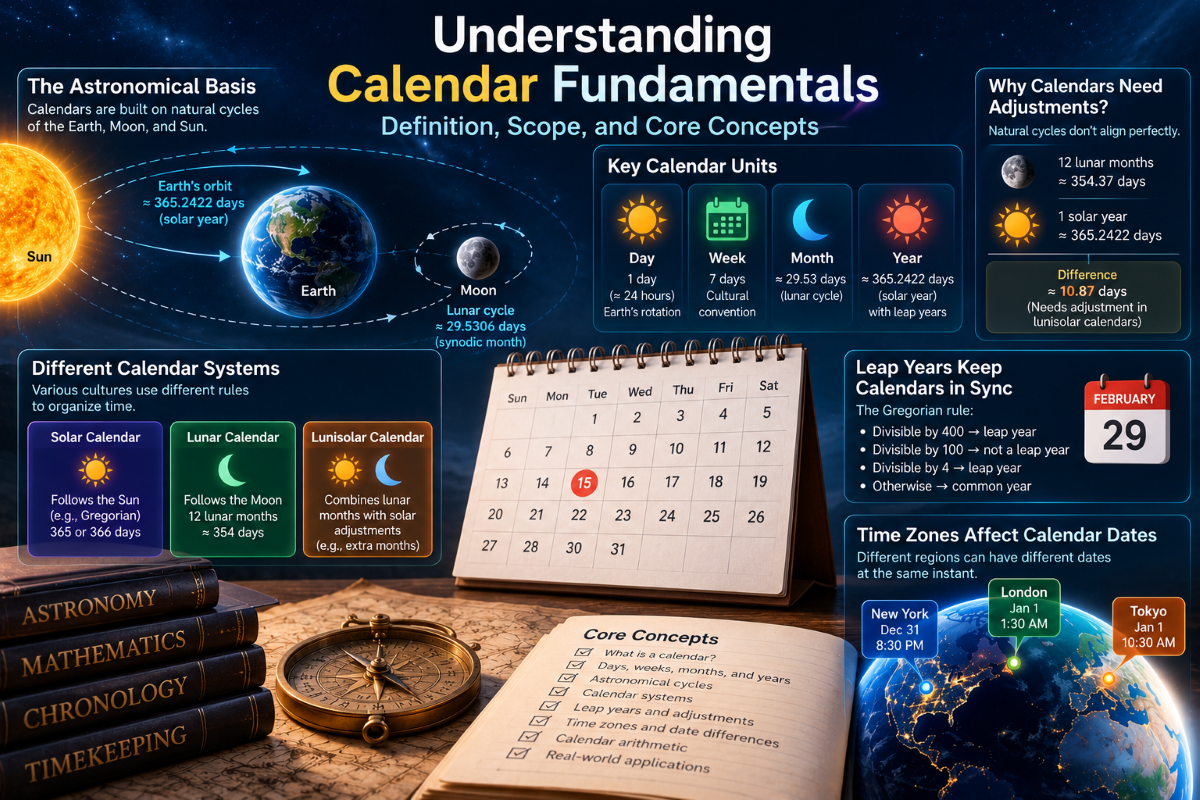
The average tropical year is approximately 365.2422 days, while a synodic lunar month is approximately 29.5306 days.
Twelve synodic months total approximately 354.37 days, which is shorter than a solar year.
This difference creates a challenge for calendar design.
A calendar that follows lunar months may gradually move through the seasons unless additional rules are used to keep it aligned with the solar year.
These relationships explain why calendars use different structures and correction methods.
4. The Day as a Fundamental Calendar Unit
The day is one of the most basic units in calendar organization.
It provides the foundation for numbering dates and organizing longer calendar periods.
4.1 Calendar days and elapsed time
A calendar day is a labeled date within a calendar system.
An elapsed duration of 24 hours is a fixed quantity of time under ordinary civil-time calculations, while the length of a local civil day can vary when clocks are adjusted for daylight saving time.
For example, when a region advances its clocks by one hour, the local calendar day may contain 23 hours of clock time. When clocks move backward, the local day may contain 25 hours.
This distinction is important when comparing calendar dates with elapsed durations.
4.2 Day boundaries
A calendar must define when one date ends and the next begins.
In the Gregorian civil calendar, dates are commonly organized around local midnight.
However, other calendar traditions may define the beginning of a day differently, including sunset-based conventions.
The day boundary therefore depends on the rules of the calendar system and the context in which it is used.
4.3 Numbering calendar days
A calendar assigns a number or label to each day within a month.
For example, the first day of a month is commonly labeled 1, followed by 2, 3, and so on.
This numbering allows dates to be represented using a combination of year, month, and day.
5. The Week and Its Role in Calendars
The week is a repeating sequence of seven days.
Unlike the day and year, the seven-day week is not directly determined by a simple astronomical cycle.
Its structure is primarily based on historical and cultural conventions.
5.1 The seven-day sequence
In the widely used Gregorian calendar, the seven-day week includes:
- Monday
- Tuesday
- Wednesday
- Thursday
- Friday
- Saturday
- Sunday
The sequence repeats continuously.
5.2 Weeks and calendar dates
Weeks provide a convenient way to organize recurring activities, work schedules, and events.
A date can be identified by its year, month, and day, or by its year, week number, and weekday under a specified week-numbering convention.
These representations are related but not always interchangeable without additional rules.
5.3 Week-numbering systems
Different conventions define the first day of the week and the first week of a calendar year differently.
For example, ISO week numbering uses Monday as the first day of the week and defines the first week as the week containing the first Thursday of the year.
As a result, some dates near the beginning or end of a Gregorian year may belong to a different ISO week-numbering year.
Understanding this distinction is important for calendars, business reports, and date-based data analysis.
6. Months and Their Different Lengths
A month is a calendar unit used to divide a year into smaller periods.
In the Gregorian calendar, months contain 28, 29, 30, or 31 days.
Their unequal lengths reflect the historical development of the calendar and the need to organize the year into manageable units.
6.1 Months in the Gregorian calendar
The Gregorian calendar contains 12 months:
January, February, March, April, May, June, July, August, September, October, November, and December.
The month lengths are:
- January: 31 days
- February: 28 days in a common year and 29 in a leap year
- March: 31 days
- April: 30 days
- May: 31 days
- June: 30 days
- July: 31 days
- August: 31 days
- September: 30 days
- October: 31 days
- November: 30 days
- December: 31 days
6.2 Calendar months and lunar months
A Gregorian month is not generally equal to a complete lunar cycle.
Although some calendar systems use months based on lunar observations, Gregorian month lengths are organized to maintain the calendar's structure and alignment with the solar year.
A lunar calendar may use alternating month lengths of 29 and 30 days to approximate the synodic month.
6.3 Month boundaries
A month begins with its first calendar day and ends with its final calendar day.
The number of days in the month determines its length.
When performing calculations involving months, software and calendar tools must account for these different lengths rather than assuming that every month contains an identical number of days.
7. The Year and Calendar Structure
A year organizes a larger sequence of calendar days into a recurring period.
The meaning of a year depends on the calendar system and its relationship to astronomical or conventional rules.
7.1 Common years
A common Gregorian calendar year contains 365 days.
The year is divided into 12 months, with February containing 28 days.
7.2 Leap years
A leap year contains 366 days, with an additional day assigned to February.
The Gregorian leap-year rule is:
- Years divisible by 400 are leap years.
- Years divisible by 100 but not by 400 are common years.
- Other years divisible by 4 are leap years.
For example, 2000 was a leap year, while 1900 was not.
The rule helps keep the calendar aligned with the seasonal year over long periods.
7.3 Why leap years are needed
The seasonal year is not exactly 365 days long.
If every calendar year contained exactly 365 days, the calendar's relationship with the seasons would gradually shift.
Leap-year adjustments help reduce this drift.
The Gregorian calendar uses a correction rule that provides a close approximation to the tropical year.
8. Major Types of Calendar Systems
Different calendar systems organize days, months, and years according to different principles.
Their structures reflect the natural cycles they follow and the conventions used to maintain their dates.
8.1 Solar calendars
Solar calendars are designed to remain aligned with the seasonal year.
The Gregorian calendar is the most widely used civil calendar internationally.
Its year structure uses 365 days in common years and 366 days in leap years.
The calendar's leap-year rule helps keep seasonal events, such as equinoxes, near their expected calendar dates.
8.2 Lunar calendars
Lunar calendars organize months according to lunar phases.
A lunar month is commonly based on the interval between successive new moons.
Twelve lunar months produce a year of approximately 354 days, which is shorter than the solar year.
Consequently, a purely lunar calendar does not remain aligned with the seasons.
8.3 Lunisolar calendars
Lunisolar calendars combine lunar months with adjustments intended to keep the calendar aligned with the solar year.
They may add an extra month in selected years.
This allows the calendar to follow lunar phases while also maintaining a relationship with seasonal cycles.
8.4 Other calendar structures
Some calendars use special year numbering, different month structures, or different rules for determining the beginning of a year.
These systems demonstrate that a calendar is not simply a universal arrangement of months and days. It is a defined framework with its own rules.
9. Calendar Epochs and Year Numbering
A calendar needs a method for identifying years.
Year numbering typically uses a reference point, known as an epoch or era.
9.1 The purpose of an epoch
An epoch establishes the point from which a system organizes its chronology.
It provides a reference for assigning year numbers and comparing dates within a calendar framework.
9.2 Different year-numbering systems
Different calendars may use different starting points for year numbering.
For this reason, a year number alone is not sufficient to identify a date universally.
A date should be interpreted using the calendar system and year-numbering convention that apply to it.
9.3 Historical dates
When studying historical records, researchers must consider the calendar system used at the time an event occurred.
A historical date may require conversion into another calendar before it can be compared accurately with dates in modern records.
Such conversions depend on the calendar rules and the historical period involved.
10. Calendar Dates and Time Zones
A calendar date identifies a day within a particular calendar system, while a time zone determines how local clock time relates to a common global reference.
These concepts are closely connected in modern timekeeping.
10.1 Local calendar dates
Different regions can have different local dates at the same instant.
For example, when it is early morning on a particular date in one country, another region may still be on the previous date.
This happens because local times are based on different time-zone offsets.
10.2 UTC as a reference
Coordinated Universal Time (UTC) provides a common reference for representing instants.
Applications often use UTC to exchange timestamps between systems, then convert those timestamps into local time for display.
10.3 Time-zone rules
Time zones are not determined solely by geographical longitude.
Countries and regions establish civil-time rules through laws and administrative decisions.
Some regions observe daylight saving time, while others use a consistent offset throughout the year.
These rules can also change over time.
10.4 Calendar date versus instant
A calendar date such as 1 January identifies a day, not a single moment.
A timestamp with sufficient time-zone information can identify an instant.
Keeping these concepts separate helps avoid errors when scheduling events or comparing dates across locations.
11. Calendar Arithmetic and Date Relationships
Calendar arithmetic involves calculating relationships between calendar dates.
These calculations are important in scheduling, historical research, accounting, and many digital applications.
11.1 Adding and subtracting days
Adding a number of calendar days moves forward through consecutive dates.
Subtracting calendar days moves backward through the date sequence.
These operations must account for month boundaries, year boundaries, and leap days.
11.2 Calculating date differences
The difference between two dates can be expressed as a number of elapsed days.
For example, the difference between 10 March and 15 March is five days when measured as the elapsed interval between the dates.
Counting both the starting and ending dates inclusively would produce six calendar dates.
The intended method should be specified whenever date differences are calculated.
11.3 Calendar months and years
A calendar month is not a fixed number of days.
Likewise, a calendar year is not always 365 days.
Calculations that add a month or a year therefore require calendar rules rather than simple multiplication by a fixed duration.
11.4 Recurring dates
Recurring dates include birthdays, anniversaries, monthly payments, and annual events.
Their recurrence depends on calendar rules.
For example, an event occurring on the last day of each month requires a different recurrence rule from an event occurring on the 15th day of each month.
12. The Relationship Between Calendars and Natural Cycles
Calendars organize time using units that are connected to natural phenomena or established conventions.
The relationship between these units is not always exact.
12.1 Natural cycles are continuous
Astronomical events occur continuously.
The Earth does not complete its orbit around the Sun at the exact instant that a calendar year ends.
Likewise, lunar phases do not necessarily occur at midnight or at the beginning of a calendar month.
12.2 Calendars use discrete units
A calendar must assign whole-number dates and organize them into recognizable units.
This requires conventions for defining boundaries and adjusting the calendar when astronomical cycles do not align with the chosen units.
12.3 Approximation and adjustment
Calendar systems use different methods to manage the difference between natural cycles and whole calendar units.
Leap days, intercalary months, and other adjustments help maintain the intended relationship between calendar dates and astronomical events.
This is a central principle of calendar design.
13. Why Calendar Fundamentals Matter in Everyday Life
Calendar systems support many activities beyond simply displaying the date.
13.1 Scheduling and planning
Calendars allow people to coordinate appointments, meetings, travel, and recurring events.
A shared calendar framework helps ensure that participants understand when an event is scheduled.
13.2 Education and research
Calendar concepts are useful in astronomy, mathematics, history, geography, and scientific data analysis.
Researchers use dates to organize observations and compare events across different periods.
13.3 Business and administration
Businesses rely on calendars to determine reporting periods, payment schedules, working days, deadlines, and annual planning cycles.
The calendar conventions used by an organization can influence how dates are calculated and interpreted.
13.4 Digital applications
Websites, mobile applications, databases, and scheduling tools use calendar structures to store and display dates.
Understanding the underlying principles helps users interpret date-based information correctly.
14. Common Misunderstandings About Calendars
Several common assumptions can lead to confusion.
Every year contains exactly 365 days.A Gregorian leap year contains 366 days.
Every month contains the same number of days.Gregorian month lengths vary between 28 and 31 days.
A calendar month is equal to a lunar month.Gregorian months do not generally correspond to complete lunar cycles.
A calendar date represents one exact instant.A date identifies a day, while an instant identifies a specific point on the timeline.
All calendar systems use the same year numbering.Different calendars may use different epochs and year-numbering conventions.
Time zones are determined only by geography.Civil-time rules are also established through legislation and administrative decisions.
Understanding these distinctions provides a more accurate foundation for interpreting dates.
Conclusion
Calendar fundamentals explain how people organize the passage of time into days, weeks, months, and years.
A calendar is a structured system that combines natural reference cycles with mathematical rules and human conventions. The day is associated with Earth's rotation, the year is related to Earth's orbit around the Sun, and lunar months are connected to the repeating phases of the Moon.
Because these cycles do not align perfectly, calendar systems use different structures and adjustment rules to organize dates consistently.
The Gregorian calendar, lunar calendars, and lunisolar calendars illustrate different approaches to the same fundamental challenge: transforming continuous natural cycles into a practical framework for identifying and organizing days.
Understanding calendar fundamentals provides a foundation for studying astronomy, chronology, timekeeping, date calculations, and modern digital systems. It also helps explain why calendars differ and why the meaning of a date depends on the calendar rules used to interpret it.
Frequently Asked Questions
What are calendar fundamentals?
Calendar fundamentals are the basic principles used to organize time into calendar units, including days, weeks, months, and years. They include the astronomical, mathematical, and conventional rules that define calendar structures.
What is the main purpose of a calendar?
The main purpose of a calendar is to organize time into recognizable units and assign dates to days so that events can be recorded, compared, and scheduled.
What is the difference between a calendar and a clock?
A calendar organizes days into longer periods such as weeks, months, and years. A clock measures or displays time within a day, such as hours, minutes, and seconds.
Why do calendars use leap years?
Leap years help keep a calendar aligned with the seasonal year because the time required for Earth to complete its seasonal cycle is not exactly 365 days.
What are the main types of calendars?
The main types include solar calendars, lunar calendars, and lunisolar calendars. They differ in how they organize months and years and how they relate to astronomical cycles.
What is a lunar month?
A lunar month is a period associated with the repeating phases of the Moon. The synodic month, measured from one new moon to the next, lasts approximately 29.53 days.
Why do different countries sometimes have different calendar dates at the same time?
Different countries and regions use different time zones. At a given instant, local clocks and calendar dates may differ because each region expresses time according to its civil-time rules.
Are all calendars based on astronomy?
Many calendar systems are influenced by astronomical cycles, but calendar structures also depend on cultural, historical, religious, and administrative conventions.
Why is understanding calendar fundamentals useful?
Calendar fundamentals help people understand date organization, timekeeping, astronomy, historical chronology, date calculations, scheduling, and the interpretation of dates across different calendar systems.
Comments
No comments yet.