Introduction
Time governs nearly every aspect of human civilization. From scheduling daily activities and coordinating transportation systems to launching spacecraft and conducting scientific research, accurate timekeeping is essential. While time on Earth feels familiar and predictable, it becomes far more fascinating when we look beyond our planet.
Mars, often called the Red Planet, has captured human imagination for centuries. Today, it stands at the center of future space exploration plans. Space agencies such as NASA and private organizations envision sending humans to Mars and eventually establishing permanent settlements there. However, living on Mars presents many challenges, and one of the most surprising involves something we rarely question on Earth: time itself.
Although Mars and Earth share similarities, their systems of timekeeping are not identical. A Martian day is slightly longer than an Earth day. A Martian year is almost twice as long as an Earth year. Seasons behave differently, and astronauts must adapt to an entirely new schedule.
Understanding Martian time is not merely an academic exercise. It is a practical necessity for spacecraft operations, rover missions, scientific experiments, and future human colonies.
In this comprehensive guide, we explore the differences between time on Mars and Earth, how scientists measure Martian time, why a Martian day is longer, and what life might be like when humanity eventually lives on another world.
Understanding Time on Earth
Before comparing Mars and Earth, it is important to understand how time is measured on our home planet.
Earth completes one rotation around its axis approximately every 24 hours. This rotation creates the cycle of day and night that structures human life.
Earth also travels around the Sun once every 365.25 days. This orbital period defines our year and creates the changing seasons.
Modern timekeeping uses atomic clocks, which measure the vibrations of atoms with extraordinary precision. Coordinated Universal Time (UTC) serves as the international standard used worldwide.
Because Earth rotates at a predictable rate, dividing the day into 24 hours, 60 minutes per hour, and 60 seconds per minute has become the foundation of modern civilization.
Mars, however, follows different astronomical rules.

How Long Is a Day on Mars?
One of the most famous facts about Mars is that its day is longer than Earth's.
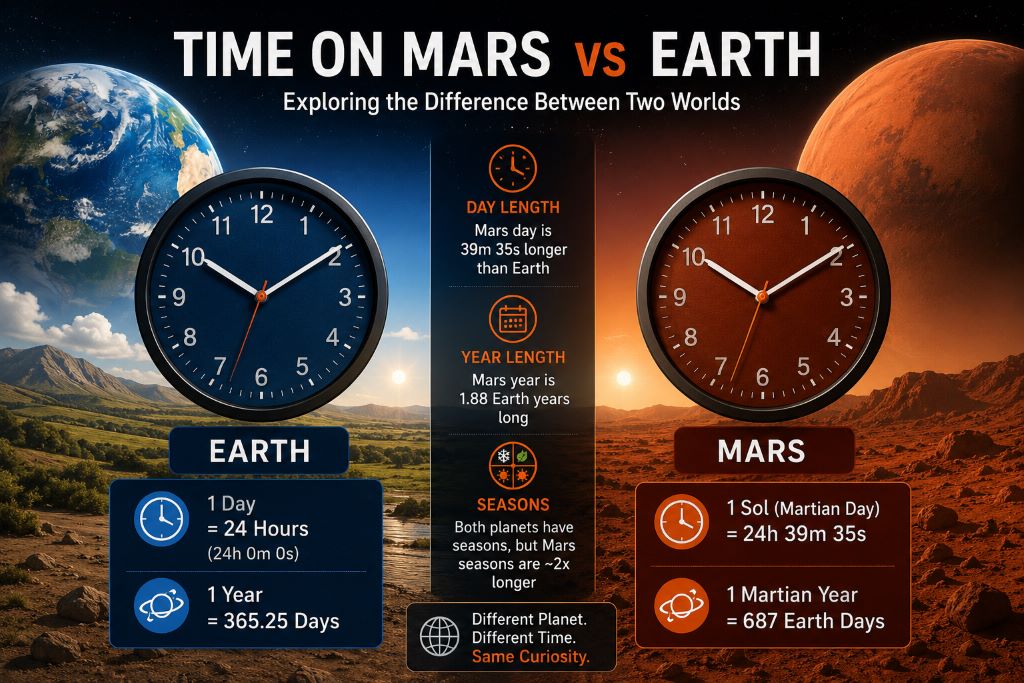
Scientists use the term "sol" to describe a Martian solar day.
A Martian sol lasts:
24 hours, 39 minutes, and 35 seconds
By comparison:
Earth day = 24 hours
This means a Martian day is approximately:
39 minutes and 35 seconds longer than an Earth day.
Although this difference seems small, it accumulates rapidly.
After several weeks, clocks synchronized with Martian time become significantly different from clocks on Earth.
For astronauts living on Mars, every day would begin roughly 40 minutes later than the previous Earth day.
Why Is a Martian Day Longer?
The answer lies in planetary rotation.
Mars rotates slightly more slowly than Earth.
Earth rotation period:
23 hours 56 minutes 4 seconds
Mars rotation period:
24 hours 37 minutes 22 seconds
Because Mars spins more slowly on its axis, sunlight takes longer to return to the same position in the sky.
This creates a longer solar day.
Interestingly, Mars has one of the most Earth-like day lengths in the Solar System.
Compare:
- Mercury day: 176 Earth days
- Venus day: 243 Earth days
- Jupiter day: 9.9 hours
- Saturn day: 10.7 hours
- Mars day: 24.6 hours
- Earth day: 24 hours
Among all planets, Mars is the closest match to Earth's daily cycle.
What Is a Sol?
A sol is the Martian equivalent of a day.
NASA frequently uses sols when operating Mars missions.
Instead of saying:
"Mission Day 100"
Scientists might say:
"Sol 100"
This indicates that 100 Martian days have passed since landing.
Examples include:
- Viking missions
- Spirit rover
- Opportunity rover
- Curiosity rover
- Perseverance rover
Using sols allows mission teams to synchronize operations with Martian daylight.
How Long Is a Year on Mars?
The differences become even more dramatic when examining years.
Earth completes one orbit around the Sun in:
365.25 days
Mars completes one orbit in:
687 Earth days
This means:
One Martian year equals approximately 1.88 Earth years.
In other words, if you were ten years old on Mars, you would be nearly nineteen years old on Earth.
This longer orbital period affects everything from seasonal cycles to future Martian calendars.
Why Is a Martian Year Longer?
Mars is farther from the Sun than Earth.
Average distance from Sun:
Earth:149.6 million kilometers
Mars:227.9 million kilometers
Because Mars travels along a larger orbital path, it takes longer to complete one revolution around the Sun.
A longer orbit naturally creates a longer year.
Seasons on Mars
Mars experiences seasons just like Earth.
This occurs because Mars is tilted on its axis.
Earth axial tilt:23.5°
Mars axial tilt:25.2°
These tilts are remarkably similar.
As a result, Mars experiences:
- Spring
- Summer
- Autumn
- Winter
However, seasons on Mars last much longer.
Since a Martian year is nearly twice as long, each season extends for several months more than on Earth.
A Martian summer can last around six Earth months.
Martian Months and Calendars
Scientists have proposed numerous Martian calendars.
Future colonists may eventually need:
- Martian months
- Martian weeks
- Martian holidays
- Martian work schedules
Several proposed calendars divide the Martian year into 24 months.
Others adapt Earth's Gregorian system.
No official Martian calendar currently exists, but one will become necessary if humans establish permanent settlements.
Sunrise and Sunset on Mars
Sunrises and sunsets on Mars look dramatically different.
Earth's atmosphere scatters blue light.
Mars' thin atmosphere scatters red dust.
As a result:
Earth:Blue sky, red-orange sunset
Mars:Red sky, blue sunset
The Martian sky often appears butterscotch-colored during the day.
At sunset, the sky near the Sun glows blue.
This unusual phenomenon is one of the most striking visual differences between the two worlds.
How NASA Uses Martian Time
Mars missions must operate according to local Martian daylight.
When a rover lands, engineers often switch to "Mars Time."
This means their work schedule follows Martian sols rather than Earth days.
For example:
Day 1:8:00 AM Earth time
Day 2:8:40 AM Earth time
Day 3:9:20 AM Earth time
Eventually, schedules drift into nighttime hours on Earth.
Mission controllers may find themselves working at midnight, 3 AM, or sunrise.
This adjustment ensures rover commands arrive during daylight on Mars.
The Challenges of Living on Martian Time
Adapting to Martian time is surprisingly difficult.
Humans evolved under a 24-hour cycle.
Our biological clocks regulate:
- Sleep
- Hormones
- Body temperature
- Alertness
Although Mars differs by only 39 minutes, maintaining synchronization can still be challenging.
Studies involving NASA engineers found:
- Sleep disruption
- Fatigue
- Reduced concentration
These effects may become significant during long-term Martian missions.
Would Humans Adapt Easily?
Scientists believe humans could adapt relatively well.
Research suggests the human circadian rhythm naturally averages slightly longer than 24 hours.
Many studies estimate:
24.2 to 24.9 hours
Since Mars has a 24.65-hour day, adaptation may be easier than expected.
Special lighting systems could help colonists adjust.
Artificial sunrise and sunset simulations may regulate biological clocks.
Time Zones on Mars
Earth has 24 major time zones.
Future Mars settlements may eventually require their own system.
Possible Martian time zones could be based on:
- Longitude
- Colony locations
- Scientific regions
Initially, settlements may use:
Mars Coordinated Time (MTC)
similar to UTC on Earth.
As populations grow, local Martian time zones may emerge.
Coordinated Mars Time (MTC)
Scientists already use a system called Mars Coordinated Time.
MTC serves a role similar to UTC.
It provides a standardized reference point for:
- Rovers
- Satellites
- Research teams
- Future astronauts
Without a common time standard, coordinating activities across Mars would become difficult.
Communication Delays Between Earth and Mars
Time differences become even more important because communication is not instantaneous.
Radio signals travel at the speed of light.
Depending on planetary positions:
Signal delay:3 to 22 minutes one way
Round-trip communication:6 to 44 minutes
This means astronauts cannot rely on real-time conversations with Earth.
Many decisions must be made independently.
Timekeeping becomes critical for coordinating operations.
How Rovers Experience Time
Mars rovers operate according to local solar time.
Each rover has:
- Internal clocks
- Solar tracking systems
- Mission schedules
Engineers plan activities based on:
- Sunrise
- Solar energy availability
- Temperature conditions
Every command sequence depends on accurate Martian timing.
Comparing Daily Life on Earth and Mars
Imagine waking up on Mars.
Your clock might show:
07:00 MTC
You begin work, eat meals, and follow routines much like on Earth.
However:
- The day lasts longer.
- Seasons last longer.
- Years pass more slowly.
Birthdays become rare events.
A child born on Mars would celebrate only one birthday every 687 Earth days.
This alone could create a unique Martian culture.
Sports, Work, and Education on Mars
Future colonies may redesign schedules.
Possible adaptations include:
Work
- 8-hour shifts
- Sol-based scheduling
- Flexible daylight operations
Schools
- Martian academic calendars
- Extended seasonal breaks
Sports
- Lower gravity competitions
- Sol-based tournaments
Timekeeping would influence every social institution.
Gravity and Time
According to Einstein's Theory of Relativity, gravity affects time.
Stronger gravity slows time slightly.
Earth's gravity is:
9.81 m/s²
Mars' gravity is:
3.71 m/s²
Because Mars has weaker gravity, clocks there run very slightly faster.
The effect is extremely small but measurable with precise instruments.
This demonstrates that time is not completely universal.
Relativity and Interplanetary Timekeeping
Modern navigation already accounts for relativistic effects.
GPS satellites require relativistic corrections daily.
Future Mars navigation systems will likely require similar adjustments.
Without such corrections:
- Navigation errors accumulate
- Positioning becomes inaccurate
- Scientific measurements suffer
Relativity will remain important even on another planet.
What Will Martian Clocks Look Like?
Future Martian clocks may display:
- Sol number
- Martian date
- Earth date
- MTC time
- Local colony time
Dual-planet clocks could become common in homes and workplaces.
Colonists may need constant awareness of both Earth and Mars schedules.
Could Mars Have Its Own Holidays?
Almost certainly.
As Martian society develops, new traditions may emerge:
- Landing Day celebrations
- Colony Founding Day
- First Harvest Festival
- Mars New Year
A distinct calendar naturally encourages unique cultural identities.
How Time Shapes the Future of Mars Colonization
Timekeeping may seem simple, but it is fundamental to civilization.
On Mars, accurate time affects:
- Transportation
- Communication
- Science
- Agriculture
- Healthcare
- Education
- Governance
Every future settlement will depend on reliable clocks and calendars.
The challenge is not merely technical—it is cultural and psychological as well.
Conclusion
Mars and Earth share many similarities, yet their systems of time differ in fascinating ways. A Martian day lasts 24 hours, 39 minutes, and 35 seconds, while a Martian year extends for 687 Earth days. These differences influence seasons, calendars, communication, scientific missions, and future human settlements.
NASA already operates using Martian sols when managing rover missions, and future astronauts will likely adapt their daily routines to Martian schedules. As humanity moves closer to becoming an interplanetary species, understanding how time works on Mars becomes increasingly important.
The study of Martian time reminds us that timekeeping is not merely about clocks and calendars. It is deeply connected to planetary motion, gravity, human biology, and civilization itself. One day, millions of people may check Martian clocks just as naturally as we check our watches today, marking the beginning of a new chapter in humanity's relationship with time.
Comments
No comments yet.