Introduction
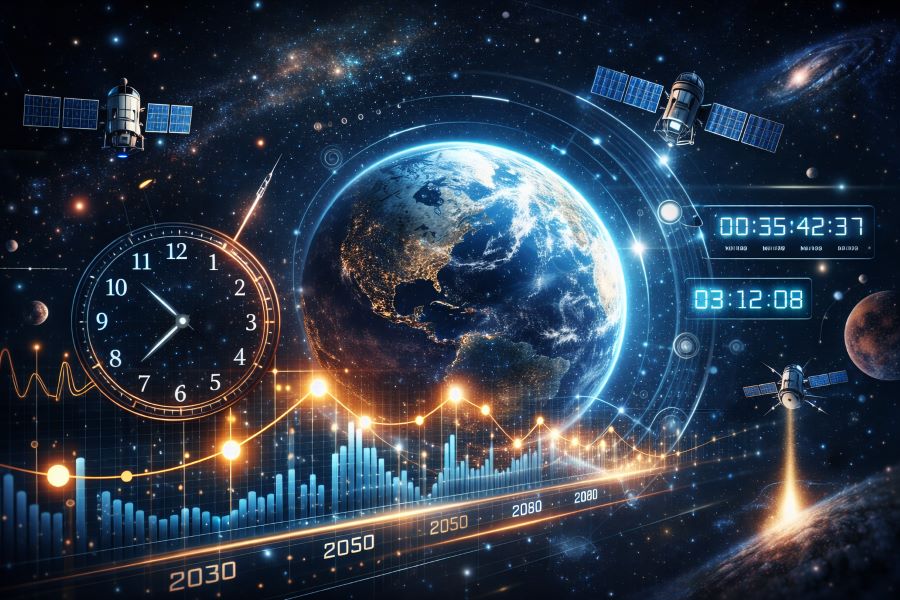
Time is one of the most fundamental dimensions of the universe. On Earth, it governs daily life, scientific processes, and technological systems. However, beyond our planet, time takes on an even more critical and complex role. In space exploration, time is not just a measurement—it is a precision tool, a navigational framework, and a scientific variable that determines the success or failure of missions.
From launching rockets at precisely calculated moments to synchronizing satellites orbiting Earth, time is deeply embedded in every aspect of space science. Without accurate timekeeping, modern space missions, global positioning systems, and astronomical observations would be impossible.
To understand its broader importance in human life and science, it is essential to explore time as the most valuable resource, which forms the foundation of all technological and scientific advancements.
This article explores the role of time in space exploration, examining how it influences navigation, relativity, satellite systems, communication, and the future of space technology.
Why Time Is Critical in Space Missions
Space missions operate in environments where even a millisecond can make a significant difference. Unlike terrestrial systems, where small timing errors may be negligible, space missions require extreme precision.
Launch Windows and Orbital Mechanics
Every space mission begins with a carefully calculated launch window. These windows are determined by:
- Planetary alignment
- Orbital trajectories
- Fuel efficiency considerations
A delay of even a few minutes can result in mission failure or require significantly more energy to correct the trajectory.
Synchronization of Systems
Spacecraft systems must operate in perfect synchronization:
- Navigation systems
- Communication modules
- Scientific instruments
Any deviation in timing can lead to incorrect data collection or loss of communication.
Time Measurement in Space Technology
Atomic Clocks: The Backbone of Space Timekeeping
Modern space exploration relies on atomic clocks, which are the most accurate timekeeping devices ever created. These clocks measure time based on the vibrations of atoms, typically cesium or rubidium.
To understand the evolution of precise timekeeping, explore how precise time measurement works, which laid the foundation for atomic clock technology.
Atomic clocks are used in:
- Satellites
- Space probes
- Ground control systems
They provide accuracy up to billionths of a second, which is essential for navigation and communication.
Deep Space Network and Time Coordination
NASA and other space agencies use global networks to track spacecraft. These systems depend on synchronized time signals to:
- Measure distances
- Calculate positions
- Send and receive signals
Time delays caused by vast distances in space must be carefully accounted for.
Relativity and Time in Space
One of the most fascinating aspects of time in space is its relationship with physics, particularly Einstein’s theory of relativity.
Time Dilation
According to relativity:
- Time moves slower in stronger gravitational fields
- Time moves differently at high velocities
This means that time on Earth and time in space are not the same.
For example:
- Astronauts on the International Space Station experience slightly slower time compared to people on Earth
- Satellites must adjust their clocks to account for these differences
Without these corrections, systems like GPS would fail within minutes.
Gravitational Effects on Time
The closer an object is to a massive body (like Earth), the slower time moves relative to objects farther away. This effect must be considered in:
- Satellite operations
- Space navigation
- Scientific measurements
GPS, Satellites, and Time Synchronization
One of the most practical applications of time in space exploration is the Global Positioning System (GPS).
How GPS Works
GPS relies on a network of satellites that continuously transmit time signals. A receiver calculates its position by measuring the time it takes for signals to travel from multiple satellites.
This requires:
- Extremely precise clocks
- Accurate synchronization
- Real-time corrections
Even a nanosecond error can result in location inaccuracies of several meters.
Satellite Communication
Satellites orbit Earth at high speeds and varying altitudes. To maintain communication:
- Signals must be timed precisely
- Data transmission must be synchronized
This ensures reliable communication for:
- Navigation systems
- Weather monitoring
- Global communications
Time and Navigation in Deep Space
Interplanetary Travel
When spacecraft travel to other planets, time becomes a critical factor in navigation.
Examples:
- Mars missions require precise timing for orbital insertion
- Spacecraft must adjust trajectories based on time-based calculations
Signal Delay and Communication
In deep space, communication delays can range from minutes to hours.
For example:
- Earth to Mars communication delay: 4 to 24 minutes
This means:
- Commands cannot be executed in real-time
- Spacecraft must operate autonomously
Time-based programming becomes essential for mission success.
Astronomy and the Measurement of Cosmic Time
Observing the Universe
Astronomers use time to study:
- Star lifecycles
- Planetary motion
- Cosmic events
Telescopes capture light that has traveled for millions or billions of years, allowing scientists to look back in time.
Cosmic Time Scale
The universe operates on vast time scales:
- Age of the universe: ~13.8 billion years
- Lifespan of stars: millions to billions of years
Understanding these scales helps scientists study the evolution of the cosmos.
The Role of Time in Space Technologies
Precision Engineering
Modern space technologies require extreme precision, similar to advancements in precision in timekeeping technology.
This includes:
- Satellite synchronization
- Navigation systems
- Scientific instruments
Autonomous Systems
Future space missions rely heavily on autonomous systems that operate based on time-based algorithms.
These systems:
- Execute tasks without human intervention
- Adapt to changing conditions
- Optimize performance over time
Challenges of Time in Space Exploration
Extreme Distances
The vast distances in space create challenges in:
- Communication delays
- Signal synchronization
Environmental Factors
Space conditions can affect timekeeping devices:
- Radiation
- Temperature fluctuations
- Microgravity
Data Complexity
Managing time-based data in space missions requires:
- Advanced algorithms
- High-performance computing
- Real-time processing
The Future of Time in Space Exploration
Next-Generation Clocks
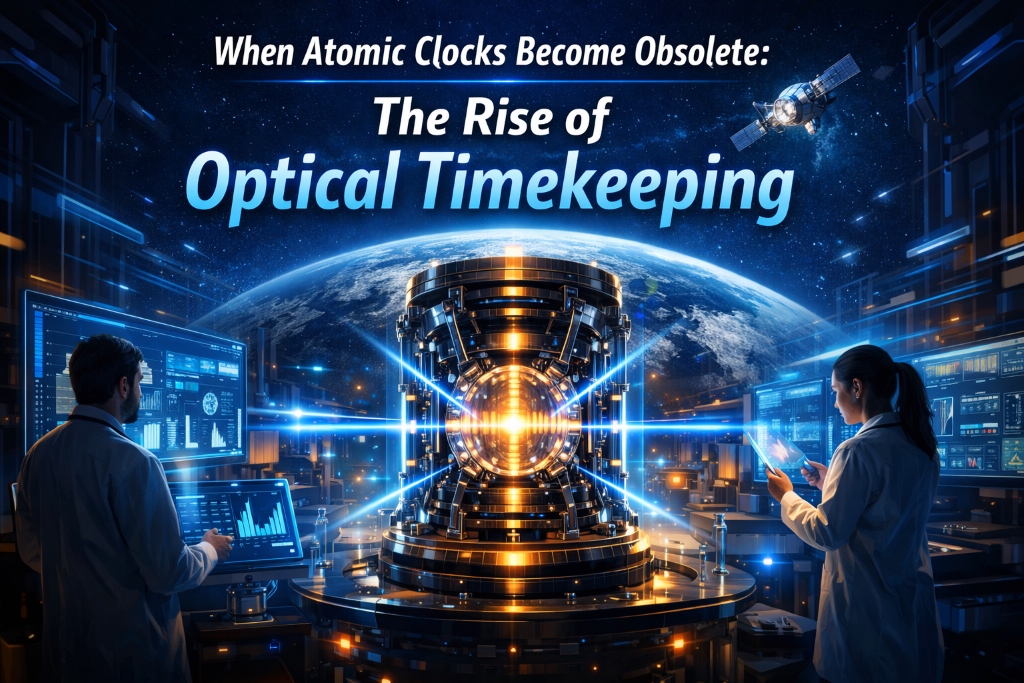
Scientists are developing optical and quantum clocks that are even more accurate than atomic clocks.
These clocks will:
- Improve navigation
- Enhance scientific measurements
- Enable deep space exploration
AI and Time Optimization
Artificial Intelligence will play a major role in managing time-based systems:
- Predictive navigation
- Real-time decision-making
- Autonomous mission control
Interstellar Exploration
Future missions beyond our solar system will depend heavily on precise time measurement.
Challenges include:
- Long-duration missions
- Communication delays spanning years
- Autonomous system
Ethical and Philosophical Perspectives
Time in space also raises deeper questions:
- How do humans perceive time in long-duration missions?
- What happens to human psychology in altered time environments?
- How does time influence our understanding of the universe?
These questions highlight the intersection of science, philosophy, and human experience.
Conclusion
Time is not just a tool for measuring moments—it is the foundation of space exploration. From launching spacecraft to navigating distant planets, from synchronizing satellites to understanding the universe, time plays a central role in every aspect of space science.
As technology advances, the importance of time will only grow. Future missions, powered by AI, quantum clocks, and advanced navigation systems, will rely on even greater precision and understanding of temporal dynamics.
In the vast expanse of space, where distances are immense and conditions are extreme, time remains the most reliable constant—guiding humanity’s journey into the unknown.
Comments
No comments yet.