Dates are among the most widely used forms of information in modern life. They appear in scientific observations, historical records, business documents, digital applications, databases, schedules, publications, and everyday communication. Although a date may contain only a few numbers or words, its meaning depends on a defined structure.
A date is not simply a sequence of numbers. It is a structured representation of a position within a calendar system. The individual components, their order, separators, and interpretation rules all contribute to its meaning.
This becomes particularly important when dates are exchanged between people, countries, organizations, and computer systems. A numerical expression such as 03/04/YYYY can be interpreted differently depending on the convention being used. One system may understand the first number as the month, while another may interpret it as the day.
International standards provide a way to reduce this type of ambiguity. Among the best-known standards for date and time representation is ISO 8601, which defines structured representations intended for information interchange.
However, understanding date formats requires more than learning one standard. It involves understanding the individual components of a date, the relationship between calendars and representations, the difference between dates and date-times, the role of precision and validation, and the way temporal information is handled by scientific and digital systems.
This article explores the structure of date formats from a scientific and technical perspective and explains why standardized temporal representations are important for accurate communication and reliable data.
What Is a Date Format?
A date format is a defined way of representing a calendar date.
The most familiar components of a conventional date are:
- Year
- Month
- Day
These components can be displayed using numbers, words, or combinations of both.
For example, a calendar date may be represented using a structure such as:
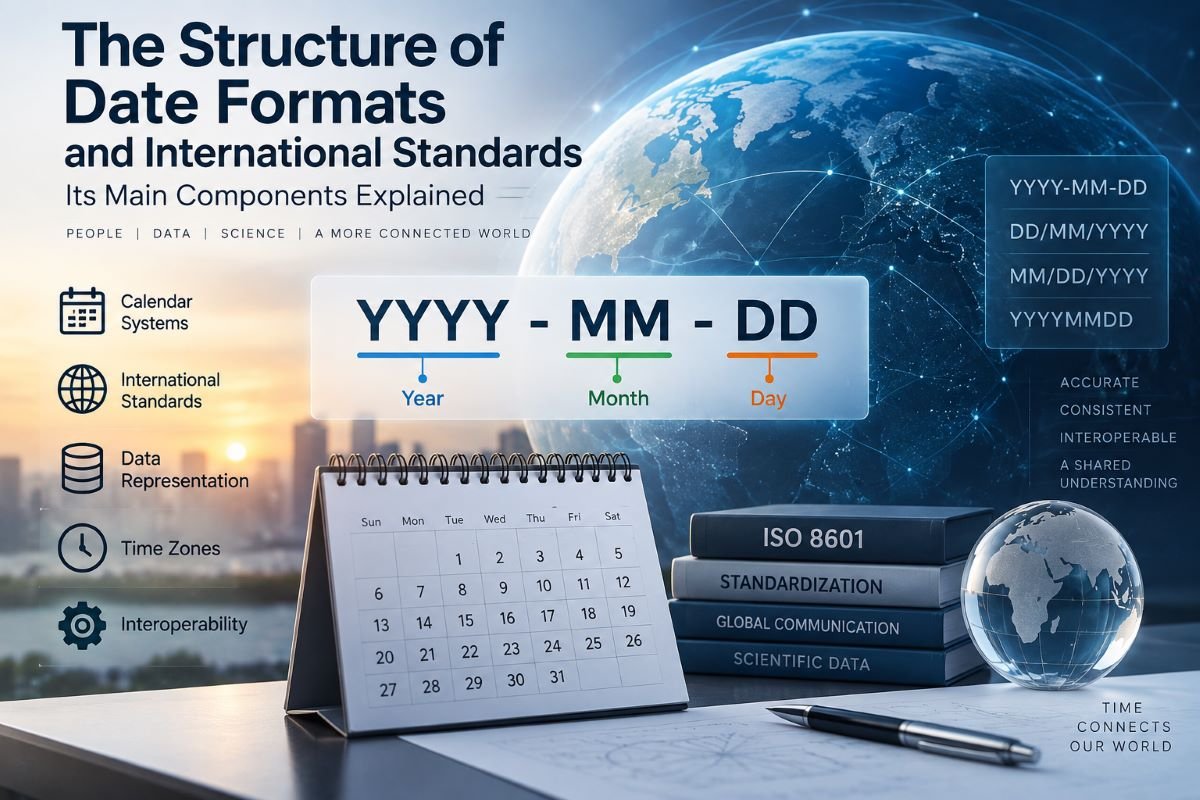
YYYY-MM-DD
The symbols indicate the role of each component:
- YYYY = year
- MM = month
- DD = day
The same underlying calendar date can also be displayed in a localized textual form, such as a month name followed by the day and year.
Therefore, a date format describes the appearance and arrangement of temporal information, while the calendar determines the system within which that date exists.
This distinction is fundamental.
A calendar defines how days, months, and years are organized. A date identifies a particular day within that system. A date format defines how that information is communicated.
Why Is the Structure of a Date Important?
The structure of a date determines how its components are interpreted.
Consider a numerical pattern such as:
04/05/YYYY
Without additional information, it may not be immediately clear whether:
- 04 represents the day and 05 represents the month, or
- 04 represents the month and 05 represents the day.
A person may infer the intended meaning from the surrounding context, language, or regional convention. A computer system, however, needs explicit rules.
This distinction is particularly important when information crosses boundaries.
Dates may be exchanged between:
- Different countries
- Different software applications
- Scientific institutions
- International organizations
- Databases
- Websites
- APIs
- Digital archives
A consistent structure reduces the amount of interpretation required.
The purpose of a standardized date format is therefore not simply visual consistency. It is to preserve the intended meaning of temporal information.
The Main Components of a Date Format
A conventional calendar date consists of three primary components.
1. Year
The year identifies the position of a calendar year within the relevant calendar system.
In a standardized year-month-day representation, the year is generally represented using four digits:
YYYY
The four-digit structure provides greater clarity than a shortened two-digit year.
For example:
YY
does not explicitly identify the century.
By contrast:
YYYY
provides a complete four-digit representation.
This becomes especially important in:
- Historical databases
- Scientific datasets
- Long-term archives
- Financial records
- Government records
- Software systems
The year is the largest conventional component of the date and is therefore placed first in year-month-day representations.
2. Month
The month identifies a particular subdivision of the calendar year.
In the Gregorian calendar, the year is divided into twelve months.
A numerical representation commonly uses:
MM
where the month occupies two digits.
The use of two digits provides a consistent structure.
For example:
- 01 represents the first month
- 06 represents the sixth month
- 12 represents the twelfth month
The month component is therefore not simply a number. Its meaning depends on the calendar system being used.
This is another reason that a date should be understood as structured information rather than an arbitrary sequence of numerical characters.
3. Day
The day identifies a particular position within a month.
The number of valid days depends on the month and, in some cases, the year.
A standardized representation commonly uses:
DD
The two-digit form provides consistency between dates.
However, the day component cannot be validated independently from the other components.
For example, whether a particular day number is valid depends on the month. The validity of the final day of a month can also depend on whether the year is a leap year.
This illustrates an important characteristic of calendar data:
Date components are related to one another.

The Relationship Between Date Components
Year, month, and day should not be treated as three completely independent values.
They form a hierarchical structure:
Year → Month → Day
The year establishes the larger temporal context.
The month identifies a subdivision within that year.
The day identifies a subdivision within that month.
This relationship is important for both human interpretation and computer processing.
A value such as:
YYYY-MM-DD
therefore communicates more than three separate numbers. It describes a particular location within a calendar structure.
Date Format and Calendar System Are Not the Same
A common misunderstanding is to assume that a date format determines the calendar.
It does not.
A calendar system defines how dates are organized.
A date format defines how those dates are represented.
The Gregorian calendar is widely used for civil purposes, but other calendar systems also exist.
Different calendars can organize years, months, and days according to different rules.
Therefore, a complete temporal interpretation may require two types of information:
- Which calendar system is being used?
- How is the date represented?
The format alone cannot always answer both questions.
This distinction is especially important in scientific research, historical studies, software localization, and systems that support multiple calendar systems.
The Importance of Component Order
The order of date components is one of the most visible differences between date conventions.
Three broad patterns are commonly encountered:
Day-Month-Year
DD/MM/YYYY
Month-Day-Year
MM/DD/YYYY
Year-Month-Day
YYYY-MM-DD
Each arrangement can be meaningful when the convention is clearly established.
The difficulty occurs when a date is presented without identifying its convention.
A value such as:
05/06/YYYY
can be interpreted differently by readers using different conventions.
This is why internationally exchanged information benefits from explicit component ordering.
Why Year-Month-Day Is Useful for Structured Data
The year-month-day arrangement has an important technical characteristic.
It places the largest component first and the smallest conventional component last:
Year → Month → Day
When all components use fixed widths, this structure also makes chronological sorting easier.
For example, a collection of consistently formatted dates can be ordered according to:
- Year
- Month
- Day
This can make the representation particularly useful in:
- Databases
- File names
- Digital archives
- Scientific datasets
- Logs
- Data exports
- Software systems
The benefit comes from the structure itself.
The representation follows the same hierarchical direction as the temporal units.
What Do the Hyphens Mean?
The hyphens in:
YYYY-MM-DD
are separators.
Their purpose is to make the boundaries between components immediately visible.
Without separators, a compact representation can be written as:
YYYYMMDD
The information can still be structured because the component widths are defined.
With separators:
YYYY-MM-DD
the structure is easier for humans to read.
This demonstrates the difference between syntax and meaning.
The hyphens improve readability and explicitly separate components, while the defined order determines how those components are interpreted.
Why Leading Zeros Matter
Leading zeros are often used to create fixed-width date components.
Compare:
YYYY-M-D
with:
YYYY-MM-DD
The second representation is structurally more consistent.
A month always occupies two positions.
A day always occupies two positions.
This consistency is useful for machine processing, text comparison, sorting, and data validation.
For example, dates stored using a consistent structure can be compared more predictably than dates whose components have varying widths.
Leading zeros therefore serve a practical data-organization purpose rather than merely being a visual preference.
Date Validity: More Than Checking the Format
A date can have the correct appearance while still being invalid.
For example, a value may follow the general pattern:
YYYY-MM-DD
but contain a day that does not exist in the specified month.
This creates two separate validation questions:
Structural validation
Does the value follow the expected pattern?
Calendar validation
Does the value represent a real date according to the applicable calendar rules?
A reliable date-processing system needs to consider both.
This distinction is important in software development and scientific data processing because syntactically correct information is not necessarily semantically correct.
Leap Years and Calendar Logic
Leap years demonstrate why date validation requires knowledge of calendar rules.
In the Gregorian calendar, February normally contains fewer days than the other months, and an additional day is included during a leap year.
The leap-year rules involve divisibility by four, with special treatment for century years and years divisible by four hundred.
As a result, determining whether a particular day is valid may require examining the year as well as the month.
This shows that a date is a relational structure.
The year can affect the number of valid days in a particular month.
Date Precision and Temporal Resolution
Not all temporal information needs the same level of precision.
A record may identify:
YYYY
Another may identify:
YYYY-MM
Another may identify:
YYYY-MM-DD
A more detailed record may include:
YYYY-MM-DDThh:mm:ss
These values contain progressively more temporal information.
The appropriate representation depends on the precision of the underlying observation.
A scientific dataset describing an annual measurement does not necessarily need a precise timestamp.
Conversely, an instrument recording rapidly changing physical phenomena may require date and time information at a much finer resolution.
This leads to an important scientific principle:
More digits do not automatically mean more accurate information.
Representation precision should reflect the actual temporal resolution of the observation.
Date Versus Date-Time
A date and a date-time describe different types of information.
A date identifies a calendar day.
A date-time identifies a calendar date together with a time of day.
A structured date-time can follow a pattern such as:
YYYY-MM-DDThh:mm:ss
The letter T separates the date component from the time component.
For example, the structure can be understood as:
Date + T + Time
The time portion can then be divided into:
- Hour
- Minute
- Second
The distinction is important because knowing the day does not necessarily identify the exact moment at which an event occurred.
The Components of a Time Value
When time is added to a date, additional components become relevant.
Hour
Identifies the hour within the day.
Minute
Identifies the minute within the hour.
Second
Identifies the second within the minute.
A timestamp can therefore be conceptually represented as:
Year → Month → Day → Hour → Minute → Second
This creates a progressively more precise temporal structure.
Depending on the application, even smaller units such as fractions of a second may be required.
Scientific instruments, telecommunications systems, financial infrastructure, and high-speed computing applications may require very precise timestamps.
Time Zones and Date Representation
Time zones become important when a date-time is associated with a particular location.
A local clock reading such as:
YYYY-MM-DDThh:mm:ss
does not necessarily identify one unique moment worldwide unless the relevant time-zone context is known.
A date-time may therefore include a UTC offset.
A representation can use a structure such as:
YYYY-MM-DDThh:mm:ss+hh:mm
or another valid offset form.
The offset expresses the relationship between local time and Coordinated Universal Time.
This is particularly important for:
- International scheduling
- Transportation
- Scientific observations
- Distributed systems
- Online services
- Financial transactions
- Telecommunications
The Meaning of Z in a Timestamp
A timestamp ending in:
Z
uses the UTC designator for a zero UTC offset.
A general structure may look like:
YYYY-MM-DDThh:mm:ssZ
The Z provides important information about the time reference.
This is different from a local time that contains no time-zone context.
The distinction becomes especially important when two systems operating in different locations exchange timestamps.
UTC and ISO 8601 Are Different Concepts
UTC and ISO 8601 are closely related in practical applications, but they are not the same thing.
UTC is a time scale.
ISO 8601 is a representation standard.
UTC provides an internationally coordinated reference for time.
ISO 8601 provides structured methods for representing date and time information.
A system can therefore use UTC as the temporal reference while using an ISO-style representation to communicate the value.
Keeping these concepts separate helps avoid confusion between what a time means and how that time is written.
Ordinal Dates
A conventional calendar date identifies a day using:
Year + Month + Day
An ordinal date uses a different structure:
Year + Day of Year
Instead of identifying the month and day separately, it identifies the sequential position of the day within the year.
This approach can be useful when data is naturally organized as a continuous sequence of days.
Potential applications include:
- Scientific observations
- Engineering records
- Industrial operations
- Environmental monitoring
- Time-series datasets
Ordinal dates demonstrate that there is more than one valid way to represent temporal position.
Week-Based Dates
Another approach identifies a date according to a week-based structure.
A week-based representation can identify:
- Week-based year
- Week number
- Weekday
This can be useful when activities are organized around weekly cycles rather than monthly calendars.
Examples include:
- Production planning
- Business reporting
- Logistics
- Manufacturing
- Project management
- Operational scheduling
Week-based representations are particularly useful when the week is the primary organizational unit.
Intervals Between Dates
Sometimes the important information is not one date but the period between two dates.
An interval can be represented conceptually as:
Start → End
This structure is useful for describing:
- Research periods
- Observation windows
- Project durations
- Operating periods
- Subscription periods
- Historical ranges
The concept of an interval is different from a single date.
A date identifies a temporal position, while an interval describes a span between temporal boundaries.
This distinction becomes important in scientific analysis and scheduling systems.
Recurring Temporal Information
Some applications need to describe events that repeat according to a pattern.
Examples include:
- Weekly events
- Monthly reporting
- Annual maintenance
- Repeated observations
- Recurring appointments
A recurring event is not simply a collection of unrelated dates.
It has a temporal rule or pattern.
This is another reason modern date and time standards extend beyond the representation of individual calendar days.
Temporal information can describe:
points, durations, intervals, and recurring patterns.
Date Formats as Machine-Readable Data
A modern computer system does not need to treat a date as a piece of ordinary text.
Dates can be represented as structured data with distinct components.
Conceptually, a date object can contain:
| Year |
| Month |
| Day |
A date-time object can extend this structure:
| Year |
| Month |
| Day |
| Hour |
| Minute |
| Second |
| Time-zone information |
This allows software to perform operations such as:
- Date comparison
- Sorting
- Filtering
- Validation
- Date arithmetic
- Conversion
- Formatting
- Data exchange
The visible date displayed to a user is therefore only one representation of the underlying temporal data.
Storage Format and Display Format
A major principle in international software is to distinguish between how temporal data is stored or exchanged and how it is displayed.
A system may internally use a standardized representation such as:
YYYY-MM-DD
while showing a localized form to the user.
This allows different audiences to interact with the same underlying information using familiar conventions.
For example:
Machine representation → Localized display
The stored value remains consistent while the presentation can adapt to:
- Language
- Region
- User preference
- Application context
This approach is particularly important for websites and applications serving international audiences.
Localization Does Not Mean Changing the Date
Localization can change how a date appears without changing the underlying calendar value.
This is an important distinction.
Suppose an application stores one date internally.
It may display that date using:
- Numeric notation
- A month name
- A day-first convention
- A month-first convention
The presentation can change while the underlying temporal value remains the same.
This separation helps international software support users from different regions without creating multiple interpretations of the stored information.
Date Formats in Scientific Research
Scientific research frequently depends on accurate temporal information.
Researchers may record when:
- An observation occurred
- A sample was collected
- An experiment began
- An instrument produced a measurement
- A process ended
- A dataset was created
When datasets from multiple sources are combined, inconsistent date representations can make chronological analysis more difficult.
A standardized temporal structure helps researchers:
- Sort observations
- Compare measurements
- Identify sequences
- Detect gaps
- Calculate intervals
- Exchange datasets
Date representation can therefore become an important part of scientific data quality.
Date Formats in Time-Series Data
A time series consists of observations associated with temporal positions.
Examples include:
- Environmental measurements
- Economic indicators
- Sensor readings
- Astronomical observations
- Laboratory measurements
- System monitoring data
A time-series dataset may contain thousands or millions of observations.
Each observation needs a reliable temporal reference.
If date values are ambiguous or inconsistently formatted, the sequence of observations can become difficult to reconstruct.
Standardized date and time representations help preserve the chronological structure of the dataset.
Why Scientific Data Needs Consistency
Imagine combining measurements from several research groups.
One dataset may use:
DD/MM/YYYY
Another may use:
MM/DD/YYYY
A third may use:
YYYY-MM-DD
If the conventions are not documented or normalized, automated data processing may misinterpret some records.
This can affect:
- Sorting
- Statistical analysis
- Trend identification
- Event correlation
- Data visualization
- Reproducibility
The problem is therefore not merely cosmetic.
An ambiguous date can become a data-quality problem.
Date Standards and Interoperability
Interoperability means that different systems can exchange information and correctly interpret it.
Date standards contribute to interoperability by providing predictable representations.
Consider a digital workflow:
Instrument → Database → API → Application → User Interface
Temporal information may pass through every stage.
Each system needs to preserve the meaning of the date.
A standardized representation reduces the need for every system to develop its own interpretation rules.
This can simplify:
- Data integration
- API communication
- Database design
- Software development
- Scientific collaboration
- Digital archiving
ISO 8601 and International Information Exchange
ISO 8601 is important because it provides standardized representations for dates and times used in information interchange.
The familiar structure:
YYYY-MM-DD
is one of its best-known representations.
However, ISO 8601 is broader than this single pattern.
It includes representations related to:
- Calendar dates
- Times
- Combined date-times
- UTC relationships
- Time offsets
- Week dates
- Ordinal dates
- Intervals
- Recurring temporal information
Understanding this broader scope prevents the common mistake of treating ISO 8601 as simply another name for YYYY-MM-DD.
It is better understood as a framework for structured temporal representation.
ISO 8601 and RFC 3339
Another specification frequently encountered in digital systems is RFC 3339.
RFC 3339 is focused on Internet date-time representation and is related to concepts from ISO 8601.
The two should not be considered identical.
ISO 8601 provides a broader international framework.
RFC 3339 defines a more specific profile intended for Internet applications.
This distinction can matter when developers work with:
- APIs
- Web services
- Internet protocols
- Application logs
- Distributed systems
The exact specification being followed should therefore be identified when precise interoperability is required.
Common Date-Format Problems
Several problems can occur when date information is represented or exchanged.
Ambiguous component order
A numerical date may not reveal whether the first component is the day or month.
Two-digit years
Short years can create uncertainty about the century.
Inconsistent formatting
Different records may use different structures.
Invalid dates
A value can follow the general pattern while violating calendar rules.
Missing time-zone context
A local date-time may not identify a unique global moment.
Incorrect conversion
Software can introduce errors when converting between representations.
Excessive precision
A timestamp may imply more temporal accuracy than the original measurement actually supports.
These problems demonstrate why date handling requires both formatting conventions and logical validation.
A Layered View of Temporal Information
Date and time information can be understood as a series of layers.
Layer 1: Calendar System
Defines how days, months, and years are organized.
Layer 2: Calendar Date
Identifies a particular day.
Layer 3: Date Representation
Defines how the date is written.
Layer 4: Time of Day
Adds hours, minutes, and seconds.
Layer 5: Time-Zone Context
Provides the relationship between local time and a reference such as UTC.
Layer 6: Data Exchange
Defines how the information is transferred between systems.
Layer 7: User Presentation
Determines how the information is displayed to a particular audience.
This layered model helps explain why the same temporal information can have different appearances without having different meanings.
Date Formats and Information Accuracy
A standardized format does not automatically make a date factually correct.
For example, a value may be perfectly formatted but still contain the wrong day.
Standardization addresses representation consistency.
It does not guarantee:
- Correct data collection
- Correct measurement
- Correct source information
- Correct conversion
- Correct event timing
Therefore, date quality has several dimensions.
Reliable temporal data should be:
- Correct
- Valid
- Consistent
- Unambiguous
- Appropriately precise
- Properly contextualized
Formatting standards contribute to these goals but are only one part of a larger data-quality process.
Why Date Formats Matter in Digital Archives
Digital records may need to remain understandable for long periods.
A standardized representation can help future systems identify the structure of stored temporal information.
This is particularly useful for:
- Research archives
- Government records
- Institutional databases
- Historical datasets
- Digital libraries
- Software logs
A clearly structured date is less dependent on the reader knowing a particular local convention.
This makes standardized representations valuable for long-term information preservation.
Date Formats and File Naming
Dates are frequently included in filenames.
For example, a generic structure might be:
YYYY-MM-DD-report
Using the year first can make collections of dated files easier to organize chronologically.
When the same fixed-width structure is used consistently, alphabetical sorting can correspond naturally with chronological ordering.
This can be useful for:
- Research files
- Reports
- Backups
- Data exports
- Laboratory records
- Digital archives
The benefit comes from applying a consistent structure rather than relying on local assumptions.
Why Standardization Does Not Eliminate Local Formats
International standards do not necessarily require everyone to use one visual date format in everyday communication.
Local conventions remain useful.
A person may prefer a familiar regional format when reading a calendar or writing a personal document.
A global software system, however, may use a standardized representation internally.
This creates a practical relationship:
Local presentation + standardized data exchange
Both can coexist.
The user receives familiar information, while systems exchange data using a clearly defined structure.
Date Formats and Global Applications
Modern applications often serve users across geographical boundaries.
A single platform may need to handle:
- Different languages
- Different date conventions
- Multiple time zones
- International users
- Different calendar preferences
- Machine-readable data
- External APIs
The underlying data must remain consistent even when presentation changes.
This is why international date representation is an important part of software internationalization.
A reliable application should not assume that every user interprets numerical dates in the same way.
Why Date Standards Matter to Science
Science depends on observations that can be compared, reproduced, and analyzed.
Temporal information is part of that process.
A scientific result may depend on knowing:
- When an observation was made
- The order of measurements
- The interval between events
- Whether observations occurred before or after another event
- The temporal resolution of the measurement
Standardized date representation helps preserve these relationships.
It also makes it easier to exchange scientific datasets between researchers and institutions.
In this sense, date standards support not only communication but also the reproducibility and interoperability of scientific information.
A Practical Model for Understanding Date Formats
A useful way to analyze any date format is to ask five questions:
1. What calendar is being used?
This determines the underlying calendar rules.
2. What components are included?
For example:
Year + Month + Day
3. In what order are the components arranged?
For example:
Year → Month → Day
4. How are the components separated?
For example:
Hyphens, slashes, periods, or spaces
5. Is additional temporal context included?
For example:
Time, UTC offset, or time-zone information
These questions make it easier to determine exactly what a date representation means.
The Future of Structured Temporal Information
As digital systems become more interconnected, temporal information will continue to play an important role.
Scientific instruments, distributed computing systems, artificial intelligence applications, cloud platforms, navigation technologies, and international databases all depend on reliable temporal information.
Future systems may require increasingly precise representations of events and relationships between events.
However, the basic principle will remain unchanged:
Temporal information needs a clearly defined structure if different systems are expected to interpret it consistently.
The continued importance of standards therefore reflects a broader technological trend toward interoperable data.
Key Takeaways
The structure of date formats can be summarized through several fundamental principles:
- A date is structured temporal information rather than an arbitrary sequence of numbers.
- The principal components of a conventional date are year, month, and day.
- The order of these components determines how numerical dates are interpreted.
- Leading zeros create consistent component widths.
- Separators improve readability and distinguish individual components.
- A structurally correct date may still be invalid according to calendar rules.
- Leap-year rules demonstrate the relationship between date components.
- A date identifies a calendar day, while a date-time adds time-of-day information.
- Time-zone information may be necessary when a date-time represents a precise global moment.
- ISO 8601 provides internationally recognized representations for date and time information.
- RFC 3339 provides a more specific Internet-oriented date-time profile.
- Standardized representations improve data interoperability.
- Scientific datasets benefit from consistent temporal representation.
- Localized display formats can coexist with standardized internal representations.
- Date precision should reflect the precision of the underlying information.
Frequently Asked Questions
What are the main components of a date format?
The primary components of a conventional calendar date are the year, month, and day. These components can be arranged according to different conventions.
What does YYYY-MM-DD represent?
YYYY-MM-DD represents a year-month-day structure. YYYY identifies the year, MM identifies the month, and DD identifies the day.
Why are dates sometimes written in different orders?
Different regions and applications use different conventions for arranging the day, month, and year. A standardized format can reduce ambiguity when information crosses these boundaries.
Why is YYYY-MM-DD useful?
The year-month-day structure provides an explicit component order and works particularly well for machine-readable data, sorting, databases, file names, and international information exchange.
What is the purpose of leading zeros?
Leading zeros create fixed-width month and day components. This makes dates more consistent for both human reading and computer processing.
Can a date have the correct format but still be invalid?
Yes. A date may follow the expected structural pattern while containing a day that does not exist in the applicable calendar.
What is the difference between a calendar and a date format?
A calendar defines how days, months, and years are organized. A date format defines how a particular date is represented or displayed.
What is the difference between a date and a date-time?
A date identifies a calendar day. A date-time combines the calendar date with a time of day.
Why is the letter T used in date-time representations?
The letter T is commonly used as a separator between the date and time portions of an ISO-style date-time representation.
What does Z mean in a timestamp?
The Z designator indicates a zero UTC offset in a timestamp representation.
What is UTC?
UTC, or Coordinated Universal Time, is an internationally coordinated reference time scale. It is different from a date representation standard such as ISO 8601.
What is an ordinal date?
An ordinal date identifies a day according to its position within the year rather than using a month and day combination.
What is a week date?
A week date identifies temporal information using a week-based year, week number, and weekday.
What is ISO 8601?
ISO 8601 is an international standard that defines structured representations of dates and times for information interchange.
Is ISO 8601 the same as RFC 3339?
No. RFC 3339 is an Internet-focused specification related to ISO 8601 concepts, while ISO 8601 provides a broader framework for date and time representation.
Why are date standards important in scientific research?
Scientific datasets often combine observations from different sources. Consistent date representation helps researchers organize, compare, exchange, and analyze temporal information accurately.
Should every website display dates in the same format?
No. Websites can use standardized representations internally while displaying dates according to the user's regional or language preferences.
Why are time zones important?
A local time may not identify the same moment everywhere. Time-zone or UTC-offset information can provide the additional context needed for international date-time coordination.
Why should date precision match the underlying data?
Using more apparent precision than the original observation supports can create a misleading impression of accuracy. Temporal representation should reflect the actual resolution of the information.
Final Perspective
The structure of a date is a compact example of how science and technology transform real-world information into a form that people and machines can understand.
A conventional date consists of interconnected components—year, month, and day—but reliable temporal representation extends beyond these three values. Calendar rules determine validity, component ordering determines interpretation, separators and leading zeros provide structural consistency, and additional time-zone information can establish the relationship between local time and a global reference.
International standards such as ISO 8601 provide a common framework for representing this information when it needs to move between systems and organizations.
The significance of standardized date formats is therefore not simply that they make dates look uniform. Their deeper value lies in making temporal information structured, interpretable, comparable, and interoperable.
For scientific research, digital databases, software applications, international communication, and long-term data preservation, that consistency is essential.
A date may appear to be only a small piece of information, but when its structure is clearly defined, it becomes a reliable building block for much larger systems of scientific and digital knowledge.
Comments
No comments yet.