Introduction
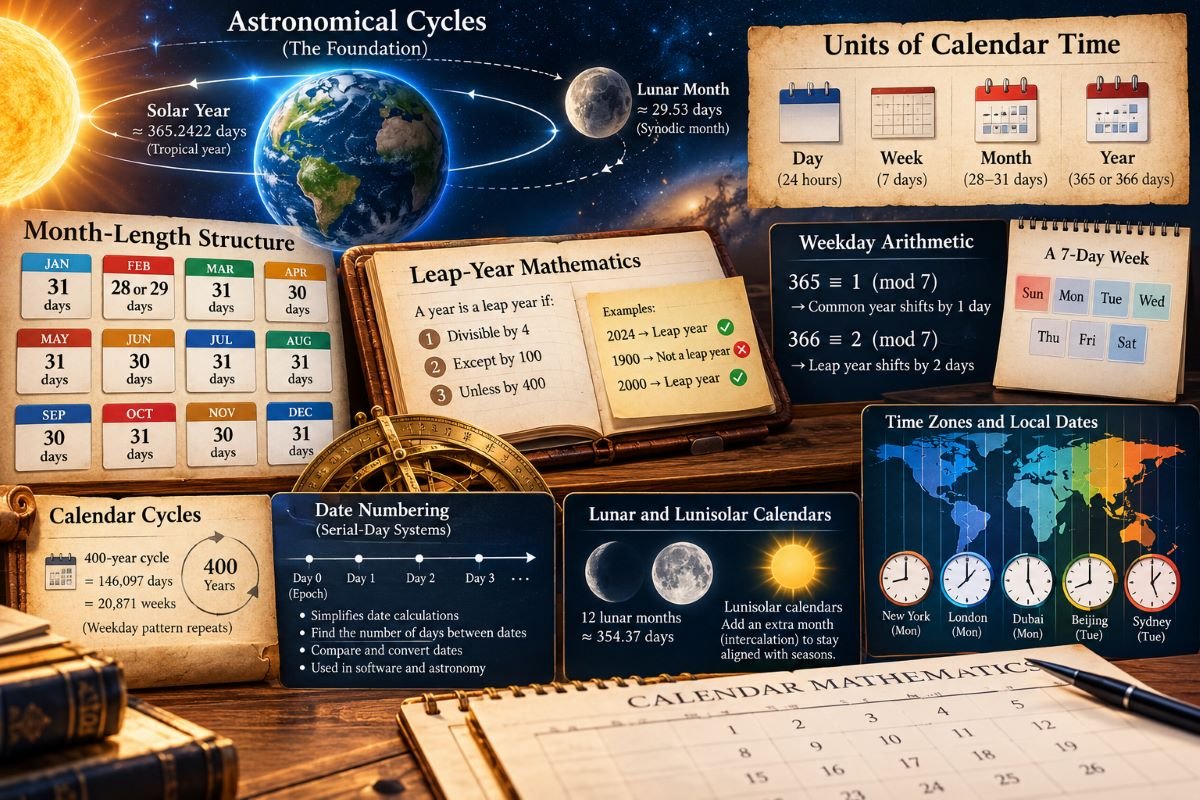
Calendars are among the most familiar systems used in everyday life, yet their underlying structure involves a surprisingly complex combination of astronomy, arithmetic, numerical patterns, and time measurement. People use calendars to schedule appointments, calculate ages, plan journeys, manage financial deadlines, and organize events. Although a calendar may appear to be a simple arrangement of days, weeks, months, and years, its construction depends on mathematical relationships that are not always straightforward.
Calendar mathematics is the study of the numerical rules and relationships that organize dates and connect them to the passage of time. It explains why years have different lengths, why months contain unequal numbers of days, how weekdays repeat in predictable patterns, and why leap years are necessary in certain calendar systems.
The central challenge is that the natural cycles used to measure time do not fit together into perfect whole-number relationships. Earth's revolution around the Sun does not take exactly 365 days, and the lunar cycle does not divide evenly into either a civil month or a solar year. Calendars must therefore use carefully designed rules to keep dates reasonably aligned with astronomical seasons and other recurring events.
The Gregorian calendar, which is widely used for civil purposes, addresses this challenge through a combination of fixed month lengths, a seven-day week, leap-year rules, and a repeating pattern of ordinary and leap years. Other calendar systems use different combinations of lunar observations, solar calculations, and intercalation rules.
Understanding the structure of calendar mathematics requires examining its major components separately and then seeing how they work together. These components include astronomical cycles, units of calendar time, leap-year calculations, weekday arithmetic, date numbering, recurring patterns, and algorithms for converting between dates.
1. Astronomical Cycles: The Foundation of Calendar Mathematics
Calendar systems begin with the observation of recurring natural events. Although modern civil calendars rely on defined numerical rules, the need for those rules originally arose from the behavior of the Earth, Moon, and Sun.
Three astronomical cycles are particularly important.
1.1 The solar year
A solar year describes the cycle associated with Earth's orbit around the Sun. For seasonal calendars, the tropical year—the average interval between corresponding seasonal points, such as successive March equinoxes—is especially important.
The tropical year is approximately 365.2422 days long. This means that a calendar year containing exactly 365 days falls short of the seasonal cycle by approximately 0.2422 days, or about 5 hours and 49 minutes.
The difference may seem small, but it accumulates over time. If every calendar year contained only 365 days, the calendar would gradually move out of alignment with the seasons. After roughly four years, the accumulated difference would be close to one day.
Leap-year rules help correct this discrepancy by adding an extra calendar day in selected years.
1.2 The lunar month
The Moon passes through a sequence of phases, from new moon to full moon and back again. The average interval between successive new moons is approximately 29.53 days. This interval is called the synodic month.
A lunar month is therefore not a whole number of days. Calendars that use lunar months must decide how to represent this fractional duration. Some alternate between months of 29 and 30 days, while others determine month beginnings through astronomical calculations or observations.
Twelve average synodic months total approximately 354.37 days. This is about 10.88 days shorter than a tropical year.
Consequently, a purely lunar calendar does not remain aligned with the same seasons. A lunisolar calendar addresses this problem by adding an extra month in selected years.
1.3 The relationship between astronomical cycles
The solar year, lunar month, and civil day are not exact multiples of one another. Calendar mathematics must manage these differences rather than eliminate them.
For example:
- A common Gregorian year contains 365 days.
- A Gregorian leap year contains 366 days.
- Twelve average lunar months total approximately 354.37 days.
- A tropical year lasts approximately 365.2422 days.
These values explain why calendars need correction rules. They also demonstrate that calendar arithmetic is not simply a matter of dividing one fixed number into equal parts.
2. The Basic Units of Calendar Time
A calendar organizes time into a hierarchy of units. Each unit serves a different practical purpose, and the relationships among these units form an important part of calendar mathematics.
2.1 Days
The day is the basic unit of civil calendar arithmetic. In ordinary date calculations, a date advances to the next date after one calendar day, regardless of whether the month changes or the year ends.
However, the astronomical definition of a day and the civil measurement of time are not identical concepts. Earth's rotation provides the basis for the natural day-night cycle, while modern timekeeping uses precisely defined standards to maintain consistent measurements.
For most calendar calculations, a day is treated as a whole-number unit. This makes it possible to calculate the difference between two dates by counting the days separating them.
2.2 Weeks
The Gregorian calendar uses a seven-day week. Unlike the year and month, the seven-day week does not correspond to an exact subdivision of the solar year or the lunar month.
This distinction is mathematically important. A year does not contain a whole number of weeks:
[365 = 52 \times 7 + 1]
A common year contains 52 complete weeks and one additional day. A leap year contains two additional days beyond 52 complete weeks:
[366 = 52 \times 7 + 2]
These remainders explain why the weekday associated with a particular date usually shifts from one year to the next.
2.3 Months
The Gregorian calendar divides the year into twelve months, but those months do not have equal lengths. They contain 28, 29, 30, or 31 days.
The unequal month lengths are a feature of the established calendar structure rather than a direct mathematical division of the solar year into twelve equal periods.
Because month lengths vary, calculating the number of days between two dates requires more than multiplying the number of months by a constant. The actual months crossed by the date interval must be considered.
2.4 Years
The Gregorian year is either 365 or 366 days long. The calendar uses ordinary years and leap years to keep the civil calendar aligned with the seasonal cycle.
The year acts as a larger organizing unit for months, holidays, anniversaries, fiscal schedules, and long-term planning. In mathematical terms, its variable length is one of the main reasons calendar calculations require special rules.
3. The Gregorian Calendar's Month-Length Structure
The Gregorian calendar uses a fixed pattern of month lengths. Seven months have 31 days, four months have 30 days, and February has 28 days in common years or 29 days in leap years.
The month lengths are:
- January: 31 days
- February: 28 or 29 days
- March: 31 days
- April: 30 days
- May: 31 days
- June: 30 days
- July: 31 days
- August: 31 days
- September: 30 days
- October: 31 days
- November: 30 days
- December: 31 days
The total for a common year is:
[7(31) + 4(30) + 28 = 365]
In a leap year, February receives one additional day:
[365 + 1 = 366]
This arrangement illustrates an important principle: calendar mathematics operates within an established structure. The month lengths are not derived anew every year; instead, they follow a defined pattern, with February receiving a special adjustment when the leap-year rules require it.
For date calculations, knowing this pattern is essential. It determines when a date crosses into the next month and how many days separate dates in different parts of the year.
4. Leap-Year Mathematics
Leap years are among the clearest examples of mathematical correction in a calendar system.
If the Gregorian calendar used only 365-day years, its average year would be too short compared with the tropical year. Adding a day every four years provides a useful approximation, but the correction is slightly too large if applied without exception.
The Gregorian calendar therefore uses a three-part rule.
A year is a leap year if:
- It is divisible by 4.
- However, if it is divisible by 100, it is not a leap year.
- If it is divisible by 400, it is a leap year after all.
This rule can be expressed mathematically as:
[\text{Leap year} =\begin{cases}\text{Yes}, & \text{if } y \bmod 400 = 0\\text{No}, & \text{if } y \bmod 100 = 0\\text{Yes}, & \text{if } y \bmod 4 = 0\\text{No}, & \text{otherwise}\end{cases}]
Here, (y) represents the year and the modulo operation gives the remainder after division.
Consider three examples:
- 2024: Divisible by 4 but not by 100, so it is a leap year.
- 1900: Divisible by 100 but not by 400, so it is not a leap year.
- 2000: Divisible by 400, so it is a leap year.
The Gregorian system has 97 leap years in every 400-year cycle. Its average year length is therefore:
[365 + \frac{97}{400} = 365.2425]
This is close to the tropical year, although it is not an exact match. The remaining difference is small enough that the calendar stays closely aligned with the seasons over long periods.
5. Weekday Arithmetic and Repeating Patterns
One of the most useful components of calendar mathematics is the arithmetic used to determine weekdays.
The seven-day week creates a repeating cycle. If a date falls on a Monday, the date seven days later also falls on a Monday. This is a direct consequence of the week containing seven days.
5.1 Calculating weekday shifts
Because (7) divides evenly into a full week, weekday calculations can use remainders after division by seven.
For a common year:
[365 \bmod 7 = 1]
For a leap year:
[366 \bmod 7 = 2]
Therefore, if a year begins on a Monday, the next year begins on Tuesday after a common year, or Wednesday after a leap year.
This rule is often called the weekday shift. It allows calendar algorithms to determine how weekdays move from one year to another without counting every day individually.
5.2 Month boundaries
The same principle applies when moving from one month to the next. If a month contains 31 days, its length leaves a remainder of three when divided by seven:
[31 \bmod 7 = 3]
A month containing 30 days leaves a remainder of two:
[30 \bmod 7 = 2]
February contributes a remainder of zero in a 28-day common-year February, but a remainder of one in a 29-day leap-year February.
These remainders determine how weekdays shift across month boundaries. They are useful for constructing calendars, checking date calculations, and understanding why certain weekday patterns repeat.
6. The Mathematics of Calendar Cycles
Calendar systems contain repeating patterns, but those patterns operate at different levels.
A weekday cycle repeats every seven days. The leap-year pattern of the Gregorian calendar repeats every 400 years. These cycles interact to create larger patterns in the arrangement of dates.
6.1 Why the Gregorian calendar uses a 400-year cycle
The Gregorian leap-year rule creates a repeating pattern over 400 years. Within that period, the calendar contains:
[400 \times 365 + 97 = 146097 \text{ days}]
Dividing by seven gives:
[146097 \div 7 = 20871]
The result is a whole number of weeks. Consequently, the weekday arrangement of the Gregorian calendar repeats after 400 years, assuming the same Gregorian rules are applied throughout.
This is a useful mathematical property. It allows software developers and calendar designers to reuse patterns rather than calculate every possible year from scratch.
6.2 Repeating calendars
Two Gregorian years can share the same calendar layout if they have the same leap-year status and begin on the same weekday. In that case, the month lengths and weekday positions match throughout both years.
However, the same calendar layout does not necessarily return at a fixed interval such as every six or eleven years. The recurrence depends on the intervening leap years and weekday shifts.
The 400-year cycle provides a reliable mathematical boundary for studying these repetitions. It is also useful for testing calendar algorithms across a wide range of dates.
7. Date Numbering and Serial-Day Systems
A calendar date such as 11 October 2026 is a human-readable label. Computer programs often benefit from converting dates into a numerical representation.
One approach is to assign each date a consecutive day number relative to a chosen starting point. The resulting value is sometimes called a serial date or day count.
For example, a date system might count the number of days elapsed since a specified epoch. The exact starting point depends on the system being used.
7.1 Why serial dates are useful
Serial-day systems simplify several types of calculation:
- Finding the number of days between two dates.
- Determining whether one date comes before another.
- Adding or subtracting a number of days.
- Calculating the weekday of a date.
- Comparing dates across months and years.
Suppose two dates have serial-day values (D_1) and (D_2). The difference between them can be calculated as:
[\Delta D = D_2 - D_1]
If the result is positive, the second date occurs later in the chosen day-count system. The difference gives the elapsed number of calendar days under that system's conventions.
Care is necessary when translating an elapsed-day difference into an inclusive count. If a period begins on Monday and ends on Tuesday, one day has elapsed, but two calendar dates are included.
7.2 Epochs and historical dates
Different computing and astronomical systems use different reference points. The Unix time system, for example, measures elapsed seconds from its defined epoch, while Julian Day Number conventions are used in astronomy and other technical applications.
These systems should not be confused with the Julian calendar. Julian Day Numbers are a continuous day-counting convention, whereas the Julian calendar is a historical civil calendar with its own leap-year rule.
A reliable date calculator must know which representation it is using and how that representation relates to the calendar dates entered by the user.
8. Calendar Algorithms and Date Conversion
Calendar algorithms translate calendar rules into a sequence of mathematical operations. They allow computers to determine weekdays, validate dates, add intervals, and convert dates between calendar systems.
A date such as 29 February is valid in a Gregorian year only if that year satisfies the leap-year rule. A calendar algorithm must therefore validate the year before accepting the date.
Similarly, adding one month to a date is not always equivalent to adding a fixed number of days. One month may contain 28 days, while another contains 31. Software must define what happens when the original day number does not exist in the target month.
For example, adding one month to 31 January raises a question: should the result be the last day of February, or should the software use another documented convention? Different systems may make different choices, so a reliable date calculator should apply a clearly defined rule.
8.1 Date validation
Date validation checks whether a combination of year, month, and day is valid under the selected calendar system.
In the Gregorian calendar, a valid date must satisfy all of the following:
- The month is between 1 and 12.
- The day is at least 1.
- The day does not exceed the length of the selected month.
- February has 29 days only in a leap year.
These rules prevent impossible dates from entering calculations.
8.2 Date conversion
Converting dates between calendar systems requires more than changing the display format. Different calendars may use different year boundaries, month structures, leap rules, or historical conventions.
A conversion algorithm must identify the source calendar, interpret the input date under that calendar's rules, and then calculate the corresponding date in the destination system.
Historical conversions may also require special treatment of calendar reforms. The Gregorian calendar was adopted at different times in different countries, so historical dates can depend on location and the convention used by a source.
9. Lunar and Lunisolar Calendar Mathematics
The Gregorian calendar is a solar calendar, but other calendar systems organize time differently.
A lunar calendar uses months based primarily on the Moon's phases. A lunisolar calendar combines lunar months with adjustments intended to keep the calendar aligned with the solar year.
9.1 Lunar calendars
A lunar year of twelve synodic months lasts approximately 354.37 days. Because this is shorter than a tropical year, a purely lunar calendar moves through the seasons over time.
The mathematical challenge is representing the fractional duration of the lunar month in whole calendar days. Alternating between 29-day and 30-day months can approximate the lunar cycle, although the precise method differs between calendar systems.
9.2 Lunisolar calendars
A lunisolar calendar uses lunar months but introduces an additional month in selected years. This process is known as intercalation.
The extra month helps keep calendar months in approximate alignment with the seasons. Without such adjustments, a calendar based only on lunar months would gradually shift relative to agricultural seasons and solar events.
The decision about when to insert an additional month depends on the rules of the particular calendar. Some systems use calculated astronomical relationships, while others use traditional or officially defined criteria.
9.3 Different systems, different mathematical rules
Lunar, lunisolar, and solar calendars solve different problems. They should not be treated as interchangeable simply because all of them organize days into months and years.
Their mathematical structures reflect the cycles they are designed to track. Understanding these differences is essential when converting dates, interpreting historical records, or working with religious and cultural observances.
10. Calendar Mathematics and Time Zones
Calendar mathematics also connects to the practical handling of dates across different regions. A date is not always the same local calendar date everywhere on Earth at a given moment.
Time zones divide the world into regions that use particular local-time conventions. Their boundaries are influenced by geography, political decisions, and administrative requirements rather than by a simple equal division of longitude.
When it is Monday morning in one location, it may already be Monday evening or even Tuesday in another. This difference becomes important for international meetings, travel planning, deadlines, and timestamp conversion.
10.1 Local dates and universal time
A timestamp identifies a particular moment or a date and time under a specified convention. To convert that moment into local time, a system must know the relevant time zone and its applicable offset.
Time-zone offsets may change because of daylight saving time or changes in local law. As a result, adding a fixed number of hours to a local date and time does not always produce a reliable conversion unless the relevant time-zone rules are considered.
10.2 Why date boundaries matter
Suppose a meeting takes place late at night in one country. The same instant may fall on the following calendar day in another country. Software that handles international scheduling must therefore calculate both the local time and the corresponding local date.
This is where calendar mathematics meets time-zone computation. Calendar rules determine how dates progress, while time-zone rules determine how a moment is represented in a particular location.
For world-clock tools and meeting planners, both are essential. Correct results require accurate date arithmetic as well as up-to-date time-zone information.
11. The Role of Modular Arithmetic in Calendar Calculations
Modular arithmetic is one of the most useful mathematical techniques for working with repeating calendar patterns.
In ordinary arithmetic, division produces a quotient and possibly a remainder. Modular arithmetic focuses on that remainder. For calendar calculations, the modulus is often seven because weekdays repeat every seven days.
For example:
[100 \bmod 7 = 2]
This means that 100 days contain 14 complete weeks and two additional days. If a period begins on Monday, 100 days later the weekday will be Wednesday, when counting the elapsed-day shift.
The same principle can be applied to month lengths, year lengths, and longer repeating cycles.
Modular arithmetic helps reduce large date calculations to smaller operations. Rather than counting thousands of days individually, an algorithm can use remainders to determine weekday shifts and identify repeating patterns.
This method is especially useful in computer programming, calendar validation, scheduling systems, and mathematical analysis of the Gregorian calendar.
12. Common Challenges in Calendar Mathematics
Although calendar rules are systematic, several features can make date calculations more complicated than they initially appear.
12.1 Variable month lengths
Months do not all contain the same number of days. As a result, adding a month is not equivalent to adding 30 days, and subtracting a month can produce different results depending on the starting date.
12.2 Leap-year exceptions
A simple rule that treats every fourth year as a leap year does not correctly describe the Gregorian calendar. Century years require an additional test, and years divisible by 400 are treated differently from other century years.
12.3 Inclusive and exclusive counting
People may ask how many days are between two dates or how many calendar dates a period includes. These questions can have different answers.
For example, the elapsed time from 1 March to 4 March is three days. However, counting both the starting date and ending date gives four calendar dates.
12.4 Calendar-system differences
The same historical event may be recorded using different calendar systems. A date conversion must account for the rules of both systems rather than assuming that every year and month has the same structure.
12.5 Time-zone transitions
A local date-time can be affected by changes in a time zone's offset. Some local times may be skipped or repeated when clocks change. Software must use the relevant time-zone rules to handle these cases correctly.
13. Practical Applications of Calendar Mathematics
Calendar mathematics is used in many everyday and technical situations.
Age calculation: Determining age in years, months, and days requires accounting for month lengths and leap days rather than simply dividing a total number of days by 365.
Date-span calculation: Project schedules, contracts, travel plans, and event countdowns depend on accurate differences between dates.
Business and financial planning: Billing cycles, reporting periods, payment deadlines, and annual schedules rely on consistent date rules.
Education and research: Scientists, historians, and researchers may need to interpret historical dates, calculate intervals, or compare events across calendar systems.
Software development: Databases, scheduling applications, calendar interfaces, and timestamp-processing systems depend on reliable date arithmetic.
International coordination: Meeting planners and world-clock applications combine date calculations with time-zone conversion to represent the same event correctly in different locations.
In each case, understanding the underlying rules helps prevent errors caused by leap years, month boundaries, date formats, or local-time differences.
14. How the Main Components Work Together
The components of calendar mathematics are most useful when understood as parts of one system.
Astronomical cycles explain why calendars need to approximate natural periods. Units of time organize those periods into days, weeks, months, and years. Month-length rules establish the structure of the civil year, while leap-year calculations compensate for the difference between a 365-day year and the seasonal cycle.
Weekday arithmetic uses modular calculations to determine how dates move through the seven-day cycle. Serial-day systems make it easier to calculate intervals, while calendar algorithms apply all these rules to validate dates and convert between representations.
Lunar and lunisolar systems demonstrate that alternative calendar structures can be designed around different astronomical priorities. Time-zone computation extends the practical application of date mathematics by connecting local calendar dates to particular moments around the world.
These components are interdependent. A date-conversion program that ignores leap-year rules may produce incorrect results. A meeting planner that handles time zones but ignores date changes can display the wrong day. A date-span calculator that confuses inclusive counting with elapsed time can return misleading results.
Reliable calendar computation therefore depends on using the correct rules together, not treating each calculation as an isolated arithmetic problem.
Conclusion
Calendar mathematics provides the structure that makes organized civil time possible. Its main components include astronomical cycles, units of calendar time, month-length rules, leap-year calculations, weekday arithmetic, repeating calendar cycles, serial-day systems, and date-conversion algorithms.
These components address a fundamental challenge: natural time cycles do not divide into convenient whole-number units. The Gregorian calendar manages this problem through a carefully defined arrangement of months and a leap-year rule that keeps its average year length close to the tropical year.
Other calendar systems use different mathematical approaches to represent lunar or lunisolar cycles. Modern software adds further complexity by handling time zones, historical conversions, date validation, and international scheduling.
Understanding these principles makes it easier to interpret calendars, calculate date intervals, work with historical dates, and build reliable time-related applications. What appears to be a simple grid of dates is, in fact, a carefully coordinated system of astronomical approximations and mathematical rules.
Frequently Asked Questions
What is calendar mathematics?
Calendar mathematics is the study of numerical rules used to organize dates and calculate relationships among days, weeks, months, and years. It includes leap-year rules, weekday calculations, date differences, calendar cycles, and date conversions.
What are the main components of calendar mathematics?
The main components include astronomical cycles, calendar units, month lengths, leap-year calculations, weekday arithmetic, repeating patterns, serial-day systems, modular arithmetic, and calendar-conversion algorithms.
Why does the Gregorian calendar have leap years?
The Gregorian calendar uses leap years because the tropical year is approximately 365.2422 days long rather than exactly 365 days. Adding a day in selected years keeps the calendar more closely aligned with the seasons.
Why do weekdays change from one year to the next?
A common year contains 365 days, which is one day more than 52 complete weeks. A leap year contains 366 days, which is two days more than 52 complete weeks. These extra days shift the weekday on which the next year begins.
What is modular arithmetic used for in calendars?
Modular arithmetic uses remainders to calculate repeating patterns. Since weekdays repeat every seven days, division by seven helps determine weekday shifts and supports efficient calendar algorithms.
Are lunar and solar calendars mathematically different?
Yes. Solar calendars are designed around the seasonal year, lunar calendars follow lunar-month cycles, and lunisolar calendars combine lunar months with adjustments to maintain approximate seasonal alignment.
How is calendar mathematics used in software?
Software uses calendar mathematics to validate dates, calculate ages, determine weekdays, find date differences, add calendar intervals, convert dates, and coordinate schedules across time zones.
What is the difference between a calendar date and a timestamp?
A calendar date identifies a day within a calendar system. A timestamp generally represents a particular moment or a date-time under a defined convention. Time-zone information may be required to convert a timestamp into the correct local date and time.
Comments
No comments yet.