Introduction
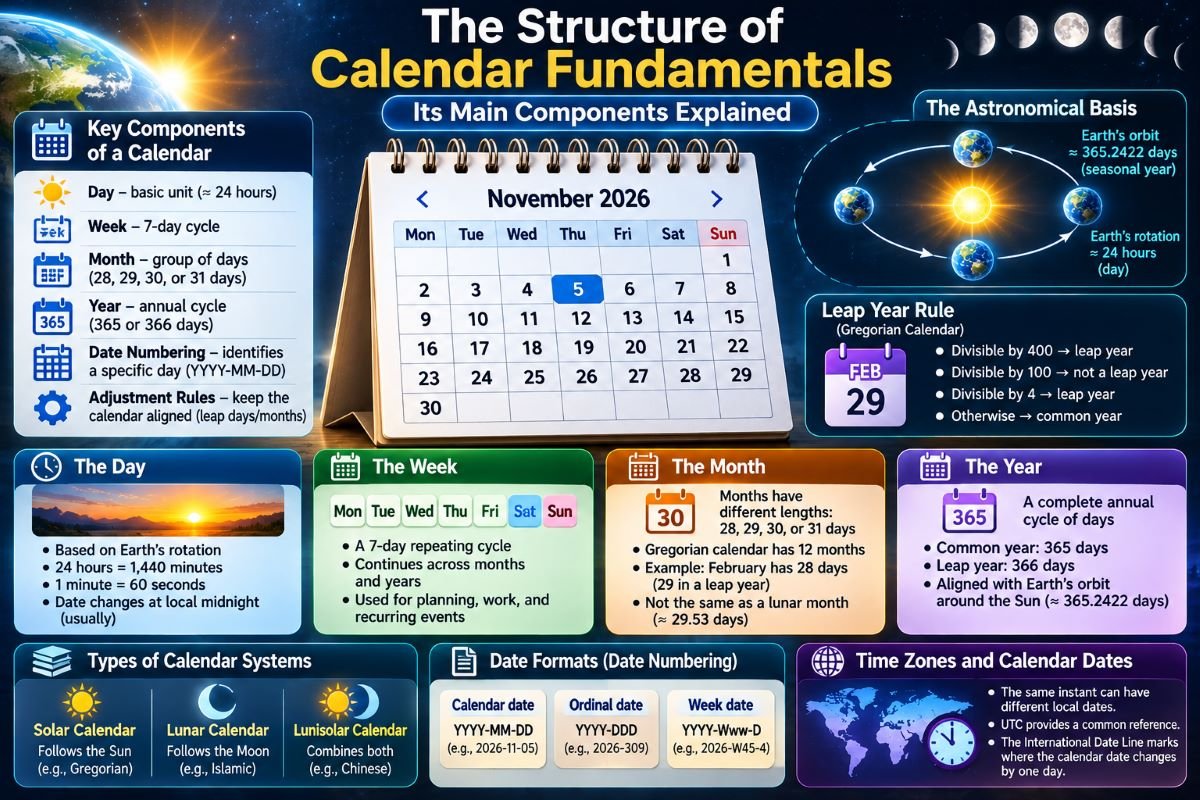
A calendar may appear to be a simple arrangement of numbered dates, named months, and years. However, behind this familiar structure is a system of interconnected components that organize the passage of time into recognizable and measurable units.
Every calendar requires a way to identify individual days, group them into larger periods, establish the beginning and end of those periods, and maintain a consistent sequence of dates. Some calendar systems also incorporate astronomical observations, additional days, or extra months to maintain a relationship with natural cycles.
The structure of a calendar is therefore more than a collection of dates. It is a framework consisting of several components that work together to make time measurable, identifiable, and useful.
The Gregorian calendar, for example, organizes its dates into 12 months, uses a repeating seven-day week, and applies leap-year rules to maintain alignment with the seasonal year. Other calendar systems use different arrangements based on lunar phases, solar cycles, or combinations of both.
Understanding the main components of calendars helps explain why months have different lengths, why leap years exist, how weekdays repeat, and how different calendar systems organize the same passage of time.
This article examines the structural elements of calendar systems, their mathematical relationships, and the principles that allow them to function as organized systems of time measurement.
1. The Basic Architecture of a Calendar
A calendar is built from several connected units. Each unit performs a particular function, while the complete structure provides a method for organizing dates over extended periods.
The main components commonly include:
- Days, which identify individual calendar units.
- Weeks, which group days into repeating sequences.
- Months, which divide the year into larger periods.
- Years, which organize a complete annual sequence.
- Date numbering, which identifies individual days.
- Calendar rules, which determine the length and arrangement of periods.
- Adjustment mechanisms, which help maintain the intended relationship between calendar units and natural cycles.
Not every calendar uses all these components in exactly the same way. For example, some calendars do not use a seven-day week, while others organize months according to lunar observations.
1.1 Components and their relationships
The components of a calendar are not independent.
Days form the basic sequence of dates. Weeks group days into repeating cycles. Months organize dates into larger divisions, and years provide a framework for arranging those divisions.
The relationship between these units depends on the calendar system.
In the Gregorian calendar, a year normally contains 365 days, while a leap year contains 366. These days are distributed among 12 months with different lengths.
The week continues independently of month boundaries, meaning that a month can begin on any weekday and contain four or five occurrences of particular weekdays.
This interconnected structure allows a calendar to organize both short-term and long-term time periods.
2. The Day: The Fundamental Unit
The day is the basic building block of most modern calendar systems.
It provides the individual unit from which longer calendar periods are constructed.
2.1 The astronomical basis of a day
The everyday cycle of day and night is associated with Earth's rotation around its axis.
As Earth rotates, different locations move into and out of sunlight. This creates the familiar alternation between daylight and darkness.
The apparent solar day is based on the time between successive passages of the Sun across a local reference point in the sky. Because Earth's orbit and rotation interact, apparent solar days do not have perfectly uniform lengths.
For ordinary civil timekeeping, a mean solar day is used as the basis for the conventional 24-hour day.
2.2 Dividing a day
A standard civil day is divided into:
- 24 hours
- 1,440 minutes
- 86,400 seconds
These divisions provide a consistent framework for everyday clock time.
A calendar uses the day as a date unit, while a clock divides the day into smaller units of time.
2.3 Calendar days and civil days
A calendar day identifies a particular date, such as 12 June.
A civil day is the local period between the beginning of one date and the beginning of the next according to the applicable timekeeping rules.
These concepts are not always equivalent to exactly 24 elapsed hours. When daylight saving time begins or ends, a local civil day may contain 23 or 25 hours of clock time.
This distinction is important when calendar dates are compared with elapsed time.
2.4 Day boundaries
Every calendar needs a rule for deciding when one date ends and another begins.
In the Gregorian civil calendar, local midnight is commonly used as the date boundary.
Some traditional calendar systems use a different convention, such as beginning the day at sunset.
The chosen boundary determines how events are assigned to calendar dates.
3. The Week: A Repeating Group of Days
A week is a recurring group of days used to organize shorter periods within a calendar.
The seven-day week is widely used in the Gregorian calendar and many other modern civil contexts.
3.1 The seven-day structure
The standard seven-day sequence is:
- Monday
- Tuesday
- Wednesday
- Thursday
- Friday
- Saturday
- Sunday
After Sunday, the sequence returns to Monday.
The week continues across month and year boundaries rather than restarting at the beginning of each month.
3.2 The mathematical relationship of weeks and years
A common Gregorian year contains 365 days.
Since a week contains seven days:
[365=52\times7+1]
This means that a common year contains 52 complete weeks and one additional day.
A leap year contains 366 days:
[366=52\times7+2]
It therefore contains 52 complete weeks and two additional days.
These remainders explain why the weekday associated with the beginning of a year shifts from one year to the next.
3.3 Week numbering
Calendar systems may assign numbers to weeks to support planning, administration, and reporting.
The ISO week-date system is an internationally recognized week-numbering convention.
It uses Monday as the first day of the week and defines the first week of an ISO week-numbering year as the week containing the first Thursday of that year.
This can produce an interesting result: a date near the beginning of January may belong to the final week of the previous ISO week-numbering year, while a date near the end of December may belong to the first week of the next one.
3.4 Why weeks are useful
Weeks provide a repeating organizational structure for activities that occur more frequently than monthly or annually.
They are commonly used for:
- Work schedules.
- School timetables.
- Weekly planning.
- Business reporting.
- Recurring appointments.
- Religious and cultural observances.
The week is therefore an important calendar component even though its seven-day structure is primarily a historical and cultural convention rather than a direct division of an astronomical cycle.
4. The Month: A Larger Calendar Division
A month organizes a sequence of days into a larger unit.
The structure and length of months vary between calendar systems.
Some months are based on lunar observations, while others are arranged according to the requirements of a solar calendar.
4.1 Months in the Gregorian calendar
The Gregorian calendar contains 12 months.
| Month | Number of days |
| January | 31 |
| February | 28 or 29 |
| March | 31 |
| April | 30 |
| May | 31 |
| June | 30 |
| July | 31 |
| August | 31 |
| September | 30 |
| October | 31 |
| November | 30 |
| December | 31 |
The different month lengths are part of the calendar's established structure.
4.2 Why months have different lengths
The Gregorian month structure developed through historical calendar arrangements and reforms.
The months are not designed to represent twelve identical astronomical cycles. Instead, their lengths collectively organize the annual sequence into a practical civil calendar.
This explains why a Gregorian month does not necessarily begin with a new moon or end with a particular lunar phase.
4.3 Lunar months
A lunar month is associated with the repeating phases of the Moon.
The synodic month, measured from one new moon to the next, lasts approximately 29.53 days.
Calendar systems based on lunar observations commonly alternate between months of 29 and 30 days or use other observational and calculation rules.
Because the lunar cycle is not an exact whole number of days, these calendars require conventions for determining individual month boundaries.
4.4 Calendar months and lunar months are different
A calendar month in the Gregorian system is a fixed named division of the civil year.
A lunar month is an interval based on the Moon's phase cycle.
Although both are called months, their underlying definitions are different.
Understanding this distinction helps explain why lunar calendar dates move through the Gregorian seasons.
5. The Year: The Main Annual Structure
A calendar year organizes a complete sequence of days into a larger annual period.
In solar calendars, the year is designed to remain closely aligned with Earth's seasonal cycle.
5.1 The astronomical basis of the year
Earth revolves around the Sun. The seasonal year is closely related to the cycle of the seasons and the Sun's apparent position along the ecliptic.
The tropical year, which is important for seasonal alignment, is approximately 365.2422 days.
This is slightly longer than 365 complete days.
A calendar that used exactly 365 days every year would gradually move away from the seasonal cycle.
5.2 Common and leap years
The Gregorian calendar uses two basic year types.
Common year: Contains 365 days.
Leap year: Contains 366 days.
The additional day is placed in February, making it 29 days long during a leap year.
5.3 The Gregorian leap-year rule
The Gregorian calendar determines leap years using the following rule:
- A year divisible by 400 is a leap year.
- A year divisible by 100 but not by 400 is not a leap year.
- Other years divisible by 4 are leap years.
- All remaining years are common years.
For example:
- 2024 was a leap year.
- 2025 was a common year.
- 1900 was a common year.
- 2000 was a leap year.
This rule provides a closer approximation to the seasonal year than the simpler Julian leap-year system.
5.4 The 400-year Gregorian cycle
The Gregorian calendar has a repeating 400-year cycle.
Within this cycle, there are 97 leap years and 303 common years.
The total number of days is:
[(303\times365)+(97\times366)=146097]
Since:
[146097\div7=20871]
the complete 400-year period contains an exact whole number of weeks.
This mathematical property explains why the Gregorian calendar's weekday arrangement repeats after 400 years, assuming the same calendar rules are applied throughout.
6. Date Numbering: Identifying Individual Days
Date numbering provides a method for identifying each day within a month and year.
A conventional Gregorian date contains three principal components:
- Year.
- Month.
- Day.
For example, 2026-11-05 represents 5 November 2026.
6.1 Year, month, and day
The year identifies the larger annual period.
The month identifies a division within that year.
The day identifies a particular position within the month.
Together, these components provide a structured date identifier.
6.2 Ordinal dates
An ordinal date identifies a day by its position within the year.
For example, 1 January is day 1, while 31 December is day 365 in a common Gregorian year.
In a leap year, the final day is day 366.
Ordinal dates can be useful in scientific records, data processing, and applications that need to represent dates using a year and a sequential day number.
6.3 Week dates
A week date identifies a date using a week-numbering year, week number, and weekday.
For example, an ISO week date may identify a day using the year, week number, and weekday number.
This representation is useful for organizations that plan work and reports around standardized weekly periods.
6.4 Standardized date formats
International date formats help reduce ambiguity when dates are exchanged between regions.
The ISO 8601 standard includes the familiar year-month-day format:
YYYY-MM-DD
For example:
2026-11-05
Using a standardized format helps distinguish the year, month, and day without relying on regional assumptions about the order of numeric components.
7. Calendar Epochs and Year Numbering
A calendar must establish a reference system for identifying years.
This reference is commonly associated with an epoch or era.
7.1 What is an epoch?
An epoch is a reference point used to organize dates or measure time.
Different calendar systems may use different historical or conventional starting points for their year numbering.
As a result, the same historical period can have different year numbers in different calendars.
7.2 Era-based year numbering
Some calendar systems identify years according to a particular historical, religious, or cultural reference.
An era allows dates to be organized into a continuous sequence relative to that reference.
The year number alone is therefore not universally meaningful without knowing the calendar and era being used.
7.3 Calendar chronology
Chronology uses dates and year numbering to arrange events in their historical sequence.
The calendar's numbering system provides a framework for comparing records, constructing timelines, and identifying the order of events.
8. Calendar Adjustment Rules
Calendar components do not always align perfectly with natural astronomical cycles.
Adjustment rules help maintain the intended relationship between the calendar and the phenomena it represents.
8.1 Intercalation
Intercalation is the insertion of an additional day or month into a calendar.
It is used in certain calendar systems to correct differences between the calendar structure and an astronomical cycle.
The Gregorian leap day is one example of an intercalary adjustment.
Lunisolar calendars may insert an additional month to keep lunar months more closely aligned with the solar year.
8.2 Leap days
A leap day adds one calendar day to a year.
In the Gregorian calendar, this occurs on 29 February during leap years.
The adjustment helps prevent seasonal drift over long periods.
8.3 Leap months
Some lunisolar calendars use an additional month in selected years.
Because twelve lunar months are shorter than a solar year, adding an extra month helps maintain the calendar's seasonal alignment.
The timing and naming of the additional month depend on the rules of the particular calendar system.
8.4 Calendar correction
Calendar correction refers more broadly to changes made to a calendar's structure or rules to improve its relationship with astronomical cycles or administrative requirements.
The Gregorian reform of 1582 is a historical example of a calendar correction.
9. The Relationship Between Calendar Components
The main components of a calendar work together to create a continuous and organized sequence of dates.
Understanding their relationships is more important than examining each unit independently.
9.1 Days and weeks
A week consists of a repeating sequence of seven days.
However, calendar months do not contain an exact number of weeks.
A 30-day month contains four complete weeks and two additional days.
A 31-day month contains four complete weeks and three additional days.
A 28-day February contains exactly four complete weeks, while a 29-day February contains one additional day.
9.2 Weeks and months
Because weeks continue across month boundaries, the first day of a month can fall on any weekday.
Similarly, a month can contain four or five occurrences of a particular weekday.
This is why the number of Mondays, Fridays, or Sundays in a month can vary.
9.3 Months and years
The months are arranged in a sequence within the year.
In the Gregorian calendar, their lengths collectively add up to either 365 or 366 days.
The year structure determines when a new annual sequence begins.
9.4 Years and astronomical cycles
The calendar year is designed to approximate the seasonal cycle.
Leap-year adjustments help keep the calendar's annual structure aligned with the tropical year.
This connection between calendar rules and astronomy is one of the most important features of solar calendar design.
10. Different Calendar Systems and Their Structures
Not every calendar uses the same combination of days, weeks, months, and years.
Different systems organize time according to their own rules and purposes.
10.1 Solar calendars
A solar calendar is designed to remain aligned with the seasonal year.
The Gregorian calendar is a widely used example.
Its structure includes 12 months and a leap-year rule that adjusts the length of the calendar year.
10.2 Lunar calendars
A lunar calendar organizes its months according to lunar phases.
The Islamic calendar is an important example.
Its months are based on lunar cycles, and its year is shorter than the solar year.
As a result, its dates move through the seasons over time.
10.3 Lunisolar calendars
A lunisolar calendar combines lunar months with adjustments intended to maintain alignment with the solar year.
The traditional Chinese calendar is a well-known example.
It uses lunar month structures and intercalary adjustments.
10.4 Why their components differ
The structure of each calendar reflects its underlying principles.
A solar calendar prioritizes seasonal alignment. A lunar calendar follows lunar cycles, while a lunisolar calendar attempts to preserve both lunar and seasonal relationships.
Therefore, the same words—day, month, and year—may represent different arrangements across calendar systems.
11. Time Zones and the Interpretation of Calendar Dates
Calendar dates are also affected by the way civil time is organized around the world.
Although a global instant is the same everywhere, the local calendar date associated with that instant can differ between regions.
11.1 UTC as a global reference
Coordinated Universal Time (UTC) provides a common reference for expressing instants.
Time zones describe how local clock time relates to UTC.
When an instant is converted into a local time, the resulting date may differ depending on the location.
11.2 Date changes between regions
For example, an instant occurring shortly after midnight UTC may correspond to the previous evening in a region west of the UTC reference.
At the same instant, a region far to the east may already be on a later calendar date.
This is why international scheduling applications must account for time zones when displaying dates.
11.3 The International Date Line
The International Date Line is a geographical convention located mainly in the Pacific Ocean.
It marks the general boundary where the calendar date changes by one day when crossing between the two sides.
Its route is not a perfectly straight line because it accommodates national and regional boundaries.
11.4 Local dates and global instants
A local calendar date identifies a day according to a location's civil-time rules.
A global instant identifies a particular point on the timeline.
These should not be treated as interchangeable values in calendar calculations or digital applications.
12. How Calendar Structure Supports Digital Systems
Modern applications depend on the structural rules of calendars to organize dates, schedule events, and perform calculations.
Although software can automate these operations, it still relies on the underlying calendar system.
12.1 Date storage
Digital systems store dates using structured fields or standardized numerical representations.
A date-only value may contain a year, month, and day, while a timestamp may represent a more precise point in time.
Choosing the appropriate representation depends on the intended use.
12.2 Date calculations
Applications use calendar rules to add days, calculate date differences, identify weekdays, and determine month boundaries.
A reliable calculation must account for variable month lengths and leap years.
12.3 Calendar interfaces
Digital calendars arrange dates into visual grids.
These interfaces commonly display weekdays as columns and dates as individual cells.
The layout is generated from the calendar's rules for month length and weekday alignment.
12.4 International scheduling
Calendar applications use time-zone information to convert event times between regions.
The displayed date can change when an event is viewed from a different time zone.
This requires the application to distinguish between the event's underlying instant and its local representation.
13. Common Structural Differences and Misunderstandings
Understanding calendar structure also requires recognizing that some familiar assumptions are not universally correct.
Every calendar contains 12 months.
Many widely used calendars contain 12 months, but calendar structures differ. Some lunisolar calendars occasionally include an additional month.
Every month contains four weeks.
A month can contain 28, 29, 30, or 31 days. Consequently, most months contain more than four complete weeks when their remaining days are included.
Every year contains exactly 365 days.
A Gregorian leap year contains 366 days. Other calendar systems may use different year structures.
A week always begins on Monday.
Week-start conventions vary by region and calendar system. ISO week numbering uses Monday, but other civil calendars may use Sunday or another convention for display and organization.
A calendar month is always a lunar cycle.
Gregorian months are civil calendar divisions and do not generally correspond to complete lunar cycles.
A calendar date identifies one global instant.
A date identifies a calendar day, not a unique instant. A precise instant requires a time and an appropriate time-zone or UTC reference.
All calendar systems use the same adjustment rules.
Leap days, leap months, and other corrections depend on the calendar's structure.
14. Why Understanding Calendar Components Matters
The components of a calendar influence many aspects of everyday life, scientific research, and digital organization.
14.1 Everyday planning
Days, weeks, and months allow individuals to organize appointments, holidays, personal events, and recurring activities.
14.2 Scientific observations
Researchers use calendar dates to record observations and compare events over time.
Accurate date identification is particularly important when studying seasonal patterns, astronomical phenomena, and long-term environmental changes.
14.3 Business and administration
Organizations use calendar structures to define payment schedules, reporting periods, deadlines, working days, and annual plans.
Understanding the difference between calendar months and fixed-duration periods helps prevent incorrect calculations.
14.4 International coordination
Different time zones and calendar conventions make international scheduling more complex.
A clear understanding of calendar components helps applications and organizations communicate dates consistently.
Conclusion
The structure of a calendar is formed by several connected components that organize time into recognizable and measurable units.
Days provide the basic sequence, weeks create repeating groups, months divide the annual structure, and years organize longer periods. Date numbering, year references, and adjustment rules make it possible to identify individual dates and maintain a consistent calendar system.
The relationships between these components are influenced by astronomy, mathematics, historical conventions, and practical requirements. The Gregorian calendar, for example, combines a seven-day week, 12 months, and leap-year adjustments to maintain a useful relationship with the seasonal year.
Other calendar systems use different arrangements based on lunar, solar, or lunisolar principles.
Understanding these structural elements explains why calendar systems differ, how their dates are organized, and why certain adjustments are necessary. It also provides a foundation for studying astronomy, chronology, date calculations, and modern digital timekeeping.
Frequently Asked Questions
What are the main components of a calendar?
The main components commonly include days, weeks, months, years, date numbering, year references, and adjustment rules. Their exact arrangement depends on the calendar system.
What is the most basic unit of a calendar?
The day is the most basic unit in most modern calendar systems. It provides the foundation for organizing weeks, months, and years.
Why does the Gregorian calendar have 12 months?
The Gregorian calendar inherited its 12-month structure from earlier Roman calendar arrangements. The months collectively organize the annual sequence into a practical civil calendar.
Why do months have different numbers of days?
Gregorian month lengths are part of the historical structure of the calendar. Their lengths vary between 28 and 31 days to organize the year into 12 divisions.
What is the difference between a calendar month and a lunar month?
A calendar month is a named division of a particular calendar system. A lunar month is based on the Moon's repeating phase cycle, which averages approximately 29.53 days.
What is a leap year?
A leap year is a calendar year containing an additional day or another calendar adjustment. In the Gregorian calendar, it contains 366 days, including 29 February.
What is intercalation in a calendar?
Intercalation is the insertion of an additional day or month to help maintain the intended relationship between calendar units and astronomical cycles.
Why does the weekday change at the beginning of a new year?
A common Gregorian year contains 365 days, which is one day more than an exact number of 52 weeks. A leap year contains two additional days beyond 52 complete weeks. These extra days shift the weekday of the next year's beginning.
Do all calendar systems use the seven-day week?
No. The seven-day week is widely used, but calendar traditions differ in their organization of weekly cycles and other time units.
How do time zones affect calendar dates?
Different regions have different local times. At the same global instant, one region may be on one calendar date while another is on the previous or following date.
Why are calendar components important in software?
Digital systems use calendar components to validate dates, calculate intervals, display calendar layouts, schedule events, and organize records. Correct handling of month lengths, leap years, and time zones helps prevent date-related errors.
Comments
No comments yet.