Introduction
Timekeeping has always been one of humanity’s most essential needs. From ancient sundials to modern atomic clocks, the quest for accurate time measurement has driven innovation across centuries. Among the most important breakthroughs in this journey is the invention of the quartz clock.
Quartz clocks are known for their exceptional accuracy, reliability, and affordability. Today, they power everything from wall clocks and wristwatches to computers and communication systems. Unlike traditional mechanical clocks, which rely on gears and springs, quartz clocks use electronic oscillation to measure time with remarkable precision.
But what exactly makes quartz clocks so accurate? Why have they become the global standard for everyday timekeeping?
In this article, we explore the science, technology, and history behind quartz clocks, and explain why they continue to dominate modern timekeeping systems.
The Evolution of Timekeeping Before Quartz
Before the invention of quartz technology, mechanical clocks were the primary tools for measuring time.
Mechanical clocks relied on:
- Springs or weights as power sources
- Gear trains to transfer motion
- Escapements to regulate movement
- Balance wheels or pendulums for oscillation
While these systems were engineering marvels, they had limitations. Factors such as friction, temperature changes, gravity, and wear could affect their accuracy.
Even the best mechanical clocks typically deviate by several seconds per day.
As technology advanced, scientists sought more reliable and stable timekeeping methods. This led to the development of quartz-based systems in the early 20th century.
What Is Quartz?
Quartz is a naturally occurring mineral composed of silicon dioxide (SiO₂). It is widely found in the Earth’s crust and has unique physical properties that make it ideal for timekeeping.
The key property that makes quartz special is its piezoelectric effect.
The Piezoelectric Effect: The Science Behind Quartz
The piezoelectric effect is the ability of certain materials, including quartz, to generate an electrical charge when mechanical pressure is applied.
More importantly for clocks, quartz also works in reverse:
When an electric current is applied to a quartz crystal, it vibrates at a very precise and consistent frequency.
This vibration is extremely stable and predictable, making quartz an ideal oscillator for timekeeping.
How Quartz Clocks Work
Quartz clocks operate using a combination of electronic and mechanical components.
Here’s a simplified explanation of the process:
1. Power Source
A battery supplies electrical energy to the circuit.
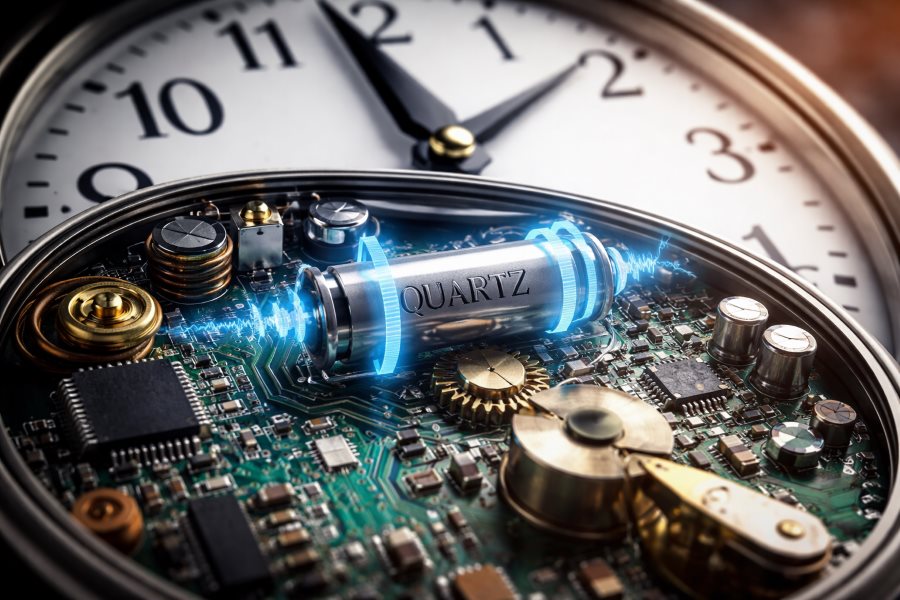
2. Quartz Crystal Oscillation
The electric current causes the quartz crystal to vibrate at a fixed frequency—typically 32,768 times per second (Hz).
3. Frequency Division
An electronic circuit counts these vibrations and divides them into one-second intervals.
4. Signal Conversion
Each second, the circuit sends an electrical pulse.
5. Movement of Hands
In analog clocks, this pulse drives a small motor that moves the gears and hands.
In digital clocks, the signal is displayed electronically.
Why 32,768 Hz?
The frequency of 32,768 Hz is commonly used because it is a power of two (2¹⁵).
This makes it easy for digital circuits to divide the frequency down to exactly one second using binary counting.
This clever design simplifies electronics while maintaining precision.
Why Quartz Clocks Are So Accurate
Quartz clocks are significantly more accurate than mechanical clocks for several reasons.
1. Stable Oscillation
The vibration of a quartz crystal is extremely consistent.
Unlike mechanical systems, which depend on moving parts, quartz oscillation is governed by atomic structure, making it highly stable.
2. Minimal Friction
Mechanical clocks rely on gears and moving parts that generate friction.
Quartz clocks use electronic circuits with very few moving components, reducing energy loss and mechanical error.
3. Resistance to Gravity
Mechanical watches can be affected by their position due to gravity.
Quartz clocks are largely unaffected by orientation, ensuring consistent performance.
4. Low Sensitivity to Wear
Mechanical components wear down over time, affecting accuracy.
Quartz crystals and electronic circuits experience minimal degradation, maintaining long-term precision.
5. Temperature Stability
While temperature can affect quartz slightly, modern designs compensate for these variations.
Some high-end quartz systems use temperature-compensated crystals for even greater accuracy.
Accuracy Comparison: Quartz vs Mechanical
To understand the advantage of quartz, consider this comparison:
Mechanical Clocks
- Accuracy: ±5 to ±20 seconds per day
- Influenced by position, friction, and wear
Quartz Clocks
- Accuracy: ±15 seconds per month (or better)
- Highly stable and consistent
This means quartz clocks can be 10 to 100 times more accurate than mechanical clocks.
The Quartz Revolution
The introduction of quartz technology in the 20th century transformed the watch and clock industry.
This period is often referred to as the Quartz Revolution or Quartz Crisis.
Quartz watches were:
- More accurate
- More affordable
- Easier to maintain
As a result, traditional mechanical watchmakers faced significant challenges.
Many companies adapted by incorporating quartz technology, while others focused on luxury mechanical craftsmanship.
Applications of Quartz Technology
Quartz technology is used in far more than just clocks.
Everyday Timekeeping
- Wall clocks
- Wristwatches
- Alarm clocks
Consumer Electronics
Quartz oscillators are used in:
- Smartphones
- Computers
- Televisions
They help regulate timing in electronic circuits.
Communication Systems
Accurate timing is essential for:
- GPS systems
- Internet networks
- Telecommunications
Quartz technology plays a critical role in synchronizing these systems.
Scientific Instruments
Quartz-based timing is used in:
- Laboratory equipment
- Measurement devices
- Medical instruments
Types of Quartz Clocks
Quartz clocks come in several forms:
Analog Quartz Clocks
These clocks use traditional hands but are powered by quartz technology.
They combine classic design with modern accuracy.
Digital Quartz Clocks
These display time numerically using LED or LCD screens.
They are commonly used in electronics and appliances.
High-Precision Quartz Clocks
Some advanced quartz clocks use:
- Temperature compensation
- High-frequency crystals
These systems offer even greater accuracy.
Limitations of Quartz Clocks
Despite their advantages, quartz clocks are not perfect.
Battery Dependency
Quartz clocks require batteries or external power.
When the battery dies, the clock stops.
Temperature Sensitivity
Extreme temperatures can slightly affect quartz frequency.
However, modern designs minimize this issue.
Lack of Craftsmanship Appeal
Compared to mechanical watches, quartz clocks are often seen as less artistic.
Luxury watch enthusiasts value the craftsmanship of mechanical movements.
Quartz vs Atomic Clocks
Quartz clocks are extremely accurate, but they are not the most accurate timekeeping devices.
Atomic clocks use atomic vibrations to measure time with incredible precision.
However:
- Atomic clocks are expensive
- They are used in scientific and industrial applications
Quartz clocks remain the best balance of accuracy, cost, and practicality for everyday use.
The Future of Quartz Technology
Quartz technology continues to evolve.
Modern innovations include:
- Smartwatches with quartz-based timing systems
- Solar-powered quartz watches
- Hybrid mechanical-quartz systems
Even as new technologies emerge, quartz remains a cornerstone of timekeeping.
Why Quartz Still Dominates
Despite advances in atomic and digital timekeeping, quartz clocks remain dominant because they offer:
- High accuracy
- Low cost
- Reliability
- Ease of use
They represent the perfect balance between performance and practicality.
Conclusion
Quartz clocks revolutionized timekeeping by introducing a level of accuracy and reliability that was previously unimaginable. By harnessing the piezoelectric properties of quartz crystals, these clocks transformed how we measure and interact with time.
From everyday wall clocks to advanced communication systems, quartz technology has become an essential part of modern life.
While mechanical clocks continue to be admired for their craftsmanship and heritage, quartz clocks stand as a testament to scientific innovation and practical engineering.
In a world that depends on precise timing more than ever, quartz clocks remain one of the most important inventions in the history of timekeeping.
Comments
No comments yet.