Introduction
Throughout human history, the measurement of time has played a fundamental role in shaping civilization. From ancient sundials to modern atomic clocks, humanity has continuously developed new ways to track the passage of time. Among these innovations, one invention stands out as particularly transformative: the mechanical clock.
Mechanical clocks, powered by intricate systems of gears, springs, and escapements, revolutionized how societies organized work, travel, science, and daily life. Long before digital devices and smartphones existed, mechanical clocks provided reliable and precise timekeeping that enabled the development of modern industry, navigation, and scientific research.
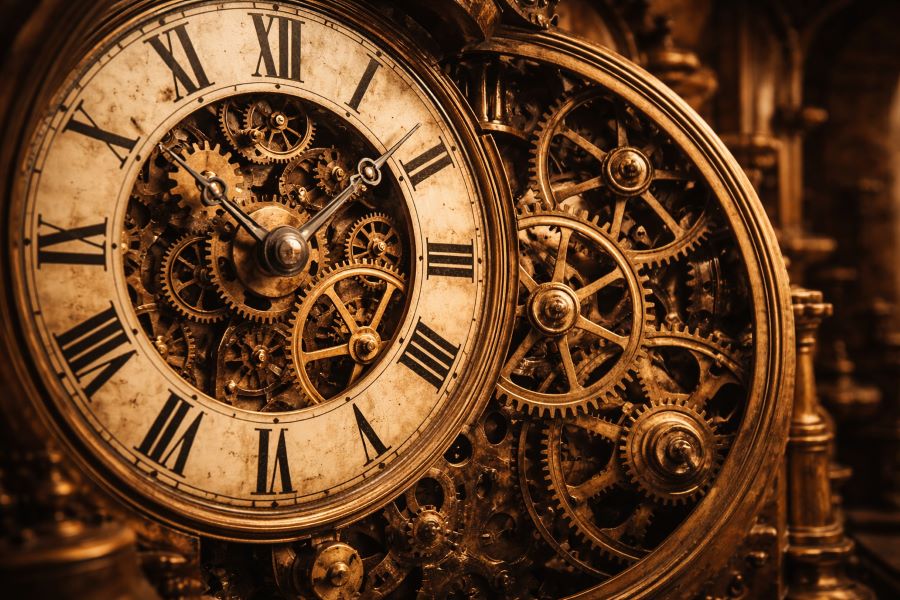
At the heart of every mechanical clock lies a brilliant piece of engineering: the gear mechanism. These gears regulate motion, distribute energy, and divide time into measurable intervals. The invention and refinement of gear-driven clocks changed not only the technology of timekeeping but also the structure of society itself.
This article explores how mechanical clocks evolved, how gear mechanisms made accurate timekeeping possible, and how these remarkable inventions reshaped the world.
The Early Human Need for Time Measurement
Long before mechanical clocks were invented, humans recognized the importance of measuring time. Early civilizations relied on natural cycles to track the passage of days and seasons.
The movement of the sun, moon, and stars provided early references for timekeeping. Ancient societies developed several tools to observe these natural patterns.
Some of the earliest timekeeping devices included:
- Sundials, which used shadows cast by the sun to indicate time.
- Water clocks, also known as clepsydra, which measured time through the steady flow of water.
- Candle clocks, where marked candles burned at predictable rates.
- Hourglasses, which measured time using flowing sand.
While these devices helped early civilizations estimate time, they were limited by environmental factors. Sundials did not work at night or during cloudy weather. Water clocks could be inconsistent due to variations in water flow.
As societies grew more complex, the need for a more reliable and consistent timekeeping system became increasingly important.
The Birth of Mechanical Clocks
Mechanical clocks first appeared in Europe during the late Middle Ages, around the 13th century. These early clocks represented a major technological breakthrough because they did not rely on natural elements like sunlight or flowing water.
Instead, mechanical clocks used a system of gears and weights to regulate time.
Early mechanical clocks were typically installed in churches, monasteries, and public buildings. Their primary purpose was to signal prayer times, community events, and daily schedules.
These clocks were large and often powered by heavy weights suspended on ropes. As the weights slowly descended due to gravity, they drove a series of gears that moved the clock hands.
The invention of the mechanical escapement mechanism allowed these clocks to release energy in controlled intervals, enabling consistent time measurement.
This innovation laid the foundation for modern timekeeping.
Understanding the Role of Gears in Mechanical Clocks
The true genius of mechanical clocks lies in their gear systems.
Gears are rotating mechanical components with teeth that mesh together to transfer motion and energy. In clocks, gears perform several essential functions.
First, they distribute the energy generated by the power source, such as a falling weight or wound spring.
Second, gears reduce or increase rotational speed to regulate the movement of different components.
Finally, gear trains divide time into precise units, allowing the clock hands to move in consistent intervals.
Without gears, mechanical clocks would not be able to convert stored energy into accurate timekeeping.
The Gear Train: Dividing Time Precisely
The gear train is the central system that controls how time is divided within a mechanical clock.
A gear train consists of multiple gears connected in a sequence. Each gear has a specific number of teeth that determines how it interacts with the next gear in the chain.
By carefully calculating the ratio between gears, clockmakers can ensure that the movement of the clock hands corresponds precisely to seconds, minutes, and hours.
For example:
- One gear may rotate once per minute.
- Another gear may rotate once per hour.
- Another gear may rotate once every twelve hours.
These gear ratios allow clocks to display time accurately over long periods.
The precision required in these gear systems was remarkable for medieval technology. Early clockmakers had to craft gears by hand, often using simple tools.
Despite these limitations, they managed to produce remarkably accurate machines.
The Escapement Mechanism: Controlling Motion
While gears distribute energy within a clock, another component is responsible for controlling how that energy is released.
This component is known as the escapement.
The escapement regulates the motion of the gear train by allowing energy to pass through in small, controlled bursts. This process creates the familiar ticking sound associated with mechanical clocks.
The escapement works together with an oscillating regulator, such as a pendulum or balance wheel.
Each oscillation allows the gears to move forward by a small increment. This controlled release of energy ensures consistent timekeeping.
Without the escapement, the gears would spin freely and the clock would run uncontrollably fast.
The Pendulum Revolution
In the 17th century, a major breakthrough dramatically improved the accuracy of mechanical clocks: the pendulum.
The pendulum was introduced as a time-regulating mechanism that oscillates at a consistent rate under the influence of gravity.
Pendulum clocks were far more accurate than earlier mechanical clocks. They could measure time with an accuracy previously unimaginable.
This improvement transformed many fields that relied on precise time measurement.
Pendulum clocks became widely used in observatories, scientific laboratories, and navigation.
For centuries, the pendulum clock remained one of the most accurate timekeeping devices available.
Mechanical Clocks and the Rise of Modern Cities
The spread of mechanical clocks changed the rhythm of daily life.
Before clocks became common, most people organized their activities based on natural daylight. Work schedules varied depending on the season and location.
Mechanical clocks introduced standardized time into society.
Public clock towers allowed entire communities to coordinate activities. Bells rang to signal the beginning of work shifts, market hours, and religious services.
This new ability to measure time precisely contributed to the growth of cities and organized labor.
Factories and businesses began to rely on scheduled working hours, laying the foundation for the modern industrial economy.
The Role of Clocks in Scientific Progress
Mechanical clocks also played a crucial role in scientific advancement.
Accurate time measurement was essential for astronomy, physics, and navigation.
Scientists studying planetary motion needed precise timekeeping to track the movement of celestial bodies.
Mechanical clocks provided the consistency required for these observations.
Later, improvements in clock technology helped scientists measure physical phenomena with greater precision.
Experiments involving motion, gravity, and energy often depended on accurate time measurement.
In this way, mechanical clocks contributed significantly to the development of modern science.
Mechanical Clocks and Global Navigation
One of the greatest challenges faced by early explorers was determining longitude at sea.
Latitude could be calculated using the position of the sun or stars, but longitude required accurate timekeeping.
To determine longitude, sailors needed to compare the local time at sea with the time at a fixed reference point.
This was impossible without highly accurate clocks.
The development of precise marine chronometers solved this problem.
Marine chronometers were specialized mechanical clocks designed to maintain accurate time even on moving ships.
This invention revolutionized navigation and made long-distance sea travel far safer.
It also played a key role in the expansion of global trade and exploration.
Craftsmanship and the Rise of Horology
The development of mechanical clocks gave rise to a specialized field known as horology.
Horology is the science and art of measuring time.
Clockmakers became highly respected craftsmen who combined engineering knowledge with artistic skill.
Many early clocks were not only functional instruments but also works of art.
Elaborate clock cases, decorative engravings, and intricate mechanical displays became symbols of prestige and technological sophistication.
This tradition continues today in the world of luxury watchmaking.
Modern mechanical watches still rely on the same fundamental gear principles developed centuries ago.
The Miniaturization of Clock Mechanisms
As clockmaking technology improved, artisans began developing smaller timekeeping devices.
Large tower clocks eventually evolved into portable clocks and watches.
The challenge of miniaturizing mechanical movements required extraordinary engineering creativity.
Clockmakers had to design smaller gears, springs, and escapements while maintaining accuracy.
This process led to the creation of pocket watches in the 16th century and wristwatches in the 20th century.
Even today, miniature mechanical watches contain dozens or even hundreds of tiny components working together to measure time.
Mechanical Clocks in the Industrial Revolution
Mechanical clocks played a major role during the Industrial Revolution.
Factories required workers to arrive at precise times and complete tasks according to strict schedules.
Clock towers and factory whistles helped coordinate labor on a large scale.
This shift toward time-based productivity transformed economic systems.
Time became closely associated with efficiency, productivity, and discipline.
The phrase “time is money” emerged during this period, reflecting the growing importance of time management in industrial societies.
The Evolution Toward Modern Timekeeping
Over the centuries, mechanical clocks continued to evolve.
Improvements in materials, engineering techniques, and design led to increasingly accurate and reliable timepieces.
Later innovations introduced quartz clocks, which use vibrating crystals to measure time electronically.
Today, atomic clocks provide extraordinary accuracy by measuring the oscillations of atoms.
Despite these technological advancements, mechanical clocks remain highly valued.
Their appeal lies not only in their functionality but also in the craftsmanship and historical significance they represent.
Why Mechanical Clocks Still Matter Today
In the digital age, one might assume that mechanical clocks are obsolete.
However, they continue to hold immense cultural and technological significance.
Mechanical clocks represent centuries of human ingenuity and engineering creativity.
They demonstrate how simple physical principles—gears, gravity, and oscillation—can produce remarkably accurate timekeeping.
In the world of luxury watches, mechanical movements are celebrated as masterpieces of miniature engineering.
Collectors and enthusiasts appreciate the artistry, heritage, and craftsmanship that mechanical clocks embody.
Conclusion
Mechanical clocks are among the most important inventions in human history. By harnessing the power of gears and controlled motion, they transformed the way societies understand and organize time.
From medieval clock towers to modern mechanical watches, the principles of gear-driven timekeeping have shaped science, industry, navigation, and daily life.
The invention of mechanical clocks did far more than measure time—it changed how humanity interacts with it.
Through their intricate gears and precise mechanisms, these remarkable machines continue to remind us that the measurement of time is both a scientific achievement and a cultural legacy.
Comments
No comments yet.