Introduction
Among the many achievements of the ancient world, few have fascinated historians, archaeologists, astronomers, and the general public as much as the Mayan Calendar. It is often surrounded by mystery, legends, and misconceptions—especially after the worldwide attention it received in 2012. While many believed the calendar predicted the end of the world, the truth is far more interesting.
The Maya created one of the most sophisticated calendar systems ever developed without modern telescopes, computers, or advanced scientific instruments. Their calendars combined astronomy, mathematics, religion, agriculture, and history into an incredibly accurate system that tracked time across days, months, centuries, and even thousands of years.
Unlike modern calendars that simply organize dates, the Mayan calendar reflected an entire worldview. Every day had spiritual meaning, every cycle represented cosmic order, and time itself was considered sacred rather than merely practical.
This article explores the real history behind the Mayan calendar, explains how it worked, separates myths from facts, and reveals why it continues to amaze researchers even today.
Who Were the Maya?
The Maya were one of the greatest civilizations of ancient Mesoamerica. Their civilization flourished across present-day:
- Southern Mexico
- Guatemala
- Belize
- Honduras
- El Salvador
The Maya civilization existed for more than two thousand years, with its peak occurring between approximately 250 CE and 900 CE, a period known as the Classic Era.
Unlike the Roman Empire or Ancient Egypt, the Maya were not a single kingdom. Instead, they consisted of many independent city-states, including famous cities such as:
- Tikal
- Chichén Itzá
- Palenque
- Copán
- Calakmul
Each city had its own rulers, temples, and traditions, yet they shared a common language family, religious beliefs, and calendar system.
Masters of Astronomy
One reason the Mayan calendar was so accurate is that the Maya were extraordinary astronomers.
Generation after generation, priests carefully observed:
- The movement of the Sun
- The phases of the Moon
- Venus
- Mars
- Jupiter
- Solar eclipses
- Lunar eclipses
- Solstices
- Equinoxes
These observations were recorded over centuries.
Unlike many ancient cultures that relied mainly on myths, the Maya combined religious beliefs with systematic observation, creating remarkably precise astronomical records.
Their calculations were accurate enough to predict celestial events years in advance.
Why Did the Maya Need a Calendar?
For the Maya, calendars served far more than scheduling daily life.
They were essential for:
- Religious ceremonies
- Agricultural planning
- Coronations
- Building temples
- Naming children
- Choosing favorable dates
- Recording history
- Predicting astronomical events
The Maya believed that every day possessed unique spiritual energy.
Selecting the correct day for important activities was considered vital.
This belief explains why they developed several calendars instead of relying on only one.
The Maya View of Time
Modern society usually thinks of time as a straight line moving from the past into the future.
The Maya viewed time differently.
To them, time moved in repeating cycles.
Certain events, energies, and cosmic influences returned again and again.
This cyclical understanding influenced:
- Religion
- Politics
- Architecture
- Agriculture
- Daily life
Rather than fearing the end of a cycle, they celebrated the beginning of another.
This concept later became central to misunderstandings about the famous 2012 prediction.
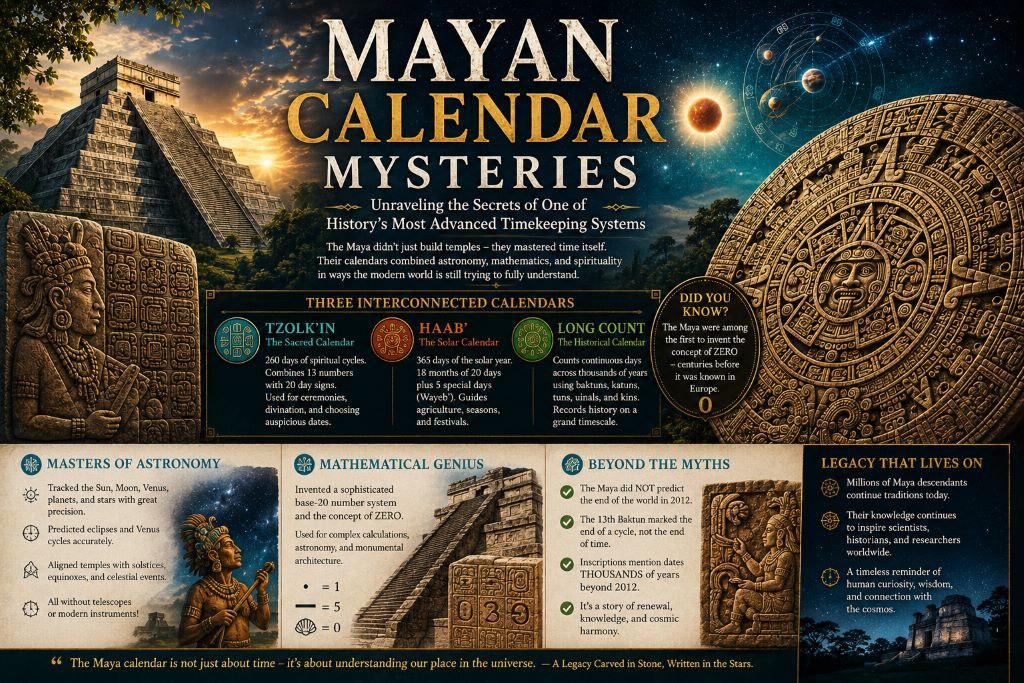
Three Calendars Working Together
One of the most remarkable aspects of Maya civilization is that they did not rely on a single calendar.
Instead, they simultaneously used three different systems:
- The Tzolk'in – Sacred Calendar
- The Haab' – Solar Calendar
- The Long Count – Historical Calendar
Each served a different purpose.
Together they formed one of history's most advanced systems for measuring time.
The Tzolk'in: The Sacred Calendar
The Tzolk'in was the Maya's ceremonial calendar.
It contained:
- 260 days
- 20 day names
- 13 numbers
Each day combined one number with one day name.
Since the two cycles rotated together, there were exactly:
260 unique day combinations.
No date repeated until all 260 combinations had occurred.
Why 260 Days?
Historians continue debating why the Maya chose 260 days.
Several theories exist.
Human Pregnancy
Some researchers note that 260 days roughly corresponds to the average period between conception and birth.
This may have connected the calendar to human life.
Agriculture
Another theory suggests that 260 days matched important agricultural cycles in parts of Mesoamerica.
Farmers could use it to organize planting and harvesting.
Astronomy
Some scholars believe the cycle reflects observations involving Venus, the Sun, or zenith passages.
Although no single explanation has been universally accepted, most historians agree the number carried deep religious significance.
How the Tzolk'in Was Used
The sacred calendar guided many important decisions.
Priests consulted it before:
- Religious ceremonies
- Weddings
- Military campaigns
- Naming newborn children
- Building temples
- Choosing rulers
Each date possessed unique symbolic meaning.
Some days were considered favorable.
Others warned against beginning important projects.
The Haab': The Solar Calendar
Alongside the sacred calendar, the Maya also maintained a practical calendar based on the solar year.
This calendar was known as the Haab'.
It consisted of:
- 18 months
- 20 days each
This produced:
360 days.
Five additional days were added at the end of the year.
These special days were called:
Wayeb'.
The total became:
365 days.
The Wayeb': Five Unlucky Days
Unlike ordinary days, the Wayeb' period was considered dangerous.
The Maya believed the boundary between the physical and spiritual worlds became weaker.
During these five days many people avoided:
- Traveling
- Major ceremonies
- Marriages
- Political decisions
- Beginning construction
Instead, families stayed close together and performed rituals for protection.
Although these beliefs varied between regions, the Wayeb' remains one of the most fascinating aspects of Maya culture.
Agriculture and the Haab'
The Haab' calendar helped farmers determine the proper seasons for:
- Planting maize
- Harvesting crops
- Irrigation
- Religious festivals connected to agriculture
Since food production depended on seasonal weather, maintaining an accurate solar calendar was essential.
This practical function complemented the spiritual role of the Tzolk'in.
The Calendar Round
One of the Maya's greatest achievements was combining the Tzolk'in and Haab' into a larger cycle called the Calendar Round.
Imagine two gears rotating together.
One gear represents:
260 days.
The other represents:
365 days.
A specific combination of dates would not repeat until:
18,980 days had passed.
That equals approximately:
52 solar years.
This enormous cycle allowed the Maya to identify dates with remarkable precision.
Why the Calendar Round Was Important
The Calendar Round was used to:
- Record birthdays
- Identify historical events
- Schedule festivals
- Track generations
- Organize political events
For most people, a 52-year cycle was longer than many significant periods of life, making it highly practical for everyday use.
However, recording events that occurred centuries apart required an even larger system.
The Maya solved this problem by inventing one of history's most impressive chronological tools—the Long Count Calendar.
Mathematics Behind the Calendar
The Maya possessed one of the world's earliest true positional number systems.
Even more remarkable, they independently invented the concept of zero, centuries before it became common in Europe.
Their number system used only three symbols:
- A dot = 1
- A bar = 5
- A shell symbol = 0
This elegant mathematical system made extremely large calendar calculations possible.
It allowed priests to calculate dates extending thousands of years into both the past and the future.
Without zero, such calculations would have been nearly impossible.
The Importance of Zero
Today, zero seems ordinary.
Yet in the ancient world it represented a revolutionary mathematical idea.
The Maya used zero not merely as an empty space but as an actual number.
This innovation enabled them to:
- Record large historical dates
- Build complex calendars
- Perform astronomical calculations
- Develop advanced mathematics
Many historians consider this one of the Maya civilization's greatest intellectual achievements.
The Long Count Calendar: Recording Time Across Millennia
While the Tzolk'in and Haab' calendars worked well for everyday life and religious ceremonies, they had one major limitation.
Because their date combinations repeated every 52 years, they could not uniquely identify events that occurred centuries apart.
Imagine trying to distinguish between two kings born exactly 52 years apart using only the Calendar Round. Their recorded dates would appear identical.
To solve this problem, the Maya invented one of the world's earliest systems for counting time continuously over thousands of years.
This system became known as the Long Count Calendar.
What Was the Long Count?
Unlike the cyclical calendars, the Long Count functioned much like a running day counter.
Instead of repeating every year, it counted the total number of days that had passed since a specific starting point in Maya history.
Modern historians estimate that this starting date corresponds approximately to:
August 11, 3114 BCE (according to the widely accepted GMT correlation).
For the Maya, this date represented the beginning of the current creation cycle rather than the creation of the entire universe.
Every subsequent day simply increased the count.
Units of the Long Count
The Long Count organized time using a modified base-20 numbering system.
Each unit represented a different length of time.
| Unit | Days | Approximate Length |
|---|---|---|
| Kin | 1 | One day |
| Uinal | 20 Kin | 20 days |
| Tun | 18 Uinal | 360 days |
| Katun | 20 Tun | 7,200 days (~19.7 years) |
| Baktun | 20 Katun | 144,000 days (~394 years) |
Notice one interesting exception.
Instead of 20 Uinals making one Tun (which would equal 400 days), the Maya used 18 Uinals, creating a 360-day unit that aligned much more closely with the solar year.
This clever adjustment demonstrates how mathematics and astronomy were combined.
Reading a Long Count Date
A Long Count date appears as five numbers separated by periods.
For example:
13.0.0.0.0
Each number represents:
- Baktuns
- Katuns
- Tuns
- Uinals
- Kins
Therefore:
13 Baktuns
0 Katuns
0 Tuns
0 Uinals
0 Kins
This date became famous worldwide because it corresponded to December 21, 2012.
Why the Long Count Was Revolutionary
Most ancient civilizations recorded years relative to the reign of kings or important rulers.
For example:
- "The fifth year of King X"
- "The third year after the great flood"
The Maya instead used an absolute chronological system.
This allowed them to record events separated by hundreds or thousands of years with remarkable accuracy.
Modern archaeologists greatly benefit from this precision because inscriptions can often be converted into modern calendar dates.
Monument Inscriptions
Throughout the Maya world, stone monuments called stelae were erected to commemorate important events.
These monuments recorded:
- Royal births
- Coronations
- Victories
- Temple dedications
- Religious ceremonies
- Astronomical observations
Each inscription frequently included a Long Count date.
This allows modern researchers to reconstruct detailed historical timelines.
The Maya Loved Big Numbers
One fascinating characteristic of Maya mathematics is their willingness to think on enormous timescales.
Some inscriptions reference dates:
- Thousands of years in the past
- Thousands of years into the future
These inscriptions prove something important:
The Maya never believed time simply stopped after one cycle ended.
Instead, they imagined endless repeating eras.
The Famous 13th Baktun
The Long Count attracted worldwide attention because of one specific date:
13.0.0.0.0
This marked the completion of the 13th Baktun.
Many people mistakenly believed it represented the end of the Maya calendar.
In reality, it represented the completion of one great cycle and the beginning of another.
It was no more an "end" than December 31 is the end of calendars today.
The 2012 End-of-the-World Myth
Few archaeological subjects have generated as much misunderstanding as the supposed Maya prediction that the world would end in 2012.
Books, documentaries, websites, and movies claimed:
- Massive earthquakes
- Planetary collisions
- Solar catastrophes
- Alien invasions
- Earth's magnetic poles reversing
- Global destruction
None of these ideas originated from Maya writings.
Where Did the Myth Come From?
The misunderstanding developed gradually during the late twentieth century.
Several factors contributed:
- Misinterpretation of archaeological discoveries
- Popular books mixing history with mysticism
- Internet speculation
- Television documentaries
- Hollywood films
As the year 2012 approached, these ideas spread rapidly across the world.
Unfortunately, most ignored actual Maya texts.
What Did the Maya Really Believe?
Evidence from surviving inscriptions tells a very different story.
The completion of the 13th Baktun represented:
- Renewal
- Continuation
- Celebration
- Transition into another cycle
Several inscriptions even mention dates that occur after 2012, proving that the Maya expected history to continue.
If they had predicted the destruction of humanity, there would be little reason to reference future events.
Archaeological Evidence
One important inscription discovered at Tortuguero in present-day Mexico mentions the completion of the 13th Baktun.
The damaged monument has been widely misunderstood.
Although parts of the inscription are broken, scholars generally agree it refers to ceremonial events associated with the transition between cycles—not global destruction.
The Dresden Codex
One of the most valuable surviving Maya books is the Dresden Codex.
Unlike many manuscripts destroyed after European contact, this codex survived and contains:
- Astronomical tables
- Eclipse calculations
- Venus observations
- Ritual calendars
- Mathematical computations
Researchers have found no prediction that the world would end in 2012.
Instead, the document demonstrates centuries of careful scientific observation.
Why People Believed the Myth
Psychologists suggest several reasons why the 2012 story became popular.
People are naturally fascinated by:
- Mysteries
- Ancient civilizations
- Predictions
- Catastrophes
- Hidden knowledge
The Maya already possessed an aura of mystery because many of their cities had been abandoned centuries earlier.
Combining that mystery with an approaching calendar date created the perfect environment for sensational stories.
How Accurate Was Maya Astronomy?
One of the most astonishing achievements of Maya civilization was the precision of its astronomical observations.
Without telescopes, they accurately tracked:
- Solar cycles
- Lunar cycles
- Venus
- Mars
- Mercury
- Jupiter
- Seasonal changes
- Eclipse patterns
Their observations often rivaled those of much later civilizations.
The Importance of Venus
Among all celestial bodies, Venus held special significance.
The Maya associated Venus with:
- Warfare
- Kingship
- Divine power
- Religious ceremonies
Priests carefully observed:
- Morning Star appearances
- Evening Star appearances
- Disappearances behind the Sun
Their records became extraordinarily accurate.
Venus Tables
The Dresden Codex contains detailed Venus tables spanning hundreds of years.
The Maya calculated the synodic cycle of Venus at approximately:
584 days
Modern measurements place it at:
583.92 days
The difference amounts to only a tiny fraction of a day.
Considering they lacked modern instruments, this accuracy is astonishing.
Eclipse Predictions
The Maya also recognized repeating eclipse cycles.
Although they could not predict every eclipse with modern precision, they identified recurring patterns that allowed priests to anticipate periods when eclipses were likely.
This knowledge reinforced the authority of rulers and religious leaders.
Architecture as Astronomy
Many Maya temples were carefully aligned with astronomical events.
Examples include:
- Sunrise during equinoxes
- Solstice sunsets
- Venus risings
- Zenith passages of the Sun
These alignments transformed architecture into giant astronomical instruments.
Temples functioned as observatories, religious centers, and calendars simultaneously.
El Castillo at Chichén Itzá
One of the most famous examples is the pyramid known as El Castillo.
During the spring and autumn equinoxes, sunlight creates the illusion of a serpent descending the staircase.
This phenomenon demonstrates the Maya's remarkable understanding of geometry, architecture, and solar movement.
Thousands of visitors still gather every year to witness this spectacular event.
Astronomy Without Telescopes
Perhaps the most impressive achievement of Maya science is that none of these discoveries required optical technology.
Instead, generations of astronomer-priests relied on:
- Careful observation
- Patient record keeping
- Mathematical calculations
- Repeated measurements over centuries
Their dedication produced one of the most advanced astronomical traditions in the ancient world.
The Spiritual Meaning of Time in Maya Civilization
For the Maya, time was not merely a sequence of days, months, and years. It was a living force woven into every aspect of existence. Every sunrise, every season, and every celestial movement carried spiritual meaning.
Unlike the modern world, where clocks primarily regulate work schedules, the Maya viewed time as sacred. Every day possessed its own personality, divine influence, and symbolic energy. Priests carefully interpreted these energies to guide kings, farmers, merchants, and ordinary citizens.
Understanding the calendar therefore meant understanding the will of the gods.
Time Was Circular, Not Linear
Modern societies generally think of time as a straight line.
Past → Present → Future
The Maya viewed time very differently.
To them, time moved in repeating cycles.
- Days repeated.
- Months repeated.
- Sacred ceremonies repeated.
- Astronomical events repeated.
- Great historical ages repeated.
Nothing truly disappeared forever. Every cycle eventually returned in a different form.
This philosophy deeply influenced Maya religion, politics, and daily life.
Every Day Had a Spiritual Identity
Within the Tzolk'in calendar, every one of the 260 days possessed unique symbolic characteristics.
Rather than being ordinary dates, they represented combinations of sacred numbers and day names.
Each combination carried meanings related to:
- Luck
- Destiny
- Character
- Agriculture
- Warfare
- Leadership
- Healing
- Spiritual growth
Children born on different days were believed to inherit different personalities and life paths.
Maya Day Signs
The Tzolk'in calendar contained twenty sacred day signs.
Some examples include:
- Imix
- Ik'
- Ak'bal
- Kan
- Chicchan
- Cimi
- Manik'
- Lamat
- Muluk
- Ok
- Chuen
- Eb'
- Ben
- Ix
- Men
- Cib
- Caban
- Etznab
- Cauac
- Ahau
Each represented natural forces, animals, gods, or cosmic principles.
Ahau: The Day of Kings
One of the most important day signs was Ahau.
It symbolized:
- Leadership
- Enlightenment
- Royal authority
- Divine wisdom
- Completion
Many rulers preferred to schedule coronations and major ceremonies on Ahau days because they believed the date carried powerful blessings.
Ik': The Breath of Life
Another significant day sign was Ik', associated with:
- Wind
- Breath
- Communication
- Divine inspiration
Priests believed Ik' days favored:
- Prayer
- Teaching
- Diplomacy
- Religious rituals
Chicchan: Power and Vitality
Chicchan represented the sacred serpent.
It symbolized:
- Life force
- Energy
- Transformation
- Spiritual awakening
This day often appeared in ceremonies connected with healing and renewal.
The Sacred Numbers
The twenty day signs combined with thirteen sacred numbers.
These numbers also possessed symbolic meanings.
Examples include:
Number 1
- Beginnings
- Creation
- Opportunity
Number 4
- Stability
- Balance
- Earth
Number 7
- Reflection
- Inner wisdom
- Spiritual insight
Number 13
- Completion
- Transformation
- Divine connection
Every day therefore combined two layers of meaning:
- Day sign
- Sacred number
This produced 260 unique spiritual identities.
Divination and Prophecy
Maya priests used the Tzolk'in calendar to perform divination.
Rather than predicting an unchangeable future, divination helped identify favorable and unfavorable periods.
People consulted priests before:
- Marriage
- Warfare
- Building houses
- Planting crops
- Long journeys
- Naming children
- Coronations
The calendar acted as a guide rather than a rigid prophecy.
The Role of Maya Priests
Priests occupied one of the highest positions in Maya society.
Their responsibilities included:
- Reading sacred calendars
- Conducting ceremonies
- Advising rulers
- Observing stars
- Recording astronomical events
- Performing rituals
- Preserving knowledge
Because relatively few people understood the complex calendar systems, priests became guardians of sacred time.
Time and Kingship
Political authority in Maya civilization depended heavily upon sacred timing.
Kings often scheduled:
- Coronations
- Military campaigns
- Temple dedications
- Public ceremonies
according to favorable calendar dates.
Choosing the correct day demonstrated harmony between the ruler and the cosmos.
A king ruling against sacred time risked losing divine legitimacy.
Calendar Ceremonies
The arrival of important dates was celebrated through elaborate ceremonies.
These included:
- Offerings
- Music
- Dancing
- Processions
- Bloodletting rituals
- Burning incense
- Public feasts
Entire communities participated in honoring the passage of sacred time.
Bloodletting Rituals
One of the most misunderstood Maya practices involved ritual bloodletting.
Royal family members sometimes offered small amounts of their own blood during important calendar ceremonies.
This act symbolized:
- Sacrifice
- Renewal
- Communication with ancestors
- Respect for the gods
It was considered an offering that maintained cosmic balance.
Ancestor Worship
The Maya believed their ancestors continued influencing the living world.
Certain calendar days were especially appropriate for honoring:
- Royal ancestors
- Family members
- Founders of cities
- Mythological heroes
Offerings were made to strengthen connections between generations.
Agricultural Rituals
Agriculture depended heavily on sacred timing.
Priests consulted the calendar before recommending:
- Planting maize
- Harvesting crops
- Irrigation projects
- Rain ceremonies
Although practical observation of weather remained important, spiritual timing was believed to increase agricultural success.
The Rain God Chaac
One of the most important Maya gods was Chaac, the deity of rain and storms.
Rain determined whether crops survived.
Special ceremonies dedicated to Chaac often occurred on carefully selected calendar dates.
Offerings included:
- Food
- Incense
- Ceremonial dances
- Sacred prayers
Communities hoped these rituals would bring healthy rainfall.
Kukulkan and the Feathered Serpent
Another famous Maya deity was Kukulkan, the Feathered Serpent.
He represented:
- Wisdom
- Civilization
- Knowledge
- Cosmic order
Many temples aligned with astronomical events associated with Kukulkan.
The famous serpent-shadow phenomenon at El Castillo demonstrates this relationship between architecture and sacred time.
The Hero Twins
Maya mythology includes the legendary Hero Twins described in the Popol Vuh.
Their adventures symbolize:
- Death and rebirth
- Light overcoming darkness
- Cycles of nature
- Renewal of life
These themes closely parallel the cyclical philosophy of the Maya calendar.
The Popol Vuh
Although written after European contact, the Popol Vuh preserves much older Maya traditions.
It describes:
- Creation myths
- Divine beings
- Cosmic cycles
- Human origins
- Sacred numbers
Many scholars believe these stories reflect ideas that influenced Maya calendar systems.
Sacred Geometry
The Maya frequently combined mathematics with spiritual symbolism.
Important numbers appeared repeatedly:
- 4 directions
- 13 heavens
- 9 underworld levels
- 20 day signs
- 52-year Calendar Round
- 260 sacred days
These numerical relationships appeared in:
- Temple architecture
- Ceremonial plazas
- Religious art
- Calendar calculations
Temple Architecture as Cosmic Symbols
Maya temples were rarely built randomly.
Many reflected cosmic order.
Examples include:
- Four staircases representing cardinal directions
- Nine terraces representing the underworld
- Thirteen upper sections representing the heavens
Architecture became a three-dimensional calendar.
Sacred Ceiba Tree
The Maya believed the universe centered around the great Ceiba Tree.
Its roots reached the underworld.
Its trunk represented Earth.
Its branches stretched into heaven.
Many calendar ceremonies symbolically connected participants to this cosmic tree, reinforcing the relationship between humanity and the universe.
Why the Calendar Was Never Separate from Religion
Modern people often separate:
- Science
- Religion
- Government
- Agriculture
The Maya did not.
Astronomy, mathematics, politics, religion, and daily life formed one integrated system.
The calendar connected all of them.
This explains why understanding Maya calendars requires studying far more than dates alone.
Hidden Numerical Patterns
Researchers continue discovering fascinating mathematical relationships inside Maya calendars.
Examples include:
- Multiples of Venus cycles
- Lunar synchronization
- Solar approximations
- Eclipse intervals
- Agricultural seasons
- Ritual frequencies
These patterns reveal centuries of accumulated observation.
Calendar Knowledge Was an Elite Science
Learning the Maya calendar required years of education.
Priests memorized:
- Hundreds of symbols
- Mathematical calculations
- Sacred stories
- Astronomical cycles
- Ritual procedures
Only a small educated class possessed complete mastery of this knowledge.
Modern Maya Communities
The Maya civilization did not disappear.
Millions of Maya people still live across:
- Mexico
- Guatemala
- Belize
- Honduras
- El Salvador
In several communities, modified versions of the sacred calendar continue to guide ceremonies, naming traditions, and spiritual practices.
The calendar remains a living tradition rather than merely an archaeological curiosity.
Decoding the Maya Calendar: A Scientific Puzzle
For centuries after the decline of the Classic Maya civilization, the meaning of their calendar inscriptions remained one of archaeology's greatest mysteries.
Spanish conquistadors destroyed thousands of Maya books during the sixteenth century, believing them to be pagan writings. Only four original Maya codices survived.
As a result, much of the calendar system had to be reconstructed from:
- Stone monuments
- Temple inscriptions
- Painted ceramics
- Surviving codices
- Colonial-era records
The process of decoding the calendar took more than 150 years and involved historians, archaeologists, mathematicians, linguists, and astronomers from around the world.
The Breakthrough in Deciphering Maya Writing
For many years scholars believed Maya hieroglyphs represented only religious symbols.
That assumption proved incorrect.
During the twentieth century, researchers discovered that Maya glyphs were a sophisticated writing system capable of recording:
- Historical events
- Royal genealogies
- Wars
- Religious ceremonies
- Astronomical observations
- Calendar dates
This breakthrough transformed Maya studies forever.
Once scholars learned how to read Long Count dates, entire dynasties and centuries of history suddenly became understandable.
The Goodman-Martinez-Thompson Correlation
One of the biggest challenges in Maya studies was connecting Maya dates with the modern Gregorian calendar.
This required a correlation system.
The most widely accepted solution today is known as the Goodman-Martinez-Thompson (GMT) Correlation.
It allows archaeologists to convert Long Count dates into modern calendar dates with remarkable accuracy.
Although some alternative correlations exist, the GMT correlation remains the international academic standard.
Archaeology Continues to Reveal New Discoveries
Modern technology has transformed Maya research.
Scientists now use:
- LiDAR scanning
- Satellite imagery
- Drone photography
- Digital mapping
- Ground-penetrating radar
- 3D reconstruction
These tools have uncovered thousands of previously hidden structures beneath dense jungle canopies.
Entire cities once thought lost are now being mapped in extraordinary detail.
Each new discovery provides additional calendar inscriptions that improve our understanding of Maya chronology.
LiDAR Changed Everything
One of the most revolutionary technologies is LiDAR (Light Detection and Ranging).
Laser pulses fired from aircraft can penetrate forest vegetation and reveal ancient structures hidden beneath trees.
Using LiDAR, researchers have discovered:
- Massive road networks
- Defensive walls
- Agricultural terraces
- Reservoir systems
- Pyramids
- Entire cities
Many of these sites contain new calendar inscriptions awaiting study.
Mathematical Genius of the Maya
Historians increasingly recognize the Maya as one of the greatest mathematical civilizations in history.
Their achievements include:
- Place-value notation
- Base-20 mathematics
- Accurate astronomical calculations
- Large-number computation
- Zero as a numerical placeholder
Their understanding of zero appeared centuries before it became common in Europe.
Without this innovation, the Long Count Calendar would have been impossible.
The Maya Concept of Zero
The shell-shaped symbol representing zero was revolutionary.
Zero allowed the Maya to:
- Perform advanced calculations
- Record enormous dates
- Create positional notation
- Track astronomical cycles efficiently
Modern mathematics relies heavily on zero, making the Maya contribution especially significant.
Astronomy Beyond Naked-Eye Observation
Although the Maya lacked telescopes, they compensated through generations of meticulous observation.
Their astronomical knowledge included:
- Solar year measurements
- Lunar cycles
- Venus movements
- Eclipse intervals
- Seasonal changes
- Planetary visibility
Modern researchers continue comparing Maya calculations with modern astronomical data and remain impressed by their precision.
Why the Maya Calendar Still Fascinates Scientists
Researchers continue studying the Maya calendar because it combines multiple disciplines:
- Archaeology
- Astronomy
- Mathematics
- Linguistics
- Anthropology
- Religious studies
- History
Few ancient systems integrate so many fields of knowledge into a single framework.
Myths Versus Historical Reality
The popularity of the Maya calendar has also produced many misconceptions.
Let's separate fact from fiction.
Myth: The Maya Predicted the End of the World
Reality
No surviving Maya text predicts global destruction in 2012.
The completion of the 13th Baktun marked the end of one cycle and the beginning of another, similar to moving from December 31 to January 1.
Myth: The Calendar Was Magical
Reality
The Maya calendar reflected careful observation, mathematics, astronomy, and religious belief.
Its sophistication came from centuries of accumulated knowledge rather than supernatural powers.
Myth: Only Priests Used the Calendar
Reality
While priests mastered its complexities, ordinary people also relied on calendar systems for farming, festivals, markets, and daily life.
Myth: Maya Civilization Suddenly Disappeared
Reality
The cities declined for complex environmental and political reasons, but the Maya people survived.
Millions of Maya descendants continue living throughout Central America today.
Myth: We Fully Understand Every Maya Calendar
Reality
Many inscriptions remain undeciphered.
Researchers continue discovering new monuments, glyphs, and astronomical relationships every year.
There is still much to learn.
Lessons the Modern World Can Learn
Although separated from us by more than a thousand years, the Maya calendar offers valuable lessons.
1. Observation Matters
The Maya built extraordinary scientific knowledge simply by observing nature patiently over generations.
Their work reminds us that careful observation remains one of science's greatest tools.
2. Mathematics Has Universal Power
Without modern computers or calculators, Maya scholars developed sophisticated mathematical systems capable of tracking astronomical events over centuries.
Their achievements demonstrate the timeless importance of mathematical thinking.
3. Science and Culture Can Work Together
The Maya never separated astronomy from culture.
Their scientific discoveries strengthened architecture, agriculture, religion, and governance.
Modern societies often divide these disciplines, but the Maya viewed knowledge as interconnected.
4. Long-Term Thinking
Modern life often focuses on weeks or years.
The Maya thought in cycles lasting hundreds and even thousands of years.
Their perspective encouraged planning beyond individual lifetimes.
5. Sustainability
The calendar helped communities coordinate agriculture with seasonal rhythms.
Although environmental challenges eventually affected Maya civilization, their emphasis on understanding natural cycles remains highly relevant today.
The Maya Calendar in Popular Culture
The Maya calendar continues to inspire:
- Books
- Museums
- Documentaries
- Scientific research
- Educational programs
- Tourism
- Historical fiction
- Video games
- Films
Unfortunately, entertainment sometimes emphasizes myths more than historical evidence.
Learning from reliable archaeological research provides a much clearer picture of this remarkable civilization.
Why Historians Still Study the Maya Calendar
Every newly translated inscription helps answer questions about:
- Ancient kings
- Political alliances
- Wars
- Trade
- Climate
- Religion
- Population changes
- Scientific development
The calendar functions as a chronological backbone connecting all aspects of Maya history.
The Legacy of Maya Timekeeping
Few civilizations achieved such an extraordinary combination of:
- Mathematics
- Astronomy
- Architecture
- Writing
- Religious philosophy
- Historical record keeping
The Maya calendar remains one of humanity's greatest intellectual accomplishments.
Rather than predicting catastrophe, it celebrates continuity, renewal, and humanity's enduring relationship with the cosmos.
More than a thousand years after many Maya cities were abandoned, their calendar continues to inspire scientists, historians, and curious minds across the globe.
Conclusion
The Maya calendar is far more than an ancient method for measuring time—it is a masterpiece of human knowledge. Through the Tzolk'in, Haab', Calendar Round, and Long Count systems, the Maya developed an intricate framework that united astronomy, mathematics, religion, agriculture, and governance into one coherent vision of the universe.
Modern research has revealed that the Maya were exceptional observers of the sky, innovative mathematicians, and careful historians. Their sophisticated understanding of celestial cycles continues to impress archaeologists and astronomers alike, while their philosophy of cyclical time offers a unique perspective that differs greatly from today's linear view of history.
Perhaps the greatest mystery of the Maya calendar is not whether it predicted the end of the world—it did not—but how an ancient civilization, working without telescopes or modern instruments, achieved such extraordinary scientific precision. Their achievements remind us that curiosity, observation, and the pursuit of knowledge are timeless qualities that transcend cultures and centuries.
The Maya calendar remains one of humanity's most remarkable intellectual legacies, inviting each new generation to explore the enduring relationship between time, the cosmos, and civilization.
Frequently Asked Questions (FAQs)
1. What is the Maya Calendar?
The Maya Calendar is a collection of interconnected calendar systems used by the ancient Maya to measure time for religious, agricultural, astronomical, and historical purposes.
2. How many calendars did the Maya use?
The Maya primarily used four major systems: the Tzolk'in, Haab', Calendar Round, and Long Count calendars.
3. Did the Maya predict the world would end in 2012?
No. The completion of the 13th Baktun marked the end of a major cycle and the beginning of another. There is no evidence that the Maya predicted a global apocalypse.
4. Why is the Maya Calendar considered scientifically advanced?
It combined accurate astronomical observations, sophisticated mathematics, positional notation, and one of the earliest known uses of zero.
5. What is the Long Count Calendar?
The Long Count records the total number of days since a mythological creation date, allowing the Maya to document historical events across thousands of years.
6. Is the Maya Calendar still used today?
Yes. Some modern Maya communities in Mexico and Central America continue using traditional calendar systems for cultural and spiritual ceremonies.
7. Why is the Maya Calendar important today?
It provides valuable insight into ancient science, mathematics, astronomy, history, and one of the world's most sophisticated civilizations, while continuing to inspire researchers and educators worldwide.
Comments
No comments yet.