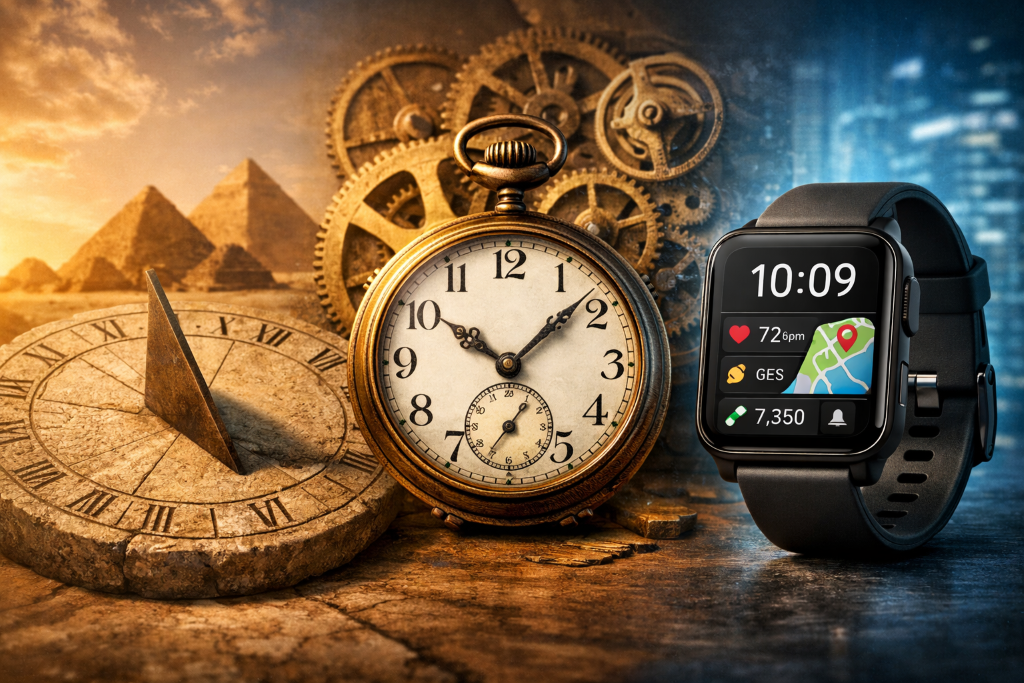
The Evolution of Timekeeping: From Sundials to Smartwatches
Imagine a world with no clocks, no schedules, and no alarms. People would wake with the sun, eat when they felt hungry, and sleep when night fell. For much of human history, that was life — until humans learned how to measure time.
From the shadows of sundials to the touchscreens of smartwatches, the story of timekeeping is one of curiosity, innovation, and an ongoing obsession with precision. Let’s explore how humanity went from watching the sky to wearing time on our wrists.
1. Timekeeping Begins with Nature
Before any tools existed, nature itself was the first clock.
- The Sun: People observed how shadows moved as the sun changed position.
- The Moon and Stars: Used to mark months, seasons, and long cycles.
- Human Body Rhythms: Natural sleep-wake cycles helped estimate daily time.
However, nature alone wasn’t enough. As civilizations grew, humans needed more accurate and reliable ways to measure time.
2. Ancient Sundials: The First Clocks
The earliest known timekeeping device was the sundial, dating back to around 1500 BCE in ancient Egypt.
How it worked: A vertical stick (called a gnomon) cast a shadow on a marked surface. As the sun moved, the shadow shifted — indicating the time.
Interesting Fact: The ancient Greeks and Romans divided daylight into 12 hours, which changed length depending on the season.
Limitation: Sundials were useless at night and during cloudy weather.
3. Water Clocks and Sand Timers
To measure time without sunlight, ancient civilizations invented alternatives:
- Water Clocks (Clepsydra): Water flowed at a steady rate between containers, marking time by water level.
- Hourglasses: Sand flowed between two glass bulbs, creating a simple countdown timer.
These devices were not perfectly accurate, but they worked indoors and at night.
4. Mechanical Clocks Revolutionize Time
In the 14th century, mechanical clocks appeared in European church towers.
Key features:
- Powered by gears and weights
- Used an escapement mechanism to control motion
- Rang bells to announce the hour
Famous Example: The Prague Astronomical Clock (1410) still operates today.
Over time, mechanical clocks became smaller, more accurate, and eventually portable.
5. Pocket Watches and Personal Time
By the 1500s, spring-powered pocket watches emerged.
- Mostly owned by the wealthy
- Decorative and symbolic of social status
- Early models showed only hours (no minutes or seconds)
In the 18th century, British watchmaker John Harrison created marine chronometers, enabling accurate navigation at sea.
6. Wristwatches: From War to Fashion
Wristwatches gained popularity during World War I.
- Soldiers needed hands-free timekeeping
- Pocket watches were impractical in combat
After the war, wristwatches became everyday accessories for both men and women.
7. The Quartz Revolution
In 1969, the first quartz watch changed everything.
- Used a vibrating quartz crystal for accuracy
- Far more precise and affordable than mechanical watches
Accuracy comparison:
- Quartz watches: ~±15 seconds per month
- Mechanical watches: ~±15 seconds per day
Quartz technology made reliable timekeeping accessible to everyone.
8. Smartwatches: Time Meets Technology
Today’s smartwatches are mini-computers worn on the wrist.
They can:
- Track health, heart rate, and sleep
- Send messages and take calls
- Provide GPS navigation and weather updates
- Run apps and voice assistants
Timekeeping is no longer just about knowing the hour — it’s about managing life.
What’s Next for Timekeeping?
The future may go beyond watches entirely:
- Brain-computer interfaces syncing body clocks
- Wearable atomic-level precision devices
- Augmented reality time tracking
- Time as data, not just a display
Final Thoughts
From a simple shadow on the ground to AI-powered smart devices, the evolution of timekeeping mirrors human progress itself.
The next time you glance at your watch or phone, remember — you’re looking at the result of over 5,000 years of innovation.
Comments
good
2026-01-06 09:52:47