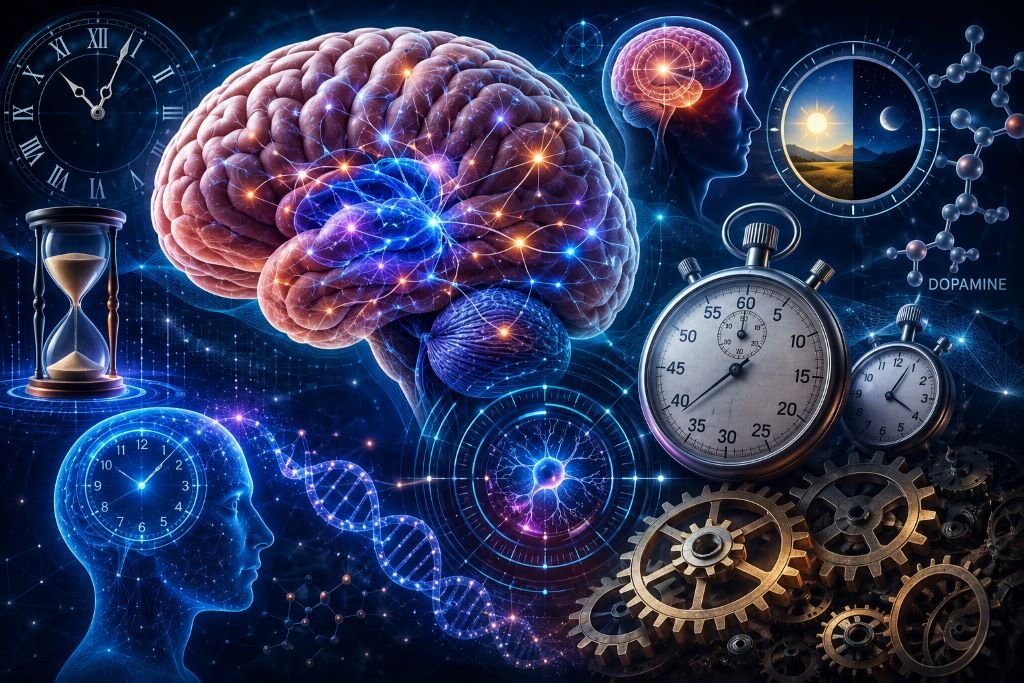
Part 1 – Understanding the Brain's Sense of Time
Introduction
Imagine trying to live for just one day without any sense of time.
You wake up but have no idea whether you slept for five minutes or ten hours. You cannot estimate how long it takes to brush your teeth, drive to work, cook dinner, or finish a conversation. Crossing a busy road becomes dangerous because you cannot judge the speed of approaching vehicles. Music loses its rhythm, sports become impossible to play, and even speaking fluently becomes difficult because every sentence depends on precise timing.
Surprisingly, this isn't science fiction.
Your brain performs these calculations every second without requiring you to think about them consciously. Long before humans invented sundials, calendars, mechanical clocks, or atomic clocks, the human brain had already evolved its own sophisticated system for measuring time.
Unlike a wristwatch or smartphone, however, the brain does not contain a tiny digital display counting seconds. Instead, it relies on billions of interconnected neurons, chemical messengers, electrical signals, and specialized brain regions that work together to estimate durations ranging from milliseconds to decades.
Understanding how the brain measures time has become one of neuroscience's most fascinating challenges. Researchers have discovered that our perception of time is not fixed or perfectly accurate. It stretches, compresses, speeds up, and slows down depending on our emotions, attention, memories, health, and even the chemicals circulating inside our brains.
This invisible "internal clock" shapes nearly every aspect of human life—from walking and talking to learning, decision-making, sports performance, and sleep.
In this article, we'll explore how the human brain keeps track of time, why our internal clock sometimes becomes inaccurate, and what modern neuroscience has revealed about one of the most remarkable abilities of the human mind.
Why Time Matters to the Human Brain
Time is unlike any other sense.
Humans have dedicated organs for seeing, hearing, tasting, smelling, and touching. Yet there is no "time organ" hidden somewhere inside the body.
Instead, the brain constructs our experience of time by combining information from multiple neural systems.
Without this ability, everyday life would quickly become impossible.
The brain depends on timing for countless essential tasks, including:
- Walking without losing balance
- Understanding spoken language
- Reading sentences in the correct order
- Playing musical instruments
- Driving safely
- Catching a ball
- Cooking meals
- Coordinating body movements
- Remembering past events
- Planning future activities
Even a simple handshake requires extraordinary timing.
Your brain must estimate another person's movement, predict when your hands will meet, control muscle contractions, and adjust grip strength—all within fractions of a second.
Most of these processes happen automatically.
We rarely notice them because the brain's timing mechanisms operate continuously behind the scenes.
Does the Brain Really Have an Internal Clock?
One of the biggest misconceptions about neuroscience is the idea that the brain contains a single biological stopwatch.
Current research suggests something far more sophisticated.
Rather than relying on one central clock, the brain appears to use multiple timing systems, each specialized for different types of time estimation.
Scientists often describe this as a network of distributed clocks working together.
For example:
- One system helps estimate milliseconds needed for speech.
- Another tracks seconds during everyday activities.
- Another organizes daily sleep-wake cycles.
- Another helps remember events from years ago.
These systems communicate constantly, allowing us to experience time as one continuous flow.
This explains why someone may accurately clap to music while simultaneously estimating how long they've been waiting in a queue.
Different timing mechanisms are operating together.
The Evolution of Time Perception
Long before civilization existed, survival depended on accurately measuring time.
Early humans who could estimate durations more effectively gained important advantages.
For example, they needed to know:
- When predators were likely to appear
- How long daylight would remain
- When fruit became ripe
- Seasonal migration patterns
- The timing of changing weather
- Safe opportunities to hunt
- How quickly prey was moving
Animals also depend heavily on timing.
Birds migrate thousands of kilometers during specific seasons.
Sea turtles return to beaches after many years.
Honeybees estimate travel times while searching for flowers.
Dogs learn daily routines with remarkable accuracy.
These abilities suggest that biological timing evolved hundreds of millions of years before humans invented clocks.
The human brain simply developed far more advanced versions of these ancient systems.
Different Types of Time the Brain Measures
Many people imagine time as a single continuous phenomenon.
Neuroscience shows otherwise.
The brain processes different kinds of time using different neural mechanisms.
1. Millisecond Timing
This involves extremely short intervals.
Examples include:
- Speaking clearly
- Understanding language
- Playing piano
- Catching objects
- Typing
- Dancing
- Eye movements
Even a difference of just a few milliseconds can affect speech or athletic performance.
2. Interval Timing
This refers to durations lasting seconds or minutes.
Examples include:
- Waiting for traffic lights
- Boiling an egg
- Giving a presentation
- Exercising
- Parking a car
- Solving a math problem
Most daily activities depend heavily on interval timing.
3. Circadian Timing
This controls approximately 24-hour biological cycles.
Examples include:
- Sleep
- Wakefulness
- Hormone release
- Body temperature
- Hunger
- Alertness
Unlike interval timing, circadian timing is strongly influenced by sunlight and environmental cues.
4. Long-Term Time
Humans also estimate months, years, and decades.
This allows us to:
- Remember birthdays
- Recall childhood memories
- Plan retirement
- Anticipate holidays
- Understand historical events
These longer timescales depend heavily on memory rather than precise internal clocks.
Why Time Sometimes Feels Faster or Slower
One of neuroscience's greatest discoveries is that physical time and psychological time are not always the same.
The clock on the wall may measure exactly one hour.
Your brain, however, may experience that hour very differently.
For example:
During an Exciting Vacation
Hours seem to disappear.
You become deeply engaged with new experiences, reducing your awareness of passing time.
During a Boring Lecture
Ten minutes can feel like thirty.
Your attention repeatedly shifts toward monitoring time itself, making the interval seem longer.
During an Emergency
Many people report that time appears to slow dramatically.
Although actual time does not change, the brain processes information more intensely, creating the impression that events unfolded more slowly.
During Childhood
Summers seem endless.
Each experience feels new and memorable.
During Adulthood
Years often seem to pass more quickly because familiar routines require less detailed processing and create fewer distinctive memories.
These experiences illustrate that the brain does not simply "read" time.
It actively constructs the feeling of time.
The Brain Doesn't Measure Time Like a Clock
A mechanical clock measures every second identically.
Your brain does not.
Instead, it constantly adjusts its estimates using information such as:
- Attention
- Emotion
- Memory
- Expectations
- Body movement
- Vision
- Hearing
- Heart rate
- Stress levels
- Dopamine activity
Because these factors change continuously, our perception of time also changes.
This flexibility is actually beneficial.
Imagine escaping danger.
If the brain processed every moment at exactly the same subjective speed, reacting quickly during emergencies would be much harder.
Instead, the brain adapts its perception depending on the situation.
The Brain as a Prediction Machine
Modern neuroscience increasingly views the brain as a prediction engine.
Rather than waiting for events to happen, the brain constantly predicts what will happen next.
Timing is central to this process.
For example, when someone throws you a ball, your brain does not wait until the ball reaches your hand.
Instead, it predicts:
- Its speed
- Its direction
- Its arrival time
- Your required muscle movements
All of these predictions rely on incredibly precise timing.
Similar predictive timing occurs when:
- Listening to music
- Holding conversations
- Driving
- Playing sports
- Reading
- Cooking
- Walking through crowds
Without accurate timing predictions, ordinary life would become chaotic.
Why Scientists Still Debate the Brain's Internal Clock
Despite decades of research, scientists have not identified one single "master clock" inside the brain.
Instead, several competing theories exist.
Some researchers believe timing emerges from synchronized neural activity.
Others argue that specialized groups of neurons function as biological timers.
Still others suggest that timing naturally arises from communication across large brain networks.
Each theory explains part of the evidence, but none fully explains every aspect of human time perception.
This ongoing mystery makes time one of the most exciting frontiers in neuroscience.
As brain imaging technology improves, researchers continue uncovering new clues about how billions of neurons cooperate to create our seamless experience of past, present, and future.
Part 2 – The Brain's Internal Clock: The Neural Networks That Measure Time
Is There Really a "Clock" Inside the Brain?
When people hear the phrase "internal clock," they often imagine a tiny biological device somewhere inside the brain, ticking away like a wristwatch.
In reality, neuroscience paints a far more fascinating picture.
The brain has no single structure responsible for measuring time. Instead, time perception emerges from the coordinated activity of several interconnected brain regions. Each contributes a different aspect of timing, and together they create the seamless experience of past, present, and future.
Think of it like an orchestra.
A symphony is not produced by one instrument. Violins, pianos, drums, and wind instruments each play different roles, yet together they create one piece of music.
The brain measures time in much the same way.
Different regions specialize in different forms of timing, but they constantly exchange information to produce one unified sense of time.
Today, neuroscientists refer to this as a distributed timing network rather than a single biological clock.
The Major Brain Regions Involved in Timing
Research using MRI scans, functional brain imaging (fMRI), EEG recordings, and studies of patients with neurological disorders has identified several key regions that contribute to time perception.
The most important include:
- Basal Ganglia
- Cerebellum
- Prefrontal Cortex
- Hippocampus
- Supplementary Motor Area (SMA)
- Insular Cortex
- Parietal Cortex
Each performs a specialized role.
1. Basal Ganglia – The Brain's Timing Hub
Among all timing-related structures, the Basal Ganglia is often considered the brain's central timing network for estimating intervals lasting from hundreds of milliseconds to several seconds.
Located deep beneath the cerebral cortex, the Basal Ganglia consist of several interconnected structures that help regulate movement, decision-making, learning, and reward.
Modern neuroscience shows that they are also essential for interval timing.
Whenever you:
- Wait for a traffic light,
- Count silently,
- Tap your foot to music,
- Estimate cooking time,
- Judge the speed of another person,
the Basal Ganglia are highly active.
Scientists believe these structures help compare ongoing neural activity against expected durations, allowing us to estimate how much time has passed.
This system becomes especially important during repetitive behaviors requiring accurate timing.
Parkinson's Disease and Time Perception
One of the strongest pieces of evidence comes from Parkinson's disease.
In Parkinson's disease:
- Dopamine-producing neurons gradually die.
- Basal Ganglia function becomes impaired.
- Patients often struggle to estimate time accurately.
Many experience:
- Difficulty judging seconds
- Slower reaction times
- Problems synchronizing movement
- Irregular walking rhythm
- Difficulty maintaining speech timing
These observations strongly suggest that the Basal Ganglia play a central role in human timing.
2. Cerebellum – Precision Timing
If the Basal Ganglia estimate intervals, the Cerebellum provides extraordinary precision.
Located beneath the back of the brain, the Cerebellum contains more neurons than the rest of the brain combined despite occupying only about 10% of its volume.
For decades, scientists believed its only job was coordinating movement.
Today, we know it also functions as one of the brain's most accurate timing systems.
The Cerebellum excels at measuring extremely short durations—often just a few milliseconds.
This makes it critical for:
- Speech
- Musical performance
- Typing
- Athletic coordination
- Eye movements
- Balance
- Dance
- Playing instruments
Without cerebellar timing, movements become awkward and poorly coordinated.
Imagine trying to play the piano while every finger moved a fraction of a second too early or too late.
That is similar to what happens when cerebellar function is disrupted.
Why Athletes Depend on the Cerebellum
Elite athletes rely heavily on cerebellar timing.
A tennis player returning a 200 km/h serve has only a few hundred milliseconds to:
- Detect the ball
- Predict its path
- Position the body
- Swing the racket
- Make contact
The Cerebellum continuously fine-tunes these movements with remarkable precision.
Rather than reacting after events occur, it predicts movement before it happens.
3. Prefrontal Cortex – Planning Across Time
The Prefrontal Cortex, located behind the forehead, is often called the brain's executive control center.
Instead of measuring milliseconds, it specializes in organizing behavior across longer periods.
Its responsibilities include:
- Planning
- Decision-making
- Working memory
- Attention
- Self-control
- Future thinking
Whenever you estimate:
- how long a meeting will last,
- when to leave for the airport,
- whether you have enough time to finish a project,
the Prefrontal Cortex becomes heavily involved.
Unlike the Cerebellum, which handles rapid precision, the Prefrontal Cortex manages cognitive timing.
It integrates information from memory, goals, attention, and expectations to estimate future events.
This is why people under stress often make poor time estimates.
Stress disrupts executive processing, making future planning less accurate.
4. Hippocampus – Time in Memory
Time is meaningless without memory.
Knowing when something happened is almost as important as remembering what happened.
This is where the Hippocampus becomes essential.
Located within the temporal lobe, the Hippocampus is famous for forming new memories.
Recent research has revealed another remarkable function—it helps organize memories along a timeline.
Scientists have even identified specialized neurons called "time cells."
These neurons activate in predictable sequences during specific intervals, allowing the brain to organize experiences in chronological order.
Because of the Hippocampus, you can remember:
- graduating from school before starting your career,
- eating breakfast before going to work,
- childhood before adulthood.
Without this ability, memories would exist without temporal order.
The Discovery of Time Cells
In the last decade, neuroscientists discovered that some hippocampal neurons fire not because of location, but because of time itself.
Just as place cells help create mental maps of physical space, time cells help create mental maps of temporal experiences.
This discovery suggests that the brain organizes time and space using surprisingly similar neural principles.
5. Supplementary Motor Area (SMA)
Hidden near the top of the brain lies the Supplementary Motor Area, commonly called the SMA.
Although less famous than the Cerebellum or Basal Ganglia, it plays an important role in internally generated timing.
The SMA becomes active whenever we:
- Clap rhythmically
- Count silently
- Dance
- Walk steadily
- Repeat practiced movements
Unlike movements triggered by external events, the SMA helps maintain internally generated rhythms.
For example, if someone asks you to tap once every second without looking at a clock, the SMA becomes highly active.
6. Insular Cortex – Feeling Time
Not every aspect of time is mathematical.
Sometimes time simply feels fast or slow.
The Insular Cortex appears to contribute to these subjective experiences.
This region integrates signals from throughout the body, including:
- Heartbeat
- Breathing
- Temperature
- Pain
- Hunger
- Emotional state
Because emotions influence bodily activity, the Insula helps explain why:
- Fear makes time appear slower.
- Excitement makes hours disappear.
- Anxiety makes waiting feel endless.
Rather than measuring objective time, the Insula helps create psychological time.
7. Parietal Cortex – Attention and Time
The Parietal Cortex helps determine where attention is directed, and attention strongly influences time perception.
Consider these examples:
Waiting in a Hospital
You repeatedly check the clock.
Every minute feels long.
Your attention remains focused on time.
Watching an Exciting Movie
Two hours pass unnoticed.
Your attention is absorbed elsewhere.
The Parietal Cortex helps allocate attention between external events and the internal passage of time.
The more attention devoted to time itself, the longer intervals usually seem.
How These Regions Work Together
One remarkable feature of the brain is that these regions rarely work independently.
Imagine catching a baseball.
Within fractions of a second:
- Your eyes track the ball.
- The Cerebellum predicts its trajectory.
- The Basal Ganglia estimate timing.
- The SMA coordinates movement.
- The Prefrontal Cortex plans your response.
- The Parietal Cortex directs attention.
- The Hippocampus stores the experience.
None of these structures acts alone.
Instead, they form a highly integrated timing network.
This distributed design also makes the brain remarkably resilient. If one system becomes less efficient, others can sometimes compensate, although not perfectly.
Why There Is No "Master Clock"
For many years, scientists searched for one central biological clock responsible for every aspect of timing.
Current evidence suggests that no such master clock exists.
Instead, the brain appears to use multiple overlapping neural timers, each optimized for different situations:
- Millisecond timing
- Motor timing
- Decision timing
- Circadian timing
- Emotional timing
- Memory timing
This distributed architecture allows humans to perform extraordinarily diverse timing tasks simultaneously—from speaking and driving to remembering childhood and planning retirement.
It is one of the brain's greatest engineering achievements.
Part 3 – The Chemistry of Time: Dopamine, Biological Clocks, and Why Time Feels Different
The Brain Doesn't Just Count Time—It Uses Chemistry
In the previous section, we explored the brain regions responsible for measuring time. However, these structures cannot function on their own. They depend on billions of neurons communicating through tiny chemical messengers known as neurotransmitters.
Think of the brain as an orchestra.
The different brain regions are the musicians, but neurotransmitters are the conductor. Without them, the orchestra would fall out of sync.
When it comes to time perception, one neurotransmitter stands above all others: dopamine.
Although serotonin, norepinephrine, acetylcholine, and GABA also influence our experience of time, dopamine has emerged as one of the most important chemicals for helping the brain estimate durations, anticipate future events, and coordinate movement.
Understanding dopamine is essential for understanding how the brain measures time.
Dopamine: The Brain's Timing Messenger
Dopamine is often described as the brain's "reward chemical," but that label tells only part of the story.
Modern neuroscience has shown that dopamine is deeply involved in:
- Estimating time intervals
- Learning from experience
- Predicting future outcomes
- Coordinating movement
- Motivation
- Attention
- Decision-making
Whenever your brain estimates how long something should take, dopamine helps regulate the neural circuits involved.
Instead of functioning like a stopwatch, dopamine adjusts the speed of the brain's internal timing mechanisms.
Scientists sometimes compare dopamine to a volume knob rather than an on/off switch.
Higher dopamine activity can make internal timing signals run differently than lower dopamine activity.
How Dopamine Changes Time Perception
Research has found that dopamine levels influence how quickly or slowly time seems to pass.
Although the exact mechanisms are still being investigated, several patterns have emerged.
Increased Dopamine Activity
Higher dopamine activity is often associated with:
- Faster internal timing
- Greater motivation
- Increased alertness
- Better prediction of rewards
- Improved reaction speed
Under certain conditions, people may judge time intervals differently because their internal timing system is operating at a different pace.
Reduced Dopamine Activity
When dopamine levels decline, people may experience:
- Poorer interval estimation
- Slower movement
- Reduced motivation
- Difficulty maintaining rhythm
- Less accurate time judgments
This relationship becomes especially clear in neurological disorders such as Parkinson's disease, where dopamine-producing neurons gradually deteriorate.
Why Exciting Experiences Feel Short
Have you ever noticed that a thrilling vacation seems to end almost instantly, while waiting in a government office or airport can feel endless?
The answer lies in how the brain distributes attention—not simply in dopamine itself.
When you are deeply engaged:
- Your attention focuses on the activity.
- Your brain processes large amounts of meaningful information.
- You spend less mental effort monitoring the passage of time.
As a result, time seems to pass quickly.
By contrast, during boredom:
- Your attention repeatedly returns to the clock.
- You monitor every passing minute.
- Your awareness of time increases.
The result is a feeling that time is dragging.
This illustrates an important principle:
The brain experiences time indirectly through attention and information processing—not by reading an internal calendar.
Circadian Rhythm: The Brain's 24-Hour Clock
So far, we've discussed interval timing, which helps estimate seconds and minutes.
The brain also operates on a completely different timing system called the circadian rhythm.
The word circadian comes from the Latin words meaning "about a day."
This internal biological clock regulates approximately 24-hour cycles that influence:
- Sleep
- Wakefulness
- Hormone release
- Body temperature
- Blood pressure
- Digestion
- Alertness
- Metabolism
Unlike interval timing, circadian timing is synchronized primarily by light.
The Suprachiasmatic Nucleus (SCN)
At the center of the brain's biological clock is a tiny structure called the Suprachiasmatic Nucleus (SCN).
Located within the hypothalamus, the SCN contains roughly 20,000 specialized neurons.
Although extremely small, it acts as the body's master circadian coordinator.
Every morning:
- Light enters the eyes.
- Specialized retinal cells detect environmental brightness.
- Signals travel directly to the SCN.
- The SCN synchronizes clocks throughout the body.
Virtually every organ—including the liver, heart, lungs, and kidneys—contains its own molecular clock.
The SCN ensures they remain synchronized.
Without this coordination, the body's daily rhythms begin to drift apart.
Melatonin: The Hormone of Darkness
One of the SCN's most important responsibilities is regulating melatonin production.
Melatonin is often called the sleep hormone, although its primary role is signaling that darkness has arrived.
As evening approaches:
- Light levels decrease.
- The SCN signals the pineal gland.
- Melatonin production increases.
- Sleepiness gradually develops.
Exposure to bright screens late at night can interfere with this process by suppressing melatonin production.
This is one reason why excessive nighttime screen use may delay sleep.
Why Jet Lag Happens
Jet lag offers one of the clearest demonstrations of the brain's biological clock.
Imagine flying from New York to Tokyo.
Your watch changes immediately.
Your brain does not.
The SCN continues following the schedule of your previous time zone.
As a result:
- You may feel sleepy during the day.
- You may wake during the night.
- Hunger appears at unusual times.
- Concentration decreases.
- Reaction time slows.
Gradually, exposure to local daylight resets the circadian clock.
Most people adapt over several days, although the exact duration varies.
Attention: The Hidden Factor Behind Time Perception
One of the strongest psychological influences on time perception is attention.
Scientists have repeatedly demonstrated that people estimate durations differently depending on where their attention is directed.
Consider two situations.
Situation One
You sit in a waiting room with nothing to do.
You repeatedly glance at the clock.
Each minute feels unusually long.
Situation Two
You become completely absorbed in writing, painting, coding, or playing music.
Several hours pass before you notice the time.
Objectively, the same number of minutes has passed.
Subjectively, they feel completely different.
Attention changes the brain's experience of time.
The Flow State
Psychologists describe a condition called flow, in which a person becomes completely immersed in an activity.
Flow commonly occurs during:
- Sports
- Music
- Programming
- Scientific research
- Painting
- Writing
- Chess
- Gaming
During flow:
- Attention becomes highly focused.
- Distractions fade.
- Self-awareness decreases.
- Time often seems to disappear.
Many world-class athletes describe entering a state where events appear effortless, even though their brains are performing extraordinarily complex timing calculations.
Memory Shapes Time
Interestingly, the brain judges time differently while events are happening and after they have ended.
During an Event
Attention dominates.
If you're bored, time feels slow.
If you're engaged, time feels fast.
Looking Back
Memory becomes more important.
A vacation filled with new experiences often feels short while you're living it.
Months later, however, it may seem long because your brain stored many vivid memories.
By contrast, repetitive routines produce fewer memorable events.
Looking back, entire weeks or months can seem surprisingly brief.
This explains why childhood often appears to have lasted much longer than adulthood.
Children constantly encounter novel experiences, creating rich, detailed memories that expand their retrospective sense of time.
Stress, Fear, and the Feeling That Time Slows Down
Many people who experience accidents or life-threatening situations report that time appeared to slow dramatically.
Although this phenomenon remains an active area of research, neuroscientists generally agree on one point:
There is no evidence that the brain literally processes more "frames per second."
Instead, intense emotional arousal causes the brain to:
- Focus attention intensely.
- Encode memories in greater detail.
- Prioritize survival-related information.
Later, these unusually rich memories create the impression that the event lasted longer than it actually did.
In other words, the slowing of time is largely a subjective experience, not a change in objective reality.
Part 4 – When the Brain's Clock Breaks: Disorders, Diseases, and Altered States of Time Perception
What Happens When the Brain Loses Its Sense of Time?
Most healthy people take their sense of time for granted.
You instinctively know when a conversation has lasted too long, how many seconds remain before a traffic light changes, or whether you've been waiting five minutes or twenty. This ability feels effortless because the brain's timing systems usually work in harmony.
But what happens when those systems stop working properly?
Neurological diseases, psychiatric disorders, sleep deprivation, medications, and psychoactive substances can all disrupt the brain's internal timing network. These conditions provide scientists with valuable insights because they reveal what happens when specific timing mechanisms fail.
Rather than simply making people "bad at estimating time," these disorders often affect movement, memory, attention, planning, and emotional experience simultaneously—highlighting just how deeply time perception is woven into every aspect of brain function.
Parkinson's Disease: When the Internal Clock Slows Down
One of the strongest pieces of evidence linking the brain to time perception comes from Parkinson's disease.
Parkinson's is a progressive neurological disorder caused primarily by the loss of dopamine-producing neurons in an area of the brain called the substantia nigra. Because dopamine plays a crucial role in the Basal Ganglia's timing circuits, many patients experience disturbances in estimating time.
Common timing-related symptoms include:
- Difficulty estimating short intervals
- Slower reaction times
- Problems maintaining rhythmic movements
- Reduced walking speed
- Difficulty synchronizing speech
- Challenges performing repetitive tasks
Researchers have found that patients may underestimate or overestimate durations depending on the task and the stage of the disease.
Interestingly, treatments that restore dopamine activity can improve not only movement but also certain aspects of time estimation, providing further evidence that dopamine and timing are closely connected.
ADHD and "Time Blindness"
Many people with Attention-Deficit/Hyperactivity Disorder (ADHD) describe a phenomenon often called time blindness.
Although not an official medical diagnosis, the term accurately captures a common experience.
People with ADHD may struggle to:
- Estimate how long tasks will take
- Notice the passage of time
- Meet deadlines consistently
- Transition between activities
- Prioritize tasks according to available time
For example, someone might believe they can finish a project in twenty minutes when it realistically requires two hours.
Others become so deeply focused on one activity—a phenomenon known as hyperfocus—that they completely lose awareness of time passing.
Scientists believe these difficulties arise from differences in attention, executive function, working memory, and dopamine regulation rather than from a broken biological clock.
This demonstrates that time perception depends on cognitive control as much as it does on timing mechanisms themselves.
Alzheimer's Disease: Losing the Timeline of Life
Time is essential for memory.
When Alzheimer's disease damages memory networks, particularly the Hippocampus, patients often lose the ability to organize experiences chronologically.
A person may remember an event but become confused about when it happened.
Examples include:
- Believing childhood memories occurred recently
- Forgetting the current year
- Mixing events from different decades
- Repeating conversations without remembering they already happened
- Becoming disoriented during the day
This condition illustrates an important distinction.
Remembering facts is only one part of memory.
The brain must also place memories on a temporal timeline.
When this ability deteriorates, daily life becomes increasingly confusing.
Depression: When Time Seems to Slow
Many people experiencing major depression report that time appears to move unusually slowly.
Hours may feel endless.
Days seem difficult to complete.
Even enjoyable activities can feel prolonged and emotionally flat.
Researchers believe several factors contribute to this altered experience:
- Reduced motivation
- Lower attention toward external events
- Changes in dopamine activity
- Increased self-focused thinking
- Slower cognitive processing
Because the brain becomes less engaged with rewarding experiences, individuals often pay greater attention to the passage of time itself.
As a result, objective clock time remains unchanged, but subjective time expands.
Anxiety: When Every Second Feels Important
Anxiety affects time differently.
Instead of slowing life generally, anxiety often magnifies awareness of future events.
Someone waiting for medical test results, a job interview, or an important phone call may feel that minutes stretch endlessly.
This occurs because anxious brains continuously monitor potential threats.
Attention repeatedly returns to the anticipated event.
Since attention strongly influences time perception, waiting becomes psychologically longer than it actually is.
This explains why:
- Waiting for exam results feels much longer than taking the exam.
- Airport delays feel longer when you're worried about missing a connection.
- A five-minute medical procedure can seem like half an hour.
Schizophrenia and Distorted Temporal Experience
Schizophrenia affects many aspects of perception, including the experience of time.
Some individuals report:
- Difficulty judging durations
- Problems sequencing events
- Disrupted perception of cause and effect
- Confusion about the order of experiences
Research suggests abnormalities within neural timing networks may contribute to these symptoms.
Because accurate timing helps organize perception into coherent experiences, disruptions can affect how people interpret reality itself.
Although scientists continue investigating these mechanisms, schizophrenia highlights the importance of precise neural timing for normal consciousness.
Sleep Deprivation: A Temporary Disruption of Time
You don't need a neurological disease to experience altered time perception.
Simply missing a night's sleep can significantly affect the brain's timing systems.
Sleep deprivation reduces activity in regions responsible for:
- Attention
- Executive control
- Working memory
- Decision-making
- Reaction speed
As fatigue increases, people often become less accurate at estimating intervals and more prone to timing errors.
For example:
- Drivers react more slowly.
- Athletes mistime movements.
- Students misjudge how long tasks require.
- Workers make more scheduling mistakes.
This is one reason why adequate sleep is essential not only for memory but also for accurate perception of time.
Alcohol and the Brain's Clock
Alcohol interferes with communication between neurons throughout the brain.
As blood alcohol concentration rises, timing abilities gradually deteriorate.
People may experience:
- Slower reaction times
- Poor judgment of speed
- Reduced coordination
- Difficulty estimating intervals
- Impaired decision-making
Because accurate timing is essential for driving, operating machinery, and many workplace tasks, alcohol-related timing impairment contributes significantly to accident risk.
Even moderate intoxication can affect the brain's ability to coordinate movement precisely.
Psychoactive Drugs and Time Distortion
Various psychoactive substances can dramatically alter subjective time.
Different drugs affect different neurotransmitter systems, producing distinct experiences.
For example, some users report:
- Minutes feeling like hours
- Hours seeming to disappear
- Repeated sensations of "time stopping"
- Difficulty judging the order of events
- Distorted awareness of duration
Researchers believe these effects result from changes in attention, sensory processing, dopamine signaling, and communication between large-scale brain networks.
Although these experiences may feel extraordinarily real, they represent altered perception rather than changes in objective time.
Aging and the Feeling That Time Speeds Up
One of the most universal experiences of adulthood is the feeling that years pass increasingly quickly.
Scientific explanations include several complementary factors.
1. Familiarity
Children encounter countless new experiences.
Adults often follow predictable routines.
Novel experiences create richer memories, making periods appear longer in retrospect.
2. Attention
As people become busier with work and responsibilities, they devote less attention to the passage of time.
3. Memory Density
Periods filled with memorable events appear longer when recalled.
Routine months generate fewer distinctive memories and therefore seem shorter.
4. Biological Changes
Normal aging also affects dopamine activity, processing speed, and attention, all of which may contribute to altered time perception.
Researchers continue studying exactly how these factors interact.
What These Disorders Teach Neuroscience
The study of neurological disorders has transformed our understanding of time perception.
Together, they reveal several important principles:
- Time perception is distributed across multiple brain systems.
- Dopamine is essential but not sufficient on its own.
- Memory, attention, and emotion strongly influence timing.
- Damage to one brain region rarely affects only one aspect of time.
- Objective time and subjective time are fundamentally different experiences.
Rather than exposing a single "clock," these disorders reveal an intricate network that continuously integrates movement, memory, prediction, emotion, and attention.
Part 5 – The Future of Time Research, Artificial Intelligence, and What Neuroscience Still Doesn't Know
How Do Scientists Study Time Inside the Brain?
Unlike blood pressure or heart rate, time perception cannot be measured with a single instrument. Scientists must infer how the brain processes time by combining behavioral experiments with advanced neuroscience technologies.
Today, researchers use multiple techniques to investigate the brain's timing networks.
Functional Magnetic Resonance Imaging (fMRI)
Functional MRI measures changes in blood flow throughout the brain while participants perform timing tasks.
For example, volunteers may be asked to:
- Estimate a five-second interval
- Compare two different durations
- Synchronize finger tapping with a rhythm
- Predict when an object will reach a target
The resulting scans reveal which brain regions become more active during different types of timing.
These studies consistently show that no single brain region controls time perception. Instead, distributed networks involving the Basal Ganglia, Cerebellum, Prefrontal Cortex, and Parietal Cortex work together.
Electroencephalography (EEG)
EEG records tiny electrical signals generated by groups of neurons.
Unlike MRI, EEG provides extremely high temporal resolution, allowing scientists to observe brain activity unfolding within milliseconds.
This makes EEG particularly useful for studying:
- Reaction time
- Rhythm perception
- Speech timing
- Musical processing
- Rapid decision-making
Researchers have discovered rhythmic patterns of brain activity that appear to help organize internal timing.
Magnetoencephalography (MEG)
MEG detects the magnetic fields produced by electrical activity in neurons.
It combines excellent temporal precision with better spatial localization than EEG, making it another valuable tool for investigating neural timing.
Single-Neuron Recording
In rare clinical situations, researchers can record the activity of individual neurons.
These experiments led to the discovery of time cells, neurons that become active at specific moments during an experience.
Just as place cells represent locations in physical space, time cells appear to represent locations in time.
This discovery has significantly changed how neuroscientists understand memory and temporal processing.
The Discovery of Time Cells
One of the most exciting developments in modern neuroscience has been the identification of time cells within the hippocampus and related memory structures.
Imagine listening to a favorite song.
Different groups of time cells become active in a predictable sequence as the song progresses.
Instead of recording physical distance, these neurons appear to encode the passage of time itself.
This allows the brain to answer questions such as:
- What happened first?
- What happened next?
- How long ago did this occur?
Time cells help organize experiences into coherent episodes, enabling humans to remember not only events but also their order.
Without them, memories could become disconnected fragments rather than meaningful stories.
Can Artificial Intelligence Experience Time?
Artificial intelligence can measure time with extraordinary precision using computer clocks.
However, measuring time is not the same as experiencing it.
A computer processor can count nanoseconds with remarkable accuracy, but it does not become bored during a delay or excited during a celebration.
Human time perception is deeply influenced by:
- Emotions
- Expectations
- Attention
- Motivation
- Memory
- Social interactions
- Physical sensations
These subjective experiences remain uniquely biological.
Modern AI systems can simulate timing behavior and predict temporal patterns, but there is no evidence that they possess a conscious experience of time comparable to humans.
Understanding this distinction is increasingly important as neuroscience and artificial intelligence continue to influence one another.
The Future of Time Research
Despite decades of progress, many of the biggest questions remain unanswered.
Scientists continue investigating topics such as:
Is There a Universal Neural Timing Mechanism?
Some researchers argue that all timing emerges from shared neural principles, while others believe different timing systems evolved independently.
The answer remains uncertain.
Why Does Time Feel Faster With Age?
Many theories exist, including:
- Reduced novelty
- Changes in dopamine
- Memory density
- Attention
- Faster predictive processing
It is likely that multiple factors contribute simultaneously.
How Does Consciousness Create the Present Moment?
One of neuroscience's greatest mysteries concerns the experience of "now."
The brain requires time to process information, yet we experience reality as continuous and immediate.
Exactly how the brain constructs the present remains an active area of research.
Can Brain Disorders Be Diagnosed Through Timing?
Researchers are exploring whether changes in time perception could serve as early indicators of diseases such as:
- Parkinson's disease
- Alzheimer's disease
- ADHD
- Huntington's disease
- Schizophrenia
If successful, simple timing tests might one day become valuable diagnostic tools.
Time Perception Beyond Humans
Humans are not the only creatures with sophisticated timing abilities.
Research has shown remarkable temporal skills across the animal kingdom.
Examples include:
- Songbirds precisely timing vocal sequences.
- Bats using millisecond-scale timing for echolocation.
- Dolphins coordinating complex social behaviors.
- Honeybees estimating travel duration between flowers.
- Migratory birds navigating across continents using seasonal timing.
- Octopuses learning the timing of feeding routines.
Studying these species helps scientists understand how timing systems evolved long before humans appeared.
Why Understanding Time Matters
Research into time perception has practical applications across many fields.
Medicine
Improved understanding of timing networks may lead to better treatments for neurological disorders.
Education
Learning strategies can be optimized by understanding attention, memory, and timing.
Sports Science
Elite athletic performance depends on millisecond-level precision.
Training programs increasingly incorporate neuroscience principles.
Music
Rhythm perception provides a unique window into how the brain coordinates movement and prediction.
Artificial Intelligence
Neuroscience continues inspiring machine-learning systems that better predict sequences and adapt to changing environments.
Space Exploration
Astronauts living in environments with unusual day-night cycles offer valuable insights into circadian timing and human adaptation.
The Brain's Greatest Achievement
Perhaps the most remarkable aspect of time perception is that we rarely notice it.
Every conversation, every step we take, every musical note we hear, and every memory we create depends on extraordinarily precise neural timing.
The brain seamlessly integrates:
- Sensory information
- Motor control
- Prediction
- Attention
- Emotion
- Memory
- Biological rhythms
into one continuous experience we simply call time.
Unlike a clock hanging on the wall, the brain does not merely measure time—it creates the experience of time.
That experience changes throughout life, differs between individuals, and adapts to countless situations.
In many ways, understanding time perception means understanding one of the most fundamental aspects of being human.
Conclusion
Time is often thought of as something external—a sequence of seconds measured by clocks and calendars.
Neuroscience reveals a deeper truth.
The human brain does not passively observe time. It actively constructs it through the coordinated activity of neural networks, chemical messengers, memory systems, and biological rhythms.
There is no single master clock hidden inside the brain.
Instead, multiple systems collaborate to estimate intervals, predict future events, organize memories, coordinate movement, and synchronize daily life with the rising and setting of the Sun.
Although researchers have uncovered remarkable discoveries—including distributed timing networks, dopamine's role in interval estimation, circadian clocks, and hippocampal time cells—many mysteries remain.
As brain imaging, computational neuroscience, and artificial intelligence continue to evolve, our understanding of time perception will undoubtedly deepen.
For now, one conclusion is clear:
Every second you experience is not simply counted by your brain—it is carefully constructed by one of the most complex biological systems known to science.
Frequently Asked Questions (FAQs)
1. Does the human brain have a single internal clock?
No. Current evidence suggests that the brain uses multiple interconnected timing systems rather than one central clock.
2. Which part of the brain measures time?
Several regions contribute, including the Basal Ganglia, Cerebellum, Prefrontal Cortex, Hippocampus, Supplementary Motor Area, and Parietal Cortex.
3. What are time cells?
Time cells are neurons that activate in predictable sequences, helping organize memories according to when events occur.
4. Why does time seem to pass faster during enjoyable activities?
Focused attention and deep engagement reduce awareness of time, making intervals feel shorter.
5. Why does time feel slower during stressful situations?
Heightened attention and stronger memory formation can make events seem longer in retrospect.
6. What role does dopamine play in time perception?
Dopamine influences interval timing, movement, motivation, learning, and prediction, making it one of the brain's key timing chemicals.
7. What is the circadian rhythm?
It is the brain's approximately 24-hour biological timing system that regulates sleep, hormone release, metabolism, and alertness.
8. Can neurological diseases affect time perception?
Yes. Conditions such as Parkinson's disease, Alzheimer's disease, ADHD, and schizophrenia can alter the brain's timing networks.
9. Do animals perceive time?
Yes. Many animals possess sophisticated biological timing systems that support navigation, hunting, communication, and seasonal migration.
10. Can artificial intelligence experience time like humans?
No. AI can measure and model time accurately, but there is no evidence that it possesses subjective, conscious time perception.
11. Does aging change time perception?
Research suggests that changes in memory, attention, novelty, and brain chemistry contribute to the common feeling that time passes more quickly with age.
12. Why is understanding time perception important?
It has applications in medicine, psychology, education, sports science, artificial intelligence, and neuroscience.
Comments
No comments yet.