Introduction
Timekeeping on Earth is already a remarkable achievement of science and engineering. Atomic clocks, international time standards, satellite navigation systems, and global synchronization networks allow people, computers, transportation systems, and scientific instruments to operate according to a common reference. Coordinated Universal Time (UTC), for example, provides the principal time standard used to coordinate activities around the world.
However, measuring time becomes considerably more complicated when human activity extends beyond Earth. Spacecraft travel at high speeds, operate at different gravitational potentials, and communicate across distances so large that radio signals can take minutes or even hours to arrive. A clock aboard a spacecraft may also accumulate a different amount of elapsed time from a clock on Earth because of relativistic effects.
For NASA, time is much more than a number displayed on a clock. It is an essential part of navigation, communication, mission planning, scientific observation, and spacecraft control. Engineers need to know when an event occurred, when a signal was transmitted, how long it took to reach a destination, and where a spacecraft was when the event happened.
A timing error can affect the calculated position of a spacecraft, reduce the accuracy of scientific measurements, or complicate a critical maneuver. For this reason, space missions depend on carefully defined time systems, highly stable clocks, mathematical models, and continuous measurements.
Understanding how NASA tracks time also reveals a fundamental connection between physics and technology. Time measurements are affected by motion and gravity, while communication delays determine how spacecraft can be controlled from Earth.
This article explains the scientific principles and practical systems NASA uses to measure, coordinate, and apply time during space exploration.
1. Why Timekeeping Is Critical for NASA
Precision in Space Mission Operations
Spacecraft operations depend on accurately scheduled events. A mission plan may specify when an engine must fire, when an antenna should point toward Earth, when a scientific instrument should collect measurements, and when a spacecraft should enter a particular orbit.
These activities are connected. If an earlier maneuver occurs at the wrong time, later operations may require adjustments.
For example, orbital insertion involves changing a spacecraft's velocity so that it enters the intended orbit around a planet or moon. Engineers calculate the maneuver using the spacecraft's position, velocity, engine performance, and the gravitational environment. Timing is an important part of these calculations.
Planetary landings require even more coordination. A lander must follow a planned trajectory, manage its descent, and execute a sequence of events within a limited period. Navigation measurements and onboard clocks help determine when specific actions should occur.
Timing also matters when spacecraft communicate with Earth. A spacecraft must point its antenna in the correct direction and transmit data when ground stations can receive the signal.
The consequences of timing errors depend on the mission. Some errors can be corrected through additional calculations, while others may reduce scientific opportunities or threaten the success of a maneuver.
Synchronization Across Mission Teams
NASA missions often involve spacecraft, ground stations, scientific instruments, mission control teams, and international partners. These components may operate in different locations and time zones.
A common time reference helps engineers correlate commands, telemetry, instrument readings, and scientific observations. Without consistent timestamps, teams could struggle to determine the sequence of events or compare measurements collected by different instruments.
For example, if a spacecraft records a sudden change in temperature and another instrument detects a change in radiation, scientists need reliable timestamps to determine whether the events occurred together.
Time synchronization therefore supports both mission operations and scientific interpretation.
2. Atomic Clocks: The Foundation of Precise Timekeeping
How Atomic Clocks Work
Atomic clocks measure time by using highly stable transitions between specific energy states of atoms. When atoms interact with electromagnetic radiation at an appropriate frequency, they respond in a predictable way.
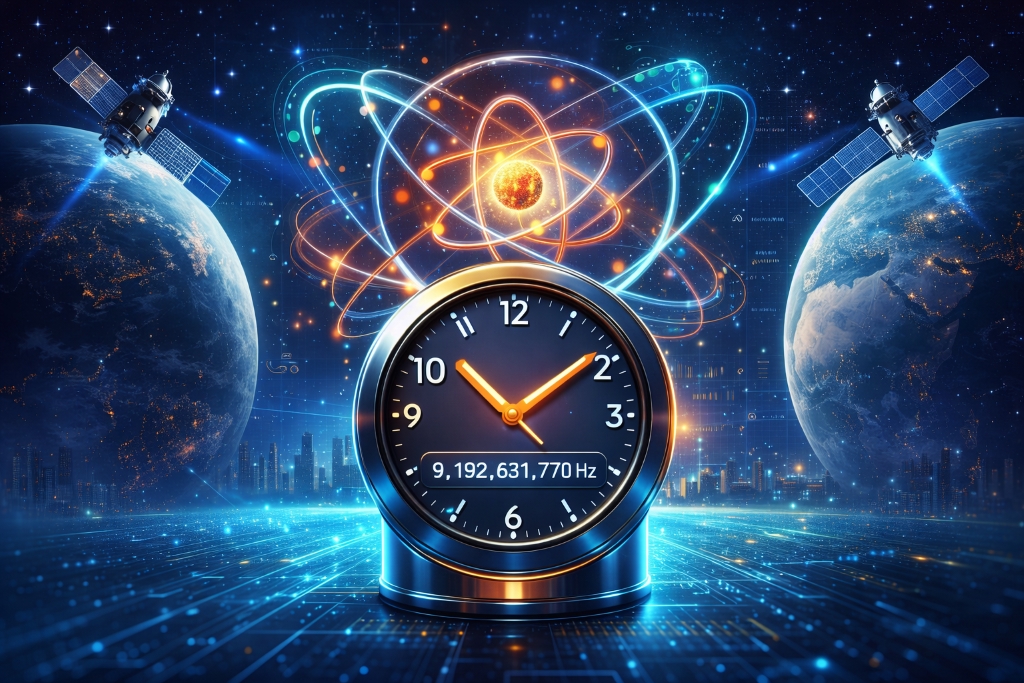
In a cesium atomic clock, the reference transition occurs at exactly 9,192,631,770 cycles per second by the definition of the SI second. The clock's electronics use this atomic reference to regulate an oscillator and count time intervals.
Other atomic clocks use atoms or ions such as rubidium, hydrogen, or strontium, depending on their design and purpose.
The important principle is that atomic transitions provide a reproducible physical reference. Unlike an ordinary mechanical clock, which depends on moving components, an atomic clock can maintain its frequency using the predictable behavior of atoms.
Not every atomic clock has the same performance. Accuracy, stability, size, power consumption, radiation tolerance, and resistance to environmental disturbances all influence whether a clock is suitable for a laboratory, satellite, or spacecraft.
Accuracy and Stability
Accuracy and stability are related but different properties.
Accuracy describes how closely a clock agrees with its intended reference. Stability describes how consistently its frequency behaves over time.
A clock may be very stable over short intervals but still have a small systematic offset. Conversely, a clock may be adjusted to agree with a reference at one moment but exhibit greater fluctuations later.
Space missions require clocks selected for the relevant operational conditions. Some applications need excellent short-term stability, while others depend on maintaining a reliable frequency over long periods without frequent corrections.
Atomic clocks support satellite navigation, telecommunications, scientific experiments, and international timekeeping. Their performance makes it possible to measure extremely small differences in signal arrival times.
For a related explanation of the underlying technology, read :
Why Spacecraft Need Reliable Clocks
A spacecraft cannot always depend on receiving a fresh timing reference from Earth. It may be outside continuous communication coverage, or its mission may require it to operate autonomously for extended periods.
An onboard clock allows the spacecraft to maintain an internal timeline, schedule instrument observations, timestamp collected data, and execute stored commands.
However, even a high-quality clock can accumulate an offset relative to another clock. Engineers must understand this behavior when interpreting spacecraft measurements or coordinating events between Earth and space.
Atomic clocks provide the stability needed to make these calculations more reliable, but they do not eliminate the need for calibration, monitoring, and mathematical corrections.
3. NASA's Time Standards and Mission Time
NASA does not rely on one simple clock reading for every space activity. Different missions and scientific applications use different time representations, depending on what must be measured.
Coordinated Universal Time (UTC)
UTC is the principal civil time standard used for coordinating activities on Earth. It is maintained using atomic timekeeping and is adjusted through leap seconds when required by the applicable international arrangements.
NASA ground operations commonly use UTC-based timestamps to coordinate observations, communication sessions, schedules, and mission events.
UTC is especially useful because it provides a shared reference independent of local time zones. A mission team in California can coordinate with a team in Europe or Australia without confusing their local clock readings.
However, UTC alone does not describe every detail of spacecraft motion or astronomical calculations. For high-precision work, scientists may need time scales specifically designed for dynamical calculations.
Spacecraft Event Time
Spacecraft Event Time, often abbreviated SCET, refers to the time associated with an event occurring at the spacecraft. Mission systems may also distinguish this from the time a signal was received on Earth or the time a command was transmitted.
These distinctions are important because radio signals require time to travel between the spacecraft and a ground station.
For example, an instrument may record an event on Mars at 10:00 according to its mission time reference. A ground station could receive the corresponding data many minutes later. The reception timestamp is not the same as the event timestamp.
Mission software must preserve these distinctions so that engineers and scientists can reconstruct the correct sequence of events.
Ephemeris Time and Dynamical Time Scales
Astronomical navigation requires mathematical descriptions of the positions and movements of planets, moons, and spacecraft. These calculations use time arguments associated with the dynamical models.
The term ephemeris time has historical significance in astronomy. Modern high-precision calculations commonly use defined time scales such as Barycentric Dynamical Time (TDB), Terrestrial Time (TT), and other related representations.
TDB is used in solar-system calculations that describe motion relative to the solar-system barycenter, the center of mass of the solar system. TT is important for geocentric astronomical applications and is related to International Atomic Time by a defined offset.
These time scales are not interchangeable with local civil time. Converting between them requires the appropriate definitions and, in some applications, corrections that account for relativistic effects.
The purpose is to provide consistent mathematical references for calculating celestial positions and interpreting observations.
4. NASA's Deep Space Network
A Global Communication System
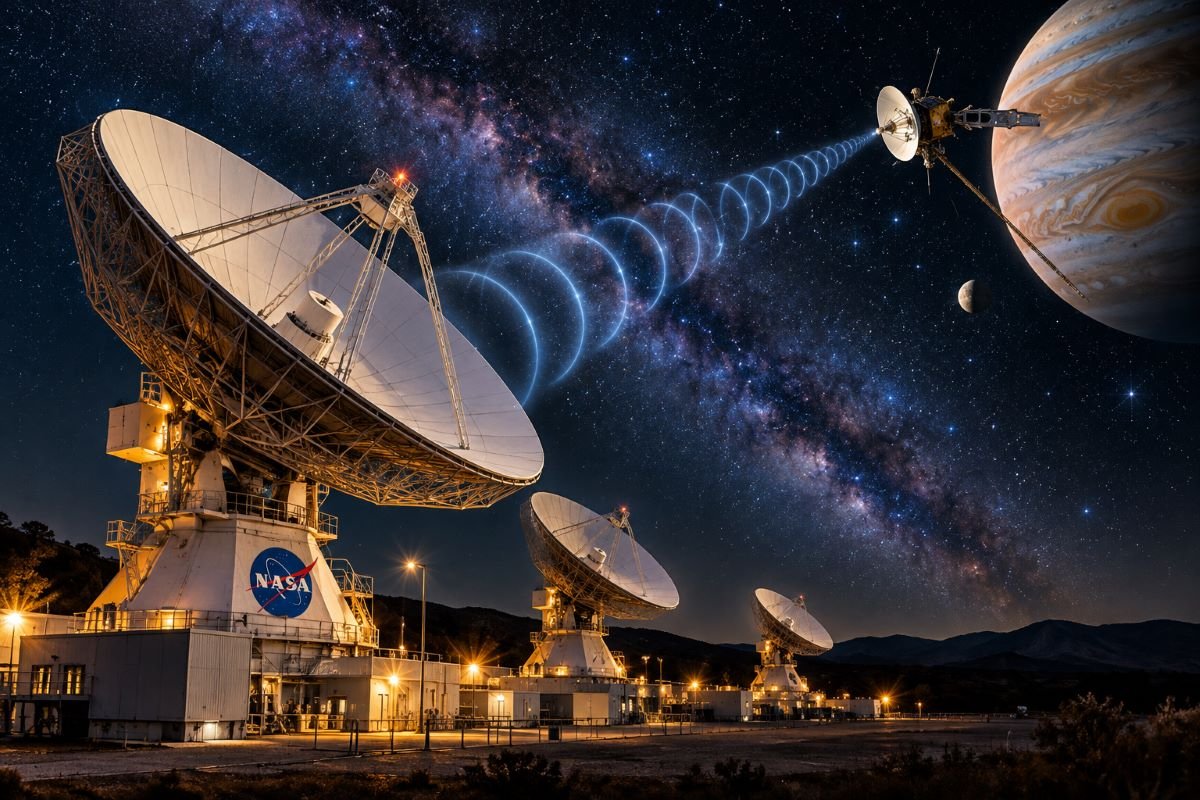
NASA's Deep Space Network (DSN) provides communication and tracking services for spacecraft exploring the solar system and beyond. Its major complexes are located near Goldstone in California, near Madrid in Spain, and near Canberra in Australia.
Their geographic separation allows NASA to maintain communication opportunities as Earth rotates. When a spacecraft moves out of view of one complex, another may be positioned to continue supporting the mission.
The network uses large antennas, sensitive receivers, transmitters, and sophisticated signal-processing systems. It supports the transmission of commands to spacecraft and the reception of scientific data and engineering information.
The DSN also contributes to spacecraft navigation through measurements of radio signals.
Measuring Distance Through Signal Timing
Radio signals travel at approximately the speed of light in a vacuum. By measuring the time required for a signal to travel between a spacecraft and a ground station, engineers can estimate the distance between them.
For a simple one-way measurement, distance is related to signal travel time by:
Distance = Signal travel time × Speed of light
For example, a signal that travels for one second covers approximately 299,792 kilometres in a vacuum.
In practical spacecraft navigation, however, the measurement is more complicated. Engineers must account for the spacecraft's movement, the station's location, equipment delays, atmospheric effects where relevant, and the geometry of the signal path.
Two-way ranging is especially useful. A station transmits a signal, the spacecraft returns a response, and the ground system measures the round-trip interval. The result helps determine the spacecraft's range, subject to the necessary corrections.
Doppler Measurements and Spacecraft Velocity
NASA can also study changes in the frequency of a spacecraft's radio signal.
When a spacecraft moves toward or away from an observer, the received frequency changes because of the Doppler effect. Measuring this change provides information about the spacecraft's motion along the line of sight.
Combining range, Doppler, antenna pointing, and mathematical models helps navigation teams estimate a spacecraft's trajectory.
Accurate timing is essential because small errors in the recorded signal phase or frequency can affect the calculated measurements. These observations help engineers refine spacecraft position and velocity estimates throughout a mission.
5. Communication Delays Between Earth and Space
Why Space Communication Is Not Instantaneous
Even though radio waves travel at the speed of light, the distances involved in space exploration create substantial delays.
Approximate one-way light-travel times include:
- Earth to the Moon: about 1.3 seconds.
- Earth to Mars: roughly 3 to 22 minutes, depending on the positions of the planets.
- Earth to the outer solar system: several hours in some cases.
These values change with distance. The delay to Mars is not constant because Earth and Mars continue moving along their respective orbits.
A command sent from Earth therefore cannot always produce an immediate response. Engineers must plan operations around the expected communication delay.
The Challenge of Operating Mars Rovers
When a rover explores Mars, a command from Earth may take several minutes to arrive. The rover's response then requires additional time to travel back.
This makes continuous, joystick-like control impractical for many operations. Instead, mission teams develop sequences of instructions and send them to the rover in advance.
The rover uses onboard software, sensors, and programmed decision-making to execute tasks and respond to certain conditions. It can assess terrain, monitor its health, and perform activities within the limits of its autonomy.
Mission teams later receive telemetry and scientific data, evaluate the results, and prepare the next sequence of commands.
Time is therefore central to the operational cycle: planning, transmission, execution, observation, and evaluation.
Predictive Mission Planning
Because commands cannot be delivered instantaneously, mission teams use models to predict what the spacecraft or rover will encounter.
They calculate expected positions, communication opportunities, lighting conditions, terrain constraints, and the timing of scientific observations.
These predictions are updated as new measurements become available. The process helps teams manage uncertainty and respond to changing conditions.
The same principle applies to spacecraft approaching asteroids, orbiting distant planets, or operating where communication windows are limited.
6. Relativity and Time Dilation in Space
Einstein's Theory of Relativity
One of the most important facts about timekeeping in space is that elapsed time depends on physical conditions.
According to special relativity, a clock moving at a high speed relative to an observer accumulates less elapsed time than a clock at rest in that observer's inertial frame, when the two clocks' readings are compared using the appropriate relativistic framework.
General relativity adds another effect: clocks at different gravitational potentials can accumulate different amounts of time.
In practical terms, a clock farther from a massive body generally runs faster than a comparable clock deeper in its gravitational field, when the clocks are compared using an appropriate reference.
These differences are not simply mechanical defects. They arise from the structure of spacetime described by relativity.
Why Motion Changes Clock Comparisons
The effects of motion become important when a spacecraft travels at high speed or when extremely precise measurements are required.
For everyday travel, the difference is usually too small to notice. However, high-precision instruments can measure extremely small changes in elapsed time.
In satellite navigation, spacecraft clocks must be compared with ground-based references. The satellites' orbital speeds create a special-relativistic effect, while their altitude creates a general-relativistic effect.
The two effects act in opposite directions for GPS satellites, and the gravitational effect is larger in magnitude.
Why Gravity Matters
Gravity affects the rate at which clocks accumulate time relative to clocks at different gravitational potentials.
For example, a clock on a satellite orbiting Earth experiences a different gravitational environment from a clock at Earth's surface. Its motion also affects the comparison.
If engineers ignored these effects, the satellite clock readings would gradually diverge from the reference needed for accurate navigation.
Relativity is therefore an operational requirement in modern satellite timing and high-precision spacecraft navigation, not merely a theoretical subject studied by physicists.
7. GPS and Satellite Timekeeping
How GPS Determines Position
The Global Positioning System uses satellites that broadcast precisely timed radio signals. A receiver compares the signal's transmitted timing information with its arrival time to estimate how long the signal travelled.
Multiplying the estimated travel time by the speed of light gives a corresponding range estimate.
A receiver normally uses signals from at least four satellites to estimate its three-dimensional position and correct its own clock offset. Additional satellites can improve accuracy and provide redundancy.
The receiver must account for a range of factors, including satellite clock errors, orbital information, atmospheric delays, and other signal effects.
Because radio waves travel so quickly, tiny timing errors can produce substantial distance errors. A timing error of one microsecond corresponds to approximately 300 metres of light-travel distance before other corrections are considered.
This illustrates why stable clocks and careful time synchronization are essential for satellite navigation.
Relativistic Corrections for GPS Satellites
GPS satellite clocks experience both gravitational and motion-related relativistic effects.
The weaker gravitational field at satellite altitude causes the clocks to run faster relative to clocks on Earth's surface. Their orbital motion produces a special-relativistic effect that causes them to run slower.
For GPS, the combined net effect is approximately 38 microseconds per day faster than comparable clocks on the ground, before the relevant system corrections are considered.
That difference may appear insignificant, but it would create rapidly growing navigation errors if left uncorrected.
GPS incorporates relativistic considerations into its timing and navigation design. Engineers also account for additional effects, such as changes associated with satellite orbit eccentricity.
NASA conducts research and develops technologies relevant to space navigation and precision measurement, while GPS itself is a U.S. Space Force-operated satellite navigation system. Both demonstrate why accurate timing and relativistic physics matter in modern space technology.
8. Timekeeping for Astronauts in Orbit
Why Astronauts Use a Coordinated Schedule
Astronauts aboard the International Space Station (ISS) typically follow a coordinated schedule based on UTC. A common reference helps synchronize crew activities with mission control, experiments, maintenance, and communications.
The station orbits Earth approximately every 90 minutes, although the exact orbital period varies slightly with altitude and orbital conditions. As a result, astronauts can experience roughly 16 sunrises and sunsets during a typical 24-hour period.
Natural daylight cycles no longer provide the same daily cues that people experience on Earth's surface.
A scheduled routine helps astronauts maintain consistent working hours, plan experiments, and coordinate with teams on the ground.
Sleep, Biological Rhythms, and Lighting
Human circadian rhythms are influenced by light exposure, sleep schedules, activity, and other biological signals.
The rapid sequence of orbital sunrises and sunsets can make natural light a less useful indicator of the time of day. Astronauts therefore rely on structured schedules, controlled lighting, and planned sleep periods.
These practices help maintain alertness and support health during long-duration missions.
Timekeeping in this context has both technical and human dimensions. Accurate schedules ensure that experiments and maintenance tasks occur as planned, while consistent routines help astronauts manage fatigue and adapt to the space environment.
9. Measuring Time on Mars
A Martian Day Is Different From an Earth Day
Mars has its own natural day-night cycle. A Martian solar day, known as a sol, lasts approximately 24 hours, 39 minutes, and 35 seconds.
This is slightly longer than an Earth day.
The difference becomes important when operating a rover according to local Martian daylight. If a mission team were to follow the same Earth clock schedule indefinitely, its activities would gradually shift relative to local sunrise and sunset on Mars.
For missions that depend on sunlight, terrain visibility, or solar power, local daylight can be a critical operational factor.
Coordinating Earth-Based Teams With Mars Operations
During some rover operations, team schedules have been organized around the Martian sol. This helps align planning with the rover's local environment and the timing of scientific activities.
However, living according to Mars time can be challenging for Earth-based personnel. Because a sol is longer than an Earth day, the work schedule shifts later relative to ordinary Earth time when followed continuously.
Mission operations therefore require careful scheduling and coordination among engineers, scientists, and support teams.
Mars also does not have a single universally adopted civil time system equivalent to UTC for all future human activities. A long-term human presence may require new standards for local clocks, planetary navigation, communications, and synchronization between Earth and Mars.
10. Launch Windows and Orbital Timing
Why Space Missions Have Launch Windows
Interplanetary spacecraft cannot simply depart Earth at any arbitrary moment and expect to reach another planet using the same trajectory.
Earth and the destination planet are continuously moving around the Sun. Their relative positions influence the distance, direction, travel time, and energy required for a mission.
A launch window is a period during which a spacecraft can depart and follow a suitable trajectory toward its destination.
Mission planners evaluate the launch vehicle's performance, planetary positions, trajectory geometry, fuel requirements, and arrival conditions.
For some missions, missing a launch opportunity can require a delay of weeks or months. In other cases, the next suitable opportunity may be much farther away.
Timing a Spacecraft's Journey
After launch, a spacecraft's trajectory must be monitored and refined using tracking observations and mathematical models.
Engineers calculate when trajectory-correction maneuvers should occur, how much velocity change is required, and how the spacecraft's position will evolve over time.
The timing of arrival is also important. A spacecraft may need to reach a planet at a particular position or approach it with a carefully controlled velocity to enter orbit or perform a landing.
Accurate clocks, reliable timestamps, and precise orbital calculations work together to support these decisions.
11. Scientific Data and Precise Timestamps
Why Every Observation Needs a Time Reference
Spacecraft instruments collect measurements of temperature, radiation, magnetic fields, atmospheric conditions, surface properties, and many other scientific quantities.
A measurement is more useful when scientists know when it occurred and can relate it to other observations.
For example, a space telescope observing a variable star may need to record the timing of changes in brightness. Researchers can then compare observations taken at different moments and identify repeating patterns.
Similarly, a planetary instrument may record a change in atmospheric composition while another instrument measures temperature or pressure. Reliable timestamps allow researchers to examine whether the changes occurred together.
Combining Data From Multiple Instruments
Different instruments may collect data at different sampling rates. Some operate continuously, while others take measurements only during specific observation windows.
Researchers use timestamps to organize these data streams and account for delays in collection, transmission, and processing.
They may also need to convert between time systems or correct for the time taken by light to travel from a distant object to an observer.
This is especially important in astronomy. When observing a distant object, scientists receive light that left the object in the past. The observation timestamp describes when the light was detected, not when the event originally occurred at the source.
Accurate timekeeping therefore supports reproducible research, reliable comparisons, and the interpretation of events across enormous distances.
12. Synchronizing Multiple Spacecraft
Some space missions involve several spacecraft observing the same target or operating as a coordinated system.
Examples include spacecraft studying planetary environments, satellite constellations collecting related measurements, and formation-flying missions designed to observe phenomena from different positions.
For these activities, researchers may need to compare measurements collected by different vehicles. Small clock offsets can make it difficult to establish whether two observations correspond to the same physical event.
Mission teams use clock calibration, synchronization procedures, navigation data, and post-processing techniques to manage these differences.
The exact requirements depend on the mission. A constellation providing ordinary communications services has different timing needs from a scientific experiment designed to compare highly precise measurements.
Reliable timing helps ensure that data from different spacecraft can be combined without introducing avoidable errors.
13. Autonomous Spacecraft and Onboard Timing
Why Spacecraft Need to Operate Independently
As spacecraft travel farther from Earth, communication delays increase and continuous contact becomes more difficult.
Future deep-space missions will therefore benefit from improved onboard navigation, autonomous planning, and the ability to execute complex activities without waiting for instructions from Earth.
A spacecraft needs a reliable internal timeline to schedule observations, manage power, coordinate instruments, monitor system performance, and execute planned maneuvers.
Its onboard computer must also associate sensor measurements with the correct times so that navigation and decision-making algorithms can interpret the information.
The Role of Better Clocks
Improved clock stability can support more accurate measurements of elapsed time and signal travel time.
When combined with navigation sensors and suitable mathematical models, onboard clocks can contribute to determining a spacecraft's trajectory and coordinating its activities.
However, an atomic clock alone cannot solve every navigation problem. A spacecraft still needs information about its initial conditions, motion, environment, and reference measurements. Clock performance is one part of a broader navigation system.
Autonomous timing and navigation could become increasingly important for missions that explore distant moons, asteroids, and other planetary systems where communication opportunities are limited.
14. Timekeeping in the Space Environment
Radiation and Temperature
Spacecraft electronics must operate in environments that can expose components to radiation, extreme temperature variations, and changing power conditions.
These conditions can affect electronic systems, including oscillators and clock components. Radiation can cause temporary disturbances or long-term degradation, while temperature changes can influence oscillator frequency.
Mission designers therefore select and test timing hardware according to the spacecraft's intended environment.
Reliability and Redundancy
A mission may use redundant components, monitoring systems, and backup operating procedures to reduce the consequences of hardware failures.
Engineers evaluate how clocks behave over time and how their outputs can be checked against other references.
Ground-based tracking can help estimate clock offsets when communication is available. Between tracking sessions, the spacecraft must maintain useful timing using its onboard system.
The objective is not necessarily to make every clock perfect. It is to understand the clock's limitations well enough that mission operations remain safe and scientific measurements remain meaningful.
15. Time in Space Telescopes and Astronomy
Space telescopes and other astronomical observatories depend on accurate timing to schedule observations and interpret measurements.
Some targets, such as pulsars, variable stars, and transient cosmic events, require observations that can be compared over precise time intervals.
For example, pulsars emit regular pulses of radiation. Measuring their arrival times can provide information about the pulsars themselves and, in certain applications, the environment through which their signals travel.
Time-sensitive observations may also be used to study eclipses, planetary transits, stellar oscillations, and short-lived astronomical events.
Light-Travel Time and Astronomical Events
Astronomers must distinguish between the time an event occurred at its source and the time its light reached an observer.
Light from the Sun takes approximately eight minutes and twenty seconds to reach Earth. The light observed from a much more distant star may have travelled for years, centuries, or longer.
For certain astronomical measurements, scientists correct observed timestamps to a specified reference location or time scale. These corrections can account for the changing position of the observer and the light-travel time across the solar system.
Such adjustments allow researchers to compare observations more consistently and infer the timing of events at their sources.
16. The Future of Timekeeping in Space Exploration
More Precise Atomic Clock Technologies
Research into advanced atomic clocks continues to improve frequency stability and measurement precision. Optical atomic clocks, which use transitions at optical frequencies, can outperform many traditional clock designs in laboratory settings.
Developing compact, robust systems suitable for space remains a separate engineering challenge. Space-qualified equipment must meet constraints involving size, mass, power consumption, environmental tolerance, and long-term reliability.
If increasingly capable clocks become practical for spacecraft, they could improve certain navigation techniques, scientific experiments, and synchronization systems.
Optical Communication and Precision Timing
Optical communication systems use light rather than conventional radio frequencies to transmit information. Laser links can support high data rates, but they also introduce demanding requirements for pointing, acquisition, tracking, and signal detection.
Precise timing and synchronization can help coordinate communication and scientific measurements, particularly when systems operate across large distances.
Optical communication does not remove the fundamental speed-of-light delay. Signals still require time to travel between Earth and a spacecraft. However, improved communication technology can make better use of available contact periods.
New Time Standards for the Solar System
As human exploration expands, missions may need more systematic ways to coordinate time across multiple planetary environments.
A future Mars settlement, for example, would need practical local schedules as well as methods for communicating with Earth-based organizations. Lunar operations may also require consistent timing for navigation, surface mobility, communication, and scientific work.
Different planets have different day lengths and gravitational environments. A universal operational framework would therefore need to define how local time systems relate to shared reference standards.
International coordination would be essential because spacecraft, scientific facilities, and commercial systems may be developed by many different organizations and countries.
Autonomous Navigation and Interplanetary Networks
Future missions may increasingly combine atomic clocks, onboard sensors, inter-spacecraft communication, and autonomous navigation algorithms.
Spacecraft could use measurements from multiple sources to refine their estimates of position and timing. Networks of vehicles might exchange information to coordinate scientific observations or provide navigation support.
These capabilities could reduce dependence on continuous Earth-based assistance, although ground-based tracking and mission oversight would remain important for many operations.
Ultimately, better timekeeping will help spacecraft measure their environment, coordinate activities, and navigate more independently.
Conclusion
NASA's approach to timekeeping combines precise clocks, carefully defined time standards, radio tracking, mathematical models, and the principles of modern physics. These systems help mission teams coordinate spacecraft operations, measure distances, calculate trajectories, schedule scientific observations, and interpret data collected across the solar system.
Atomic clocks provide stable frequency references, while the Deep Space Network helps track spacecraft through measurements of radio signals. UTC supports coordination on Earth, and specialized time scales support astronomical and dynamical calculations.
Relativity is equally important. Motion and gravity affect how clocks accumulate time, and satellite navigation demonstrates how these effects must be incorporated into practical engineering systems.
Space communication introduces another fundamental constraint: information cannot travel faster than light. Commands sent to distant spacecraft may take minutes or hours to arrive, making predictive planning and autonomous operation essential.
As exploration expands toward the Moon, Mars, and more distant destinations, reliable timing will remain a foundation of navigation and scientific discovery. NASA's work illustrates how a seemingly familiar concept—measuring time—becomes a sophisticated engineering and physics challenge when applied beyond Earth.
Comments
No comments yet.