Introduction
Calendar mathematics is the practical use of mathematical rules to calculate dates, determine weekdays, measure intervals between events, identify leap years, and organize time into a consistent system. Although calendars are commonly viewed as simple collections of days and months, their operation depends on a combination of arithmetic, astronomical measurements, repeating numerical patterns, and clearly defined rules.
Everyday activities frequently rely on these calculations. A person calculating their age must account for the actual lengths of months and years. A business determining a payment deadline must distinguish calendar days from working days. A traveler comparing departure and arrival dates must consider time zones, while a computer program calculating a future date must handle month boundaries and leap years correctly.
The mathematical principles behind these tasks are related, but each calculation requires a specific method. Determining a weekday involves a repeating seven-day cycle. Identifying a leap year requires testing divisibility rules. Calculating a date difference involves counting elapsed days, while converting between calendar systems requires interpreting the rules of both systems.
The Gregorian calendar, widely used for civil purposes, provides a useful model for understanding these techniques. It combines a regular arrangement of months with leap-year adjustments that keep the calendar approximately aligned with the seasonal year. Other calendars use different rules, particularly when they are based on lunar or lunisolar cycles.
Understanding how calendar mathematics is calculated, determined, and applied helps explain why dates behave in predictable ways and why seemingly simple calendar tasks can require careful computation.
1. The Mathematical Basis of Calendar Calculations
Calendar calculations begin with a distinction between natural time cycles and the numerical units used to represent them.
Earth's rotation produces the familiar day-night cycle, while Earth's revolution around the Sun is associated with the seasonal year. The Moon's changing phases provide another recurring cycle. These astronomical periods do not divide into convenient whole numbers of days, so calendar systems require rules to represent them.

1.1 The solar year
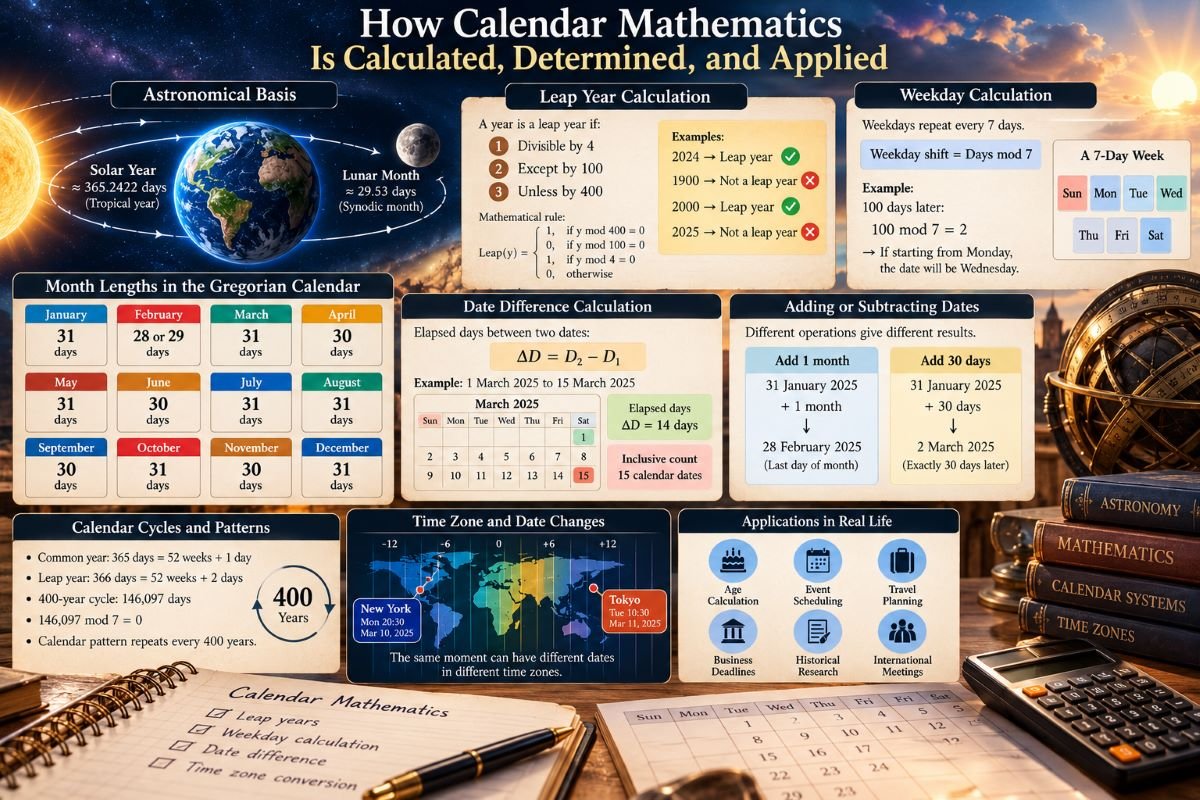
The tropical year, which is useful for keeping a calendar aligned with the seasons, lasts approximately 365.2422 days.
A calendar year of exactly 365 days would therefore be shorter than the seasonal year by approximately:
[365.2422 - 365 = 0.2422 \text{ days}]
Converting this fraction into hours gives:
[0.2422 \times 24 \approx 5.81 \text{ hours}]
The difference accumulates from year to year. Calendar mathematics manages this discrepancy through leap years, which add an extra day in selected years.
1.2 The lunar month
The average interval between successive new moons is approximately 29.53 days. Twelve such lunar months total:
[12 \times 29.5306 \approx 354.37 \text{ days}]
This is about 10.88 days shorter than the tropical year. Consequently, twelve lunar months cannot remain aligned with the same seasons indefinitely without additional adjustments.
Lunar calendars and lunisolar calendars handle this difference according to their own rules. A lunisolar calendar may add an extra month in selected years, while a purely lunar calendar allows its months to move through the seasons.
1.3 Why mathematical rules are necessary
Calendar mathematics does not eliminate the differences between astronomical cycles. Instead, it creates consistent rules for managing them.
These rules make it possible to represent dates using whole days, determine the correct length of a calendar year, and calculate the relationship between different dates.
2. How Calendar Dates Are Represented Mathematically
A calendar date is usually represented by three components: year, month, and day. For example, 14 October 2026 identifies a specific date in the Gregorian calendar.
The components have different ranges. The month is numbered from 1 to 12, while the valid day depends on the selected month and year.
A computer or calculator must interpret these components according to calendar rules before performing arithmetic.
2.1 Validating a date
A date-validation process checks whether the entered values form a valid calendar date.
For the Gregorian calendar, the process involves:
- Confirming that the month is between 1 and 12.
- Determining the number of days in that month.
- Applying the leap-year rule if the month is February.
- Checking that the day falls within the valid range.
For example, 30 April is valid because April contains 30 days. The date 31 April is invalid because April has no thirty-first day.
Similarly, 29 February is valid only in a Gregorian leap year.
2.2 Month lengths and date arithmetic
Month lengths vary between 28 and 31 days. As a result, calendar months cannot be treated as equal numerical intervals.
Adding 30 days to 1 January is not the same as adding one calendar month. The first operation counts elapsed days, while the second changes the month component according to the software's date-arithmetic rules.
This distinction is important in scheduling applications, billing systems, and date calculators.
2.3 Calendar dates versus elapsed time
A calendar date identifies a day, whereas an elapsed-time calculation measures the duration between two points.
For example, from Monday to Tuesday, one day has elapsed. However, if both Monday and Tuesday are included in a list of calendar dates, the list contains two dates.
A reliable calculation must therefore establish whether the task requires an elapsed-day difference or an inclusive count.
3. How Leap Years Are Determined
Leap-year calculation is one of the most important applications of calendar mathematics.
The Gregorian calendar uses a rule designed to approximate the tropical year more accurately than a calendar with a leap day every four years without exceptions.
A Gregorian year is a leap year if it is divisible by 4, except for century years that are not divisible by 400.
The complete rule is:
- If a year is divisible by 400, it is a leap year.
- Otherwise, if it is divisible by 100, it is not a leap year.
- Otherwise, if it is divisible by 4, it is a leap year.
- All remaining years are common years.
In mathematical notation:
[\text{Leap}(y)=\begin{cases}1, & y \bmod 400=0\0, & y \bmod 100=0\1, & y \bmod 4=0\0, & \text{otherwise}\end{cases}]
Here, (y) represents the year, and the modulo operator returns the remainder after division.
3.1 Worked examples
Example 1: 2024
The year 2024 is divisible by 4 and not divisible by 100. Therefore, it is a leap year and February has 29 days.
Example 2: 1900
The year 1900 is divisible by 100 but not by 400. Therefore, it is not a leap year, even though it is divisible by 4.
Example 3: 2000
The year 2000 is divisible by 400. Therefore, it is a leap year.
Example 4: 2025
The year 2025 is not divisible by 4. Therefore, it is a common year.
3.2 Average year length
In a Gregorian 400-year cycle, 97 years are leap years and 303 are common years.
The total number of days is:
[400 \times 365 + 97 = 146097]
The average year length is:
[\frac{146097}{400}=365.2425]
This is close to the tropical year. The difference is small, but it means the Gregorian calendar is an approximation rather than an exact representation of Earth's seasonal cycle.
4. How the Day of the Week Is Calculated
A weekday calculation determines whether a date falls on Monday, Tuesday, Wednesday, or another day of the seven-day week.
The essential mathematical idea is that weekdays repeat every seven days. This repeating cycle makes modular arithmetic particularly useful.
4.1 The seven-day cycle
If a date falls on Monday, seven days later also falls on Monday. Fourteen days later, the weekday is again Monday.
The weekday shift can therefore be calculated using the remainder after division by seven.
For example:
[100 \bmod 7 = 2]
One hundred days contain 14 complete weeks and two additional days. If the starting weekday is Monday, 100 elapsed days later the weekday is Wednesday.
4.2 Weekday shifts between years
A common Gregorian year contains 365 days:
[365 = 52 \times 7 + 1]
This means a common year contains 52 complete weeks and one extra day. The weekday on which the next year begins shifts forward by one day.
A leap year contains 366 days:
[366 = 52 \times 7 + 2]
Therefore, the next year begins two weekdays later.
For example, if a year begins on Monday and is a common year, the following year begins on Tuesday. If it is a leap year, the following year begins on Wednesday.
4.3 Calculating weekdays from a reference date
A simple weekday calculation can start with a known reference date and count the elapsed days.
If the elapsed number of days is (D), the weekday shift is:
[D \bmod 7]
The remainder tells how far the weekday moves forward from the reference day.
This method is practical for short intervals. For dates separated by many years, algorithms that account for the year, month, leap years, and century rules are more efficient.
5. How the Number of Days Between Two Dates Is Calculated
Date-span calculation determines the number of elapsed calendar days between two dates. The process is useful for event countdowns, age calculations, project planning, contracts, and travel schedules. Use our Date Span Calculator to calculate the interval between two dates. For a live countdown to an upcoming event, try our Event Countdown tool.
A direct approach is to count the days from the first date to the second. However, this can become cumbersome when the dates are separated by multiple months or years.
A more systematic method converts each date into a continuous day number.
5.1 The serial-day method
A serial-day system assigns consecutive numbers to dates using a defined starting point, known as an epoch.
Let the first date correspond to (D_1) and the second date correspond to (D_2). The elapsed-day difference is:
[\Delta D = D_2-D_1]
If the result is positive, the second date occurs later than the first in the selected system.
For example, suppose the serial-day value of a starting date is 10,000 and the ending date has a value of 10,045. The elapsed interval is:
[10045-10000=45 \text{ days}]
The values in this example are illustrative; an actual calculation must use the correct serial-day values for the selected dates and calendar.
5.2 Counting across months
When a date interval crosses a month boundary, the number of days in each month must be considered.
For example, the elapsed interval from 28 February to 2 March depends on whether the year is a common year or a leap year.
In a common year, the elapsed interval is two days: 28 February to 1 March is one day, and 1 March to 2 March is another.
In a leap year, the elapsed interval is three days because 29 February occurs between those dates.
This example shows why date-span calculations must account for leap years and actual month lengths.
5.3 Inclusive and exclusive counting
If someone asks how many days separate two dates, the usual elapsed-time calculation subtracts the earlier date from the later date.
If someone asks how many calendar dates are included in a period, both endpoints may need to be counted.
For example, the interval from 1 June through 5 June includes five calendar dates, but only four days elapse between the beginning of 1 June and the beginning of 5 June.
The counting convention should always be clear.
6. How Calendar Months and Years Are Added or Subtracted
Adding or subtracting calendar months is different from adding or subtracting a fixed number of days.
A calendar-month operation changes the month or year while attempting to preserve the day number. Difficulties arise when the target month does not contain that day.
Consider the date 31 January. If one month is added, the target month is February, which has only 28 or 29 days.
Different software systems may handle this situation differently. A system might return the final day of February, or it might apply a different documented convention.
For this reason, a calendar calculator should define how it handles invalid target dates.
6.1 Adding calendar days
Adding a fixed number of days is conceptually different. A 30-day addition means moving forward by exactly 30 calendar days, crossing month and year boundaries as necessary.
The calculation must account for the length of every month crossed, including February in leap years.
6.2 Adding calendar years
Adding one calendar year to a date usually preserves the month and day where possible. However, adding one year to 29 February creates a special case when the target year is not a leap year.
A calculator must specify how that case is resolved. The correct behavior depends on the intended convention and the software being used.
6.3 Why these distinctions matter
Billing systems, age calculators, subscription renewals, and scheduling tools may use different date-arithmetic operations. Confusing a calendar month with a fixed number of days can produce incorrect deadlines or unexpected results.
Reliable software should make the intended operation explicit.
7. How Calendar Patterns Are Determined
Calendar mathematics can identify recurring patterns by examining weekday shifts, leap years, and the arrangement of month lengths.
A common year has one more day than 52 complete weeks, while a leap year has two more. These additional days affect the weekdays associated with dates in subsequent years.
7.1 The Gregorian 400-year cycle
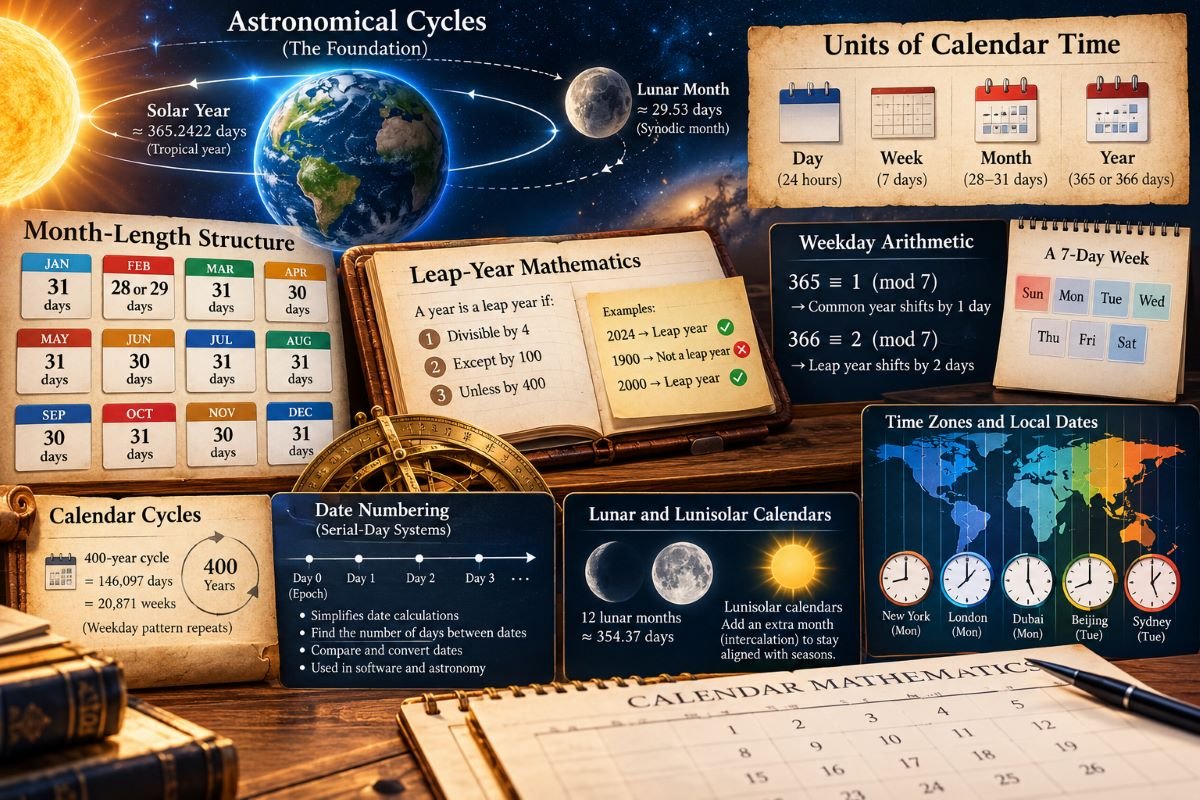
The Gregorian leap-year pattern repeats every 400 years. Across this period, the calendar contains 146,097 days.
Because:
[146097 \bmod 7=0]
the complete 400-year period contains an exact number of weeks.
Consequently, under uninterrupted Gregorian calendar rules, the calendar arrangement repeats after 400 years.
This does not mean every individual year has a unique calendar layout. Different years can share the same month-and-weekday arrangement when their leap-year status and starting weekdays match.
7.2 Finding matching calendar years
To determine whether two years share the same calendar layout, check two conditions:
- Both years must have the same leap-year status.
- Both years must begin on the same weekday.
If both conditions hold, the month lengths and weekday positions match throughout the years.
This principle is useful for calendar design and computer programs that identify years with identical layouts.
8. How Modular Arithmetic Is Applied to Calendars
Modular arithmetic studies the remainders produced by division. It is particularly useful for calendars because many calendar patterns repeat at fixed intervals.
Weekdays repeat every seven days, so calculations involving weekdays frequently use modulo 7.
8.1 Basic weekday calculation
Suppose a date is 50 days after a known Monday.
First, divide 50 by 7:
[50=7 \times 7+1]
The remainder is 1. Therefore, the date falls one weekday after Monday: Tuesday.
This approach works because each complete group of seven days returns to the same weekday.
8.2 Month-length remainders
Month lengths also determine weekday shifts.
For a 31-day month:
[31 \bmod 7=3]
For a 30-day month:
[30 \bmod 7=2]
For a 28-day February:
[28 \bmod 7=0]
For a 29-day February:
[29 \bmod 7=1]
These remainders tell how the weekday of a month's first day relates to the weekday of the next month's first day.
8.3 Applications in software
Calendar programs can use modular arithmetic to determine weekdays without repeatedly counting each individual date. It is also useful for testing repeating calendar patterns and checking whether a date calculation produces a consistent result.
The method reduces large calculations to smaller numerical operations.
9. How Date Conversion Between Calendar Systems Works
Different calendar systems use different rules for defining years, months, and leap adjustments. Converting a date between them therefore requires more than changing its display format.
A conversion process generally involves three steps:
- Interpret the input date according to the source calendar.
- Determine the corresponding day or moment using an appropriate conversion method.
- Express that result in the destination calendar.
The details depend on the calendar systems involved.
9.1 Solar calendars
A solar calendar is designed to track the seasonal year. The Gregorian calendar is a prominent example and uses a leap-year rule to keep its average year length close to the tropical year.
9.2 Lunar calendars
A lunar calendar organizes months around lunar phases. Since twelve lunar months are shorter than a tropical year, a purely lunar calendar does not remain aligned with the seasons.
9.3 Lunisolar calendars
A lunisolar calendar combines lunar months with additional adjustments in selected years. Intercalation, which may involve adding a month, helps maintain approximate alignment between the lunar calendar and the seasonal year.
9.4 Historical conversions
Historical date conversion may be complicated by calendar reforms and differences in adoption dates across regions. The same historical event can appear under different calendar dates depending on the calendar system used by the original record.
Accurate conversion therefore requires knowledge of the relevant calendar rules and historical conventions.
10. How Time Zones Affect Calendar Calculations
Calendar mathematics becomes more complex when dates are used across different time zones.
A single moment can correspond to different local dates in different parts of the world. For example, when it is shortly after midnight in one location, another location may still be on the previous calendar day.
A time-zone conversion must therefore calculate both the local clock time and the local date.
10.1 UTC and local time
Coordinated Universal Time (UTC) provides a common reference for representing time. Local civil time is determined using the applicable time-zone offset and rules.
A simplified conversion may add or subtract an offset from UTC. However, the applicable offset can change because of daylight saving time or changes in local law.
For reliable results, software should use the time-zone rules applicable to the date being calculated rather than assuming that a location always has the same offset.
10.2 Date changes during conversion
Suppose an event occurs at 23:30 UTC. A location several hours ahead of UTC may already be on the following calendar day.
A correct conversion must update the date as well as the time. Simply changing the hour while leaving the original date unchanged would produce an incorrect result.
A correct conversion must update the date as well as the time. Simply changing the hour while leaving the original date unchanged would produce an incorrect result. Use our Time Zone Converter to convert local times and dates between different time zones.
10.3 International scheduling
Meeting planners, travel systems, and world-clock tools combine calendar calculations with time-zone conversion. They must handle month boundaries, year boundaries, and local-time changes to display the correct date and time for each location.
This is particularly important for meetings scheduled close to midnight or across regions with different daylight-saving rules.
11. How Calendar Mathematics Is Applied in Everyday Life
Calendar mathematics supports many practical activities.
11.1 Age calculation
Age calculators compare a person's birth date with a reference date. An accurate result must account for leap years, variable month lengths, and whether the birthday has occurred in the reference year. Use our Age Calculator to calculate your age from your date of birth.
Age expressed in completed years is different from an age expressed as an approximate number of days. Each requires its own calculation method.
11.2 Date-span calculations
Date-span tools determine the number of days, weeks, or months between two dates. These calculations support travel planning, event countdowns, project schedules, and personal planning. Use our Date Span Calculator to calculate the duration between two dates.
The result depends on the selected counting convention and the calendar dates involved.
11.3 Business and financial deadlines
Organizations use calendar calculations to determine payment dates, renewal dates, reporting periods, and contractual deadlines.
Some deadlines use calendar days, while others use working days. Working-day calculations may exclude weekends and public holidays, depending on the applicable rules.
Some deadlines use calendar days, while others use working days. Working-day calculations may exclude weekends and public holidays, depending on the applicable rules. Use our Calendar Notes tool to organize important dates, payment deadlines, and reminders.
11.4 Education and research
Researchers use calendar arithmetic to calculate intervals between historical events, compare records, and interpret dates expressed in different calendar systems.
Astronomy and historical research may require additional care because civil calendar dates, astronomical day counts, and time standards are not interchangeable. For focused study and research sessions, use our Pomodoro Timer to organize work periods and breaks.
11.5 Travel and international meetings
Travelers and remote teams rely on accurate date and time conversion. A departure late in the evening may result in an arrival on the next calendar day, even when the journey duration is relatively short.
Calendar mathematics helps represent these changes correctly. For scheduling meetings across different time zones, use our Meeting Planner to find suitable meeting times for participants in different locations.
12. How Calendar Calculations Are Implemented in Computer Programs
Computers can perform calendar calculations quickly, but only when the rules are implemented correctly.
A date library typically provides operations for parsing dates, validating values, adding intervals, finding differences, and formatting results.
12.1 Date parsing and validation
The program first interprets the date string and determines its year, month, and day. It then checks whether the date is valid under the selected calendar rules.
Different date formats can create ambiguity. For example, a numerical date beginning with 04 and followed by 05 may mean 4 May or April 5, depending on the format convention.
Using explicit date formats reduces this risk.
12.2 Date arithmetic
A date library may support operations such as adding seven days, adding one month, or finding the number of elapsed days between two dates.
These operations are not interchangeable. Adding seven days advances by a fixed duration, while adding one month follows calendar-month rules.
The chosen operation should match the intended calculation.
12.3 Time-zone-aware calculations
For date-time values associated with a location, the program must use appropriate time-zone data. This helps account for changing offsets and transitions that can make some local times ambiguous or nonexistent.
A robust implementation should distinguish a calendar date, a local date-time, and a specific instant.
12.4 Testing calendar algorithms
Calendar software should be tested against important boundary cases, including:
- February 28 and February 29.
- The final day of each month.
- The transition from December 31 to January 1.
- Century years such as 1900 and 2000.
- Date intervals that cross leap days.
- Time-zone conversions that cross local midnight.
Testing these cases helps reveal errors that may not appear during ordinary date calculations.
13. Common Errors in Calendar Mathematics
Several mistakes occur frequently when dates are calculated manually or in software.
Treating every year divisible by four as a leap year: This fails for century years that are not divisible by 400.
Assuming every month contains 30 days: This creates errors in date-span calculations and calendar-month arithmetic.
Confusing elapsed days with inclusive counting: The number of days elapsed between two dates can differ from the number of dates included in a period.
Treating one month as a fixed number of days: Calendar months have variable lengths, so a calendar-month operation is not equivalent to adding 30 days.
Ignoring local date changes: Time-zone conversion may move an event to the previous or following calendar day.
Mixing calendar systems: A conversion between two calendars must use the rules of both systems.
Avoiding these mistakes requires defining the calculation clearly before choosing a method.
14. A Practical Method for Solving Calendar Problems
A systematic approach makes calendar calculations easier to understand and verify.
Step 1: Identify the calendar system. Determine whether the calculation uses the Gregorian calendar or another system.
Step 2: Define the required result. Decide whether the task asks for a weekday, elapsed days, inclusive date count, future date, age, or time-zone conversion.
Step 3: Validate the input. Confirm that the dates exist under the selected calendar rules.
Step 4: Apply the correct rule. Use leap-year tests, month lengths, modular arithmetic, serial-day conversion, or time-zone data as required.
Step 5: Handle boundary conditions. Check leap days, month ends, year changes, and local date transitions.
Step 6: Verify the result. Compare the output with an independent calculation or a trusted date library when accuracy matters.
This method is useful for manual calculations as well as software development. It encourages consistent results and makes mistakes easier to identify.
Conclusion
Calendar mathematics is calculated and applied through a collection of rules that translate dates into consistent numerical relationships. Leap-year calculations compensate for the difference between the civil year and the seasonal year. Modular arithmetic helps determine weekdays and repeating patterns. Serial-day systems simplify date differences, while calendar algorithms validate dates and manage month and year boundaries.
The same principles support age calculators, date-span tools, business deadlines, historical research, and international scheduling. When time zones are involved, accurate results also require local-time rules and correct handling of date changes.
The central lesson is that calendar calculations depend on the operation being performed. Counting elapsed days is different from adding a calendar month, and converting a timestamp into local time is different from changing a date's display format. By selecting the correct method and applying the appropriate calendar rules, both people and software can produce reliable results.
Frequently Asked Questions
How is calendar mathematics calculated?
Calendar mathematics is calculated using rules for month lengths, leap years, weekday cycles, and date intervals. Depending on the problem, the calculation may use arithmetic, modular remainders, serial-day values, or a calendar algorithm.
How is a leap year determined?
In the Gregorian calendar, a year divisible by 400 is a leap year. A year divisible by 100 but not by 400 is not a leap year. Other years divisible by 4 are leap years, while the remaining years are common years.
How is the weekday of a date determined?
A weekday can be calculated from a known reference date by counting elapsed days and taking the remainder after division by seven. Calendar algorithms can perform the same calculation efficiently for dates many years apart.
How do you calculate the number of days between two dates?
One method converts each date into a consecutive day number and subtracts the earlier value from the later value. The result is the elapsed-day difference. Inclusive counting may produce a different total.
Why is adding one month different from adding 30 days?
Calendar months have different lengths. Adding one month changes the calendar month, while adding 30 days advances by a fixed number of days. The results may therefore be different.
How does calendar mathematics help with time zones?
Calendar mathematics determines how dates progress, while time-zone rules determine local clock times and offsets. Combining the two allows software to calculate the correct local date and time for an event.
Can computers calculate calendar dates accurately?
Yes, provided that programs use correct calendar rules, date libraries, and time-zone data. Testing leap years, month boundaries, historical conventions, and local-time transitions is important for reliable results.
Are all calendar systems calculated in the same way?
No. Solar calendars, lunar calendars, and lunisolar calendars use different rules to represent astronomical cycles. Converting dates between them requires methods appropriate to each calendar system.
Comments
No comments yet.