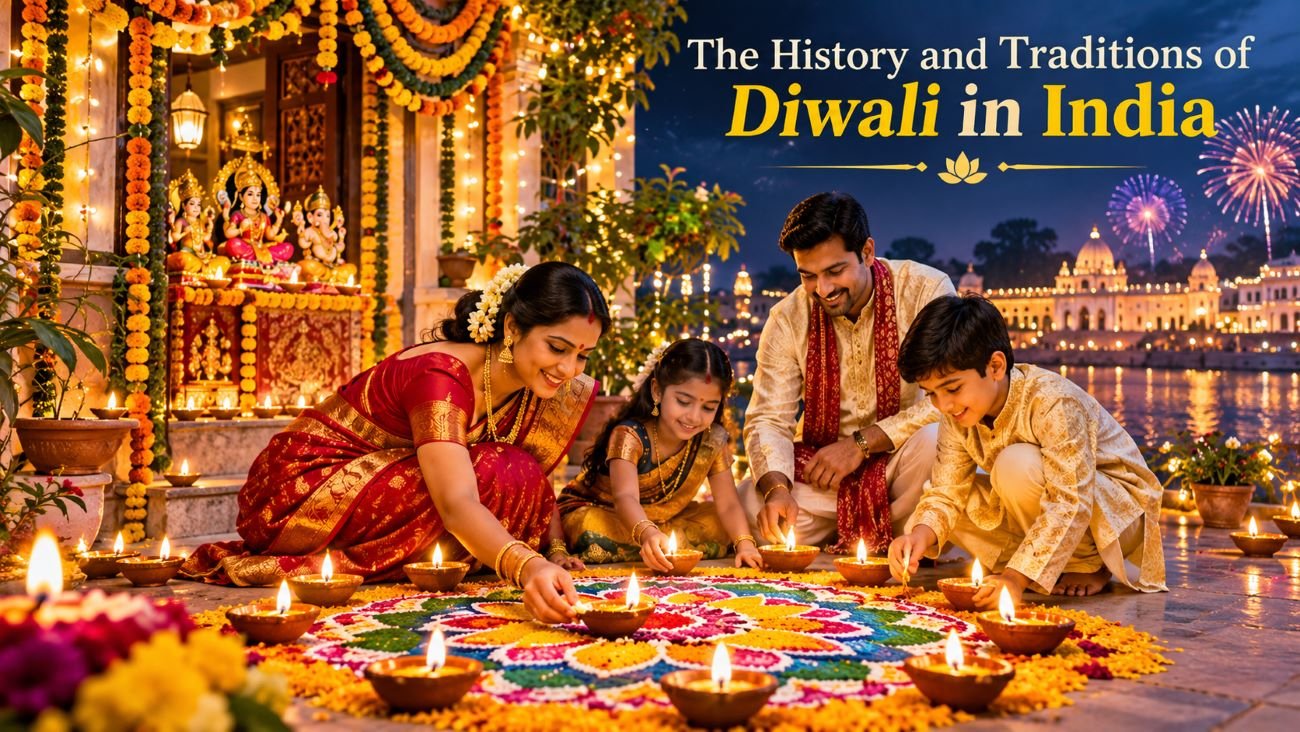
The History and Traditions of Diwali in India: Ancient Origins, Cultural Significance, and Celebrations
Introduction
Diwali, popularly known as the Festival of Lights, is one of the most significant cultural and religious celebrations in India. Also called Deepavali, the festival symbolizes the victory of light over darkness, knowledge over ignorance, and good over evil. Every year, millions of people illuminate their homes, decorate streets, prepare traditional sweets, perform religious ceremonies, and celebrate with family members and friends.
The history of Diwali is deeply connected with India's ancient religious literature, mythology, seasonal customs, and regional traditions. Although the festival is widely associated with the return of Lord Rama to Ayodhya after fourteen years of exile, its significance extends beyond this famous story. Different Indian communities celebrate Diwali for different spiritual and historical reasons.
For Hindus, the occasion is associated with Goddess Lakshmi, Lord Ganesha, Lord Rama, and other religious traditions. Jain communities commemorate the nirvana of Lord Mahavira, while Sikhs observe the occasion alongside Bandi Chhor Divas. Some Buddhist communities also recognize the period through their own cultural and social traditions.
Diwali is not simply a religious celebration. It also reflects India's agricultural heritage, traditional calendar systems, commercial practices, family relationships, and cultural diversity. Its customs have evolved over generations, but the central ideas of hope, prosperity, renewal, and togetherness remain important.
Understanding the history and traditions of Diwali offers an opportunity to explore how an ancient Indian festival continues to influence modern cultural life.
1. The Historical Origins of Diwali
The historical development of Diwali cannot be attributed to one single event or universally accepted origin. Instead, the festival evolved through different religious observances, regional customs, seasonal celebrations, and traditional narratives that gradually became associated with Deepavali.
The word Deepavali originates from Sanskrit. It combines two words: Deepa, meaning lamp, and Avali, meaning a row or series. Together, they describe a row of illuminated lamps.
The use of lamps has a long cultural and spiritual association in India. Light traditionally represents knowledge, purity, prosperity, and divine presence. Lamps are used in temples, religious ceremonies, household rituals, and important cultural occasions.
Over centuries, the custom of lighting lamps became closely associated with the autumn festival period. Different communities connected the practice with their own religious stories and local traditions.
Ancient Indian literature contains references to festivals, seasonal observances, lamps, prosperity, and celebrations connected with religious occasions. However, the development of the modern Diwali festival should be understood as a gradual cultural process rather than the result of one specific historical moment.
Agriculture also contributed to the festival's seasonal importance. In several parts of India, the period coincides with the conclusion of major monsoon-related agricultural activities and the beginning of new seasonal cycles.
For farming communities, this period offered an opportunity to express gratitude, prepare for future agricultural activities, and celebrate prosperity.
As trade, religious institutions, and regional kingdoms developed, Diwali traditions became increasingly established in different parts of the Indian subcontinent. Over time, the festival developed into a major occasion combining religious worship, family celebrations, social gatherings, and commercial activities.
2. The Story of Lord Rama's Return to Ayodhya
One of the most popular explanations for celebrating Diwali comes from the Hindu epic Ramayana.
According to the traditional story, Lord Rama, his wife Sita, and his younger brother Lakshmana spent fourteen years in exile after Rama left the kingdom of Ayodhya.
During their exile, Ravana, the king of Lanka, abducted Sita. Rama and Lakshmana eventually received assistance from Hanuman and an army of allies to locate and rescue her.
A major battle followed between Rama and Ravana. Rama ultimately defeated Ravana, representing the victory of righteousness over arrogance and evil.
After completing his fourteen years of exile, Rama returned to Ayodhya with Sita and Lakshmana.
According to popular tradition, the people of Ayodhya celebrated their return by lighting rows of oil lamps throughout the kingdom. The illuminated city represented happiness, hope, and the restoration of justice.
This story became one of the central cultural associations of Diwali, particularly in northern India.
The tradition of lighting diyas continues to represent the symbolic return of light after darkness. It also reminds people of the importance of truth, courage, responsibility, and moral values.
Ayodhya remains an important destination during Diwali because of its association with Lord Rama. The city is known for large-scale religious celebrations, illuminated temples, and traditional lamp-lighting ceremonies.
3. Other Religious Stories Associated with Diwali
Although Lord Rama's return is one of the most familiar explanations, Diwali is connected with several other stories in Hindu traditions.
Lord Krishna and the Defeat of Narakasura
In several Hindu traditions, Naraka Chaturdashi commemorates Lord Krishna's victory over the demon Narakasura.
According to the traditional account, Narakasura was a powerful ruler whose actions caused suffering among people and celestial beings. Lord Krishna eventually defeated him and restored peace.
The victory represents the destruction of negative forces and the restoration of righteousness.
This story is particularly important in several southern and western Indian communities, where Naraka Chaturdashi is a major part of Diwali celebrations.
Goddess Lakshmi and the Churning of the Ocean
Another important tradition connects Diwali with Goddess Lakshmi, who represents wealth, prosperity, abundance, and good fortune.
According to Hindu mythology, during Samudra Manthan, or the churning of the cosmic ocean, Goddess Lakshmi emerged from the ocean and became associated with prosperity and divine abundance.
Lakshmi Puja during Diwali reflects the desire for financial stability, happiness, and well-being.
Families traditionally clean and decorate their homes before performing prayers to welcome prosperity.
Goddess Kali and the Celebration in Eastern India
In West Bengal and several other eastern regions, Diwali coincides with Kali Puja.
Goddess Kali represents powerful divine energy and the destruction of evil forces. Devotees worship her through prayers, temple ceremonies, decorations, and traditional offerings.
This regional tradition demonstrates how the same festival period can carry different religious meanings across India.
4. Religious Significance of Diwali in Different Communities
Diwali is important to several religious communities, although their interpretations and reasons for celebrating the occasion are different.
Hinduism
For Hindus, Diwali represents the victory of good over evil, prosperity, spiritual awareness, and new beginnings.
Different communities associate the festival with Lord Rama, Goddess Lakshmi, Lord Ganesha, Lord Krishna, and Goddess Kali.
Lakshmi Puja is particularly important on the main Diwali evening. Families pray for prosperity, happiness, and success.
Jainism
In Jain tradition, Diwali commemorates the nirvana of Lord Mahavira, the twenty-fourth Tirthankara.
Mahavira's spiritual teachings emphasize non-violence, truth, self-discipline, and liberation from the cycle of birth and death.
For Jain communities, Diwali is an occasion for prayer, reflection, and remembering the spiritual teachings of Mahavira.
The lighting of lamps also carries a connection with spiritual knowledge and enlightenment.
Sikhism
For Sikhs, Diwali coincides with Bandi Chhor Divas.
The occasion commemorates the release of Guru Hargobind Sahib Ji from imprisonment at Gwalior Fort. According to Sikh tradition, he also helped secure the freedom of 52 imprisoned kings.
The event represents freedom, justice, and compassion.
Gurdwaras are decorated with lights, and devotees participate in prayers and community gatherings. The Golden Temple in Amritsar is particularly well known for its illuminated appearance during the celebration.
Buddhism
Some Buddhist communities in India observe Diwali as a cultural occasion associated with social equality, enlightenment, and the teachings of Dr. B. R. Ambedkar.
However, Diwali is not a universal Buddhist religious festival, and its significance varies among communities.
These different religious interpretations demonstrate the diversity of India's cultural and spiritual heritage.
5. The Five Days of Diwali Celebrations
In many Indian traditions, Diwali is celebrated over five days. Each day has its own customs, religious associations, and cultural importance.
Day 1: Dhanteras
Dhanteras marks the beginning of the five-day Diwali festival period. The word combines Dhan, meaning wealth, and Teras, referring to the thirteenth lunar day.
Families traditionally clean their homes, decorate entrances, and purchase household utensils, gold, silver, or other valuable items.
Many people worship Goddess Lakshmi and Lord Dhanvantari, who is associated with Ayurveda and health.
The occasion represents prosperity, well-being, and preparation for the main festival.
Day 2: Naraka Chaturdashi or Choti Diwali
Naraka Chaturdashi is also known as Choti Diwali.
The day is associated with Lord Krishna's victory over Narakasura. It symbolizes the destruction of evil and the removal of negativity.
In many regions, people begin the morning with traditional oil baths, prayers, and new clothes.
Families also prepare sweets and decorate their homes before the main Diwali celebration.
Day 3: Lakshmi Puja or Main Diwali
The third day is generally considered the main Diwali celebration in many parts of India.
Families decorate their homes with clay lamps, flowers, colorful rangoli, and electric lights.
In the evening, people perform Lakshmi Puja and often worship Lord Ganesha. The prayers express hopes for prosperity, wisdom, and happiness.
Families prepare festive meals, exchange sweets and gifts, visit relatives, and spend time together.
In some communities, fireworks are also part of the celebration.
Day 4: Govardhan Puja and Annakut
Govardhan Puja is associated with the story of Lord Krishna lifting Govardhan Hill to protect the people of Vrindavan from heavy rainfall.
The celebration emphasizes gratitude toward nature, agriculture, food, and the environment.
In temples and households, devotees prepare Annakut, a large collection of vegetarian dishes offered during religious ceremonies.
In Gujarat, this day is also associated with the beginning of the traditional Gujarati New Year.
Day 5: Bhai Dooj
Bhai Dooj celebrates the relationship between brothers and sisters.
Sisters traditionally apply a ceremonial tilak to their brothers and pray for their happiness, safety, and long life.
Brothers express affection through gifts and promises of support.
The final day highlights the importance of family relationships and mutual care.
6. Traditional Diwali Customs and Rituals
Diwali celebrations include several customs that have been passed down through generations.
Lighting Traditional Diyas
Lighting diyas is one of the most recognizable Diwali traditions.
Small clay lamps are filled with oil or ghee and fitted with cotton wicks. They are placed near entrances, windows, balconies, courtyards, and temples.
The lamps represent knowledge, hope, positivity, and the removal of darkness.
Creating Rangoli Designs
Rangoli is a traditional decorative art created near entrances and in courtyards.
Families use colored powders, rice flour, flower petals, and other materials to create geometric designs, floral patterns, and religious symbols.
Rangoli is traditionally considered a welcoming decoration that brings beauty and positivity to the home.
Performing Lakshmi Puja
Lakshmi Puja is an important part of Diwali for many Hindu families.
People clean and decorate their homes before performing evening prayers.
Goddess Lakshmi is worshipped as the symbol of wealth and prosperity, while Lord Ganesha is worshipped for wisdom and the removal of obstacles.
Preparing Traditional Sweets
Food plays an important role in Diwali celebrations.
Popular sweets include ladoo, barfi, kaju katli, jalebi, gulab jamun, peda, and various regional desserts.
Families prepare these foods at home or purchase them from local sweet shops to share with friends and relatives.
Exchanging Gifts
Exchanging gifts is a common way of expressing affection and goodwill.
People share sweets, clothing, decorative items, household products, and other presents.
The tradition strengthens friendships, family relationships, and community connections.
Cleaning and Decorating Homes
Cleaning is an important preparation for Diwali.
Families traditionally clean their houses, decorate entrances with flowers and torans, arrange diyas, and prepare welcoming spaces for visitors.
This custom symbolizes renewal and the beginning of a positive period.
7. Regional Diwali Traditions Across India
India's regional diversity makes Diwali a particularly interesting cultural celebration. Different states and communities observe the festival through their own religious stories, foods, decorations, and rituals.
Northern India
In Uttar Pradesh, Diwali is closely associated with Lord Rama's return to Ayodhya.
Temples, houses, and public spaces are decorated with lamps. Ayodhya attracts attention for its large-scale religious celebrations and traditional lamp-lighting ceremonies.
In Delhi, Haryana, and Punjab, families commonly celebrate with Lakshmi Puja, sweets, new clothes, and festive gatherings.
Western India
In Gujarat, Diwali is connected with Lakshmi Puja, business traditions, and the Gujarati New Year.
Many shopkeepers and business owners begin new account books during this period, symbolizing a fresh financial beginning.
In Maharashtra, celebrations include traditional oil baths, sweets, prayers, and family gatherings.
Southern India
In Tamil Nadu, Karnataka, Andhra Pradesh, and Telangana, Naraka Chaturdashi has particular importance in many communities.
Early-morning oil baths, traditional sweets, new clothes, and prayers are common customs.
In Kerala, Deepavali is also celebrated, although its prominence and traditions differ among communities.
Eastern India
In West Bengal, Odisha, and Assam, Diwali often coincides with Kali Puja.
Devotees worship Goddess Kali through temple ceremonies, prayers, and traditional offerings.
In Odisha, some communities observe Badabadua Daka, a traditional ritual honoring ancestors during the festive period.
Diwali Traditions in Bihar
Bihar has a rich tradition of celebrating Diwali through household prayers, traditional decorations, and family gatherings.
Homes are cleaned and decorated with diyas, rangoli, and flowers. Families perform Lakshmi Puja and prepare traditional sweets and festive meals.
The festival also falls within an important period of seasonal and religious observances in the state.
In Bihar, Diwali is followed by Chhath Puja, one of the region's most significant festivals. Chhath is dedicated to the worship of the Sun God and involves prayers, fasting, and offerings near rivers, ponds, and other water bodies.
Although Diwali and Chhath Puja are separate festivals with different religious practices, their close position in the seasonal calendar makes this period particularly important for many families in Bihar.
8. Diwali and the Traditional Indian Calendar
Diwali has an important connection with the traditional Hindu lunisolar calendar.
Unlike festivals that follow a fixed Gregorian calendar date, Diwali is determined through lunar calendar calculations.
The main celebration generally falls on Amavasya, the new moon day of the Hindu lunar month of Kartika.
A lunar month is based on the phases of the Moon. Because the lunar cycle does not match the Gregorian calendar year exactly, the date of Diwali changes annually.
The Hindu calendar also considers solar movements and seasonal adjustments. This combination helps keep traditional festivals aligned with their intended seasonal periods.
The precise observance of Diwali is determined using Panchang calculations. A Panchang is a traditional Hindu calendar system that provides information about important astronomical and calendrical elements, including:
- Tithi: The lunar day.
- Vara: The weekday.
- Nakshatra: The lunar mansion or star group.
- Yoga: A calculated calendrical element.
- Karana: Half of a lunar tithi.
For the main Diwali observance, Amavasya and the timing of Lakshmi Puja are particularly important.
Regional calendar conventions and local sunrise and sunset times can influence the exact observance.
This relationship between lunar phases, timekeeping, and cultural celebrations demonstrates the historical importance of calendar mathematics in Indian society.
9. The Importance of Diwali for Business and Trade
Diwali is not only a religious and cultural festival but also an important commercial occasion.
In several Indian business communities, the festival is associated with financial renewal and the beginning of new accounting periods.
Shopkeepers traditionally worship account books and business tools during the festival period. Some businesses begin new financial records as a symbolic fresh start.
The tradition of purchasing gold, silver, utensils, and household items during Dhanteras also contributes to the festival's commercial importance.
Today, Diwali is one of India's major shopping seasons.
Retailers, online marketplaces, electronics companies, clothing stores, and jewelry businesses introduce special festive offers.
Businesses also use the occasion to express appreciation to employees, customers, suppliers, and business partners through gifts and celebrations.
These practices demonstrate how traditional cultural observances have adapted to modern economic activities.
10. How Diwali Celebrations Have Changed Over Time
Diwali has evolved alongside changes in Indian society, technology, and everyday lifestyles.
In earlier generations, traditional clay lamps, handmade decorations, home-prepared sweets, and neighborhood gatherings were central to the celebrations.
Today, electric lights, LED decorations, digital greetings, online shopping, and virtual family gatherings have become increasingly common.
Modern homes often combine traditional diyas with decorative lighting systems. Families also use digital platforms to send festival greetings to relatives and friends living in different cities or countries.
Commercial activities have expanded, and Diwali has become an important period for shopping, travel, entertainment, and family events.
However, many traditional customs remain unchanged. Lakshmi Puja, rangoli, sharing sweets, wearing new clothes, and visiting relatives continue to be important parts of the celebration.
Growing environmental awareness has also encouraged people to consider more responsible celebration practices.
Many families now prefer quieter celebrations, reusable decorations, locally made products, and reduced plastic packaging.
These changes show how Diwali traditions can adapt to modern lifestyles while preserving their deeper cultural meaning.
11. The Cultural and Spiritual Meaning of Diwali
Beyond its religious stories and regional customs, Diwali represents several values that remain important in Indian society.
Light and Knowledge: Diyas symbolize wisdom, awareness, and the importance of overcoming ignorance.
Goodness and Righteousness: Stories associated with Rama, Krishna, and other religious figures emphasize truth, courage, and moral responsibility.
Prosperity and New Beginnings: Lakshmi Puja reflects hopes for financial stability, happiness, and future success.
Family and Community: Visiting relatives, sharing food, exchanging gifts, and participating in prayers strengthen relationships.
Gratitude and Renewal: Cleaning homes, remembering ancestors, and celebrating seasonal changes encourage reflection and appreciation.
Hope and Positivity: The illumination of homes and public spaces represents optimism and the belief that positive values can overcome difficult circumstances.
These ideas help explain why Diwali remains meaningful across generations and different communities.
12. Diwali's Significance Beyond India
Although India is the historical and cultural center of Diwali celebrations, the festival is also observed in many other parts of the world.
Indian communities living abroad have carried their traditions to countries such as Nepal, Singapore, Malaysia, Sri Lanka, the United Kingdom, Canada, the United States, Australia, and South Africa.
Celebrations often include temple visits, cultural performances, traditional food, community gatherings, and decorative lighting.
In countries with significant Indian communities, Diwali has also become an opportunity for cultural exchange.
Schools, community organizations, and public institutions sometimes organize educational events explaining the festival's history and significance.
The international observance of Diwali demonstrates how cultural traditions can travel across borders and remain meaningful for future generations.
13. Environmental Awareness and Responsible Diwali Celebrations
As cities become more populated and environmental concerns increase, responsible Diwali celebrations have gained importance.
Traditional celebrations can be adapted to reduce unnecessary waste and pollution without losing their cultural meaning.
Some practical approaches include:
- Using traditional clay diyas and reusable decorations.
- Choosing energy-efficient LED lighting.
- Avoiding excessive plastic packaging.
- Supporting local artisans and small businesses.
- Reducing noisy fireworks and smoke-producing celebrations.
- Sharing homemade sweets and environmentally responsible gifts.
- Cleaning public spaces after community celebrations.
These practices encourage people to preserve the spirit of Diwali while being considerate of the environment and surrounding communities.
The festival's central message of light and positivity can also inspire greater awareness of collective responsibility.
Conclusion
The history and traditions of Diwali reveal the cultural richness, religious diversity, and historical depth of India. From ancient religious narratives and traditional calendar systems to regional customs and modern celebrations, the festival has developed into an important part of India's cultural heritage.
Its meaning extends beyond lighting lamps or exchanging gifts. Diwali connects people with spiritual teachings, family traditions, seasonal celebrations, and the values of hope, prosperity, knowledge, and unity.
Whether celebrated through Lord Rama's return to Ayodhya, the worship of Goddess Lakshmi, the nirvana of Lord Mahavira, or the remembrance of Guru Hargobind Sahib Ji, the festival carries different meanings for different communities.
Every diya, prayer, rangoli, traditional sweet, and family gathering contributes to a tradition that continues to evolve across generations.
Ultimately, Diwali reminds people that light can inspire hope, knowledge can overcome ignorance, and kindness can strengthen communities. This enduring message makes the Festival of Lights meaningful far beyond the days of celebration.
Frequently Asked Questions (FAQs)
1. What is the historical origin of Diwali?
Diwali developed over centuries through different Indian religious, cultural, and seasonal traditions. Its origins are associated with multiple stories, including Lord Rama's return to Ayodhya and other regional religious narratives.
2. Why is Diwali called the Festival of Lights?
Diwali is called the Festival of Lights because people traditionally illuminate their homes, temples, and streets with rows of oil lamps known as diyas. These lamps symbolize hope, knowledge, and the victory of good over evil.
3. Why is Goddess Lakshmi worshipped during Diwali?
Goddess Lakshmi represents wealth, prosperity, and good fortune in Hindu tradition. Families worship her during Diwali to seek happiness, financial stability, and well-being.
4. How many days is Diwali celebrated in India?
In many Indian traditions, Diwali is celebrated over five days: Dhanteras, Naraka Chaturdashi, Lakshmi Puja, Govardhan Puja, and Bhai Dooj.
5. Why does the date of Diwali change every year?
Diwali follows the Hindu lunisolar calendar and generally falls on the Amavasya of Kartika. Because the lunar calendar does not align exactly with the Gregorian calendar, the festival's date changes annually.
6. Do all Indian states celebrate Diwali in the same way?
No. Different regions have distinct traditions. Northern India emphasizes Lord Rama's return to Ayodhya, while several eastern communities celebrate Kali Puja, and many southern communities give particular importance to Naraka Chaturdashi.
7. What is the significance of lighting diyas during Diwali?
Diyas symbolize light, wisdom, hope, and the removal of darkness. Lighting them represents the victory of positive values over negativity.
8. Is Diwali celebrated only by Hindus?
No. Diwali is also significant to Jain and Sikh communities, although their religious interpretations differ. Some Buddhist communities also observe the occasion culturally.
9. What is the connection between Diwali and the Hindu calendar?
Diwali is determined using the Hindu lunisolar calendar. Its main celebration generally falls on Amavasya, the new moon day of Kartika, making its Gregorian date different each year.
10. Why is Diwali important for businesses in India?
Diwali is traditionally associated with prosperity and new beginnings. Many business owners worship account books, purchase new business supplies, and begin new accounting periods during the festival.
11. What is the significance of Bandi Chhor Divas?
Bandi Chhor Divas commemorates the release of Guru Hargobind Sahib Ji from Gwalior Fort and the freedom of 52 imprisoned kings according to Sikh tradition. It coincides with the Diwali period.
12. What is the difference between Diwali and Deepavali?
Diwali and Deepavali refer to the same festival. Deepavali is the Sanskrit-derived name meaning a row of lights, while Diwali is its commonly used shortened form.
Comments
No comments yet.