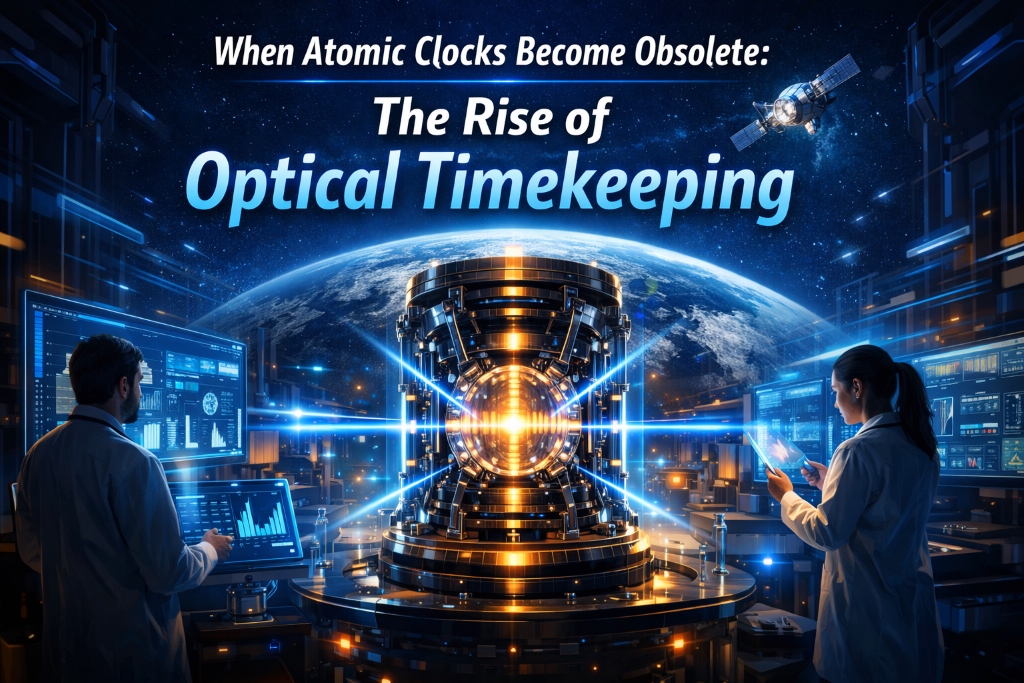
Why Atomic Clocks Are Becoming Obsolete: The Rise of Optical Timekeeping
Imagine a world where GPS navigation is accurate down to a few centimeters, where financial transactions happen without a single timing error, and where spacecraft travel billions of kilometers guided by perfect synchronization. A world where even the smallest fractions of a second are measured with astonishing precision.
This future depends on something invisible yet incredibly powerful: time.
For decades, humanity has relied on atomic clocks to define time itself. These devices are so accurate that they lose only one second over millions of years. But science never stops evolving. Today, researchers believe we are on the verge of a new revolution in timekeeping.
Atomic clocks, once considered unbeatable, may soon become obsolete.
Welcome to the era of optical clocks — the most accurate timekeeping technology ever created.
The Hidden Power of Accurate Time
Time is far more than what we see on our wristwatches or smartphones. In the modern world, precise timekeeping controls almost every digital system we rely on daily.

Accurate time measurement powers:
- GPS and satellite navigation
- Financial markets and digital payments
- Internet synchronization
- Cloud computing systems
- Power grids and transportation networks
- Space missions and scientific research
Even a microsecond-level error can cause:
- GPS navigation failures
- Data packet losses
- Stock market glitches
- Communication breakdowns
As the world becomes more interconnected and automated, timing accuracy becomes mission-critical.
Without reliable time synchronization, modern civilization would struggle to function.
A Brief History of Timekeeping
Ancient Civilizations
Humanity’s relationship with time began thousands of years ago. Ancient civilizations observed natural patterns:
- Sunrise and sunset
- Moon phases
- Seasonal changes
- Star movements
Early tools included:
- Sundials
- Water clocks
- Candle clocks
- Hourglasses
These methods worked, but accuracy depended heavily on weather and environment.
Mechanical Clocks
The Middle Ages marked a major breakthrough. Mechanical clocks introduced:
- Gears
- Springs
- Oscillating mechanisms
For the first time, societies could measure time independently of nature.
This allowed:
- Scheduled work
- Organized trade
- Religious rituals
- Scientific experiments
Later, pendulum clocks improved accuracy dramatically.
Quartz Revolution
In the 20th century, quartz clocks transformed timekeeping. By using vibrating quartz crystals:
- Accuracy improved drastically
- Maintenance became easier
- Clocks became affordable
Quartz technology laid the foundation for modern electronics.
The Atomic Age
In 1955, the first cesium atomic clock was built. This marked the biggest leap in timekeeping history.
For the first time, humans could measure time based on atomic vibrations — nature’s most stable rhythm.
How Atomic Clocks Work
Atomic clocks measure time using the natural vibration of atoms, usually cesium-133.
One second is officially defined as:
9,192,631,770 oscillations of cesium atoms
This definition is used worldwide and forms the basis of:
- Coordinated Universal Time (UTC)
- International time standards
- GPS timing
Why Atomic Clocks Are So Accurate
Atomic clocks:
- Are unaffected by temperature
- Resist mechanical wear
- Maintain stable oscillations
They lose only one second in millions of years.
This accuracy made them essential for:
- Satellites
- Telecom networks
- Scientific research
- Financial markets
For decades, atomic clocks were considered perfect.
But perfection is temporary in science.
Optical Clocks: The Next Time Revolution
Scientists are now developing optical clocks, which use:
- Laser light
- Optical frequencies
- Trapped atoms (strontium, ytterbium, aluminum)
Unlike atomic clocks that use microwaves, optical clocks operate at much higher frequencies.
Why Frequency Matters
Higher frequency means:
- More oscillations per second
- Smaller time divisions
- Greater precision
Optical clocks vibrate 100,000 times faster than cesium clocks.
This allows:
✔ Unprecedented accuracy ✔ Extreme stability ✔ Detection of tiny time differences ✔ Measurement of gravitational effects
Some experimental optical clocks are so precise they would lose:
Less than one second over the age of the universe
That’s more accurate than anything humans have ever built.
Why Optical Clocks Matter to You
This technology may sound futuristic, but it will impact daily life.
For everyday users, our time zone converter makes it easy to compare different time zones for work and travel.
1️⃣ GPS Accuracy
Today’s GPS systems:
- Have errors of several meters
Optical clocks could:
- Improve accuracy to centimeters
- Enable autonomous vehicles
- Improve drone navigation
- Support precision agriculture
2️⃣ Faster Internet
Better synchronization means:
- Faster data transfer
- Lower latency
- Stable cloud computing
- Improved video streaming
3️⃣ Financial Security
High-frequency trading depends on microseconds.
Optical clocks could:
- Prevent fraud
- Improve transaction accuracy
- Ensure fairness in global markets
4️⃣ Earth Monitoring
Using precise time differences, scientists can:
- Detect underground water movement
- Monitor volcanic activity
- Predict earthquakes
- Study tectonic shifts
Time becomes a tool to understand Earth itself.
Quantum Technology and Time
Quantum physics is pushing time measurement even further.
What Are Quantum Clocks?
Quantum clocks:
- Use quantum states of atoms
- Measure time at unimaginable precision
- Explore the nature of reality
They allow scientists to test:
- Einstein’s relativity
- Gravitational time dilation
- Space-time fabric
Future Applications
Quantum timekeeping could enable:
- Ultra-secure communication
- Quantum internet
- Deep-space navigation
- Climate monitoring
- Advanced physics experiments
Time measurement is evolving into a scientific weapon for discovery.
AI Is Changing Time Measurement
Artificial Intelligence is now helping manage time systems.
AI can:
- Predict clock drift
- Correct errors automatically
- Monitor thousands of clocks
- Prevent failures
Benefits of AI Timekeeping
✔ Real-time correction ✔ Predictive maintenance ✔ Global synchronization ✔ Self-healing systems
Future clocks may:
- Adjust themselves
- Detect cyber attacks
- Optimize performance
Timekeeping systems will become autonomous.
Global Time Synchronization
In a hyper-connected world, synchronized time is essential.
Industries that depend on perfect timing:
- Stock markets
- Banking systems
- Telecom companies
- Cloud services
- Airlines
Remote teams can also plan better using our meeting scheduler, which helps avoid time conflicts across countries.
Future developments include:
- Ultra-low latency networks
- Secure time distribution
- Backup time systems
- 6G integration
Global time will become cyber-protected infrastructure.
Timekeeping in Space
As humanity moves beyond Earth, time faces new challenges.
Different planets have:
- Different gravity
- Different rotation speeds
- Time dilation effects
A clock on Mars runs slightly faster than on Earth.
Future missions will require:
✔ Space-based optical clocks ✔ Autonomous timekeeping ✔ Relativity-aware systems ✔ Interplanetary standards
Time will no longer be Earth-centered.
Wearables & Personal Time
Time is becoming personal.
Future smart devices may track:
- Biological rhythms
- Sleep cycles
- Stress levels
- Productivity patterns
Wearables could:
- Suggest best work hours
- Optimize sleep schedules
- Prevent burnout
- Improve health
Timekeeping merges with lifestyle technology.
Biological Time and Chronobiology
Humans have internal clocks called circadian rhythms.
They control:
- Sleep
- Hunger
- Energy levels
- Mental focus
Future tech may:
- Measure biological time
- Customize daily routines
- Improve mental health
- Enhance performance
Time will become biological.
Challenges Ahead
Despite progress, challenges remain:
1️⃣ High Costs
Optical clocks are expensive and complex.
2️⃣ Technical Barriers
Extreme environments needed:
- Vacuum chambers
- Laser systems
- Cryogenic cooling
3️⃣ Cybersecurity
Time attacks could:
- Disrupt markets
- Crash systems
- Cause chaos
4️⃣ Global Governance
Who controls world time?
- Governments?
- Scientists?
- Corporations?
Precision time = power. Power must be controlled responsibly.
Ethical Questions
As time measurement improves:
- How precise is too precise?
- Who owns global time?
- Can time be weaponized?
- Will access be equal?
Humanity must ensure:
✔ Transparency ✔ International cooperation ✔ Fair access
Time should unite, not divide.
How GlobalTime.io Fits In
At GlobalTime.io, our mission is:
✔ Make global time simple ✔ Educate users ✔ Provide reliable tools
We offer:
- World clock tools
- Time zone converters
- Scheduling assistance
- Educational content
As time technology evolves, we ensure everyone understands it.
The Future: What Comes Next?
In the next decade, we may see:
- Optical clocks replacing atomic clocks
- Quantum time networks
- AI-managed global time
- Space-based time standards
Time will become:
- More precise
- More powerful
- More personal
Final Thoughts
Time was once measured using:
- Shadows
- Water
- Sand
Today it’s measured using:
- Atoms
- Lasers
- Quantum states
Tomorrow it may be measured using new physics we haven’t discovered yet.
Optical clocks may soon redefine time itself.
We are not just measuring seconds anymore.
We are measuring the future.
Comments
No comments yet.