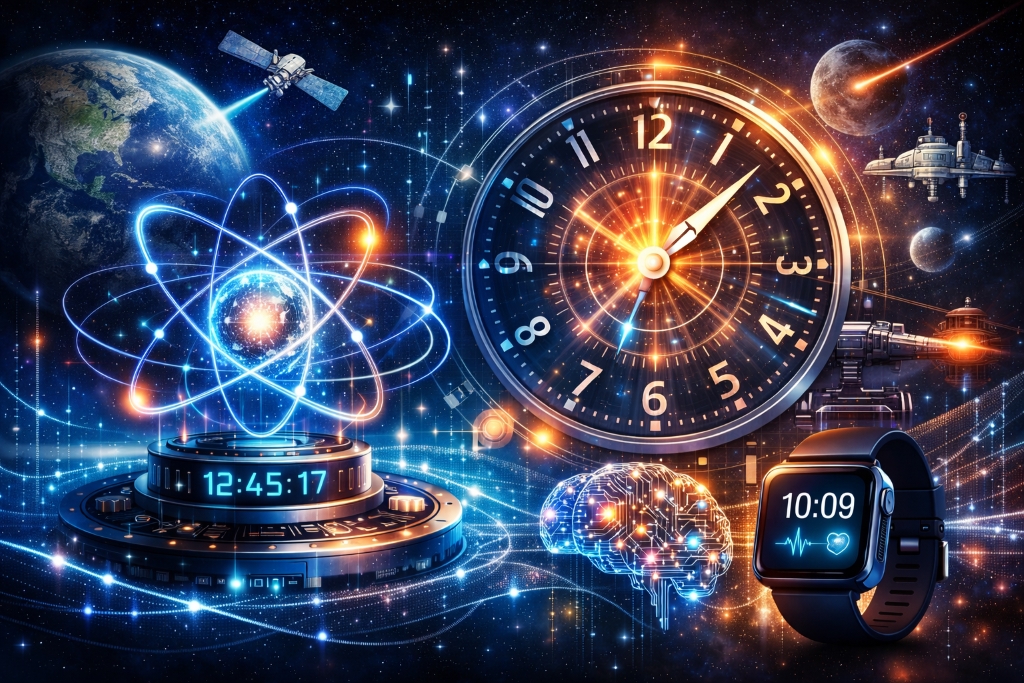
The Future of Time Measurement Technology
Time is one of the most fundamental dimensions of our universe, yet it is also one of the most complex to measure accurately. From ancient civilizations observing the movement of the sun to modern scientists working with ultra-precise atomic clocks, humanity’s relationship with time measurement has continuously evolved.
Today, we stand at the edge of a new era—where time measurement technology is becoming more precise, intelligent, and deeply integrated into our digital and scientific world. As satellites, global communication networks, financial systems, and space exploration increasingly depend on accurate timing, the future of time measurement has never been more important.
This article explores the evolution of timekeeping, the technologies shaping its future, and how these advancements will impact science, technology, and everyday life.
The Evolution of Time Measurement
The earliest methods of timekeeping were based on natural phenomena. Ancient civilizations relied on sunrise and sunset, seasonal cycles, and celestial movements to track time. This led to the invention of sundials, water clocks, and hourglasses—ingenious tools for their time, but highly dependent on environmental conditions.
The invention of mechanical clocks during the Middle Ages marked a major turning point. By using gears and oscillating mechanisms, mechanical clocks introduced standardized timekeeping, enabling societies to coordinate activities more efficiently. Later, pendulum clocks significantly improved accuracy, reducing daily errors.
The 20th century brought the next major breakthrough with quartz clocks. Using the vibration of quartz crystals, these clocks offered far greater precision and reliability. Quartz technology laid the foundation for modern electronic timekeeping and paved the way for today’s advanced systems.
Each innovation in time measurement did more than improve accuracy—it reshaped how societies functioned, communicated, and advanced scientifically.
Why Accurate Time Measurement Matters Today
In the modern world, timekeeping is no longer just about knowing the hour. Precise time measurement is critical to the functioning of global systems, including:
- Global communication and data networks
- Internet synchronization and cloud computing
- GPS and satellite navigation
- Financial markets and high-frequency trading
- Power grids and transportation systems
- Space exploration and satellite operations
Even a microsecond-level error can cause failures in navigation, data transmission, or financial transactions. As digital systems become faster and more interconnected, the demand for precise and reliable timekeeping continues to grow.
Atomic Clocks: The Backbone of Modern Timekeeping
Atomic clocks represent the current gold standard in time measurement. Unlike mechanical or quartz clocks, atomic clocks measure time based on the natural oscillations of atoms—most commonly cesium or rubidium.
A cesium atomic clock defines the official international unit of time: one second. These clocks are so accurate that they lose or gain only about one second over millions of years. Coordinated Universal Time (UTC), which the entire world relies on, is based on atomic clock measurements.
Atomic clocks power essential systems such as:
- GPS and satellite navigation
- Telecommunications networks
- Internet time synchronization
- Financial trading platforms
- Scientific research and space missions
Without atomic clocks, much of today’s digital infrastructure would simply not function.
Optical Clocks: The Next Big Leap
While atomic clocks are extraordinarily precise, scientists are already developing even more advanced systems known as optical clocks.
Traditional atomic clocks use microwave frequencies, but optical clocks operate at much higher optical frequencies using laser light. Because these frequencies oscillate much faster, optical clocks can divide time into smaller units, making them significantly more precise.
Some experimental optical clocks are so accurate that they would lose less than one second over the age of the universe.
Why Optical Clocks Matter
- Far higher accuracy than cesium atomic clocks
- Ability to detect tiny differences in time caused by gravity
- Potential to redefine the international time standard
- Improved GPS accuracy down to centimeters or even millimeters
Many scientists believe optical clocks will eventually replace atomic clocks as the world’s primary timekeeping standard.
Quantum Technology and Time Measurement
Quantum mechanics is opening entirely new possibilities for time measurement. Quantum clocks use quantum states of atoms and particles to achieve extraordinary levels of precision and stability.
Quantum timekeeping is not only about accuracy—it also allows scientists to explore fundamental questions about the nature of time and space. Ultra-precise clocks can detect minute changes in gravitational fields, confirming predictions from Einstein’s theory of relativity.
In the future, quantum clocks could enable:
- Ultra-secure quantum communication systems
- More accurate space navigation
- Detection of underground geological changes
- Improved earthquake and climate modeling
- Advanced scientific experiments
Time measurement is evolving into a powerful tool for understanding the universe itself.
Artificial Intelligence in Time Measurement
Artificial Intelligence (AI) is increasingly transforming timekeeping systems. AI algorithms can analyze massive datasets from atomic and optical clocks to identify patterns, predict errors, and correct drift before it happens.
AI-assisted timekeeping offers:
- Real-time error correction
- Predictive maintenance of time systems
- Improved synchronization across global networks
- Adaptive time standards based on environmental conditions
As AI technology advances, time measurement systems will become more autonomous, resilient, and efficient.
Global Time Synchronization in a Connected World
In today’s hyper-connected digital environment, synchronized time is essential. Cloud computing, financial markets, and communication networks rely on precise timestamps to function correctly.
Future developments in time synchronization will focus on:
- Ultra-low latency global synchronization
- Secure time distribution to prevent cyber-attacks
- Redundant and fault-tolerant systems
- Integration with next-generation networks such as 6G
Accurate global timekeeping will remain a cornerstone of future digital infrastructure.
Time Measurement in Space Exploration
As humanity expands beyond Earth, timekeeping faces new challenges. Different planets and moons have unique rotational periods and gravitational conditions, making Earth-based time standards insufficient.
Future space missions will require:
- Space-based atomic and optical clocks
- Autonomous timekeeping for deep-space travel
- Relativity-aware clocks that adjust for time dilation
- Interplanetary time synchronization frameworks
Accurate time measurement will be essential for navigation, communication, and long-duration space exploration missions.
Wearable Technology and Personal Timekeeping
Time measurement is also becoming increasingly personal. Smartwatches and wearable devices already track time, health metrics, and activity patterns.
In the future, wearable time technology may provide:
- Extremely accurate personal clocks
- Health insights based on biological rhythms
- Smarter scheduling and productivity optimization
- Integration of physical, digital, and biological time
The boundary between timekeeping and lifestyle technology is rapidly disappearing.
Biological Time and Chronobiology
Another emerging frontier is biological time measurement. Human bodies operate on internal clocks known as circadian rhythms, which influence sleep, metabolism, and mental performance.
Future technologies may allow us to measure and optimize biological time with high precision, leading to:
- Personalized sleep and work schedules
- Improved mental and physical health
- Better work-life balance
- Optimized performance and recovery
Time measurement will no longer be purely mechanical or digital—it will become biological.
Challenges and Ethical Considerations
Despite rapid progress, challenges remain:
- High cost of advanced timekeeping systems
- Technical complexity and maintenance
- Global standardization and governance
- Ensuring fair and secure access to precise time
As precision time becomes more powerful, ethical and philosophical questions also arise. Who controls global time standards? How precise is “precise enough”? How do we ensure transparency and international cooperation?
Precision time is power—and it must be managed responsibly.
The Role of GlobalTime.io
In a world where time technology is evolving rapidly, platforms like GlobalTime.io play a crucial role in educating users and making complex timekeeping concepts accessible.
By focusing on global time awareness, emerging technologies, and educational content, GlobalTime.io helps bridge the gap between advanced time science and everyday users—connecting the past, present, and future of time.
Conclusion: A New Era of Time
The future of time measurement technology is both exciting and transformative. From optical and quantum clocks to AI-driven synchronization, wearable devices, and biological timekeeping, humanity is entering an era where time can be measured with unprecedented precision.
As our dependence on digital systems grows and space exploration accelerates, accurate and reliable timekeeping will become even more essential. Time—once measured by shadows, water, and sand—is now defined by atoms, quantum states, and intelligent systems.
Understanding the future of time measurement is not just about technology. It is about understanding the rhythm of the universe—and our place within it.
Comments
nice article.
2026-01-09 19:22:36