Introduction
The Dragon Boat Festival is one of China's most recognizable traditional celebrations, combining ancient history, cultural legends, competitive boat racing, traditional food, and seasonal customs. Known in Chinese as Duanwu Jie (端午节), the festival is observed on the fifth day of the fifth month of the traditional Chinese lunisolar calendar.
Often associated with colorful dragon-shaped boats racing across rivers and lakes, the celebration represents much more than a sporting competition. It reflects centuries of Chinese cultural heritage, community participation, respect for historical figures, and traditional beliefs about health and protection.
One of the most widely known stories associated with the festival is the legend of Qu Yuan, a poet and statesman from ancient China whose death is traditionally remembered during the occasion. His story has become closely connected with dragon boat racing and the preparation of Zongzi, a traditional sticky rice dish wrapped in bamboo or other leaves.
Today, the Dragon Boat Festival is celebrated throughout mainland China and in Chinese communities around the world. Traditional boat races, family gatherings, cultural performances, and regional food customs help preserve its importance across generations.
The festival also offers an interesting connection between traditional calendar systems and seasonal celebrations. Its date changes according to the Chinese lunisolar calendar, making it an important example of how ancient calendar traditions continue to influence modern cultural life.
1. What Is the Dragon Boat Festival?
The Dragon Boat Festival is an annual traditional Chinese festival celebrated on the fifth day of the fifth lunar month.
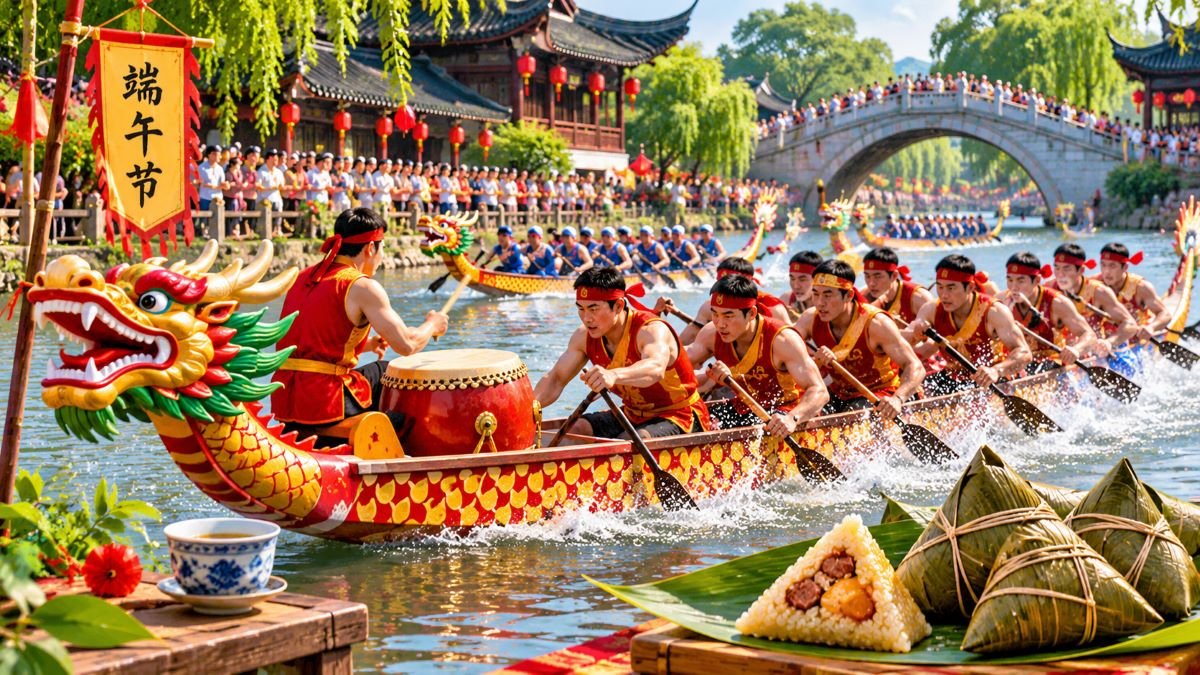
Its Chinese name, Duanwu Jie, is commonly translated as Dragon Boat Festival. The celebration is particularly famous for dragon boat competitions, in which teams paddle long, narrow boats decorated with dragon heads and tails.
These races are among the most visually exciting parts of the festival. Teams work together to move their boats through the water in coordinated movements, often accompanied by the rhythm of drums.
However, dragon boat racing is only one part of the celebration. Other important traditions include preparing Zongzi, participating in cultural activities, remembering historical figures, and following customs traditionally associated with seasonal health and protection.
The main characteristics of the Dragon Boat Festival include:
- Traditional dragon boat races.
- Eating Zongzi, a sticky rice dish wrapped in leaves.
- Remembering the historical poet Qu Yuan.
- Displaying dragon-themed decorations.
- Practicing regional customs and folk traditions.
- Spending time with family and communities.
- Participating in traditional outdoor activities.
Although the festival is strongly associated with Qu Yuan in popular culture, its historical development includes several older seasonal, agricultural, and ritual traditions.
2. History and Origins of the Dragon Boat Festival
The history of the Dragon Boat Festival extends back more than two thousand years. Its origins are connected with ancient Chinese seasonal practices, regional customs, agricultural traditions, and beliefs about the natural environment.
The festival did not necessarily begin as a single celebration with one clearly documented founder. Instead, different traditions gradually developed and became associated with the fifth day of the fifth lunar month.
Ancient Seasonal Traditions
In ancient China, the fifth lunar month was traditionally considered a period when summer conditions became increasingly intense.
Warm weather, humidity, insects, and seasonal illnesses influenced everyday life. Communities developed customs intended to promote health, prevent illness, and protect households during this period.
Certain plants, herbs, and decorative objects were traditionally believed to provide protection against harmful influences.
These practices became part of the wider cultural background of the Dragon Boat Festival.
Connection with Ancient Water and Dragon Traditions
Water has long played an important role in Chinese civilization. Rivers supported agriculture, transportation, trade, and settlement.
Dragons also occupy an important position in traditional Chinese mythology. Unlike many Western dragon traditions, the Chinese dragon is frequently associated with rain, water, prosperity, strength, and auspicious power.
Some traditional interpretations connect dragon boat activities with ancient water-related ceremonies and seasonal rituals.
Over time, boat competitions and dragon symbolism became important elements of the festival.
The Story of Qu Yuan
The most famous historical story associated with the Dragon Boat Festival concerns Qu Yuan (c. 340–278 BCE), a poet and statesman who lived during the Warring States period.
Qu Yuan served the state of Chu and became known for his political ideas, loyalty, and literary contributions.
According to traditional accounts, he opposed political corruption and expressed concern about the future of his state. His political position eventually led to his exile.
During his period away from political life, Qu Yuan produced some of the most influential works of ancient Chinese poetry.
When the state of Chu was conquered by the Qin state in 278 BCE, traditional accounts describe Qu Yuan as deeply distressed by the destruction of his homeland.
He is said to have drowned himself in the Miluo River.
How Qu Yuan Became Associated with the Festival
According to popular legend, local people who heard about Qu Yuan's death rushed onto the river in boats in an attempt to find him.
They reportedly beat drums and splashed the water with their paddles to prevent fish and other creatures from disturbing his body.
Another part of the legend says that people threw packets of rice into the river to provide food for Qu Yuan or keep fish away from his remains.
These traditional stories are commonly connected with the origins of dragon boat racing and Zongzi.
Although the exact historical origins of these customs are more complicated, Qu Yuan's story has become one of the central cultural explanations for the festival.
Literary Legacy of Qu Yuan
Qu Yuan remains one of the most respected figures in classical Chinese literature.
His famous work Li Sao (The Lament) is an important example of early Chinese poetry.
His writings explore loyalty, political disappointment, personal integrity, and concern for the future of his homeland.
Remembering Qu Yuan during the Dragon Boat Festival provides an opportunity to reflect on these values and his influence on Chinese cultural history.
3. Why Is the Dragon Boat Festival Celebrated?
The Dragon Boat Festival brings together historical remembrance, traditional beliefs, seasonal customs, and community celebrations.
Its meaning can be understood through several important cultural themes.
Remembering Qu Yuan
The story of Qu Yuan represents loyalty, integrity, and dedication to one's homeland.
His literary and historical legacy continues to influence how the festival is understood.
Remembering him is one of the most widely recognized explanations for the celebration.
Promoting Health and Protection
Traditional Chinese seasonal customs associated with the fifth lunar month included practices intended to protect people from illness and harmful influences.
Herbs, fragrant sachets, and decorative plants were traditionally used in homes and worn as protective objects.
These practices reflect historical beliefs about health and seasonal changes.
Celebrating Community Cooperation
Dragon boat racing requires teamwork, coordination, discipline, and collective effort.
Every paddler must work in rhythm with the rest of the team.
The activity therefore represents cooperation and community participation in addition to athletic competition.
Preserving Cultural Heritage
The festival provides opportunities for families and communities to pass traditional knowledge to younger generations.
Food preparation, boat craftsmanship, folk stories, and regional customs all contribute to the preservation of Chinese cultural identity.
4. Dragon Boat Racing: The Most Famous Festival Tradition
Dragon boat racing is the most recognizable activity associated with the festival.
These races feature long boats decorated with dragon heads at the front and dragon tails at the rear.
The boats are often brightly painted, with elaborate scales, eyes, and other decorative details.
How Dragon Boats Are Designed
Traditional dragon boats are generally long and narrow, allowing multiple paddlers to sit in rows.
Their construction varies according to local traditions, competition requirements, and the materials available.
Common features include:
- A decorative dragon head at the front.
- A dragon tail at the back.
- Multiple seating positions for paddlers.
- A drummer who maintains the rhythm.
- A steerer who guides the boat.
- A long hull designed for movement through water.
Modern competition boats may follow standardized dimensions and construction requirements.
The Role of the Drummer
The drummer is an important member of a dragon boat team.
Sitting near the front, the drummer uses a large drum to establish a consistent rhythm.
Paddlers follow the beat to maintain synchronized movements.
The rhythm helps the team coordinate its strokes, maintain speed, and respond during the competition.
The Role of the Steerer
The steerer controls the direction of the boat using a steering oar.
Maintaining balance and navigating the racing course are important responsibilities.
A strong team needs coordination between the paddlers, drummer, and steerer.
How a Dragon Boat Race Works
A typical competition involves several teams racing over a marked watercourse.
Teams position their boats at the starting line and begin paddling after the official signal.
The objective is to reach the finish line before the competing teams.
Depending on the event, races may include different distances, team categories, and competition formats.
Why Teamwork Matters
Dragon boat racing is not simply a test of individual strength.
Successful teams rely on rhythm, timing, communication, and collective discipline.
Even powerful paddlers cannot achieve their best performance if their movements are poorly coordinated.
This emphasis on cooperation gives the sport a wider cultural meaning beyond the competition itself.
5. Traditional Food: Zongzi and Its Cultural Meaning
Food is an essential part of the Dragon Boat Festival.
The best-known traditional dish is Zongzi (粽子), a preparation made primarily from glutinous rice wrapped in bamboo leaves or other suitable leaves.
These leaf-wrapped rice parcels are cooked by boiling or steaming.
They are closely associated with the festival and are enjoyed in different forms throughout China.
What Is Zongzi?
Zongzi is generally prepared using glutinous rice, although ingredients and fillings vary by region.
The rice is placed inside leaves, folded into a parcel, and secured before cooking.
The leaves give the rice a distinctive aroma and help maintain its shape.
Zongzi may contain sweet or savory fillings depending on regional preferences.
Common Types of Zongzi
Sweet Zongzi
Sweet varieties are popular in several regions.
Common ingredients include:
- Red bean paste.
- Sweetened glutinous rice.
- Dates.
- Nuts.
- Sweet fruit fillings.
Savory Zongzi
Savory varieties are particularly popular in many southern Chinese communities.
Common fillings include:
- Pork.
- Salted egg yolk.
- Mushrooms.
- Chestnuts.
- Seasoned meat.
- Dried shrimp.
The exact ingredients vary widely between families and regions.
Why Are Zongzi Eaten During the Festival?
According to the popular Qu Yuan legend, people threw packets of rice into the river after his death.
The food was traditionally intended to prevent fish from disturbing his body or provide nourishment in his memory.
This story became closely associated with the custom of eating Zongzi during the Dragon Boat Festival.
However, rice-wrapped foods and related traditions have a broader history, so the legend should be understood as an important cultural explanation rather than the only historical origin of the dish.
Regional Differences in Zongzi
Different parts of China have developed their own Zongzi styles.
Northern varieties often include sweet fillings such as dates and red bean paste.
Southern varieties frequently feature savory ingredients, including pork, mushrooms, and salted egg yolks.
The shape, wrapping style, texture, and cooking techniques also differ.
These regional variations demonstrate the diversity of Chinese culinary traditions.
6. Other Traditional Dragon Boat Festival Customs
Although dragon boat racing and Zongzi are the most famous festival traditions, several other customs are also associated with the celebration.
Hanging Mugwort and Calamus
Mugwort and calamus are traditional plants commonly associated with the festival.
In some communities, people hang these plants near doors and windows.
Historically, they were believed to help protect households against harmful influences and seasonal illnesses.
Their strong aromas also contributed to their traditional use.
Wearing Fragrant Sachets
Small decorative sachets filled with fragrant herbs are another traditional feature.
They are often made using colorful fabrics and may contain aromatic ingredients.
In traditional beliefs, these sachets were associated with protection, good fortune, and seasonal health.
They are also appreciated as decorative cultural objects.
Drinking Realgar Wine
Realgar wine has a historical connection with some Dragon Boat Festival customs.
Traditional beliefs associated it with protection against insects and harmful influences.
However, realgar contains arsenic compounds and is toxic. It should not be consumed.
Its historical significance is best understood as part of traditional folklore rather than a modern health practice.
Wearing Five-Colored Silk Threads
In some regional traditions, children wear colorful silk threads around their wrists or ankles.
These threads traditionally symbolize protection, good fortune, and health.
Their colors and exact meanings can vary across local customs.
Traditional Outdoor Activities
Some communities organize outdoor gatherings, folk performances, traditional games, and cultural exhibitions.
These activities provide opportunities for people to celebrate together and learn about local customs.
7. Famous Places to Experience the Dragon Boat Festival in China
Several Chinese cities and regions are especially well known for their dragon boat traditions.
Miluo, Hunan Province
Miluo is closely associated with the story of Qu Yuan.
The Miluo River is traditionally connected with the poet's death, making the area an important cultural destination during the festival.
Commemorative activities and dragon boat events help preserve the historical connection.
Yueyang, Hunan Province
Yueyang is another important location for dragon boat traditions.
Its connection with the region's rivers and cultural heritage makes it a popular setting for festival-related activities.
Hangzhou, Zhejiang Province
Hangzhou is known for its scenic waterways and cultural attractions.
Dragon boat races and seasonal celebrations provide opportunities for residents and visitors to experience traditional festival activities.
Guangzhou, Guangdong Province
Guangzhou has a strong dragon boat racing culture.
Local communities organize races and traditional events that attract participants and spectators.
Some neighborhoods maintain long-standing boat racing traditions that are closely connected with community identity.
Hong Kong
Hong Kong is internationally recognized for its dragon boat racing events.
The city hosts major competitions involving local and international teams.
The combination of traditional boat designs, competitive sporting events, and waterfront celebrations makes it an important destination for dragon boat enthusiasts.
Suzhou, Jiangsu Province
Suzhou is famous for its canals, gardens, and traditional water-based culture.
Dragon boat activities provide another connection between the city's historic waterways and Chinese festival traditions.
8. Dragon Boat Festival and the Chinese Lunar Calendar
The Dragon Boat Festival is closely connected to the traditional Chinese lunisolar calendar.
It takes place on the fifth day of the fifth lunar month every year.
Unlike the Gregorian calendar, which follows a solar-year structure, the traditional Chinese calendar uses lunar months while also considering the solar seasons.
Why Does the Festival Date Change Every Year?
A lunar month lasts approximately 29.5 days.
The Chinese calendar uses alternating months of 29 and 30 days to follow the lunar cycle.
Because the Gregorian calendar is based on a different system, the fifth day of the fifth lunar month falls on different Gregorian dates each year.
The Dragon Boat Festival generally occurs in May or June.
The Significance of the Fifth Lunar Month
The fifth lunar month is traditionally associated with the beginning of increasingly hot summer conditions.
In historical Chinese seasonal beliefs, this period was considered important for health and protection.
Many customs associated with the festival reflect these seasonal concerns.
Relationship with the Summer Season
The festival takes place as summer conditions become more prominent in many parts of China.
Traditional seasonal practices, the use of aromatic plants, and outdoor celebrations reflect the relationship between Chinese cultural life and the natural environment.
How Is the Date Determined?
The Chinese lunisolar calendar uses astronomical calculations to determine the beginning of lunar months and the placement of solar terms.
The fifth lunar month begins with the corresponding new moon.
The Dragon Boat Festival is then observed on the fifth day of that month.
This is why its Gregorian date changes annually while its traditional lunar-calendar date remains consistent.
9. Dragon Boat Festival in Modern Chinese Society
The Dragon Boat Festival continues to play an important role in contemporary Chinese culture.
Although modern lifestyles differ significantly from those of earlier generations, many traditional practices remain popular.
Modern Dragon Boat Competitions
Dragon boat racing has developed into an international sport.
Organized competitions attract professional athletes, community teams, schools, businesses, and recreational participants.
Some events follow international competition standards, while others preserve local racing styles.
Cultural Tourism
The festival has become an important attraction for cultural tourism.
Visitors travel to famous locations to experience dragon boat competitions, traditional food, historical exhibitions, and local celebrations.
These activities also support regional tourism and cultural industries.
Traditional Food and Family Gatherings
Preparing and sharing Zongzi remains one of the most popular ways to celebrate.
Families may prepare the food at home or purchase regional varieties from markets and restaurants.
Sharing traditional food helps maintain connections between generations.
Digital Media and Cultural Awareness
Social media and digital platforms have increased international awareness of the festival.
Photographs and videos of dragon boat competitions introduce people from different countries to Chinese traditions.
Online cultural programs also help preserve and share traditional stories.
Preservation of Traditional Crafts
Dragon boat construction and decorative craftsmanship remain important aspects of the festival's heritage.
Some communities continue to maintain traditional boats and teach younger generations about their construction and cultural significance.
10. Dragon Boat Festival Celebrations Around the World
The Dragon Boat Festival is no longer limited to mainland China.
Chinese communities around the world celebrate the occasion, and dragon boat racing has become an internationally recognized sporting activity.
Singapore
Singapore has a strong Chinese cultural heritage and regularly hosts dragon boat events.
The celebrations include competitive races, cultural programs, and traditional food.
Malaysia
Chinese communities in Malaysia preserve many traditional Dragon Boat Festival customs.
Zongzi preparation, family gatherings, and dragon boat activities are common parts of the celebration.
United States
Several American cities organize dragon boat festivals and competitions.
These events attract participants from different cultural backgrounds and introduce international audiences to Chinese traditions.
Canada
Dragon boat racing is popular in various Canadian cities.
Community competitions and cultural events help bring together participants, families, and visitors.
Australia
Australian cities host dragon boat competitions involving local clubs and international participants.
The events combine competitive sport with cultural celebration.
United Kingdom
Dragon boat festivals and racing competitions take place in several locations across the United Kingdom.
These events help introduce the history and traditions of the celebration to wider audiences.
The international growth of dragon boat racing demonstrates how a traditional cultural activity can become a shared sporting experience.
11. The Difference Between Dragon Boat Festival and Lantern Festival
The Dragon Boat Festival and Lantern Festival are two separate traditional Chinese celebrations.
Although both are associated with Chinese cultural heritage, their dates, customs, food, and historical meanings are different.
Lantern Festival
- Observed on the fifteenth day of the first lunar month.
- Usually takes place in February or March.
- Famous for colorful lantern displays.
- Traditional foods include Yuanxiao and Tangyuan.
- Symbolizes reunion, completeness, and happiness.
- Traditionally concludes the main Spring Festival celebration period.
Dragon Boat Festival
- Observed on the fifth day of the fifth lunar month.
- Usually takes place in May or June.
- Famous for dragon boat racing.
- Traditional food is Zongzi.
- Closely associated with Qu Yuan and seasonal customs.
- Reflects remembrance, protection, and community cooperation.
Both festivals are important parts of China's traditional annual cultural calendar, but they represent different historical and cultural experiences.
12. Is the Dragon Boat Festival an Official Public Holiday in China?
Yes. The Dragon Boat Festival is an official public holiday in mainland China.
It is included in the country's annual public holiday arrangements.
The holiday generally provides an opportunity for people to spend time with family, participate in traditional celebrations, travel, and enjoy local events.
The exact holiday schedule may vary from year to year because official arrangements can include adjusted working days and weekend combinations.
For international visitors, it is useful to check the official holiday calendar before planning travel or business activities in China.
13. Interesting Facts About the Dragon Boat Festival
- The Dragon Boat Festival is traditionally celebrated on the fifth day of the fifth lunar month.
- Its Chinese name is Duanwu Jie.
- The festival is closely associated with the ancient poet and statesman Qu Yuan.
- Dragon boat racing is its most recognizable public activity.
- Zongzi is the best-known traditional festival food.
- Zongzi can contain sweet or savory fillings depending on regional preferences.
- Traditional dragon boats feature decorative dragon heads and tails.
- A drummer helps paddlers maintain a coordinated rhythm during races.
- Mugwort and calamus are associated with traditional seasonal customs.
- The festival is celebrated by Chinese communities in many countries.
- Dragon boat racing has developed into an international competitive sport.
- The Dragon Boat Festival is an official public holiday in mainland China.
- The festival's cultural history includes traditions that extend beyond the Qu Yuan legend.
- Hong Kong is internationally known for its major dragon boat competitions.
- The festival's Gregorian calendar date changes each year because it follows the Chinese lunisolar calendar.
14. Cultural Values Reflected in the Dragon Boat Festival
The Dragon Boat Festival reflects several important values found in traditional Chinese society.
Loyalty and Integrity
The story of Qu Yuan represents loyalty, personal integrity, and concern for one's homeland.
His poetry and historical legacy continue to influence the cultural meaning of the festival.
Unity and Cooperation
Dragon boat racing demonstrates the importance of teamwork.
Every participant contributes to a shared objective, emphasizing the value of coordination and collective effort.
Respect for Tradition
Food, seasonal customs, historical stories, and boat-making practices help preserve cultural knowledge.
Families and communities continue to pass these traditions to younger generations.
Connection with Nature
The festival's timing reflects the relationship between traditional Chinese life and seasonal changes.
Its customs involving herbs, outdoor activities, and water-based competitions demonstrate how cultural celebrations developed alongside the natural environment.
Community Identity
Local dragon boat traditions often connect communities with their rivers, neighborhoods, and regional history.
Participating in the festival helps strengthen these shared cultural relationships.
15. Why the Dragon Boat Festival Remains Important Today
The continued popularity of the Dragon Boat Festival demonstrates the lasting influence of cultural traditions in modern society.
Its importance comes from its ability to connect history, food, sport, family relationships, and community activities in a single annual celebration.
For older generations, the festival provides an opportunity to preserve traditional customs and share historical knowledge.
For younger generations, dragon boat competitions and cultural activities make traditional heritage more accessible and engaging.
For international visitors, the festival offers an opportunity to understand Chinese history, mythology, seasonal traditions, and community life.
The development of dragon boat racing as an international sport has also helped introduce the celebration to people who may not be familiar with Chinese cultural traditions.
At the same time, traditional food, regional ceremonies, and the story of Qu Yuan continue to provide the festival with its distinctive cultural identity.
Rather than remaining limited to historical remembrance, the Dragon Boat Festival continues to evolve through modern competitions, cultural tourism, and international participation.
Conclusion
The Dragon Boat Festival is one of China's most meaningful traditional celebrations, bringing together ancient legends, historical remembrance, seasonal customs, traditional food, and exciting sporting activities.
Observed on the fifth day of the fifth lunar month, the festival is particularly famous for its colorful dragon boat races and the preparation of Zongzi. Its association with Qu Yuan adds a powerful historical and literary dimension to the celebration.
From the rivers of Hunan Province to the international dragon boat competitions of Singapore, Canada, Australia, and other countries, the festival continues to connect communities through shared traditions and cultural experiences.
Its lasting significance lies not only in the excitement of boat racing but also in the values it represents: loyalty, teamwork, remembrance, family connections, and respect for cultural heritage.
As modern celebrations continue to grow, the Dragon Boat Festival remains an important example of how ancient traditions can survive, develop, and bring people together across generations and geographical boundaries.
Comments
No comments yet.