Daylight Saving Time Explained: History, Science, and Global Debate
By GlobalTime Team |
January 2026 |
⏱ 3 min read
|
👁️ 220 Views
Daylight Saving Time: History, Science, Global Debate, and the Future of Clock Changes
1. What Is Daylight Saving Time?
- Seasonal clock changes (spring and autumn)
- One-hour shift relative to standard time
- Regionally coordinated transitions
2. Pre-Modern Concepts of Time and Daylight
- Ancient Egypt and Rome used variable-length daylight hours
- Time was defined by solar position, not fixed increments
- Seasonal adaptation occurred socially, not mechanically
3. The Intellectual Origins of Daylight Saving Time
Benjamin Franklin’s Misattributed Role
- It was satirical
- It suggested changing sleep habits, not clocks
- It proposed no formal timekeeping reform
The First Serious Proposals
- George Vernon Hudson (1895) proposed clock changes to increase evening daylight
- William Willett (1907) championed DST in the UK for social and economic reasons
4. War, Energy, and the First Adoption of DST
World War I
- Germany introduced DST in 1916 to conserve coal
- Other European nations followed rapidly
- The practice spread as a wartime efficiency measure
World War II
- DST returned under various forms (“War Time”)
- Reinforced the association between DST and national policy
5. Standardization in the Modern Era
The Rise of National and Global Time Standards
- Fixed time zones
- Coordinated transitions
- Legal definitions of time
6. The Scientific Rationale Behind DST
Energy Consumption
- Minor reductions in evening lighting
- Increased heating and cooling demand
- Net energy savings are often negligible or region-dependent
Circadian Biology
- Delaying sunrise relative to social time
- Causing short-term sleep deprivation
- Increasing circadian misalignment
7. Health and Safety Impacts
- Increased risk of heart attacks and strokes
- Higher rates of traffic accidents
- Reduced workplace productivity
- Short-term cognitive impairment
8. Economic and Social Effects
Economic Activity
- Increased evening commerce
- Higher participation in outdoor activities
- Tourism gains
- Scheduling errors
- Productivity losses
- Operational complexity for global businesses
Digital and Financial Systems
- Stock exchanges
- Airlines
- Software systems
- Global meetings
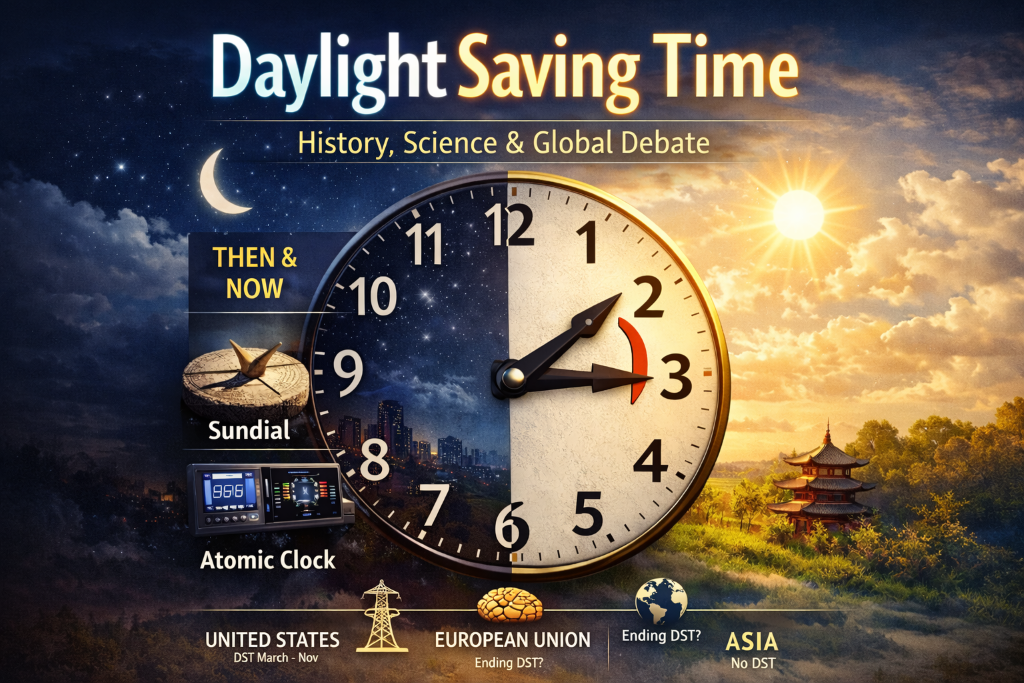
9. Daylight Saving Time in the United States
Legal Framework
- DST runs from the second Sunday in March to the first Sunday in November
- States may opt out (Arizona, Hawaii)
- Territories largely do not observe DST
Ongoing Debate
- Permanent Daylight Saving Time (more evening light)
- Permanent Standard Time (better health alignment)
10. Daylight Saving Time in the European Union
Harmonized System
- All EU countries change clocks together
- DST (Summer Time) runs from late March to late October
The 2018–2019 Turning Point
- EU public consultation showed overwhelming opposition to clock changes
- European Parliament approved ending seasonal changes
- Implementation stalled due to coordination concerns
11. Asia’s Rejection of Daylight Saving Time
Key Reasons
- Limited seasonal daylight variation near the equator
- Large populations under single time zones
- Administrative complexity outweighs benefits
Country Examples
- India: Focus on single vs multiple time zones, not DST
- China: One national time zone, no DST
- Japan: Strong scientific and labor opposition to DST
12. Latitude and Geography: Why DST Is Uneven
- Near the equator: DST offers little benefit
- Near the poles: daylight extremes dominate regardless of clock changes
13. The Global Coordination Problem
- U.S. and EU transitions occur on different dates
- Asia remains stable year-round
- Global systems must constantly adjust
14. DST in the Age of Atomic and Optical Clocks
- Atomic clocks
- Optical clocks
- UTC as a global reference
15. The Future of Daylight Saving Time
- Growing opposition to seasonal clock changes
- Increased emphasis on health and circadian science
- Likely regional divergence rather than global reform
- EU eventually ends clock changes
- U.S. continues debate without consensus
- Asia maintains non-adoption
Conclusion
Comments
No comments yet.