Introduction: Understanding China's Currency
China's currency, officially known as the Renminbi (RMB), is an important part of the country's economy and one of the most closely watched currencies in international trade and finance. Its principal unit is the yuan, represented by the symbol ¥ and identified internationally by the currency code CNY.
The Renminbi is used for everyday purchases, salaries, banking transactions, business payments, government services and commercial activities throughout mainland China.
For people living in China, the yuan is central to everyday financial life. For international visitors, students, investors, importers and exporters, understanding Chinese currency is equally important when exchanging money, making purchases, managing travel expenses or conducting cross-border transactions.
China has developed a distinctive monetary system combining traditional banknotes and coins with an extensive digital payment ecosystem. Mobile payment applications such as Alipay and WeChat Pay have transformed how consumers and businesses make everyday payments.
China is also developing the digital yuan, officially known as e-CNY, as part of its efforts to modernize the national monetary system.
The Chinese currency is increasingly relevant to international trade, global financial markets and cross-border settlements. Understanding the Renminbi provides useful insight into China's financial system and helps international users navigate its changing economic environment.
What Is the Chinese Yuan (RMB)?
The Renminbi is the official currency of the People's Republic of China and is issued by the People's Bank of China (PBOC), the country's central bank.
The word Renminbi translates approximately as "People's Currency."
Although the terms Renminbi and yuan are frequently used interchangeably, they have slightly different meanings.
- Renminbi (RMB): The official name of China's national currency.
- Yuan (¥): The basic monetary unit of the Renminbi.
- CNY: The internationally recognized currency code for the onshore Chinese yuan.
- CNH: A designation commonly used for offshore Renminbi traded outside mainland China's onshore currency market.
For example, an item priced at ¥100 costs one hundred yuan.
In financial documents, international banking and foreign exchange markets, the currency is generally identified as CNY.
Understanding the Chinese Yuan Symbol (¥)
The Chinese yuan uses the symbol ¥, which is also used for the Japanese yen.
Although both currencies share the same general symbol, they are separate monetary units.
The international codes help distinguish them:
- CNY refers to the Chinese yuan.
- JPY refers to the Japanese yen.
Chinese prices may also appear with the Chinese character 元, which means yuan.
In everyday spoken Mandarin, people commonly use the word kuai instead of yuan when discussing prices and payments.
For instance, 10 yuan may be spoken as 10 kuai.
Understanding these different forms is useful for international visitors reading shop prices, menus, invoices and financial documents in China.
Understanding Yuan, Jiao and Fen
The Renminbi follows a decimal-based monetary system.
One yuan is divided into 10 jiao, and one jiao is divided into 10 fen.
This means:
| Currency Unit | Value |
| 1 Yuan | ¥1.00 |
| 1 Jiao | ¥0.10 |
| 1 Fen | ¥0.01 |
| 10 Jiao | 1 Yuan |
| 100 Fen | 1 Yuan |
In everyday spoken Chinese, jiao is frequently called mao.
For example, 5 jiao may be expressed as 5 mao.
Fen is a much smaller monetary unit and is rarely encountered in ordinary modern retail transactions.
History of the Chinese Renminbi
The history of the Renminbi is closely connected to China's political transformation, economic development and the creation of a unified national monetary system.
Before the modern Renminbi was established, different regions of China used a variety of currencies, including silver-based monetary units, copper coins and locally issued banknotes.
The introduction of a national currency helped establish a more standardized system for payments, trade and financial administration.
The Introduction of the Renminbi in 1948
The modern Renminbi was introduced on 1 December 1948, when the People's Bank of China was established in Shijiazhuang.
The newly established bank began issuing the first series of Renminbi banknotes.
At the time, different regional currencies circulated in various parts of China.
A unified currency was important for supporting economic administration, improving financial coordination and replacing fragmented monetary arrangements.
The first series of Renminbi banknotes included a wide range of denominations, reflecting the economic conditions of the period.
These early banknotes are now important historical objects for currency collectors and researchers.
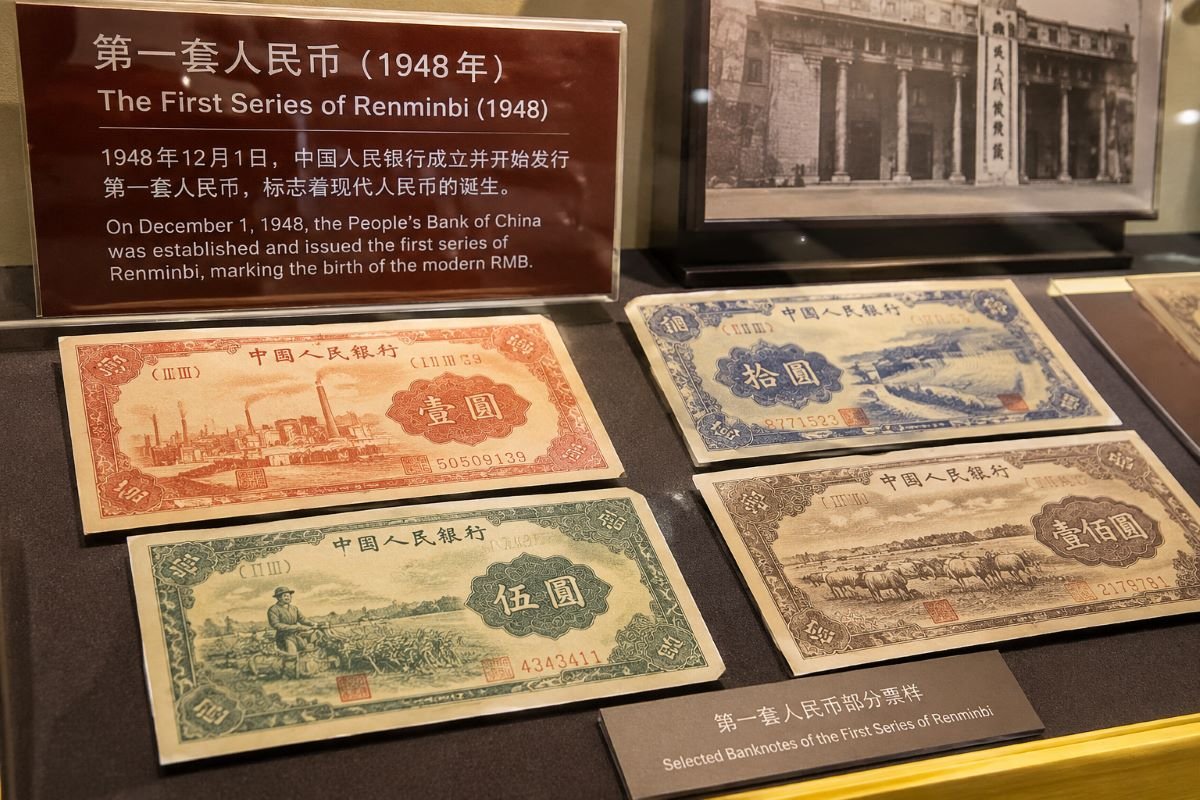
The first series of Renminbi banknotes, introduced in 1948, marked the beginning of China's modern national currency system.
The Second Series and Monetary Reform in 1955
A major change took place in March 1955 when China introduced the second series of Renminbi banknotes.
The monetary reform replaced the first series at a conversion rate of 10,000 old yuan to one new yuan.
This adjustment simplified monetary calculations and restored a more practical scale for everyday prices and financial transactions.
The second series also introduced a more standardized range of denominations and helped establish the decimal structure familiar in modern Chinese currency.
The Third and Fourth Series of Renminbi
As China's economy developed, the Renminbi underwent further changes in design and production.
The third series was introduced in 1962, with banknote designs reflecting the country's industrial, agricultural and economic activities.
The fourth series began appearing in 1987.
It included a broader range of portraits, cultural imagery and national themes, reflecting China's changing economic and social environment.
These historical banknotes remain interesting examples of the evolution of Chinese monetary design.
Introduction of the Fifth Series of Renminbi in 1999
The fifth series of Renminbi was introduced on 1 October 1999.
It represented a major modernization of China's banknotes and incorporated improved printing techniques, more sophisticated security elements and updated visual designs.
The banknotes feature Mao Zedong's portrait on the front, while the reverse sides display important Chinese buildings, landscapes and cultural landmarks.
Subsequent updates in 2005, 2015, 2019 and 2020 improved the printing quality, durability and anti-counterfeiting features of the fifth series.
The modern fifth series remains the principal family of Renminbi banknotes used in everyday transactions.
Modernization of China's Cash and Digital Payment Systems
During the twenty-first century, China experienced rapid development in electronic banking, mobile payments and financial technology.
The growth of platforms such as Alipay and WeChat Pay changed the way individuals and businesses handle everyday transactions.
Digital payments became increasingly common for shopping, transportation, restaurants, online services and personal transfers.
Alongside these developments, the People's Bank of China began researching and testing a central-bank digital currency.
This initiative eventually developed into the digital yuan, or e-CNY, which represents another important stage in the modernization of China's monetary system.
Chinese Banknotes: Understanding Renminbi Paper Currency
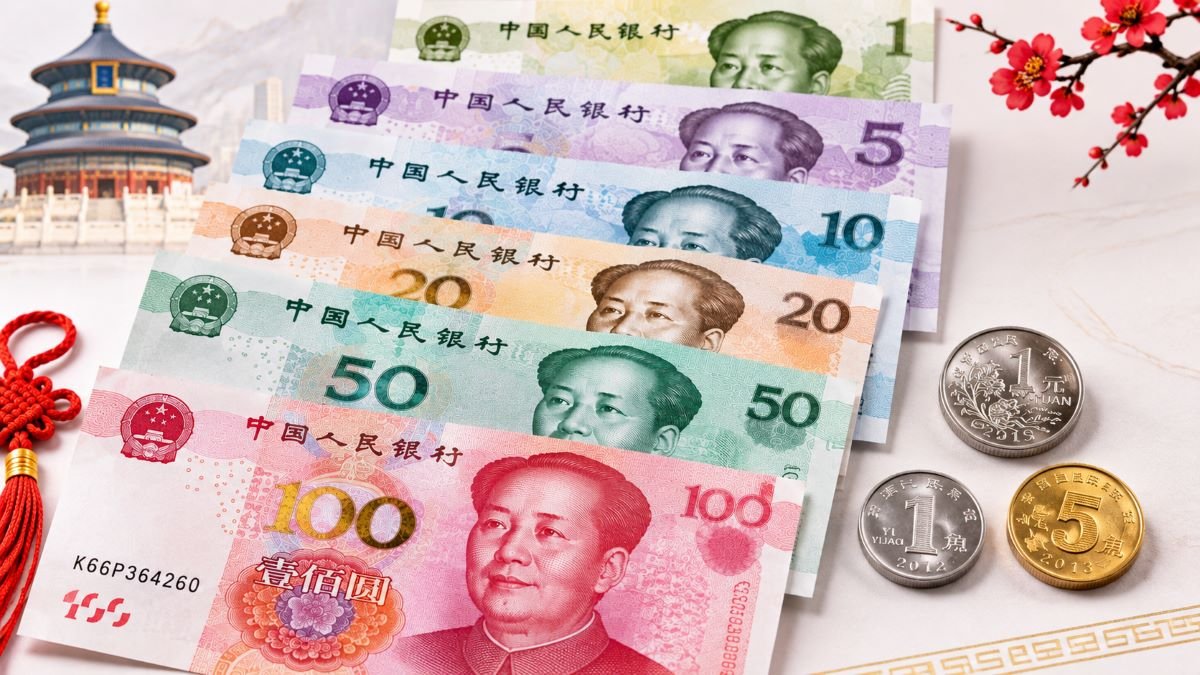
Chinese banknotes are known for their colourful designs, distinctive portraits, national symbols and representations of important landmarks.
The fifth series of Renminbi includes banknotes in six commonly encountered denominations:
| Denomination | General Colour |
| ¥1 | Olive green |
| ¥5 | Purple |
| ¥10 | Blue |
| ¥20 | Brown |
| ¥50 | Green |
| ¥100 | Red |
Mao Zedong's portrait appears on the front of these banknotes.
The reverse designs represent different parts of China's cultural, architectural and natural heritage.
The ¥1 Chinese Banknote
The ¥1 banknote has an olive-green appearance.
Its reverse side features Three Pools Mirroring the Moon, a well-known scenic landmark at West Lake in Hangzhou.
The design represents China's traditional landscape heritage and is associated with one of the country's best-known tourist destinations.
The ¥1 denomination is a smaller banknote used for low-value cash transactions.
The ¥5 Chinese Banknote
The ¥5 banknote is predominantly purple.
Its reverse side features Mount Tai, one of China's most important mountains and a site associated with Chinese cultural and religious traditions.
The 2020 edition introduced updated printing methods and enhanced security elements, including an optically variable denomination numeral.
The ¥10 Chinese Banknote
The ¥10 banknote is predominantly blue.
Its reverse side features Qutang Gorge, one of the famous Three Gorges along the Yangtze River.
The design reflects the natural scenery and geographical importance of the Yangtze River region.
The ¥20 Chinese Banknote
The ¥20 banknote is generally brown.
Its reverse side displays the famous karst mountain scenery of Guilin.
The Guilin landscape is widely recognized for its rivers, limestone formations and distinctive natural beauty.
This imagery makes the denomination one of the most recognizable examples of China's landscape-inspired banknote design.
The ¥50 Chinese Banknote
The ¥50 banknote is predominantly green.
Its reverse side features the Potala Palace in Lhasa, Tibet.
The palace is an important architectural and cultural landmark that reflects the historical heritage of the Tibetan region.
The ¥100 Chinese Banknote
The ¥100 banknote is red and represents the highest denomination in the commonly used fifth-series banknote family.
Its reverse side features the Great Hall of the People in Beijing.
The building is an important national landmark associated with China's political and government institutions.
The ¥100 denomination is widely used for larger cash purchases and financial transactions.
Understanding Chinese Banknote Security Features
Modern Chinese Renminbi banknotes incorporate security technologies designed to make counterfeiting more difficult and help users identify genuine currency.
Different denominations and production editions may have different combinations of security elements.
Common features include:
Watermarks: Certain banknotes contain visible watermark images that can be examined when the note is held against light.
Security Threads: Special threads incorporated into banknotes provide additional protection and may include denomination-related details.
Colour-Changing Ink: Selected numerals and design elements change appearance when the banknote is tilted.
See-Through Registers: Certain printed elements align when viewed against light.
Raised Printing: Special printing techniques create tactile features on selected parts of banknotes.
Microprinting: Very small lettering and fine patterns help provide additional protection against reproduction.
Advanced Printing Technology: Modern banknote production uses detailed printing processes and specialized materials to improve quality and security.
The People's Bank of China periodically upgrades the security and printing features of Renminbi banknotes.
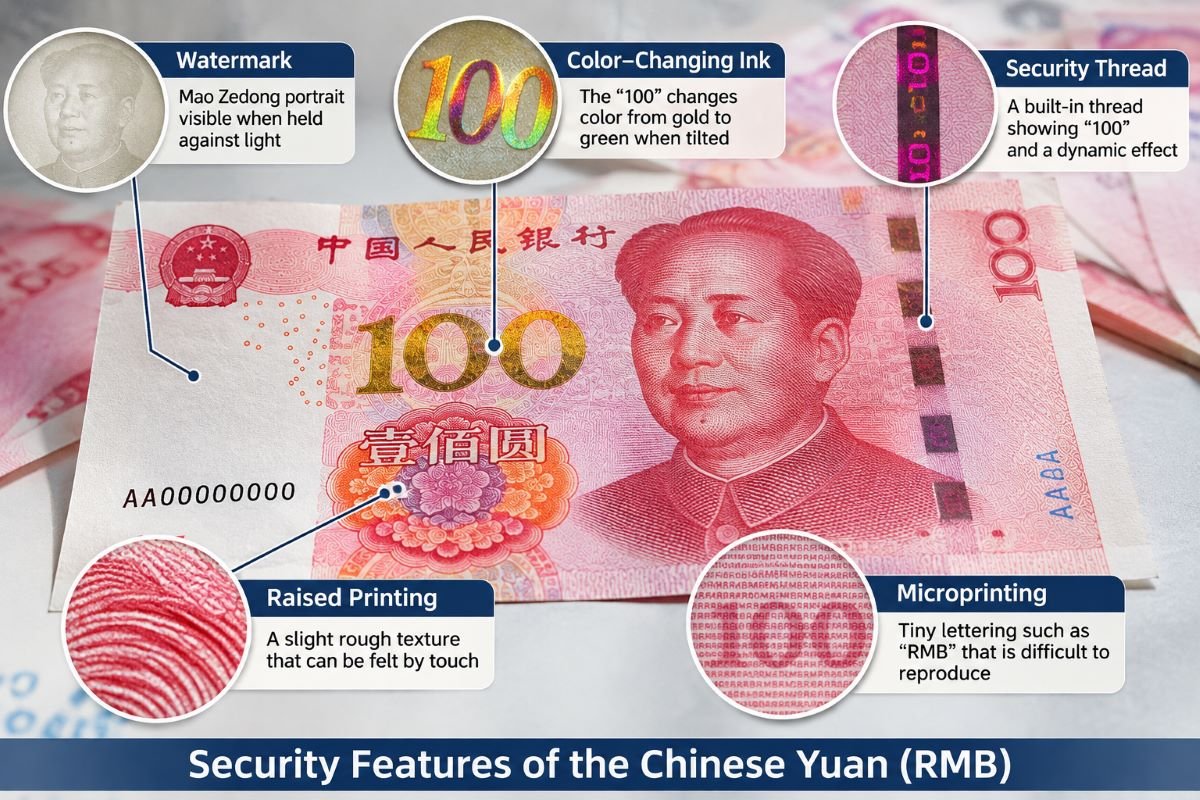
Chinese Renminbi banknotes incorporate security features such as watermarks, security threads, colour-changing ink, raised printing and microprinting to help prevent counterfeiting.
International visitors unfamiliar with Chinese currency should examine banknotes carefully and avoid accepting damaged or suspicious notes without verification.
Chinese Coins and Their Denominations
China uses both banknotes and coins for cash transactions.
Chinese circulation coins are produced with different sizes, shapes, materials and design patterns.
The commonly recognized modern coin denominations include:
| Coin | Value |
| 1 Yuan | ¥1.00 |
| 5 Jiao | ¥0.50 |
| 1 Jiao | ¥0.10 |
Smaller fen-denominated coins have also existed in the Renminbi system, although they have very limited use in ordinary modern retail transactions.
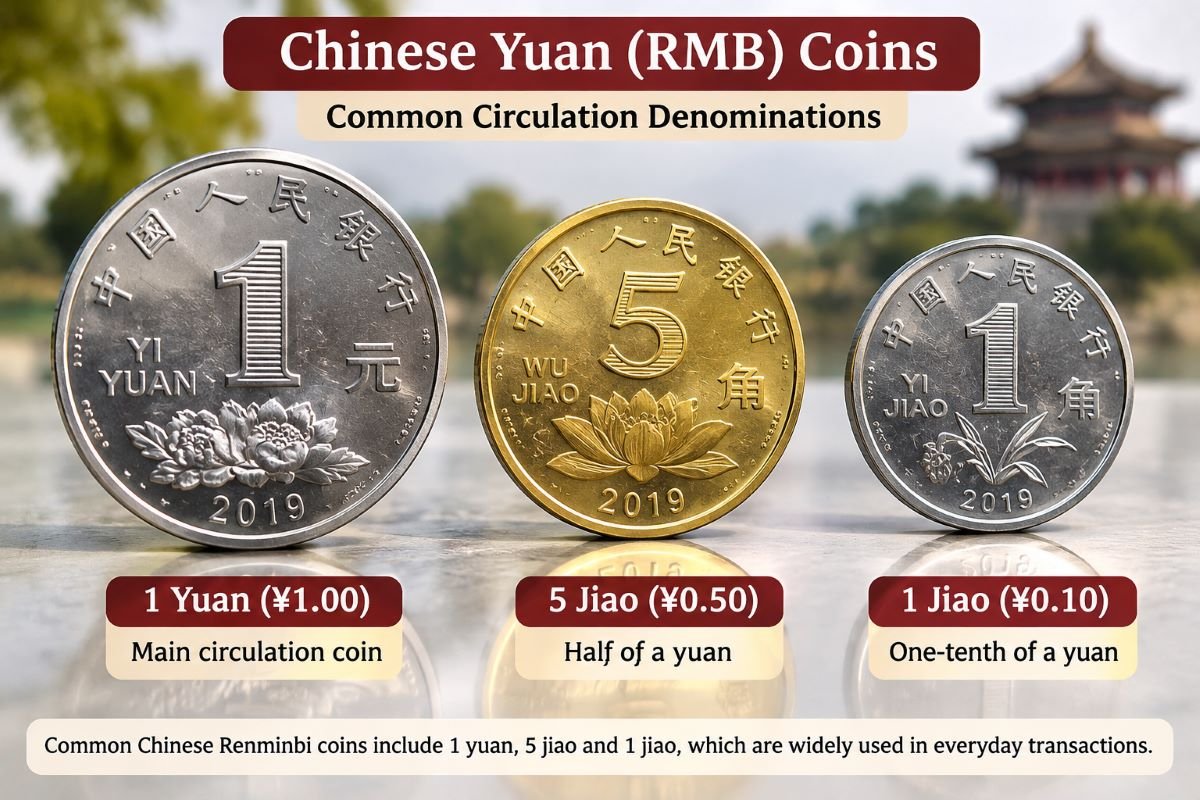
Common Chinese Renminbi circulation coins include 1 yuan, 5 jiao and 1 jiao denominations.
The One Yuan Coin
The ¥1 coin is one of China's most familiar circulation coins.
It is widely recognized by its denomination and metallic appearance.
The modern coin design includes national and decorative elements and has undergone updates to its size, appearance and security characteristics.
The Five Jiao Coin
The 5 jiao coin is worth half a yuan.
It is commonly associated with its metallic appearance and lotus-flower design.
The 2019 edition introduced a nickel-plated steel composition, replacing the earlier golden appearance with a lighter metallic finish.
The One Jiao Coin
The 1 jiao coin is worth one-tenth of a yuan.
It is the smallest commonly encountered denomination in China's modern circulation coin family.
The coin features floral design elements and is useful for smaller cash transactions.
Commemorative Coins in China
The People's Bank of China also issues commemorative coins marking significant national events, historical figures, cultural traditions and important anniversaries.
Some commemorative coins are made from ordinary metals, while others are produced using precious metals such as gold and silver.
Commemorative coins may have legal-tender status, but their collector value can differ from their stated face value.
They are often collected by numismatists and people interested in Chinese history and culture.
Who Issues and Manages Chinese Currency?
The People's Bank of China is responsible for issuing and managing the Renminbi.
It is China's central bank and plays an important role in maintaining monetary and financial stability.
Its responsibilities include:
- Issuing Renminbi banknotes and coins.
- Managing currency circulation.
- Conducting monetary policy.
- Supporting financial stability.
- Managing China's payment and settlement systems.
- Developing the digital yuan framework.
- Supporting the international use of the Renminbi.
The PBOC also works with commercial banks and other financial institutions to support the distribution of cash and the operation of China's payment infrastructure.
Chinese Yuan and International Exchange Rates
For international users, one of the most important aspects of the Chinese currency is its exchange rate.
The value of the yuan changes in relation to other currencies.
For example, CNY may rise or fall against:
- United States Dollar (USD).
- Euro (EUR).
- British Pound (GBP).
- Japanese Yen (JPY).
- Indian Rupee (INR).
- Canadian Dollar (CAD).
- Australian Dollar (AUD).
- Singapore Dollar (SGD).
The exchange rate determines how much Chinese currency someone receives when converting another currency into yuan.
It also determines how much foreign currency can be obtained when exchanging Renminbi internationally.
Is the Chinese Yuan Fixed to the US Dollar?
No. China does not maintain a permanent fixed one-to-one conversion rate between the yuan and the United States dollar.
China operates a managed floating exchange-rate regime based on market supply and demand, with reference to a basket of currencies.
Market forces play an important role in determining the exchange rate, while the People's Bank of China uses policy and market-management tools to support orderly currency conditions.
The yuan can therefore appreciate or depreciate against the US dollar and other international currencies over time.
Its movement is influenced by economic conditions, monetary policy, international trade, investment flows and global financial developments.
What Influences the Value of the Chinese Yuan?
Several economic factors influence the international value of the Renminbi.
Economic Growth
China's economic performance affects investor confidence, business activity and international demand for the currency.
Changes in industrial production, consumer spending, investment and employment can influence currency expectations.
Interest Rates
Monetary policy decisions by the People's Bank of China influence borrowing costs, investment returns and financial conditions.
Changes in domestic and international interest-rate differences can influence currency demand.
International Trade
China is an important participant in global manufacturing, exports and imports.
Changes in international trade activity can affect demand for yuan-denominated payments and financial settlements.
Foreign Investment
International investment in Chinese companies, bonds and financial markets can influence demand for Renminbi.
Investor confidence and cross-border capital flows may also affect exchange-rate conditions.
Global Economic Conditions
Changes in global interest rates, commodity prices, economic uncertainty and international market sentiment can affect the currency.
These factors interact with one another, contributing to fluctuations in the yuan's international value.
Understanding CNY and CNH: Onshore and Offshore Renminbi
International users may encounter two different currency designations when researching or trading the Chinese yuan: CNY and CNH.
Although both refer to Renminbi, they are associated with different trading markets.
What Is CNY?
CNY is the currency designation commonly used for the onshore Renminbi market within mainland China.
It is the reference code most commonly encountered in domestic Chinese banking, business transactions and international currency conversion services involving the mainland market.
What Is CNH?
CNH is the designation commonly used for offshore Renminbi traded outside mainland China.
Hong Kong is a major offshore Renminbi trading centre, although offshore RMB activity also takes place in other international financial centres.
Are CNY and CNH Different Currencies?
No. CNY and CNH represent the same underlying Chinese currency.
However, they trade in different market environments and may have different exchange rates at particular times.
Differences in market liquidity, investor demand, regulations and capital-flow arrangements can cause the two exchange-rate quotes to diverge.
For international businesses and currency investors, understanding this distinction is important when evaluating exchange-rate information and arranging cross-border financial transactions.
The Renminbi in Global Trade and International Finance
The Chinese yuan has become increasingly important in international financial markets.
China's position in manufacturing, international commerce, infrastructure investment and global supply chains creates opportunities for Renminbi-denominated transactions.
Businesses involved in importing and exporting Chinese products may use yuan when arranging payments with Chinese suppliers.
International companies can also encounter Renminbi in areas such as:
- Manufacturing and industrial supply chains.
- Energy and commodity trading.
- International shipping and logistics.
- Technology and electronics.
- Infrastructure development.
- Banking and financial services.
- Cross-border investment.
The People's Bank of China has continued efforts to promote the international use of Renminbi in payments, trade settlement, investment and financing.
Offshore Renminbi markets and international clearing arrangements support these developments.
For businesses, using the yuan may help manage currency exposure and provide another settlement option when conducting transactions involving Chinese companies.
However, international users should understand that cross-border Renminbi transactions remain subject to relevant financial regulations, banking requirements and market arrangements.
How International Visitors Can Use Money in China
People visiting mainland China for tourism, education, business or family purposes should understand how the local payment system works.
China has developed an extensive digital payment ecosystem, but foreign visitors can use several payment methods.
These include mobile payments, compatible international bank cards and Renminbi cash.
The most suitable option depends on the visitor's bank, payment application, location and merchant acceptance.
Exchanging Foreign Currency into Chinese Yuan
International visitors can obtain Renminbi before travelling or after arriving in mainland China.
Common exchange options include:
- Commercial bank branches.
- Authorized foreign currency exchange providers.
- Airport currency exchange counters.
- Approved self-service exchange machines.
- ATMs that support international bank cards.
Exchange rates and service fees can differ between providers.
Visitors should compare the final amount of Renminbi received rather than relying only on the advertised exchange rate.
Keeping exchange receipts can also be helpful for personal records and future currency-related transactions.
Using International Debit and Credit Cards
International bank cards can be used at many major hotels, shopping centres, tourist facilities and larger retailers in China.
Card acceptance depends on the merchant and the supported payment network.
Visitors may encounter compatible payment networks such as:
- Visa.
- Mastercard.
- UnionPay.
- American Express.
- JCB.
- Diners Club.
- Discover.
Foreign visitors should check the payment-network logos displayed at merchant counters.
They should also confirm whether their bank charges overseas transaction fees or additional currency conversion costs.
A physical international card is a useful payment backup, especially for hotels, transportation bookings and larger purchases.
Understanding Alipay Payments in China
Alipay is one of China's major mobile payment platforms.
It allows users to make purchases by scanning merchant QR codes or showing a payment QR code for merchants to scan.
The platform is widely used for:
- Retail purchases.
- Restaurant payments.
- Online shopping.
- Transportation services.
- Hotel reservations.
- Everyday personal payments.
International visitors may be able to register for Alipay and link supported overseas bank cards.
However, card eligibility, verification, transaction limits and service charges depend on the app's current rules and the issuing financial institution.
Understanding WeChat Pay
WeChat Pay, also known as Weixin Pay, is another major digital payment service in China.
It is integrated into the WeChat ecosystem and supports QR-code transactions for participating merchants.
The payment system is used for purchases, restaurant bills, daily services and other commercial transactions.
Foreign visitors can follow the app's registration and verification instructions to connect eligible international bank cards.
As with Alipay, payment availability and service fees can differ according to the bank card, payment product and merchant.
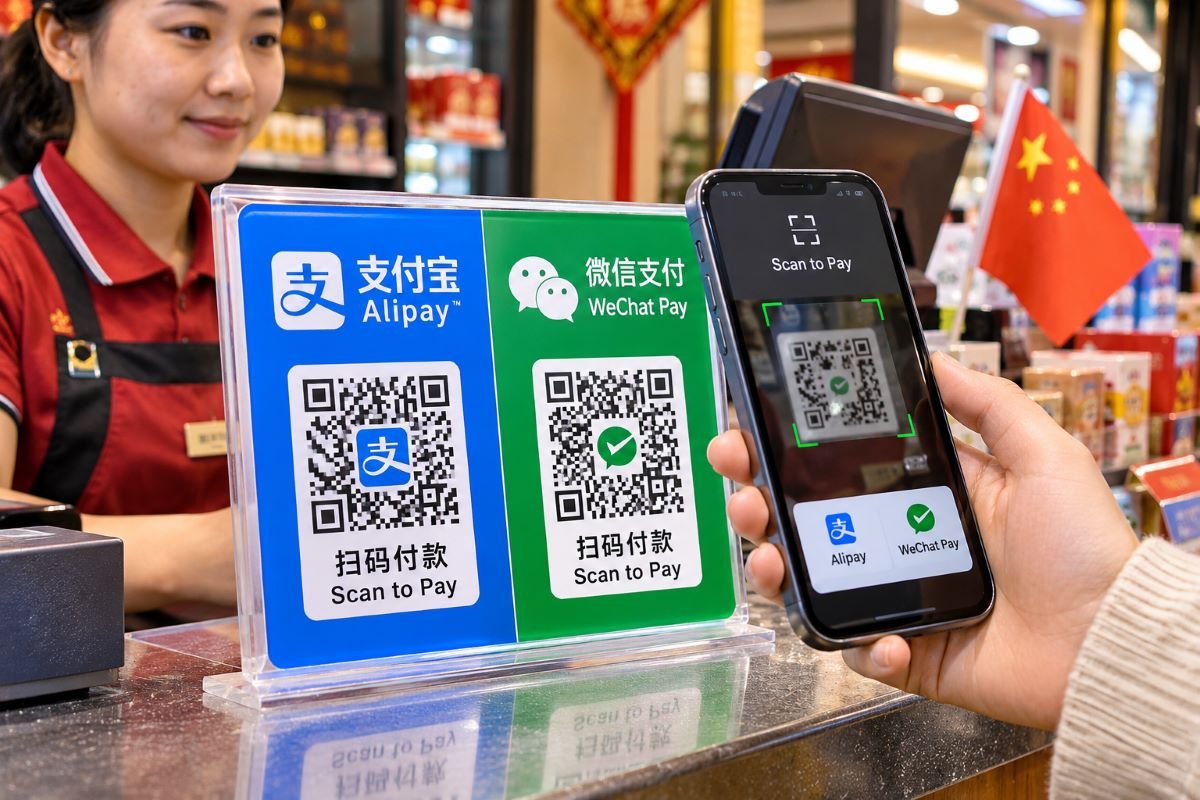
Alipay and WeChat Pay allow customers in China to make convenient purchases by scanning merchant QR codes with their smartphones.
Can Foreign Visitors Use Other International Payment Wallets?
Some international payment applications and electronic wallets can also be used with participating Chinese merchants.
Supported services may include selected e-wallets from countries such as Singapore, Malaysia, South Korea, Thailand and other markets.
However, acceptance depends on the specific wallet provider, QR network and participating merchant.
International users should check compatibility before relying on a particular overseas payment application.
Using Cash for Everyday Purchases
Despite the popularity of digital payments, Renminbi cash remains an important part of China's payment system.
Cash is useful for:
- Small retail purchases.
- Local transportation.
- Street markets.
- Small restaurants.
- Emergency payments.
- Transactions where mobile connectivity is unavailable.
Foreign visitors may find it convenient to carry smaller denominations such as ¥5, ¥10, ¥20 and ¥50.
Smaller notes can make it easier to pay for transportation, snacks and local purchases.
Commercial bank branches can also provide services for exchanging large banknotes into smaller denominations.
Using ATMs in China
International visitors may withdraw Renminbi from compatible ATMs using supported international bank cards.
The available service depends on the card network, ATM operator and issuing bank.
Before travelling, visitors should confirm that their card permits overseas withdrawals.
They should also check foreign cash withdrawal fees, currency conversion charges and applicable daily limits.
Digital Yuan (e-CNY): China's Central Bank Digital Currency
One of the most important developments in China's modern monetary system is the digital yuan, officially known as e-CNY.
The e-CNY is a digital form of China's national currency developed under the authority of the People's Bank of China.
Unlike private cryptocurrencies, it is an official monetary instrument associated with China's central banking system.
Its purpose is to provide a digital payment option alongside traditional banknotes, coins and existing electronic payment services.
How Does the Digital Yuan Work?
The digital yuan is designed to support electronic payments through authorized wallets and financial institutions.
It can be used in supported payment scenarios, including retail purchases, dining, transportation, public services and other everyday transactions.
The system has also been involved in domestic and cross-border payment trials.
Digital yuan payment arrangements are designed to support both online and selected offline payment scenarios.
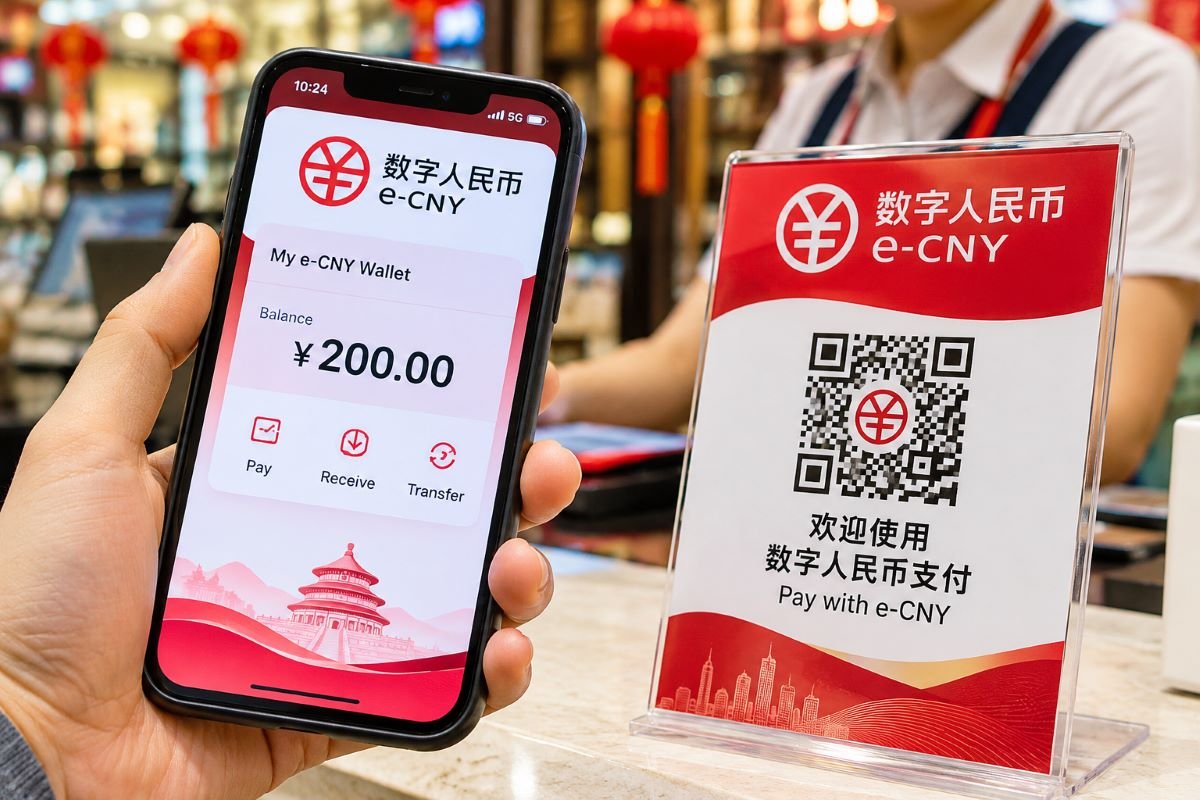
The digital yuan (e-CNY) enables electronic payments through authorized digital wallets and participating merchants in China.
Is e-CNY the Same as Alipay or WeChat Pay?
No. The digital yuan and third-party mobile payment platforms are different.
Alipay and WeChat Pay provide payment services through their respective financial and technology ecosystems.
The e-CNY is a digital form of the official Renminbi.
A customer may use a mobile payment application to pay for goods in yuan without necessarily using a digital yuan wallet.
Understanding this distinction helps international users avoid confusing the currency itself with the applications used to make payments.
China's Digital Yuan Developments in 2026
China introduced an upgraded management framework for the digital yuan on 1 January 2026.
Under the updated framework, eligible e-CNY balances held in commercial bank wallets are treated as bank deposit liabilities.
Participating commercial banks pay interest on these balances according to applicable deposit-rate rules, and the balances receive protection under the relevant deposit insurance framework.
This development represents an important change in how digital yuan balances are managed within China's financial system.
The digital yuan remains a developing area of financial technology, and wallet access and payment availability depend on authorized providers and supported services.
International visitors should check the current eligibility requirements rather than assume that every overseas bank account can directly access an e-CNY wallet.
China, Hong Kong and Macao: Understanding the Currency Difference
An important point for international travellers is that mainland China, Hong Kong and Macao do not all use the same official currency.
Although they are geographically and economically connected, their monetary arrangements are different.
Mainland China: Renminbi (RMB)
The Renminbi is the official currency of mainland China.
Its principal unit is the yuan, identified internationally by the code CNY.
Hong Kong: Hong Kong Dollar (HKD)
Hong Kong uses the Hong Kong dollar, identified by the currency code HKD.
The Hong Kong dollar remains the legal tender of the Hong Kong Special Administrative Region.
Macao: Macao Pataca (MOP)
Macao uses the Macao pataca, identified by the currency code MOP.
One pataca is divided into 100 avos.
The Hong Kong dollar is also commonly used in Macao's payment environment, but the official currency remains the pataca.
Visitors travelling between mainland China, Hong Kong and Macao should therefore check which currency is required at their destination.
Even when certain businesses accept more than one currency, the exchange rate and payment conditions may differ.
Interesting Facts About the Chinese Yuan
The Renminbi has several distinctive characteristics that make it interesting from an international perspective.
- The name means People's Currency: Renminbi is the official name of China's national currency.
- The yuan is its main unit: One yuan is divided into 10 jiao or 100 fen.
- The currency code is CNY: It is used in international banking, foreign exchange platforms and financial transactions.
- The Renminbi began in 1948: The first series of banknotes was issued when the People's Bank of China was established.
- The currency underwent a major reform in 1955: The second series replaced the first at a ratio of 10,000 old yuan to one new yuan.
- Modern banknotes feature Mao Zedong: The fifth series uses his portrait on the front of the banknotes.
- Banknote reverses show Chinese landmarks: Designs include Mount Tai, Guilin scenery, the Potala Palace and the Great Hall of the People.
- CNY and CNH refer to the same currency: They are designations associated with different onshore and offshore Renminbi markets.
- China has a digital yuan: The e-CNY is a central-bank digital currency developed by the People's Bank of China.
- Cash and digital payments operate together: Banknotes and coins continue to coexist with QR-code payments and other electronic services.
Conclusion: Why Understanding the Chinese Yuan Matters
The Chinese Renminbi is more than a national payment system. It reflects China's monetary history, economic transformation, international trade relationships and continuing financial modernization.
From the first Renminbi banknotes issued in 1948 to the modern fifth series, the Chinese monetary system has undergone major changes in design, security, management and international use.
Today, the yuan is an important currency for Chinese consumers, international visitors, global businesses, investors and financial institutions.
The development of Alipay, WeChat Pay and the digital yuan also demonstrates how China's payment ecosystem continues to evolve.
Understanding the Renminbi helps international users compare prices, exchange currencies, manage travel expenses and conduct financial transactions involving mainland China.
Whether someone is planning a visit, importing products, investing in Chinese markets or following international currency developments, knowledge of RMB provides a useful foundation for understanding China's economy.
Frequently Asked Questions About the Chinese Yuan (RMB)
1. What is the official currency of China?
The official currency of mainland China is the Renminbi (RMB), whose principal unit is the yuan. Its international currency code is CNY.
2. What does RMB stand for?
RMB stands for Renminbi, which means People's Currency. It is the official name of China's national currency.
3. What does CNY mean?
CNY is the internationally recognized currency code for the Chinese yuan used in foreign exchange and financial transactions.
4. What is the difference between RMB and yuan?
Renminbi is the name of China's currency, while yuan is its main unit. The terms are often used interchangeably in everyday conversation.
5. What is the Chinese yuan symbol?
The Chinese yuan uses the symbol ¥. The same symbol is also associated with the Japanese yen, so international currency codes such as CNY and JPY help distinguish them.
6. How many jiao are in one yuan?
One yuan is divided into 10 jiao.
7. How many fen are in one yuan?
One yuan equals 100 fen, and one jiao equals 10 fen.
8. Who issues Chinese banknotes?
The People's Bank of China is responsible for issuing and managing China's Renminbi banknotes and currency circulation.
9. What are the common Chinese banknote denominations?
The commonly encountered fifth-series Renminbi banknotes are ¥1, ¥5, ¥10, ¥20, ¥50 and ¥100.
10. What are the common Chinese coin denominations?
Common Renminbi circulation coins include 1 yuan, 5 jiao and 1 jiao.
11. When was the Renminbi introduced?
The first series of Renminbi was introduced on 1 December 1948, when the People's Bank of China was established.
12. What happened to the Chinese currency in 1955?
In March 1955, China introduced the second series of Renminbi, replacing the first series at a conversion rate of 10,000 old yuan to one new yuan.
13. What is the fifth series of Renminbi?
The fifth series is the modern family of Chinese banknotes introduced in 1999. It includes updated editions with improved printing quality and security features.
14. What is CNH?
CNH is the designation commonly used for offshore Renminbi traded outside mainland China. It refers to the same underlying currency as CNY, but the two markets may have different exchange-rate quotations.
15. Is the Chinese yuan fixed to the US dollar?
No. China follows a managed floating exchange-rate regime based on market supply and demand, with reference to a basket of currencies.
16. What affects the value of the Chinese yuan?
The value of the yuan is influenced by economic growth, interest rates, international trade, investment flows, monetary policy and global financial conditions.
17. Can international visitors use foreign bank cards in China?
Yes. Foreign visitors can use compatible international bank cards at participating merchants. Acceptance depends on the card network, payment terminal and merchant.
18. Can foreigners use Alipay in China?
Foreign visitors can register for Alipay and may be able to link supported overseas bank cards. Registration, verification, transaction limits and fees depend on the current service requirements.
19. Can foreigners use WeChat Pay in China?
Eligible international users can register for WeChat Pay and connect supported foreign bank cards, subject to the app's verification and payment conditions.
20. Is cash still accepted in China?
Yes. Renminbi banknotes and coins remain important payment options. Visitors can obtain cash through banks, authorized currency exchange services and compatible ATMs.
21. What is the digital yuan?
The digital yuan, or e-CNY, is China's central-bank digital currency developed under the authority of the People's Bank of China.
22. Is the digital yuan a cryptocurrency?
No. The e-CNY is an official digital form of Renminbi. It is different from privately issued cryptocurrencies.
23. What is the difference between Alipay and the digital yuan?
Alipay is a payment platform, while the digital yuan is an official form of Chinese currency. Alipay can facilitate payments in yuan without the transaction necessarily using an e-CNY wallet.
24. Does Hong Kong use the Chinese yuan?
Hong Kong has its own official currency, the Hong Kong dollar (HKD). The Renminbi is a different currency, although it is also used in some financial and commercial activities in Hong Kong.
25. What currency is used in Macao?
Macao's official currency is the Macao pataca (MOP), which is divided into 100 avos. The Hong Kong dollar is also commonly used in Macao.
26. Where can international visitors exchange money into Chinese yuan?
Visitors can exchange foreign currencies at commercial banks, authorized money changers, airport exchange counters and approved self-service exchange machines.
27. Why is the Chinese yuan important in international trade?
China's significant role in global manufacturing, exports and supply chains creates demand for Renminbi-denominated payments, trade settlement and international financial services.
28. Is the Chinese yuan the same as the Japanese yen?
No. The Chinese yuan is identified by CNY, while the Japanese yen uses JPY. Both currencies use the ¥ symbol, but they are separate monetary units.
29. What does kuai mean in Chinese currency?
Kuai is a commonly used spoken term for yuan. For example, 20 kuai means 20 yuan.
30. Why do Chinese banknotes show famous landmarks?
The reverse designs of modern Renminbi banknotes feature important Chinese buildings, landscapes and cultural landmarks, reflecting the country's architectural and natural heritage.
Comments
No comments yet.