Introduction: Understanding Chhath Puja, India's Festival of the Sun
India is home to countless festivals that celebrate religion, nature, seasonal changes, family relationships, and cultural traditions. Among these celebrations, Chhath Puja holds a particularly meaningful place in the cultural life of Bihar, Jharkhand, eastern Uttar Pradesh, and neighbouring regions of Nepal. It is also observed by communities living in other parts of India and by people of Indian origin around the world.
Chhath Puja is a traditional Hindu festival dedicated primarily to Surya Dev, the Sun God, and Chhathi Maiya, a goddess associated with the well-being and protection of children and families. The festival expresses gratitude for the Sun's life-supporting energy and offers prayers for health, prosperity, longevity, and the happiness of loved ones.
What makes Chhath Puja especially distinctive is its combination of devotion, discipline, environmental awareness, and community participation. Devotees observe a carefully structured four-day sequence involving ritual bathing, preparation of traditional food, fasting, and offerings to both the setting and rising Sun.
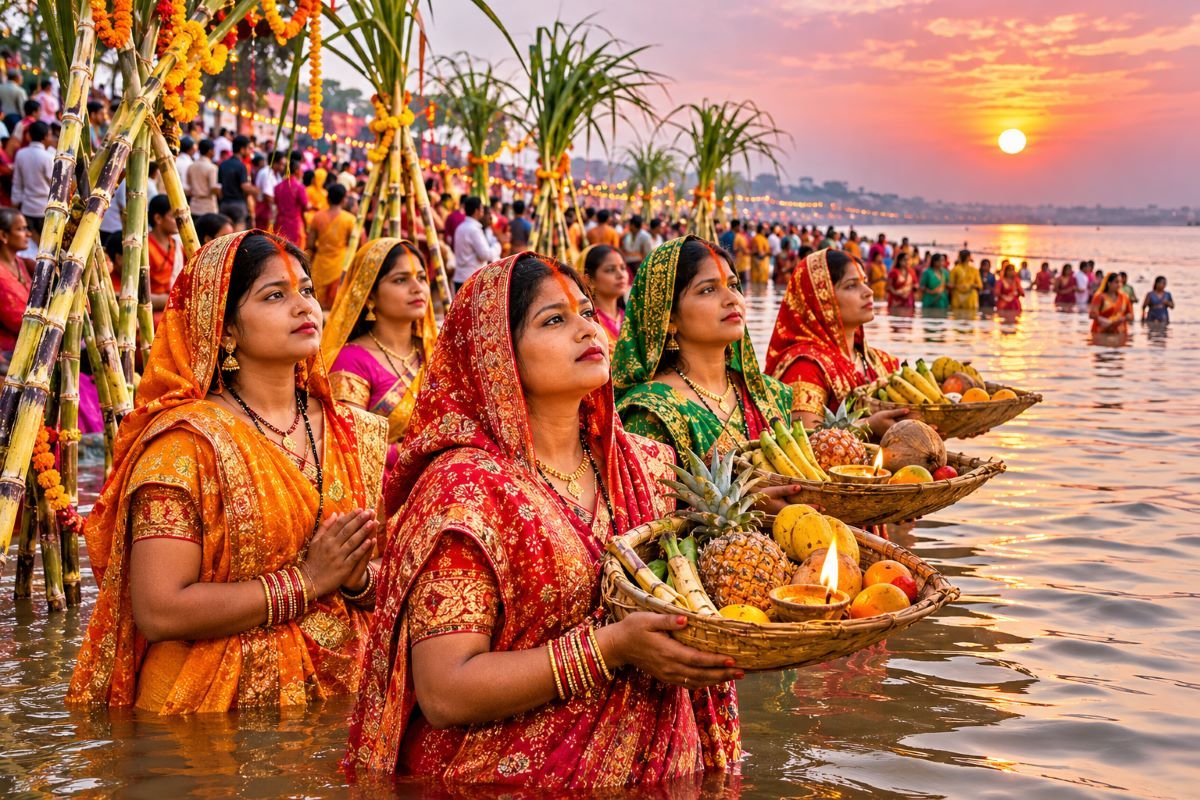
The festival is widely recognised for its evening and early-morning gatherings beside rivers, ponds, lakes, and other water bodies. Families arrive carrying bamboo baskets filled with fruits, sugarcane, Thekua, and other traditional offerings. Earthen lamps illuminate the surroundings while devotional folk songs create an atmosphere of collective prayer.
Unlike many other religious celebrations that involve elaborate temple ceremonies, Chhath Puja often centres on direct worship of the natural Sun and participation at a clean water body. The devotee, known as a Vrati or Parvaitin, performs the principal observances with dedication and discipline.
The festival is generally celebrated during the Hindu lunar month of Kartika, usually in October or November. A smaller observance also takes place during Chaitra, around March or April, in communities that follow the Chaiti Chhath tradition.
Chhath Puja is more than a religious occasion. It is a cultural expression of gratitude, self-discipline, family responsibility, community cooperation, and respect for nature. Its customs have been passed from one generation to another, making it an important part of the living heritage of eastern India.
1. What Is Chhath Puja?
Chhath Puja, also called Chhath Parva, Chhath Mahaparv, or Surya Shashthi, is a Hindu festival dedicated to the worship of the Sun God and Chhathi Maiya.
The word Chhath is commonly associated with the sixth day, or Shashthi, of the lunar fortnight. The principal Kartika observance takes place around Kartik Shukla Shashthi, the sixth day of the bright fortnight of the Hindu lunar month of Kartika.
The central purpose of the festival is to express gratitude to the Sun for sustaining life and to seek blessings for family members. Devotees pray for good health, happiness, prosperity, and the well-being of children.
Chhath Puja is traditionally observed over four days:
- Nahay Khay – purification and preparation.
- Kharna – a day of fasting followed by a sacred meal.
- Sandhya Arghya – offerings to the setting Sun.
- Usha Arghya – offerings to the rising Sun and completion of the observance.
Each stage has a specific religious and cultural meaning. Together, the four days form a sequence that combines physical discipline, household preparation, community participation, and prayer.
One of the most recognisable characteristics of Chhath is the worship of both the setting and rising Sun. Devotees offer Arghya in the evening and return before sunrise the following morning to complete the principal worship.
The festival also places great importance on the purity of food, ritual materials, water bodies, and the surrounding environment.
Although the customs may vary between families and regions, the central themes remain consistent: devotion to Surya, reverence for nature, and prayers for the well-being of family and community.
2. History and Ancient Cultural Background of Chhath Puja
The exact historical beginning of Chhath Puja is difficult to establish. There is no universally accepted historical record identifying one person, date, or event as the origin of the complete festival.
However, the worship of the Sun has a long history in the Indian subcontinent. Ancient Indian religious literature contains prayers and hymns dedicated to Surya, recognising the Sun as a source of light, energy, warmth, and life.
Chhath Puja is often connected with this broader tradition of solar worship. Its rituals also reflect the importance of rivers, seasonal agricultural produce, water, and the natural environment in the lives of communities living along the Gangetic plains.
The festival's strong association with Bihar and neighbouring regions has helped preserve distinctive local practices. These include the use of bamboo baskets, seasonal fruits, traditional sweets, folk songs, and ritual bathing at water bodies.
Sun worship in ancient Indian traditions
The Sun has held an important place in Indian religious and cultural traditions for centuries.
In Vedic literature, Surya is praised as a divine presence associated with illumination, movement, vitality, and the rhythm of the natural world. The Gayatri Mantra, one of the best-known mantras in Hindu traditions, is associated with Savitr, a solar deity.
Surya is also represented in Indian religious art and temple traditions. Ancient and medieval temples dedicated to the Sun demonstrate the importance of solar worship in different regions of the subcontinent.
The famous Sun Temple at Konark in Odisha is one example of the historical significance of Surya worship in India.
Chhath Puja belongs to a broader cultural environment in which the Sun is respected not only as a celestial object but also as a symbol of life, continuity, and cosmic order.
Regional development and preservation
Over generations, communities in Bihar, eastern Uttar Pradesh, and adjoining areas developed and preserved their own forms of Chhath observance.
Local languages, agricultural customs, food traditions, devotional songs, and family practices became closely connected with the festival.
In rural communities, seasonal produce and locally available materials naturally became part of the offerings. Bamboo baskets, earthen vessels, sugarcane, rice, wheat, and fruits reflect the relationship between religious observance and everyday agricultural life.
As people migrated to cities and other countries, they carried these traditions with them. Chhath gradually became a visible cultural celebration in places far beyond its traditional heartland.
The festival's history is therefore best understood through the combination of ancient solar worship, regional religious traditions, and generations of community practice.
3. Why Is the Sun Worshipped During Chhath Puja?
The Sun is essential to life on Earth. It provides light and warmth, supports plant growth, influences seasonal patterns, and forms an important part of the natural systems on which humans depend.
Chhath Puja expresses gratitude for these life-supporting qualities through prayer and offerings.
Surya Dev is traditionally regarded as a source of energy, health, vitality, and illumination. Devotees believe that sincere worship brings blessings and helps protect their families.
The setting Sun and gratitude
One of the most distinctive aspects of Chhath is the offering made to the setting Sun.
Many religious celebrations place particular emphasis on beginnings, renewal, or the rising Sun. Chhath gives equal importance to the evening Sun.
The setting Sun can be understood symbolically as a reminder of completion, change, and gratitude. Devotees express appreciation for the energy and blessings received throughout life.
This ritual also communicates a cultural message: respect should not be limited to moments of strength or visible success. The setting Sun is honoured with the same devotion as the rising Sun.
The rising Sun and new beginnings
The following morning, devotees return to the water to offer Arghya to the rising Sun.
Sunrise represents renewal, hope, and the continuation of life. The first light of the day is welcomed through prayer and expressions of gratitude.
The evening and morning offerings together form the spiritual centre of Chhath Puja.
Respect for natural elements
Chhath also recognises the importance of water and the natural environment.
The rituals are performed beside rivers, ponds, lakes, and other water bodies. Seasonal fruits and agricultural products form the offerings, while sunlight provides the central focus of worship.
This relationship between the Sun, water, land, and food gives the festival a strong connection with nature.
4. The Religious Significance of Chhathi Maiya
Along with Surya Dev, devotees worship Chhathi Maiya, also known in different traditions as Chhathi Mata or Shashthi Devi.
She is associated with the protection of children, motherhood, fertility, family welfare, and the healthy development of young lives.
Many families pray to Chhathi Maiya for the well-being of their children and for blessings that support the household.
Shashthi Devi in Hindu traditions
Shashthi Devi has a place in Hindu religious traditions as a protective goddess associated with children and childbirth.
Different regional traditions describe her role and identity in different ways. In Chhath observance, she is especially revered as Chhathi Maiya.
The goddess is often approached with devotion and gratitude rather than through elaborate displays. Families seek her blessings for health, protection, and happiness.
Family prayers and motherhood
Chhath Puja has a strong connection with family life.
Many women observe the fast for the well-being of their children and household. Men also perform the rituals, and families may share responsibility for preparation and participation.
The observance reflects the importance of parental care, family relationships, and the hope that children will grow in good health.
It is important to recognise that the festival's meaning is not limited to one gender or one type of family. Men, women, and people from different generations participate according to their traditions and circumstances.
5. When Is Chhath Puja Celebrated?
The principal Chhath Puja is celebrated during the Hindu lunar month of Kartika, usually in October or November.
The main offering to the setting Sun takes place on Kartik Shukla Shashthi. The final morning offering follows on the next day.
Because the festival follows the Hindu lunar calendar, its Gregorian dates change from year to year.
Kartik Chhath
Kartik Chhath is the most widely recognised observance.
It takes place after Diwali and is celebrated with particular devotion in Bihar, Jharkhand, eastern Uttar Pradesh, and the Terai region of Nepal.
The four-day sequence usually begins on Kartik Shukla Chaturthi and concludes on Kartik Shukla Saptami, with the two main Arghya ceremonies taking place on the evenings and mornings around Shashthi.
Chaiti Chhath
Some devotees also observe Chaiti Chhath during the Hindu month of Chaitra, generally in March or April.
Its structure is similar to the Kartik observance, including purification, fasting, and offerings to the setting and rising Sun.
Kartik Chhath is more widely celebrated, while Chaiti Chhath is followed by families and communities that maintain the additional seasonal observance.
Why the date changes each year
The Hindu lunar calendar is based on the movements and phases of the Moon rather than following the Gregorian calendar alone.
As a result, the date of Kartik Shukla Shashthi shifts from one Gregorian year to another.
For accurate festival planning, devotees generally consult a Hindu Panchang or a trusted local calendar. The timing of sunrise, sunset, and the relevant lunar tithi may also be considered when planning the rituals.
6. The Four Days of Chhath Puja: An Overview
Chhath Puja is a four-day observance in which every day has a specific purpose.
The sequence begins with preparation and purification, moves through fasting and the preparation of offerings, and reaches its central ceremonies at sunset and sunrise.
| Day | Ritual | Main significance |
| Day 1 | Nahay Khay | Purification and preparation |
| Day 2 | Kharna | Fasting and sacred meal |
| Day 3 | Sandhya Arghya | Worship of the setting Sun |
| Day 4 | Usha Arghya | Worship of the rising Sun and completion |
The exact details of food preparation and household practices can differ between families and communities.
7. First Day: Nahay Khay – The Beginning of Purification
Nahay Khay is the first day of Chhath Puja.
The name is commonly understood as a combination of bathing and eating. It marks the beginning of the observance and establishes the discipline followed during the remaining days.
On this day, the devotee takes a ritual bath, often in a river or another suitable water body. In places where visiting a river is not practical, families may perform the purification at home according to their customs.
The house and cooking area are cleaned carefully. Utensils used for preparing the festival food are washed, and arrangements are made to maintain the purity of the kitchen.
Traditional food on Nahay Khay
A simple vegetarian meal is traditionally prepared for the devotee.
In many households, the meal includes Arwa rice, Chana Dal, and Lauki, or bottle gourd. The preparation follows the family's accepted rules of purity.
The food is generally prepared without onion and garlic. Some households use specific cooking utensils and ingredients reserved for the festival.
The meal is eaten after the ritual bathing and preparation.
The meaning of Nahay Khay
Nahay Khay represents a conscious transition from everyday routine into a period of religious discipline.
Cleaning the home and preparing food carefully are not merely practical tasks. They form part of the devotee's preparation for the sacred observance.
The first day also brings family members together. Relatives help arrange ingredients, clean the kitchen, prepare materials, and organise the remaining activities.
Through these preparations, the festival begins as a shared household responsibility.
8. Second Day: Kharna – Fasting and the Sacred Meal
Kharna is the second day of Chhath Puja and one of the most important stages of the observance.
The devotee observes a fast throughout the day. In the evening, after completing the prescribed worship, the fast is broken with a specially prepared meal.
After Kharna, the main strict fast begins and continues until the morning Arghya on the fourth day.
Preparing Kharna Prasad
The Kharna meal commonly includes rice pudding prepared with milk and jaggery, along with roti.
In some households, the preparation is known as Rasia or Gur Ki Kheer. The precise ingredients and methods vary according to family tradition.
The food is prepared with particular attention to cleanliness and purity. The devotee offers the meal as Prasad before consuming it.
Family members and other people may also receive a portion of the sacred food.
The beginning of the Nirjala fast
After the Kharna meal, many devotees begin a strict Nirjala fast.
Nirjala means without water. The fast traditionally continues until the completion of Usha Arghya on the fourth day.
This observance requires considerable physical discipline. Practices and individual circumstances differ, and people should not treat a demanding fast as a medical recommendation.
The meaning of Kharna
Kharna represents self-discipline, devotion, and preparation for the main Arghya ceremonies.
The simple meal also reflects the festival's emphasis on modest ingredients and careful preparation rather than elaborate consumption.
Sharing the Kharna Prasad reinforces the importance of family and community participation.
9. Third Day: Sandhya Arghya – Worship of the Setting Sun
Sandhya Arghya is the principal evening ceremony of Chhath Puja.
On the third day, devotees prepare offerings and travel to rivers, ponds, lakes, or other designated water bodies.
The ceremony takes place around sunset, when devotees offer Arghya to the setting Sun.
Preparing the offerings
Families prepare bamboo baskets, known as Soop or Daura, containing fruits, Thekua, sugarcane, coconuts, and other traditional items.
The offerings are arranged carefully because they form an important part of the ritual.
Some families also prepare earthen lamps and decorative arrangements for the occasion.
Gathering at the Chhath Ghat
As evening approaches, devotees and their relatives gather at the Chhath Ghat.
The atmosphere often becomes filled with devotional songs, prayers, and the sound of traditional instruments.
The devotee enters the water, where possible and appropriate, and offers Arghya to the setting Sun.
Water is offered using a small vessel or through a traditional arrangement, while prayers are recited.
The symbolism of the evening offering
The setting Sun is honoured as part of the cycle of life.
The ritual expresses gratitude for the energy received during the day and acknowledges that natural cycles include both beginnings and endings.
The evening ceremony is also a powerful community event. People from different backgrounds gather at the same water body, often sharing space and helping one another.
10. Fourth Day: Usha Arghya – Worship of the Rising Sun
Usha Arghya is the concluding ceremony of Chhath Puja.
Devotees return to the water body before sunrise. They gather in the early morning darkness and wait for the first light to appear.
The offering is made to the rising Sun, traditionally associated with renewal, energy, and hope.
The early-morning gathering
The final morning ceremony often begins before dawn.
Families carry their baskets and offerings to the Chhath Ghat. Earthen lamps may still be visible, while devotional songs continue in the surroundings.
The devotee enters the water and prepares for the morning offering.
Offering Arghya to the rising Sun
As the Sun appears above the horizon, devotees offer Arghya and pray for the health and happiness of their families.
The ceremony completes the principal sequence of Sun worship.
Parana: Breaking the fast
After Usha Arghya, the devotee completes the fast through Parana.
The fast is traditionally broken after the morning rituals have been completed.
Prasad is distributed among family members, neighbours, and other devotees. This sharing marks the conclusion of the four-day observance.
The transition from the long fast to the shared meal is an important moment of relief, gratitude, and family togetherness.
11. Traditional Foods and Prasad of Chhath Puja
Food plays a central role in Chhath Puja.
The offerings are usually prepared with simple ingredients and traditional cooking methods. Many households follow strict rules concerning cleanliness, utensils, and the selection of ingredients.
The food is not simply prepared for consumption. It becomes part of the devotional offering made to Surya Dev and Chhathi Maiya.
Thekua
Thekua is one of the most recognisable foods associated with Chhath Puja.
It is generally prepared using wheat flour, jaggery or sugar, and ghee. Fennel seeds and other ingredients may be added according to family recipes.
The dough is shaped into small pieces, often pressed into traditional designs, and cooked until firm and golden.
Thekua is commonly offered during the evening and morning Arghya ceremonies.
Its importance is both culinary and cultural. The preparation of Thekua is often a family activity in which several generations participate.
Kharna Kheer
Kharna Kheer is a traditional rice pudding prepared for the second day.
It is commonly made with rice, milk, and jaggery. The preparation is offered during Kharna before the devotee begins the strict fast.
The dish is associated with simplicity and purity and is shared with family members.
Kasar
Kasar is a traditional sweet offering often prepared using rice flour and jaggery.
Some versions include additional ingredients according to regional and family preferences.
It is commonly placed in the offering baskets and distributed as Prasad.
Fruits
Fruits form an important part of Chhath offerings.
Common items include:
- Bananas
- Coconuts
- Apples
- Oranges
- Sweet lime
- Pomegranates
- Lemons
- Seasonal local fruits
The choice of fruits depends on availability and local tradition.
Sugarcane
Sugarcane is an especially familiar part of Chhath Puja arrangements.
It may be placed beside the offerings or used in decorative structures such as Kosi arrangements.
Its presence also reflects the importance of seasonal agricultural produce in the festival.
Other traditional preparations
Some families prepare rice-based sweets, laddus, and other regional dishes.
The exact menu differs across Bihar, Jharkhand, eastern Uttar Pradesh, and communities living elsewhere.
The shared principle is the use of carefully prepared food that follows the family's ritual customs.
12. Bamboo Baskets, Soop, Daura, and Traditional Materials
The visual identity of Chhath Puja is closely associated with bamboo baskets and traditional containers.
Soop and Daura are used to carry and arrange the offerings.
These objects are traditionally made by skilled artisans, and their use helps preserve local craft practices.
The importance of bamboo
Bamboo is widely used in everyday life across many parts of eastern India.
It is used to make baskets, household objects, furniture, and agricultural equipment.
During Chhath, bamboo baskets become important ritual objects.
Families often purchase them from local markets, supporting artisans and small businesses.
Earthen lamps and clay vessels
Earthen lamps, or Diyas, are commonly used during the festival.
Their warm light adds to the atmosphere of the evening ceremonies and household arrangements.
Clay vessels may also be used for particular preparations and offerings.
These traditional materials connect the celebration with local craftsmanship and natural resources.
Traditional crafts and community livelihoods
Preparing for Chhath supports a network of local workers and sellers.
Bamboo artisans, potters, fruit vendors, flower sellers, and food producers all contribute to the festival economy.
The demand for traditional materials creates seasonal opportunities for small businesses and craft communities.
13. Kosi Bharai: A Special Chhath Tradition
Kosi Bharai is a traditional observance associated with some families and regions during Chhath Puja.
It is often performed on the night following Sandhya Arghya.
The arrangement may include sugarcane sticks forming a canopy, earthen lamps, and baskets containing Prasad.
The Kosi structure
In many households, several sugarcane stalks are arranged to form a small canopy.
Diyas are placed around or beneath the structure, and offerings are arranged as part of the ritual.
The precise number of sugarcane stalks, lamps, and other materials may differ according to local practice.
Family participation
Kosi Bharai is often performed with the participation of relatives and other family members.
It may be connected with prayers, gratitude, or the fulfilment of a family vow.
Because customs vary, not every family performs Kosi Bharai in exactly the same way.
Cultural importance
The tradition adds another dimension to the festival's visual and spiritual character.
Sugarcane, lamps, baskets, and Prasad come together in an arrangement that reflects the relationship between agriculture, household life, and religious devotion.
14. Chhath Puja Folk Songs and Regional Music
Folk songs are among the most memorable cultural features of Chhath Puja.
Traditional songs are sung in Bhojpuri, Maithili, Magahi, and other regional languages.
They describe devotion to Surya Dev and Chhathi Maiya, family relationships, seasonal changes, the preparation of offerings, and the emotional experience of the festival.
Bhojpuri Chhath songs
Bhojpuri songs are widely associated with Chhath celebrations.
They often describe a devotee preparing the offerings, visiting the riverbank, praying for children, or expressing gratitude to the Sun.
The language and musical style help preserve the region's oral traditions.
Maithili and Magahi songs
Maithili and Magahi communities also maintain their own devotional song traditions.
These songs may include regional expressions, local references, and family customs.
Their continued performance allows traditional language and music to remain part of everyday cultural life.
Music across generations
Older family members often teach traditional songs to younger generations.
During the festival, songs may be performed at home, during preparations, or at the Chhath Ghat.
Modern recordings and digital platforms have also helped make traditional Chhath music available to people living far from their ancestral communities.
Despite these changes, live singing remains an important part of the celebration in many places.
15. Chhath Puja in Bihar: The Cultural Heart of the Festival
Bihar is widely regarded as the cultural centre of Chhath Puja.
The festival has a particularly strong presence in Patna, Gaya, Bhagalpur, Muzaffarpur, Darbhanga, Ara, Chhapra, Begusarai, and many other towns and villages.
In Bihar, Chhath is commonly called Chhath Mahaparv, reflecting its importance in religious and cultural life.
Patna and the Ganga River
Patna is one of the most recognisable places for large Chhath gatherings.
The banks of the Ganga become important locations for the evening and morning Arghya ceremonies.
Families prepare for several days by cleaning homes, arranging traditional offerings, and visiting markets.
Local authorities and community groups may organise temporary facilities, lighting, access routes, and arrangements at designated ghats.
Rural Bihar
In rural areas, Chhath is often observed at ponds, village water bodies, rivers, and other locally important locations.
The festival may involve an entire neighbourhood.
Families prepare offerings, clean the surroundings, decorate the worship area, and help one another with the arrangements.
Traditional songs and local customs give each village celebration its own character.
Chhath as a shared cultural identity
For many people from Bihar, Chhath is closely connected with family memories and regional identity.
People who have moved to other Indian states or foreign countries often return to their home towns to celebrate.
Those who cannot travel may organise the rituals in their current communities.
This connection between home, family, and tradition is one reason Chhath remains important across generations.
16. Chhath Puja in Jharkhand, Uttar Pradesh, and Nepal
Although Bihar is strongly associated with Chhath, the festival is also widely observed in neighbouring regions.
Jharkhand
Chhath Puja is celebrated in many parts of Jharkhand.
Cities such as Ranchi, Jamshedpur, Dhanbad, Bokaro, and Hazaribagh have active Chhath communities.
Devotees gather at rivers, lakes, ponds, and specially prepared ghats.
The rituals are similar to those observed in Bihar, although local languages, food practices, and community arrangements may differ.
Eastern Uttar Pradesh
Eastern Uttar Pradesh has a long cultural connection with Chhath.
The festival is observed in districts such as Varanasi, Gorakhpur, Ballia, Deoria, Ghazipur, and adjoining areas.
Many families follow Bhojpuri and regional traditions that closely connect the festival with Bihar.
Nepal
Chhath Puja is also celebrated in Nepal, particularly in the Terai region.
Cities such as Janakpur, Birgunj, and other communities in the southern plains have important Chhath observances.
The festival reflects cultural connections across the India-Nepal border.
Shared languages, family relationships, religious practices, and regional traditions have helped preserve the celebration in both countries.
17. Chhath Puja Among Indian Communities Around the World
Migration has helped Chhath Puja become an international cultural celebration.
People from Bihar, Jharkhand, eastern Uttar Pradesh, and Nepal have settled in different parts of India and abroad.
Many continue to observe Chhath as a way of maintaining family traditions and cultural identity.
Chhath in major Indian cities
The festival is celebrated in cities such as Delhi, Mumbai, Kolkata, Bengaluru, Hyderabad, Pune, Chennai, and Ahmedabad.
Urban communities often arrange temporary ghats or use designated lakes and ponds for the rituals.
Resident associations and cultural groups may coordinate cleaning, lighting, and access to the water.
Chhath in Nepal
In Nepal, Chhath has a particularly strong presence in the Terai.
Families gather near rivers and ponds to offer Arghya.
The festival is an important example of cultural traditions shared across national boundaries.
Chhath in other countries
Chhath is also observed by Indian-origin communities in countries such as:
- United Arab Emirates
- United Kingdom
- United States
- Canada
- Australia
- Mauritius
- Fiji
- Nepal
The scale and arrangements vary from place to place.
Some communities organise group celebrations near suitable water bodies, while others perform the rituals in private or community spaces.
These celebrations show how religious and cultural traditions can adapt when people move to new countries.
18. Environmental Awareness and the Importance of Clean Water
The relationship between Chhath Puja and the natural environment is one of its most important characteristics.
The festival takes place beside water bodies and includes offerings made with seasonal agricultural products.
Its rituals provide an opportunity to reflect on the importance of rivers, ponds, clean surroundings, and natural resources.
Water as a central part of the festival
Rivers and ponds are essential settings for the main Arghya ceremonies.
Water is connected with purification, agriculture, household life, and the natural systems that support communities.
The festival therefore creates an opportunity to discuss the protection of local water resources.
Clean Chhath Ghats
Preparing the Chhath Ghat is a major part of the festival in many communities.
Volunteers and local organisations often clean the area, remove waste, arrange pathways, and prepare facilities for devotees.
Clean and safe water bodies are important for both religious observance and public health.
Reducing waste during celebrations
Chhath celebrations can involve large gatherings and significant quantities of offerings.
Communities can help protect the environment by:
- Avoiding plastic bags and disposable packaging.
- Using reusable or traditional baskets.
- Disposing of waste responsibly.
- Keeping food offerings away from polluted areas.
- Avoiding the dumping of non-biodegradable materials into rivers.
- Supporting local cleaning initiatives.
- Following local instructions at public ghats.
A broader lesson from the festival
The festival's emphasis on nature offers a meaningful opportunity to connect cultural heritage with environmental responsibility.
Respect for the Sun and water can also encourage practical care for the natural resources on which communities depend.
19. Chhath Puja and Community Participation
Chhath is often described as a family festival, but its community dimension is equally important.
The preparations involve people with different responsibilities, skills, and resources.
Some prepare food, others arrange bamboo baskets, and others help clean the ghats or organise transport.
Neighbourhood cooperation
In many places, local residents work together to prepare the water body and surrounding area.
People may contribute labour, lighting, decorations, cleaning materials, or other resources.
The shared work helps create a collective atmosphere before the main ceremonies begin.
Support for traditional workers
The festival supports several local occupations.
Bamboo basket makers, potters, fruit vendors, flower sellers, farmers, transport workers, and small food businesses often experience increased activity.
This makes Chhath an important seasonal economic event in many communities.
Intergenerational participation
Children learn about the festival by watching parents, grandparents, and relatives.
They become familiar with traditional songs, food preparations, ritual objects, and the importance of the four-day sequence.
This transfer of knowledge helps maintain cultural continuity.
20. The Meaning of Fasting and Self-Discipline
Fasting is a central part of Chhath Puja.
The devotee follows a carefully observed sequence that includes dietary restrictions and, after Kharna, a traditional fast without food and water until the final morning ritual.
The fast is often understood as an expression of devotion, self-control, and commitment.
The role of the Vrati
The person who undertakes the main fast is called a Vrati or Parvaitin.
The Vrati takes responsibility for observing the prescribed rituals and maintaining the family's traditional rules of purity.
Relatives often provide support by preparing offerings, organising materials, and helping with practical arrangements.
Physical and spiritual discipline
The fast requires preparation and discipline.
Devotees may adjust their activities to manage the demands of the observance.
The religious meaning is connected with restraint, devotion, and the intention behind the prayers.
A note on health and safety
The traditional Nirjala fast can be physically demanding, particularly for older adults, pregnant people, children, and those with medical conditions.
Religious practices should not be treated as medical advice. Anyone with health concerns should seek appropriate guidance from a qualified healthcare professional and discuss safe alternatives with their family or religious community.
The spirit of devotion and family participation should not be used to pressure someone into a fast that may put their health at risk.
21. Common Ritual Objects and Their Significance
Chhath Puja uses a variety of traditional objects. Each has a practical role in preparing or presenting the offerings.
| Ritual object | Common use |
| Soop | Arranging and presenting offerings |
| Daura | Carrying festival offerings |
| Bamboo baskets | Holding fruits and Prasad |
| Diya | Lighting the worship area |
| Sugarcane | Offering and traditional decoration |
| Coconut | Traditional Prasad |
| Fruits | Sacred offerings |
| Earthen vessels | Ritual and food preparation |
| Thekua | Important traditional sweet offering |
| Water vessel | Offering Arghya to the Sun |
These objects are familiar parts of the festival and help preserve local craft traditions.
Their precise arrangement may differ between regions and families.
22. Chhath Puja and the Changing Role of Technology
Although Chhath Puja has deep traditional roots, modern technology has influenced how people prepare for and experience the festival.
Mobile phones, social media, digital calendars, online marketplaces, and video platforms have made information and cultural material easier to access.
Digital festival calendars
Many people use online calendars to check the dates of Chhath Puja.
Since the festival follows the Hindu lunar calendar, the Gregorian dates change every year.
Digital calendars can help families plan travel, leave from work, shopping, and household preparation.
Sunrise and sunset information
The Arghya ceremonies are closely connected with the local sunrise and sunset.
People living in different cities may need to check local solar timings rather than relying on the time published for another location.
This is particularly useful for families observing Chhath outside Bihar or in another country.
Online sharing of traditions
Traditional Chhath songs, recipes, photographs, and videos are shared through digital platforms.
People who cannot return to their home towns can watch family celebrations or participate in online conversations.
Technology can help preserve cultural knowledge, although it does not replace the personal experience of participating in the rituals.
23. Chhath Puja for Visitors: Understanding the Festival Respectfully
Visitors who travel to Bihar or neighbouring regions during Chhath may have an opportunity to observe one of India's most distinctive cultural celebrations.
The festival is particularly visible at riverbanks and public ghats during the evening and early morning Arghya ceremonies.
However, visitors should remember that Chhath is a religious observance rather than simply a public performance.
Respecting religious spaces
Visitors should maintain respectful behaviour near the water and during prayers.
They should avoid obstructing devotees or entering areas reserved for ritual activities.
Photography etiquette
The colourful offerings, traditional clothing, lamps, and riverbank gatherings may attract photographers.
However, visitors should ask permission before taking close-up photographs of individuals or families.
They should avoid interrupting prayers or disturbing the Vrati.
Planning a visit
The busiest locations can experience significant crowds.
Visitors should check local arrangements, road access, public transport, and safety instructions.
They should also consider the early-morning timing of Usha Arghya when planning accommodation and travel.
Understanding local customs
Different communities may follow slightly different customs.
Visitors should avoid assuming that every family observes exactly the same rules.
Respect for local traditions makes the experience more meaningful for both visitors and residents.
24. Chhath Puja Compared with Other Indian Sun Festivals
India has several traditions connected with the Sun and seasonal cycles.
Makar Sankranti, Pongal, and Chhath Puja all demonstrate the importance of sunlight, agriculture, and natural rhythms in Indian culture.
However, their rituals and central themes are different.
Chhath Puja and Makar Sankranti
Makar Sankranti is associated with the Sun's transition into the zodiac sign of Capricorn, known as Makara.
It is celebrated in different forms across India and is often connected with harvest traditions, seasonal foods, kite flying, and community gatherings.
Chhath Puja, in contrast, centres on a four-day sequence of fasting, purification, and offerings to the setting and rising Sun.
Chhath Puja and Pongal
Pongal is a major harvest festival of Tamil Nadu.
It expresses gratitude for the harvest, the Sun, cattle, and agricultural life.
Chhath Puja also reflects gratitude for nature and food production, but its main rituals involve the Vrati, water bodies, and Arghya to Surya.
Shared cultural themes
These festivals show how Indian traditions connect religious life with agriculture and the natural world.
They also demonstrate how regional communities preserve different expressions of gratitude and celebration.
25. Chhath Puja in Literature, Folk Memory, and Family Life
Chhath Puja has a strong presence in the oral culture of Bihar and neighbouring regions.
Stories, songs, family memories, and local expressions help explain the festival's meaning to younger generations.
Oral traditions
Many aspects of Chhath are passed down through oral instruction.
Children learn the names of the four days, the traditional food preparations, and the significance of the offerings by observing their families.
This informal learning is an important way of preserving cultural knowledge.
Family memories
For many people, Chhath is connected with memories of childhood.
These may include helping prepare Thekua, watching relatives arrange baskets, travelling to the riverbank, singing traditional songs, or waking before sunrise.
Such memories help maintain emotional connections with home and family.
The role of migration
When families move away from their ancestral villages, Chhath can become an important way to maintain cultural identity.
Returning home for the festival may be a major annual event.
People who cannot travel often recreate the celebration in their new communities.
This demonstrates the ability of cultural traditions to adapt while retaining their central meaning.
26. Common Misunderstandings About Chhath Puja
As Chhath becomes more widely recognised, some aspects of the festival are occasionally misunderstood.
Is Chhath Puja celebrated only in Bihar?
No. Bihar is its most prominent cultural centre, but the festival is also widely observed in Jharkhand, eastern Uttar Pradesh, Nepal, and other regions.
It is also celebrated by communities living in other Indian states and abroad.
Is Chhath Puja only a women's festival?
No. Women are highly visible in many Chhath observances, but men also undertake the fast and perform the rituals.
Participation depends on family and community traditions.
Is Chhath celebrated only once a year?
The main observance is Kartik Chhath, but Chaiti Chhath is also observed by some communities during Chaitra.
Is the setting Sun worshipped?
Yes. One of the distinctive features of Chhath is the offering to the setting Sun, followed by another offering to the rising Sun the next morning.
Does every family follow identical rituals?
No. The central four-day structure is widely recognised, but details such as food preparation, Kosi Bharai, and household customs may vary.
Is Chhath Puja a public holiday everywhere in India?
No. Public holiday arrangements depend on the state, institution, and local government calendar.
The festival may receive official holiday recognition in some states or regions, while other places follow their normal work schedules.
27. Why Chhath Puja Remains Important in Modern India
Modern lifestyles have changed how people work, travel, communicate, and celebrate.
Despite these changes, Chhath Puja continues to hold an important place in the lives of many families.
Its survival is connected with the strength of family traditions and the simplicity of its central message.
A connection with nature
The festival encourages people to recognise the importance of the Sun, water, and agricultural produce.
This relationship remains meaningful even as communities become more urbanised.
A tradition of shared responsibility
Chhath involves cooperation between family members, neighbours, artisans, and local organisations.
The preparations remind people that a major cultural celebration can depend on collective effort.
A celebration across generations
Parents and grandparents teach children the customs through participation.
This helps preserve songs, recipes, languages, and ritual practices.
A living cultural identity
For people connected with Bihar and eastern India, Chhath is often an expression of belonging.
Even when celebrated far from home, it provides a connection with family history and regional heritage.
28. Conclusion: Chhath Puja as a Celebration of Nature, Devotion, and Gratitude
Chhath Puja is one of India's most distinctive traditional festivals. Its four-day observance brings together devotion to Surya Dev and Chhathi Maiya, disciplined fasting, traditional food preparation, family participation, and respect for nature.
From Nahay Khay and Kharna to Sandhya Arghya and Usha Arghya, every stage contributes to the festival's spiritual and cultural meaning.
The offering to the setting Sun expresses gratitude for the energy and blessings received, while the morning offering symbolises renewal and hope.
Traditional items such as Thekua, bamboo baskets, sugarcane, fruits, and earthen lamps connect the celebration with local agriculture and craftsmanship. Folk songs and family customs preserve regional languages and cultural memory.
Although Bihar remains the heart of Chhath celebrations, the festival is now observed by communities across India, Nepal, and many other parts of the world.
Its continued importance demonstrates how a tradition can travel across generations and geographical boundaries without losing its central values.
Ultimately, Chhath Puja is a celebration of life, discipline, gratitude, family, and the natural world. It reminds people to appreciate the resources that sustain them and to preserve the cultural traditions that connect communities with their past.
Frequently Asked Questions (FAQs) About Chhath Puja
1. What is Chhath Puja?
Chhath Puja is a traditional Hindu festival dedicated to Surya Dev and Chhathi Maiya. Devotees observe a four-day sequence of purification, fasting, and offerings to the setting and rising Sun.
2. In which Indian state is Chhath Puja most popular?
Chhath Puja is particularly prominent in Bihar. It is also widely celebrated in Jharkhand, eastern Uttar Pradesh, and other regions.
3. When is Chhath Puja celebrated?
The main Chhath Puja is celebrated during Kartik Shukla Shashthi, usually in October or November. Chaiti Chhath is observed by some communities during March or April.
4. How many days does Chhath Puja last?
The main observance lasts four days: Nahay Khay, Kharna, Sandhya Arghya, and Usha Arghya.
5. What are the four days of Chhath Puja?
The four days are Nahay Khay (purification), Kharna (fasting and sacred meal), Sandhya Arghya (offering to the setting Sun), and Usha Arghya (offering to the rising Sun).
6. Why is the setting Sun worshipped during Chhath?
The setting Sun is honoured as an expression of gratitude for the energy and life-supporting benefits received. The following morning, devotees also offer prayers to the rising Sun.
7. Who is Chhathi Maiya?
Chhathi Maiya is a goddess associated with the protection of children, motherhood, family welfare, and well-being. She is worshipped alongside Surya Dev during Chhath.
8. What is the main Prasad of Chhath Puja?
Thekua is one of the most recognisable offerings. Other traditional items include Kasar, Kharna Kheer, fruits, coconuts, and sugarcane.
9. What is Kharna in Chhath Puja?
Kharna is the second day of the festival. The devotee observes a fast during the day and breaks it in the evening with a traditional meal, commonly including jaggery-based rice pudding and roti.
10. What is Sandhya Arghya?
Sandhya Arghya is the evening offering made to the setting Sun on the third day of Chhath Puja. Devotees gather at water bodies with traditional offerings.
11. What is Usha Arghya?
Usha Arghya is the morning offering made to the rising Sun on the fourth day. It completes the main religious observance.
12. What is the meaning of Nirjala fast?
Nirjala refers to fasting without drinking water. During Chhath, the traditional fast begins after Kharna and continues until the final morning rituals are completed.
13. Why is Thekua important in Chhath Puja?
Thekua is a traditional sweet prepared with ingredients such as wheat flour, jaggery, and ghee. It is offered to the Sun and distributed as Prasad.
14. What is Kosi Bharai?
Kosi Bharai is a traditional ritual observed by some families. It commonly involves a decorative arrangement of sugarcane sticks, lamps, and offerings.
15. Is Chhath Puja celebrated outside Bihar?
Yes. It is celebrated in other Indian states, Nepal, and by Indian-origin communities in countries around the world.
16. Is Chhath Puja a public holiday?
Holiday arrangements vary by state and institution. It is recognised as a major festival in several regions, but it is not a uniform nationwide public holiday.
17. Can men observe Chhath Puja?
Yes. Both men and women can observe the fast and perform the rituals according to their family and community traditions.
18. What is Chaiti Chhath?
Chaiti Chhath is an additional observance held during the Hindu month of Chaitra, usually in March or April. It follows a similar ritual structure to Kartik Chhath.
19. Why are rivers and ponds important during Chhath Puja?
Water bodies are the traditional locations for the evening and morning Arghya ceremonies. They are also associated with purification and the natural environment.
20. What is the main message of Chhath Puja?
Chhath Puja expresses gratitude to the Sun and nature, encourages discipline, and celebrates family well-being, community cooperation, and cultural continuity.
Comments
No comments yet.