
Introduction: Understanding the Canadian Dollar
The Canadian dollar, commonly known as the CAD, is the official currency of Canada and an important part of the country's economy. Represented by the symbol $, it is used for everyday purchases, business transactions, international trade, financial services and government payments throughout the country.
For people living in Canada, the Canadian dollar is the currency used to receive salaries, pay bills, purchase groceries and manage personal finances. For international visitors, students, investors and businesses, understanding the Canadian dollar is equally important when exchanging money, planning travel expenses, making international payments or comparing prices across countries.
Canada has developed a distinctive monetary system with its own banknotes, circulation coins, central bank and flexible exchange-rate framework. Its colourful polymer banknotes and familiar coins, particularly the one-dollar loonie and two-dollar toonie, are recognizable features of Canadian everyday life.
The Canadian dollar also plays a significant role in international financial markets. Its exchange rate is influenced by Canada's economic performance, global trade, commodity markets, interest rates and international demand for Canadian currency.
Understanding the Canadian dollar provides a useful introduction to Canada's financial system and helps international users make informed decisions when dealing with money in the country.
What Is the Canadian Dollar (CAD)?
The Canadian dollar is the official national currency of Canada. Its internationally recognized three-letter currency code is CAD, while its commonly used symbol is $.
One Canadian dollar is divided into 100 smaller units called cents.
The Canadian dollar is used throughout Canada's ten provinces and three territories. It is the standard currency for consumer purchases, salaries, banking services, business payments, taxes and financial transactions.
Internationally, the currency is commonly identified as CAD to distinguish it from other dollar-denominated currencies, including the United States dollar (USD), Australian dollar (AUD) and New Zealand dollar (NZD).
Canadian Dollar Symbol and Currency Code
The Canadian dollar uses the familiar dollar symbol ($). However, the same symbol is used by several countries, which can create confusion when comparing international prices.
For this reason, financial institutions, foreign exchange platforms and international businesses commonly use CAD when referring specifically to Canadian currency.
For example:
- CAD 10 means ten Canadian dollars.
- CAD 50 means fifty Canadian dollars.
- CAD 100 means one hundred Canadian dollars.
The notation C$ is also sometimes used to distinguish Canadian dollars from US dollars.
This distinction is particularly useful for international shoppers, businesses, currency traders and people comparing prices between Canada and the United States.
History of the Canadian Dollar
The history of the Canadian dollar reflects the economic development of Canada, its changing financial institutions and its growing relationship with international trade.
Before the establishment of a standardized national monetary system, different currencies circulated throughout British North America.
Currency Before the Canadian Dollar
Before the introduction of a more unified currency system, people in different parts of present-day Canada used a mixture of monetary units.
British pounds, Spanish silver dollars, American coins, colonial paper money and banknotes issued by private financial institutions circulated in different regions.

Early Canadian trade and colonial currencies reflected the French and British influences that shaped Canada's monetary history.
Because financial systems were not always standardized, the value and acceptance of money could vary between communities.
This created difficulties for merchants, banks and businesses conducting transactions across colonial boundaries.
The increasing importance of trade and economic development encouraged policymakers to consider a more consistent decimal-based monetary system.
The Introduction of Decimal Currency in 1858
An important milestone occurred in 1858, when the Province of Canada introduced its first distinctive decimal coinage.
The new monetary system was based on the dollar, divided into 100 cents.
This structure was similar to the decimal systems already familiar through international trade and the growing use of dollar-denominated currencies in North America.
The introduction of Canadian coins helped establish a more recognizable monetary identity and provided a foundation for the currency system that developed over subsequent decades.
Confederation and Monetary Standardization
Canadian Confederation in 1867 brought several British North American colonies together to form the Dominion of Canada.
As the country expanded, a more standardized monetary framework became increasingly important for trade, government administration and financial development.
Further legislation and monetary reforms helped establish the Canadian dollar as the country's national currency.
During this period, banks and government authorities played important roles in issuing and managing the notes used in everyday financial transactions.
The Establishment of the Bank of Canada
A major transformation occurred during the Great Depression of the 1930s.
Economic instability and weaknesses in the existing banking arrangements contributed to growing support for a central banking institution.
The Bank of Canada Act received royal assent in 1934, and the Bank of Canada began operations in March 1935.
The Bank issued its first banknotes in 1935, marking an important development in the country's modern monetary system.
Over time, the Bank of Canada became the country's central bank and assumed responsibility for issuing Canadian banknotes and conducting monetary policy.
Its activities support confidence in the currency and the stability of the Canadian financial system.
The Development of Canada's Modern Currency
Over the decades, Canadian money has undergone several important changes.
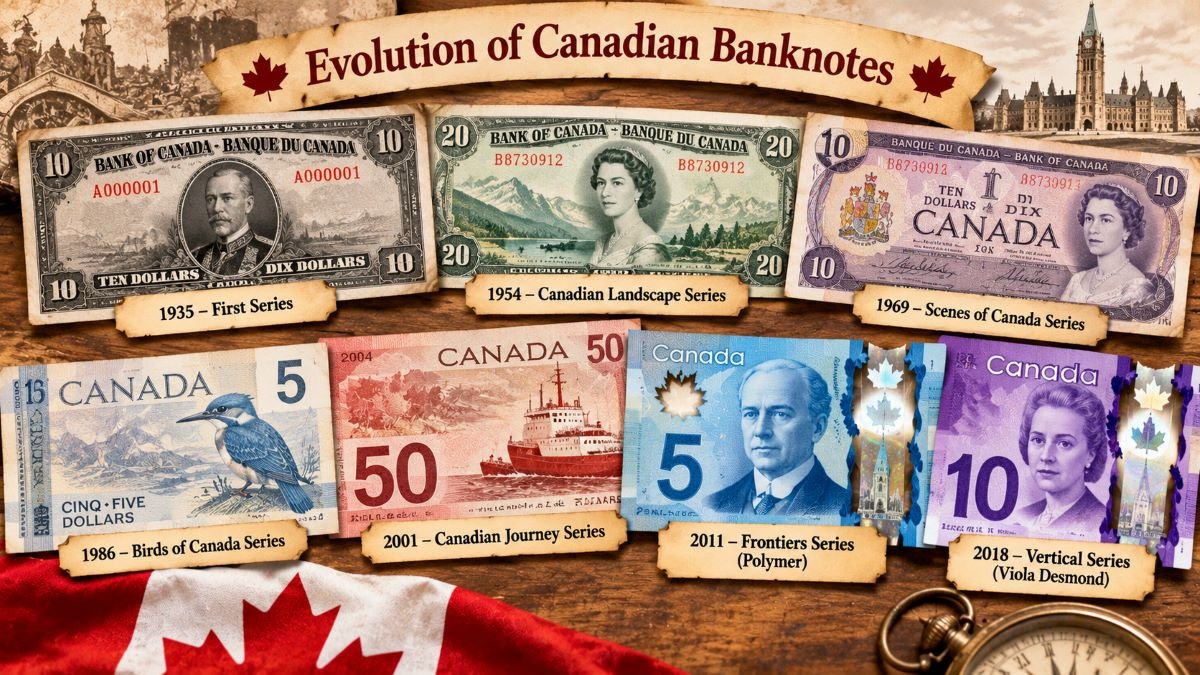
Canadian banknotes have evolved through different designs and printing technologies, from the early 1935 series to modern polymer currency.
Traditional paper banknotes were gradually replaced by more durable polymer currency. Coin denominations also evolved, with one-dollar and two-dollar banknotes being replaced by circulation coins.
Canada also adopted a flexible exchange-rate system, allowing the Canadian dollar's international value to change according to conditions in foreign exchange markets.
These developments helped create the modern Canadian monetary system used today.
Canadian Banknotes: Understanding Canada's Paper Currency
Canadian banknotes are known for their colourful designs, polymer construction, security technology and distinctive national imagery.
Unlike traditional paper banknotes, modern Canadian notes are produced using durable polymer material.
The Bank of Canada issues and distributes banknotes through financial institutions.
Common Canadian banknote denominations include:
| Denomination | Common Colour |
| $5 | Blue |
| $10 | Purple |
| $20 | Green |
| $50 | Red |
| $100 | Brown |
Each denomination has its own distinctive appearance, design elements and security characteristics.
The $5 Canadian Banknote
The Canadian $5 banknote is commonly associated with its blue colour.
The current note features Sir Wilfrid Laurier, Canada's first francophone prime minister.
Its design also recognizes Canadian contributions to space exploration and engineering through imagery associated with the Canadarm2 robotic system.
The $5 denomination is widely used for smaller everyday purchases.
The $10 Canadian Banknote
The $10 banknote is purple and features Viola Desmond, a Canadian civil rights pioneer.
Her story represents the struggle for racial equality and social justice in Canada.
The vertically oriented design also features imagery associated with Halifax and the Canadian Museum for Human Rights.
It is an important example of how Canadian currency can recognize individuals and events that have shaped the country's history.
The $20 Canadian Banknote
The $20 banknote is traditionally green and features Queen Elizabeth II.
Its imagery includes the Canadian National Vimy Memorial, which commemorates the service and sacrifice of Canadians during military conflicts.
The Bank of Canada has also announced a new vertical $20 polymer banknote featuring King Charles III. The new design represents an important development in the continuing evolution of Canadian banknotes.
The $50 Canadian Banknote
The $50 banknote is red and features William Lyon Mackenzie King, one of Canada's longest-serving prime ministers.
Its design recognizes Canada's northern regions and Arctic exploration.
The CCGS Amundsen research icebreaker is an important visual element associated with the denomination.
The $100 Canadian Banknote
The $100 banknote is brown and features Sir Robert Borden, Canada's eighth prime minister.
Its design highlights Canadian contributions to medical research and scientific innovation.
Images associated with medical discoveries, laboratory research and scientific achievements reflect the country's role in advancing healthcare and technology.
Polymer Banknotes and Security Features
One of the most distinctive characteristics of modern Canadian currency is its use of polymer banknotes.
Polymer notes are made from a durable synthetic material rather than traditional paper.
This material offers several advantages:
Durability: Polymer banknotes generally last longer than traditional paper notes and can withstand repeated handling.
Security: Transparent windows, metallic images and advanced printing techniques make modern banknotes more difficult to counterfeit.
Accessibility: Different colours, raised printing and other design features help people identify and use banknotes.
Distinctive appearance: Polymer technology allows the Bank of Canada to incorporate detailed visual elements and complex security designs.
Common security features include transparent windows, metallic portraits, raised ink, colour-changing elements and detailed maple leaf designs.
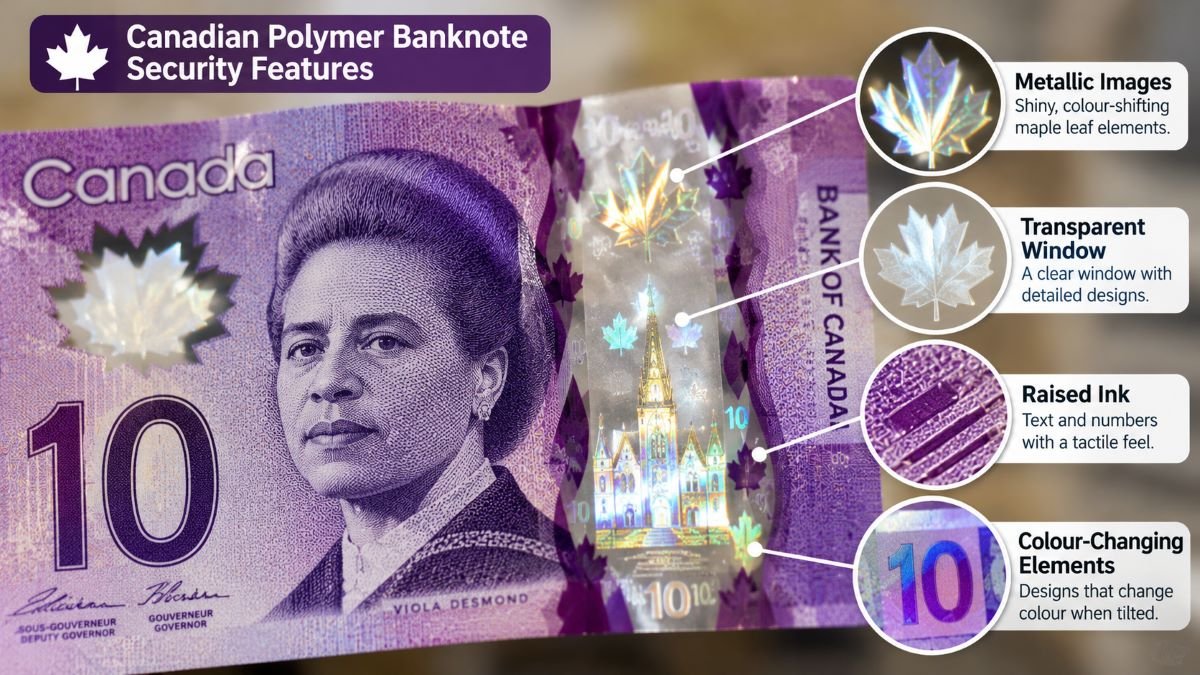
Canadian polymer banknotes feature security elements such as transparent windows, metallic images, raised printing and colour-changing details to help prevent counterfeiting.
The Bank of Canada encourages users to check banknotes by feeling, looking, tilting and flipping them.
These features are particularly useful for international visitors who may be unfamiliar with Canadian banknotes.
Canadian Coins and Their Denominations
Canadian circulation coins are produced by the Royal Canadian Mint.
They are available in different sizes, colours, compositions and designs, making them easy to distinguish during everyday transactions.
The commonly encountered Canadian circulation denominations include:
| Coin | Value | Common Name |
| Nickel | 5 cents | Nickel |
| Dime | 10 cents | Dime |
| Quarter | 25 cents | Quarter |
| Loonie | 1 dollar | Loonie |
| Toonie | 2 dollars | Toonie |
Canada also has a 50-cent coin, although it is not commonly used in everyday transactions.
The Canadian Nickel (5 Cents)
The nickel is the five-cent coin.
It is one of the smaller-value Canadian coins and is commonly used when giving change for cash purchases.
The Canadian Dime (10 Cents)
The dime represents ten cents.
It features the famous Bluenose schooner, a symbol associated with Canada's maritime heritage and sailing history.
The Canadian Quarter (25 Cents)
The quarter is worth 25 cents, or one-quarter of a Canadian dollar.
It is widely used in everyday transactions and has featured many different designs representing Canadian history, nature, culture and important national events.
The Loonie: Canada's One-Dollar Coin
The Canadian one-dollar coin is commonly known as the loonie.
The nickname comes from the common loon depicted on its reverse side.
Introduced in 1987, the loonie replaced the one-dollar banknote as a more durable form of everyday money.
Its familiar golden appearance and distinctive design have made it one of Canada's best-known currency symbols.
The Toonie: Canada's Two-Dollar Coin
The two-dollar Canadian coin is commonly called the toonie.
Introduced in 1996, the toonie replaced the two-dollar banknote.
It is a distinctive bi-metallic coin with an outer ring and an inner centre.
The familiar polar bear design is one of its best-known visual features.
Together, the loonie and toonie represent an important part of Canada's modern cash system.
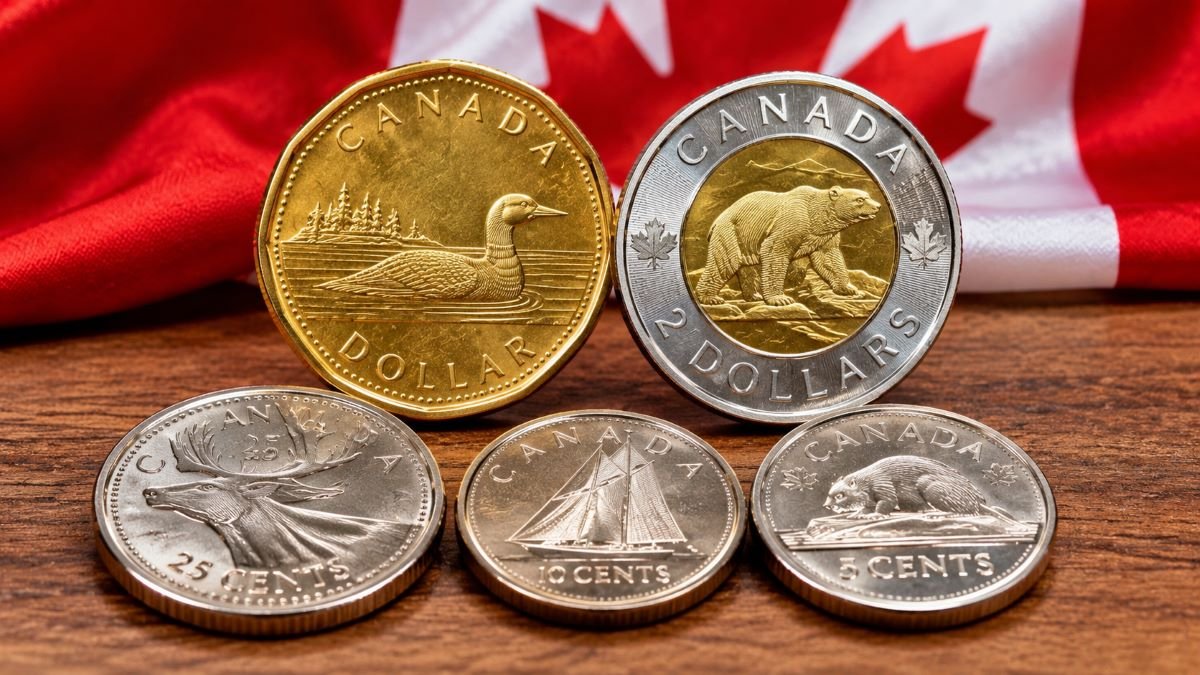
Canada's loonie and toonie are iconic circulation coins featuring the common loon and polar bear, respectively.
Why Canada Removed the Penny
Canada once used a one-cent coin commonly known as the penny.
However, the Canadian government decided to phase out the penny because its production and handling costs had become increasingly difficult to justify relative to its purchasing value.
The Royal Canadian Mint stopped distributing pennies in 2013.
Although the cent remains a unit of accounting, pennies are no longer produced for general circulation.
When pennies are not available, cash transactions are generally rounded to the nearest five cents.
This rounding applies to the final amount of a cash purchase. Electronic payments, including debit and credit card transactions, continue to be calculated to the exact cent.
This distinction is useful for international visitors who may notice that the final cash payment differs slightly from the exact electronic total.
Who Issues and Manages Canadian Currency?
Canada's monetary system involves two important national institutions: the Bank of Canada and the Royal Canadian Mint.
Although both organizations are associated with Canadian money, they have different responsibilities.
The Role of the Bank of Canada
The Bank of Canada is the country's central bank.
Its responsibilities include:
- Issuing Canadian banknotes.
- Conducting monetary policy.
- Supporting financial stability.
- Maintaining confidence in Canada's currency.
- Supporting an efficient financial system.
The Bank of Canada also helps maintain the security and quality of banknotes circulating throughout the country.
The Role of the Royal Canadian Mint
The Royal Canadian Mint manufactures Canadian circulation coins.
It also produces collector coins, commemorative coins and precious-metal products.
Its responsibilities include maintaining the supply of circulation coins and supporting the development of Canadian coin designs.
The Mint's products often feature important historical figures, wildlife, national symbols and cultural achievements.
The Canadian Dollar and International Exchange Rates
For international users, one of the most important aspects of the Canadian dollar is its exchange rate.
The value of CAD changes in relation to other currencies.
For example, the Canadian dollar can rise or fall against currencies such as:
- United States Dollar (USD)
- Euro (EUR)
- British Pound (GBP)
- Australian Dollar (AUD)
- Japanese Yen (JPY)
- Indian Rupee (INR)
- Chinese Yuan (CNY)
The exchange rate determines how much Canadian money someone receives when converting another currency into CAD.
It also determines how much foreign currency can be obtained when exchanging Canadian dollars internationally.
Is the Canadian Dollar Fixed to the US Dollar?
No. The Canadian dollar is not permanently fixed or pegged to the United States dollar.
Canada operates a flexible, or floating, exchange-rate system.
This means that the international value of the Canadian dollar is primarily determined by demand and supply in foreign exchange markets.
The Bank of Canada does not maintain a permanent fixed conversion rate between CAD and USD.
Consequently, the amount of US dollars received for Canadian dollars can change over time.
What Influences the Canadian Dollar's Value?
Several economic factors influence the Canadian dollar's international value.
Interest Rates
Interest-rate decisions by the Bank of Canada can influence international demand for Canadian financial assets.
Higher or lower interest rates relative to other countries may affect investment flows and currency demand.
Economic Growth
The strength of Canada's economy can influence confidence in the currency.
Employment, productivity, business investment and consumer spending all contribute to the overall economic outlook.
Oil and Commodity Prices
Canada is an important producer and exporter of natural resources.
Changes in the international prices of oil, natural gas, minerals and other commodities can influence the country's export revenues and economic outlook.
These developments may affect international demand for the Canadian dollar.
International Trade
Canada participates in extensive international trade, particularly with the United States and other major trading partners.
Changes in exports, imports and global demand can influence currency movements.
Global Financial Conditions
International investors consider economic risks, interest rates and market confidence when deciding where to invest.
These decisions can also affect demand for Canadian dollars.
Because of these factors, the Canadian dollar can fluctuate even when Canada's domestic economic conditions appear relatively stable.
The Canadian Dollar in Global Trade and Finance
The Canadian dollar plays an important role in international business and financial transactions.
Canada maintains extensive trade relationships with countries across North America, Europe and Asia.
Businesses involved in importing and exporting goods often use Canadian dollars when conducting transactions within the Canadian market.
International investors also monitor CAD when evaluating Canadian financial assets, companies and economic conditions.
The currency is particularly relevant to sectors such as energy, agriculture, mining, manufacturing, transportation and financial services.
For international businesses, understanding the Canadian dollar helps with pricing, budgeting, contract management and currency-risk planning.
How International Visitors Can Use Money in Canada
People visiting Canada for tourism, education, business or family purposes need to understand how the local payment system works.
Although Canada uses a modern banking and electronic payment system, cash remains useful in many situations.
Exchanging Foreign Currency into Canadian Dollars
International visitors can obtain Canadian dollars before travelling or after arriving in Canada.
Common currency exchange options include:
- Banks and authorized currency exchange providers.
- Airport currency exchange counters.
- Foreign exchange services in major cities.
- Automated banking machines (ABMs).
Exchange rates and service fees can differ between providers.
It is therefore useful to compare the final amount received rather than looking only at the advertised exchange rate.
Using International Debit and Credit Cards
Many businesses across Canada accept major international debit and credit cards.
Contactless payments are widely used for everyday purchases.

Contactless debit and credit card payments make everyday purchases convenient for international visitors and residents in Canada.
However, foreign cardholders should check whether their bank charges international transaction fees or applies additional currency conversion costs.
When using a card in Canada, it is generally useful to review the payment currency and the conversion terms offered by the payment provider.
Using Cash for Everyday Purchases
Canadian dollars are useful for smaller purchases, local services and situations where electronic payments are unavailable.
Most merchants accept cash, although some businesses choose to operate without cash.
Carrying a modest amount of Canadian currency can make everyday transactions more convenient.
Understanding Canadian Sales Taxes
One important difference international shoppers may notice is the way sales taxes are applied in Canada.
Depending on the province or territory, purchases may be subject to different combinations of federal and provincial sales taxes.
These systems include:
- Goods and Services Tax (GST).
- Harmonized Sales Tax (HST).
- Provincial Sales Tax (PST).
The applicable tax depends on factors such as the type of purchase and the place of supply.
As a result, the final amount paid at a store may be higher than the displayed pre-tax price.
International visitors should consider applicable sales taxes when planning their shopping and travel budgets.
Tipping and Everyday Expenses
Tipping is a familiar practice in several Canadian service industries.
Visitors may encounter tipping expectations in restaurants, hospitality services, taxis and other service situations.
The amount can depend on the type of service, location and personal preference.
International visitors should also remember that everyday expenses vary significantly between Canadian cities and regions.
Accommodation, transportation, food and entertainment costs can differ considerably between major urban centres and smaller communities.
Canadian Dollar vs United States Dollar
The Canadian dollar and United States dollar are separate national currencies.
Although both use the dollar symbol ($), they are issued and managed by different monetary authorities.
| Feature | Canadian Dollar | US Dollar |
| Currency Code | CAD | USD |
| Currency Symbol | $ or C$ | $ or US$ |
| Issuing Authority | Bank of Canada | Federal Reserve System |
| Country | Canada | United States |
| Subdivision | 100 cents | 100 cents |
| Exchange System | Floating | Floating |
The two currencies are closely connected through trade, investment and economic relationships.
However, they do not always have the same international value.
International businesses should therefore identify the correct currency when setting prices, issuing invoices and preparing financial reports.
Digital Payments and the Future of Canadian Money
The way Canadians use money has evolved considerably.
Traditional cash transactions now exist alongside debit cards, credit cards, contactless payments, online banking and mobile payment services.
Digital transactions make it easier for consumers to purchase products, pay bills and transfer money without physically handling cash.
For international users, these payment options can simplify financial activities while travelling, studying or conducting business in Canada.
However, digital payments do not represent a separate national currency.
A bank balance or digital payment denominated in CAD is still measured in Canadian dollars.
The Canadian monetary system continues to evolve as financial technology, payment habits and security requirements develop.
Interesting Facts About the Canadian Dollar
The Canadian dollar has several distinctive features that make it interesting from an international perspective.
- The currency code is CAD: It identifies Canadian dollars in international banking and foreign exchange markets.
- The dollar is divided into 100 cents: Canada's decimal currency system makes financial calculations straightforward.
- The loonie replaced the one-dollar bill: Canada's one-dollar circulation coin was introduced in 1987.
- The toonie replaced the two-dollar bill: The bi-metallic two-dollar coin was introduced in 1996.
- Canadian banknotes are made from polymer: Their durable construction and security features distinguish them from traditional paper currency.
- The Canadian penny was phased out: The Mint stopped distributing the one-cent coin in 2013.
- Canada has its own central bank: The Bank of Canada began operations in 1935.
- The Canadian dollar has a floating exchange rate: Its international value changes according to foreign exchange market conditions.
- Canadian currency uses bilingual designs: Banknotes feature English and French wording, reflecting Canada's official-language framework.
- The Royal Canadian Mint produces circulation coins: It also manufactures commemorative and collector products.
Conclusion: Why Understanding the Canadian Dollar Matters
The Canadian dollar is more than a national payment system. It reflects Canada's economic history, financial institutions, international trade relationships and evolving role in the global economy.
From the introduction of decimal coinage in the nineteenth century to the development of modern polymer banknotes and the familiar loonie and toonie, Canadian currency has undergone significant changes.
Today, CAD is an important currency for people living in Canada and for international visitors, students, businesses, investors and financial institutions.
Understanding the Canadian dollar makes it easier to compare international prices, exchange foreign currencies, manage travel expenses and participate in financial transactions involving Canada.
Whether someone is planning a visit, studying abroad, conducting international business or monitoring global currency markets, knowledge of CAD provides a useful foundation for understanding Canada's monetary and economic environment.
Frequently Asked Questions About the Canadian Dollar (CAD)
What is the official currency of Canada?
The official currency of Canada is the Canadian dollar, identified by the international currency code CAD and the symbol $.
What does CAD stand for?
CAD stands for Canadian Dollar. It is the standardized three-letter currency code used in international banking, financial transactions and foreign exchange markets.
How many cents are in one Canadian dollar?
One Canadian dollar is divided into 100 cents.
What is the Canadian dollar symbol?
The commonly used symbol is $. The notation C$ is also used to distinguish Canadian dollars from other dollar-denominated currencies.
What are the common Canadian banknote denominations?
The common Canadian banknote denominations are $5, $10, $20, $50 and $100.
What is a loonie in Canada?
A loonie is the nickname for Canada's one-dollar circulation coin. It features a common loon on its reverse side.
What is a toonie in Canada?
A toonie is Canada's two-dollar circulation coin. It is a distinctive bi-metallic coin featuring a polar bear design.
Who issues Canadian banknotes?
The Bank of Canada is responsible for issuing Canadian banknotes and distributing them through financial institutions.
Who produces Canadian coins?
The Royal Canadian Mint produces Canadian circulation coins, along with collector and commemorative coins.
Does Canada still use the penny?
Canada no longer distributes the one-cent penny for general circulation. The Royal Canadian Mint stopped distributing it in 2013, although pennies retain their legal status. Cash totals are generally rounded to the nearest five cents when pennies are not available.
Is the Canadian dollar the same as the US dollar?
No. CAD and USD are separate currencies issued by different monetary authorities. Their exchange rate changes according to market conditions.
Is the Canadian dollar fixed to the US dollar?
No. Canada operates a floating exchange-rate system, meaning the Canadian dollar's value is primarily determined by foreign exchange markets.
What affects the value of the Canadian dollar?
The Canadian dollar is influenced by interest rates, economic performance, international trade, commodity prices, investment flows and broader global financial conditions.
Can international visitors use foreign debit and credit cards in Canada?
Many Canadian merchants accept major international payment cards. However, acceptance and foreign transaction fees depend on the merchant, card network and card issuer.
Is cash still used in Canada?
Yes. Cash continues to be used for purchases and services, although electronic and contactless payments are also widely available.
Why are Canadian banknotes made of polymer?
Polymer provides a durable material for banknotes and supports advanced security features, transparent windows and distinctive printing elements.
Are Canadian banknotes legal tender?
Banknotes issued by the Bank of Canada and coins issued by the Royal Canadian Mint are legal tender. However, legal-tender status does not require every business to accept cash.
Why do Canadian cash payments sometimes get rounded?
Canada phased out distribution of the one-cent penny. When pennies are unavailable, the final cash payment is generally rounded to the nearest five-cent increment. Electronic payments continue to be settled to the exact cent.
Do Canadian prices include sales tax?
Not necessarily. Applicable GST, HST or PST may be added depending on the purchase and province or territory. International visitors should check the final amount at checkout.
Where can international users check the Canadian dollar exchange rate?
International users can check CAD exchange rates through financial institutions, foreign exchange services and reliable currency conversion platforms. Rates vary over time and may differ between providers.
Comments
No comments yet.