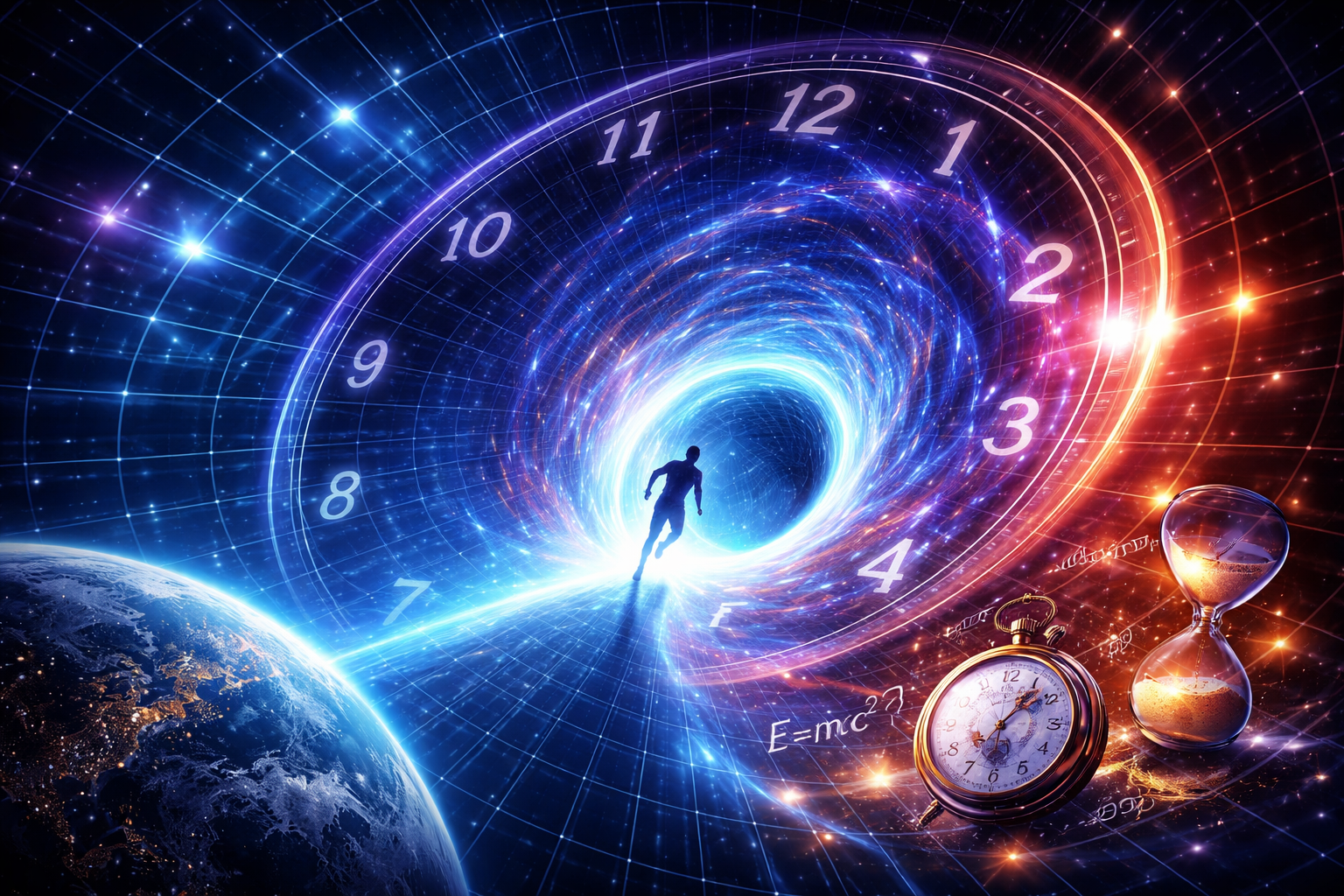
Introduction: Why Humans Are Obsessed with Time
Time is one of the few realities that every human experiences equally, yet understands very differently. From the earliest days of civilization, humans have tried to explain time—where it comes from, why it moves only forward, and whether it can ever be controlled. Ancient myths often spoke of gods who could slow, stop, or reverse time, while religious texts described time as part of a divine plan beyond human reach. Philosophers debated whether time truly exists or is merely a construct of the human mind.
In the modern era, this fascination has only intensified. We organize our lives around clocks and calendars, measure productivity in seconds, and fear the passage of time as a reminder of aging and mortality. At the same time, humans dream of escaping time—of revisiting the past, correcting mistakes, or seeing the future.
The idea of time travel sits at the center of this obsession. It dominates science fiction literature and cinema, shaping how society imagines the future of science. However, time travel is no longer confined to imagination alone. Today, it appears in serious discussions among physicists, cosmologists, and philosophers who study the nature of spacetime and the fundamental laws of the universe.
For student researchers and curious minds across the globe, the question “Can time travel ever be possible?” lies at the intersection of imagination and evidence-based science. Is time travel nothing more than a fantasy inspired by storytelling, or does modern physics genuinely allow—even in theory—the possibility of traveling through time?
This discussion explores time travel from scientific, philosophical, and technological perspectives, carefully separating what science has already proven, what current theories suggest, and what remains pure speculation.
Understanding Time: What Is Time, Really?
Before discussing time travel, it is essential to understand what time itself is. Surprisingly, even today, scientists and philosophers do not fully agree on a single definition of time.
At a basic level, time is used to describe change. We say time passes because events occur in a sequence: morning follows night, causes lead to effects, and life progresses from birth to death. But whether time is a fundamental property of the universe or simply a way humans describe change remains an open question.
Time in Classical Physics
In classical physics, particularly in the work of Sir Isaac Newton, time was treated as:
- Absolute
- Constant
- Universal
Newton believed that time flowed at the same rate for everyone, everywhere, regardless of motion or location. According to this view, time was like an invisible river moving forward uniformly, independent of the physical universe. Space and time were considered separate entities, and nothing could influence the passage of time.
Under this framework, time travel is impossible. If time moves forward at a fixed rate for all observers, then there is no mechanism to slow it down, speed it up, or reverse it. The past is gone forever, and the future does not yet exist.
This view dominated scientific thinking for more than two centuries.
Time in Modern Physics
This understanding of time changed dramatically in the early 20th century with the revolutionary work of Albert Einstein.
Einstein demonstrated that time is not absolute. Instead:
- Time is relative, depending on the observer
- Time can slow down or speed up based on motion and gravity
- Time and space are interconnected, forming a four-dimensional structure called spacetime
This discovery completely transformed humanity’s understanding of reality. Time was no longer a rigid background against which events unfold—it became a dynamic part of the universe itself.
As a result, time travel shifted from being scientifically impossible to being theoretically discussable.
Einstein’s Relativity and the Science of Time Dilation
One of the most important consequences of Einstein’s theories is time dilation, the phenomenon in which time passes at different rates for different observers.
Special Relativity: Traveling to the Future
According to Einstein’s Special Theory of Relativity, time slows down for objects that move at speeds close to the speed of light. The faster an object moves, the slower time passes for it relative to a stationary observer.
This effect becomes significant only at extremely high speeds, but it has been experimentally verified.
The Twin Paradox Explained
Consider a famous thought experiment known as the Twin Paradox:
- One twin remains on Earth
- The other twin travels into space at near-light speed and later returns
When the traveling twin comes back, they are younger than the twin who stayed on Earth. This is not a paradox in the logical sense—it is a real consequence of relativistic physics.
Experiments using atomic clocks on fast-moving airplanes and satellites have confirmed this effect.
➡️ Conclusion: Traveling into the future is already possible, at least in small amounts.
Astronauts aboard the International Space Station age slightly more slowly than people on Earth. Although the difference is tiny, it proves that forward time travel is scientifically real and experimentally verified.
General Relativity: Gravity and Time
Einstein’s General Theory of Relativity introduced another profound idea: gravity affects time.
According to this theory:
- Stronger gravity → time passes more slowly
- Weaker gravity → time passes more quickly
This phenomenon is called gravitational time dilation.
Near extremely massive objects such as black holes, gravitational forces become so strong that time slows dramatically. From the perspective of a distant observer, someone near a black hole would appear to age very slowly.
➡️ In theory, a person near a black hole could experience a few hours while decades or even centuries pass elsewhere in the universe.
However, surviving such extreme conditions is currently beyond any known technology.
Traveling Backward in Time: Where Things Get Complicated
While forward time travel fits within established physics, backward time travel raises far more serious scientific and logical problems.
The Problem of Causality
Causality is one of the most fundamental principles of reality:
Every effect has a cause, and causes come before effects.
Backward time travel threatens this principle and leads to famous paradoxes.
Common Time Travel Paradoxes
- The Grandfather Paradox: If someone travels back in time and prevents their grandparents from meeting, how could the time traveler ever have been born?
- The Bootstrap Paradox: Can an object or piece of information exist without ever being created, simply looping through time?
These paradoxes suggest that backward time travel could lead to logical contradictions that challenge the consistency of the universe itself.
Wormholes: Theoretical Shortcuts Through Spacetime
One of the most discussed theoretical ideas related to time travel involves wormholes.
What Is a Wormhole?
A wormhole is a hypothetical tunnel connecting two distant points in spacetime. If such a tunnel exists, it could allow travel across vast cosmic distances—and potentially across time.
Some solutions to Einstein’s equations, known as Einstein–Rosen bridges, mathematically allow for such structures.
If one end of a wormhole experiences time differently than the other, it might theoretically allow time travel.
The Catch
Despite their mathematical possibility, wormholes face major problems:
- They have never been observed
- They may collapse instantly
- They may require exotic matter with negative energy
Exotic matter has not been proven to exist in the required form or quantity.
➡️ For now, wormholes remain a theoretical concept, not an experimental reality.
Quantum Mechanics and Time Travel
Quantum physics introduces ideas that are even stranger than relativity.
At the quantum level:
- Particles can exist in multiple states simultaneously
- Cause and effect can appear blurred
- Events can behave probabilistically rather than deterministically
Some interpretations suggest the existence of microscopic time loops, but these effects do not scale up to everyday objects or humans.
Closed Timelike Curves (CTCs)
Certain solutions in physics allow paths through spacetime that loop back on themselves, known as closed timelike curves.
Physicists debate whether:
- CTCs can exist in reality
- The universe actively prevents them
Stephen Hawking proposed the Chronology Protection Conjecture, suggesting that the laws of physics prevent time travel in order to preserve consistency and avoid paradoxes.
Technology: Could Humans Ever Build a Time Machine?
Even if time travel is theoretically allowed, technology is a major barrier.
Many proposed models require:
- Energy comparable to stars or galaxies
- Materials unknown to science
- Precise control over spacetime curvature
At present, humanity still struggles with basic challenges such as sustainable fusion power and interplanetary travel.
➡️ If time travel technology is possible, it would likely be thousands or millions of years beyond our current capabilities.
Philosophical Questions: Should We Time Travel?
Time travel raises profound philosophical and ethical questions.
Free Will vs Determinism
If time travel exists:
- Is the future already fixed?
- Can past events be changed?
- Do alternate timelines emerge?
Some theories suggest that changing the past creates a new timeline, avoiding paradoxes but raising questions about identity and responsibility.
Ethical Concerns
Potential risks include:
- Manipulation of history
- Political or military misuse
- Cultural and social disruption
Even as a hypothetical concept, time travel presents serious moral challenges.
Science Fiction vs Science Reality
Science fiction often portrays time travel as easy and consequence-free. In reality:
- Forward time travel is slow and limited
- Backward travel remains unproven
- Paradoxes remain unresolved
Nevertheless, science fiction plays an important role by inspiring scientific curiosity and innovation.
Conclusion: So, Can Time Travel Ever Be Possible?
Yes—partially. Forward time travel already occurs due to relativistic effects.
Maybe—conditionally. Backward time travel is allowed in some theories but faces extreme constraints.
Not yet—and possibly never. There is no evidence that practical human-scale time travel will ever be achievable.
Time travel remains one of the greatest intellectual challenges in science—a powerful blend of physics, philosophy, and imagination. Whether or not humanity ever builds a time machine, the study of time has already reshaped our understanding of the universe.
And perhaps that exploration itself is the most meaningful journey of all.
Comments
No comments yet.