Introduction
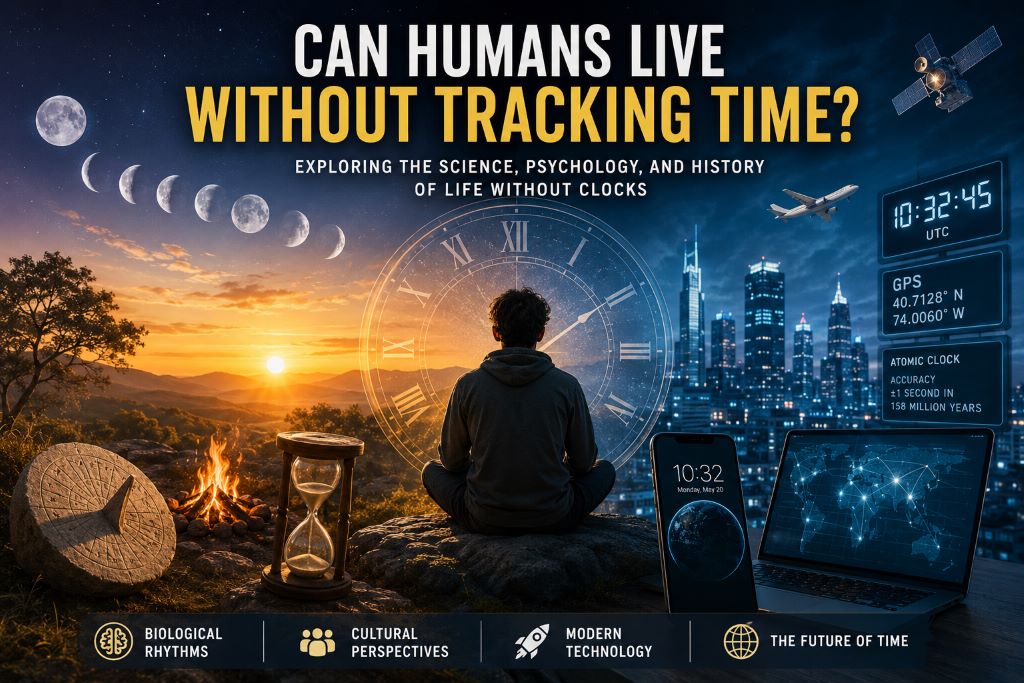
Imagine waking up tomorrow to find that every clock has disappeared.
Your phone no longer shows the time. Watches have stopped working. Calendars are blank. There are no alarms, appointment reminders, train schedules, or digital clocks on computers. Even the familiar numbers that divide the day into hours and minutes have vanished.
Would humanity continue living normally, or would modern civilization begin to unravel?
At first, it might seem that humans could simply follow the Sun as people did thousands of years ago. Sunrise could signal the beginning of the day, sunset could indicate the approaching night, and the changing seasons could provide a broader sense of time.
In fact, humans lived this way for most of history.
Long before mechanical clocks and smartphones, people organized their lives around daylight, darkness, the Moon, seasons, weather, animal behavior, and other recurring natural patterns. Human beings did not need digital clocks to sleep, hunt, farm, travel, or raise families.
Yet modern civilization has transformed our relationship with time.
Today, precise time is built into transportation, telecommunications, financial systems, scientific research, navigation, healthcare, computers, and the internet. Some technologies depend on synchronization so precise that ordinary human perception of time is completely inadequate.
So, can humans truly live without tracking time?
The answer depends on what we mean by "humans."
An individual can survive without a clock. A complex global civilization cannot easily function without a shared system of time.
The Evolution of Timekeeping
Before Clocks: Nature Was Humanity's First Clock
Before mechanical clocks existed, nature provided humanity with a remarkably effective timing system.
The daily movement of the Sun created an obvious cycle:
- Sunrise signaled the beginning of daytime activity.
- The Sun's position helped people estimate the progression of the day.
- Sunset marked the transition toward nighttime.
- Moon phases provided longer natural cycles.
- Seasonal changes helped communities plan agriculture, migration, and food gathering.
For early human communities, this system was usually sufficient.
A farmer did not necessarily need to know that it was exactly 10:37 a.m. The important information was whether the Sun had risen, whether the soil was ready for work, whether daylight remained, or whether a seasonal change was approaching.
In other words, early societies often needed relative time rather than the highly precise clock time used today.
Why Humans Began Measuring Time More Precisely
As human settlements became larger and more organized, natural time became less convenient.
Agriculture created recurring seasonal demands. Cities required coordinated labor. Religious ceremonies needed predictable timing. Traders and travelers needed ways to organize journeys. Governments needed systems for taxation and administration.
This encouraged the development of increasingly sophisticated timekeeping devices.
Sundials used the position of the Sun's shadow. Water clocks measured the passage of time through the controlled movement of water. Candle clocks and hourglasses provided additional methods of measuring intervals.
Eventually, mechanical clocks introduced a new level of precision and consistency.
The important change was not simply that humans learned how to "tell time." Humans learned how to coordinate with one another using a shared measurement of time.
That distinction would eventually become fundamental to civilization.
Your Body Already Keeps Time
The Human Biological Clock
Even if every mechanical clock disappeared, your body would continue operating according to biological rhythms.
One of the most important is the circadian rhythm, a roughly 24-hour cycle that influences sleep, wakefulness, hormone activity, body temperature, metabolism, and alertness.
In mammals, the suprachiasmatic nucleus, or SCN, in the brain acts as a central coordinator of circadian timing. Research describes the SCN as a principal pacemaker that helps synchronize daily physiological and behavioral rhythms.
This means your body does not simply react to the numbers displayed on a clock.
It has its own biological timing system.
Your body can therefore provide information such as:
- When you are becoming sleepy
- When you are naturally waking
- When you tend to feel hungry
- When alertness rises or falls
- When your body temperature changes during the day
Light is particularly important because environmental signals help synchronize the internal clock with the Earth's day-night cycle.
What Happens Without External Time Signals?
The biological clock is powerful, but it is not a perfect replacement for a clock on the wall.
When people are isolated from strong environmental time cues such as daylight, clocks, and normal social schedules, their internal rhythms can become less precisely synchronized with the 24-hour day.
This reveals an important fact about human timekeeping:
We possess both internal and external clocks.
The internal system helps coordinate our biology, while external timekeeping helps coordinate our behavior with the rest of society.
Could Humans Survive Without Measuring Time?
Individual Survival
From a basic biological perspective, yes.
A person living in a natural environment could organize much of daily life around environmental signals:
- Daylight
- Darkness
- Hunger
- Fatigue
- Temperature
- Weather
- Seasonal changes
- Animal behavior
Humans evolved for an environment in which these cues were essential.
A person does not need a wristwatch to know that it is becoming dark. The environment itself provides information.
Modern Civilization
The situation changes dramatically when millions or billions of people need to coordinate.
Modern society depends on shared expectations.
Imagine trying to operate an airport without clocks.
A passenger might know that a flight leaves "after sunrise," but that is not precise enough to coordinate hundreds of passengers, pilots, ground crews, air-traffic controllers, baggage systems, and connecting flights.
The same problem appears throughout civilization.
Without standardized time, coordination would become slower, less predictable, and far more complicated.
Why Transportation Depends on Time
Transportation is one of the clearest examples of society's dependence on synchronized time.
Airlines, railways, buses, shipping networks, and other transportation systems rely on schedules.
A train cannot simply leave "sometime in the morning." Passengers, staff, connecting services, and other trains all need a common reference.
The larger the transportation network becomes, the more important synchronization becomes.
Even when vehicles operate autonomously, their systems still need accurate timing for communication, positioning, control, and coordination.
Without standardized time, transportation would not necessarily become impossible—but it would become dramatically less efficient and predictable.
Healthcare Also Requires Precise Timing
Timekeeping is particularly important in healthcare.
Hospitals and medical teams organize procedures, medication schedules, patient monitoring, emergency responses, and laboratory processes around time.
A medicine may need to be administered at particular intervals. A surgical team may need to coordinate with imaging, anesthesia, laboratory, and recovery departments. Emergency services need reliable timing when responding to critical situations.
In healthcare, the difference between "around now" and "exactly when required" can matter.
This demonstrates that timekeeping is not merely a convenience.
In some environments, it becomes part of safe coordination.
Technology and the Internet Need Synchronized Time
Modern digital systems make our dependence on time even more surprising.
Computers and networks constantly create, compare, record, and synchronize timestamps.
Accurate timing is important for:
- Computer networks
- Telecommunications
- GPS and satellite navigation
- Financial systems
- Cloud infrastructure
- Cybersecurity
- Data logging
- Scientific experiments
- Distributed computing
Atomic clocks are especially important because they provide extremely stable references for technologies such as telecommunications and satellite-based positioning. NIST notes that atomic clocks underpin applications including telecommunications, computer networks, and satellite-based positioning systems such as GPS.
In these systems, time is not simply displayed to humans.
Time becomes part of the underlying infrastructure.
A timestamp can help determine the order in which events occurred. Synchronized clocks can allow different machines to coordinate operations even when those machines are physically separated.
This is one reason modern civilization cannot simply return to sunrise-and-sunset time.
Nature Tracks Time Without Clocks
Humans are not the only organisms that respond to recurring cycles.
Biological timekeeping exists across many forms of life.
Plants, insects, birds, mammals, and other organisms respond to environmental cycles involving light, temperature, seasons, and other signals.
Examples include:
- Birds changing behavior according to seasonal cycles
- Bees using the position of the Sun for navigation
- Plants opening or closing flowers according to daily conditions
- Animals adjusting activity between day and night
- Marine organisms responding to environmental and lunar cycles
These examples reveal something fundamental:
Life evolved in a world that already contained repeating patterns of time.
There was no need for a mechanical clock for evolution to favor biological systems capable of responding to those patterns.
The Earth's rotation, changing daylight, and seasonal cycles created environmental signals long before humans invented clocks.
Why Time Sometimes Feels Faster or Slower
Psychological Time
There is another fascinating distinction between physical time and human experience.
One hour measured by a clock is still one hour. But one hour does not always feel like one hour.
Our perception of time can change with attention, emotion, stress, boredom, and novelty.
Consider these familiar experiences:
- Waiting for an important message can make a few minutes feel extremely long.
- An enjoyable vacation can seem to pass surprisingly quickly.
- A repetitive task can make an afternoon feel slow.
- An exciting new experience may seem to disappear almost instantly.
This shows that humans experience time on at least two levels.
There is measured time, represented by clocks and calendars.
And there is experienced time, which is shaped by the brain.
These two systems can disagree without either one being "wrong."
Why Childhood Can Seem Longer
Many people feel that childhood seemed longer than adulthood.
One possible reason is that novel experiences create richer memories. As people grow older, familiar routines may make periods of life feel less distinct when remembered afterward.
This does not mean that physical time moves faster with age.
Instead, our perception and memory of time change.
The clock remains constant.
Our experience does not.
Different Cultures Experience Time Differently
Not every society has historically treated time in exactly the same way.
Industrial societies often emphasize clock time.
This means that activities are organized around fixed schedules:
- Work begins at a particular hour.
- Classes have defined starting times.
- Trains depart according to schedules.
- Meetings are expected to begin at designated times.
- Deadlines determine when tasks should be completed.
This approach is extremely useful for large-scale coordination.
However, other communities and cultural traditions have also placed greater emphasis on event-based time.
Instead of saying an activity must begin at an exact clock time, people may organize events around what is happening:
- When participants arrive
- When food is prepared
- When a ceremony reaches a particular stage
- When environmental conditions become suitable
These approaches should not be treated as simply "modern versus primitive."
They represent different ways of organizing social life.
Clock time is highly effective when precise coordination is necessary. Event-based time can be more flexible when activities naturally depend on circumstances.
Life Beyond Earth: Time in Space
Space exploration introduces an even more complicated relationship with time.
Astronauts cannot simply depend on the natural rhythm of sunrise and sunset as people on Earth do.
The International Space Station, for example, travels around Earth rapidly enough that astronauts experience many cycles of sunrise and sunset during a single Earth day.
If astronauts organized their lives entirely around those visual cycles, maintaining a stable sleep and work schedule would be extremely difficult.
Instead, space missions use carefully planned schedules and standardized time references.
This is another example of humans deliberately creating an artificial time environment because natural signals are no longer sufficient.
Future missions to the Moon, Mars, and beyond will make this problem even more interesting.
Different worlds have different day lengths. Communication also takes time across large distances.
A spacecraft far from Earth cannot simply behave as though everyone shares the same immediate clock.
As humanity expands beyond Earth, timekeeping may become an increasingly important part of space navigation, communication, science, and mission planning.
Could Humanity Become Happier Without Clocks?
This question is more philosophical than scientific, but it is worth asking.
Modern life can create a strong awareness of time.
People often worry about:
- Being late
- Missing deadlines
- Running out of time
- Productivity
- Work schedules
- Appointments
- Time pressure
A world without clocks might reduce some of this psychological pressure.
People could potentially pay more attention to natural rhythms and personal needs rather than constantly checking the time.
But eliminating clocks would create other problems.
Education, transportation, healthcare, communication, employment, and emergency services all require coordination.
The better solution may therefore not be to eliminate timekeeping.
Instead, it may be to use precise time when precision is useful while allowing flexibility when it is not.
A clock can help civilization coordinate without needing to control every moment of an individual's life.
The Future of Timekeeping
Humanity's relationship with time is not becoming less precise.
It is becoming more precise.
Traditional mechanical clocks measure time through physical oscillations and moving mechanisms. Quartz clocks use the regular vibration of quartz crystals. Atomic clocks use extremely stable atomic frequencies.
The latest generation of optical atomic clocks pushes precision even further.
NIST explains that optical clocks use much higher-frequency transitions than traditional microwave atomic clocks, allowing scientists to measure time with extraordinary precision.
Some modern optical clocks have reached performance levels that could correspond to an error of less than one second over tens of billions of years under the stated experimental conditions.
That level of accuracy may sound unnecessary for everyday life.
It is.
Your breakfast does not need an optical atomic clock.
But advanced timekeeping can become valuable for technologies and scientific measurements that depend on extremely precise synchronization.
Potential applications include:
- Advanced navigation
- Satellite systems
- Deep-space exploration
- Telecommunications
- Precision scientific experiments
- Fundamental physics
- Geodesy and gravitational measurements
- Future quantum technologies
Scientists are even exploring clocks as precision instruments for detecting extremely small physical effects.
This means the future of clocks may be about much more than telling humans whether it is 8:00 or 8:01.
The most advanced clocks are becoming scientific instruments for studying the universe itself.
Final Verdict
Can humans live without tracking time?
Biologically, yes.
Human beings possess internal biological timing systems that allow us to sleep, wake, eat, work, and respond to environmental cycles without looking at a clock.
For most of human history, people lived without mechanical clocks.
As a modern global civilization, however, living without standardized time would be extremely difficult.
Transportation requires schedules. Hospitals coordinate procedures and treatments. Computers exchange timestamped information. Telecommunications require synchronization. Navigation systems depend on precise timing. Scientific experiments often require measurements far beyond human perception.
The deeper lesson is that humans do not simply measure time anymore.
We use time to organize civilization.
A clock does not create the passage of time. It gives people a shared language for describing and coordinating events within it.
Nature gave humanity day and night.
Biology gave us internal rhythms.
Civilization added calendars, clocks, time zones, standardized seconds, and eventually atomic time.
The result is remarkable.
An individual human can still live according to the Sun.
But billions of humans living together need something more precise.
We may be able to live without clocks, but modern civilization cannot easily live without a shared understanding of time.
Frequently Asked Questions
Can humans survive without clocks?
Yes. Humans can survive using natural environmental signals such as daylight, darkness, hunger, fatigue, weather, and seasonal changes. However, modern societies depend heavily on standardized time for coordination.
What is the human biological clock?
The human biological clock is a network of biological timing mechanisms that helps regulate daily rhythms. The suprachiasmatic nucleus, or SCN, acts as a major central coordinator of circadian rhythms in mammals.
How did ancient humans measure time?
Ancient people relied heavily on natural cycles such as the movement of the Sun, phases of the Moon, stars, seasons, and recurring environmental events. Later civilizations developed devices such as sundials and water clocks to measure time more systematically.
Why do humans need standardized time?
Standardized time allows large groups of people and machines to coordinate activities. Transportation schedules, communication networks, financial systems, scientific experiments, and many other systems depend on shared time references.
Why does time sometimes feel faster or slower?
The psychological experience of time is influenced by attention, emotion, stress, novelty, and memory. Physical time measured by a clock remains consistent even though our subjective experience can change.
Do animals have biological clocks?
Yes. Many organisms have biological timing systems that help them respond to daily and seasonal environmental cycles. These systems can influence behavior, activity, feeding, reproduction, and other biological processes.
Why is precise time important for GPS?
Satellite-based positioning depends on highly accurate timing because the system uses signals traveling between satellites and receivers. Even very small timing differences can affect calculated positions. Atomic clocks provide the stability required for such systems.
Are modern atomic clocks more accurate than mechanical clocks?
Yes. Atomic clocks use stable atomic frequencies as their time reference and are vastly more accurate than mechanical clocks. Modern optical atomic clocks represent an even more precise generation of atomic timekeeping.
Will humans ever stop using clocks?
It is unlikely. Even if future technology changes how people interact with time, synchronized time will remain important for communication, transportation, science, computing, and other forms of coordination.
What would happen if all clocks suddenly disappeared?
Individuals could still follow natural rhythms, but modern systems would face severe coordination problems. Transportation schedules, digital networks, financial transactions, healthcare operations, communication systems, and many automated processes would be disrupted because they depend on shared time references.
Conclusion
Time is one of the few things humans cannot stop, yet it is something we have learned to measure with extraordinary precision.
Our ancestors watched shadows move across the ground. Today, scientists use atomic transitions and optical frequencies to construct clocks capable of measuring incredibly small differences in time.
Between those two extremes lies the story of civilization.
Humans learned not only to observe time, but to coordinate through it.
That is why the question "Can humans live without tracking time?" has two different answers.
A human can. Civilization cannot easily.
And perhaps that is the most interesting thing about time: the clock on your wall is not merely telling you what time it is.
It is helping billions of people agree on when something happens.
Comments
No comments yet.