Introduction
Imagine waking up tomorrow to find that every clock has disappeared. Your phone no longer shows the time, watches have stopped working, calendars are blank, and there are no alarms, schedules, or reminders.
Would humanity continue as normal, or would modern civilization begin to unravel?
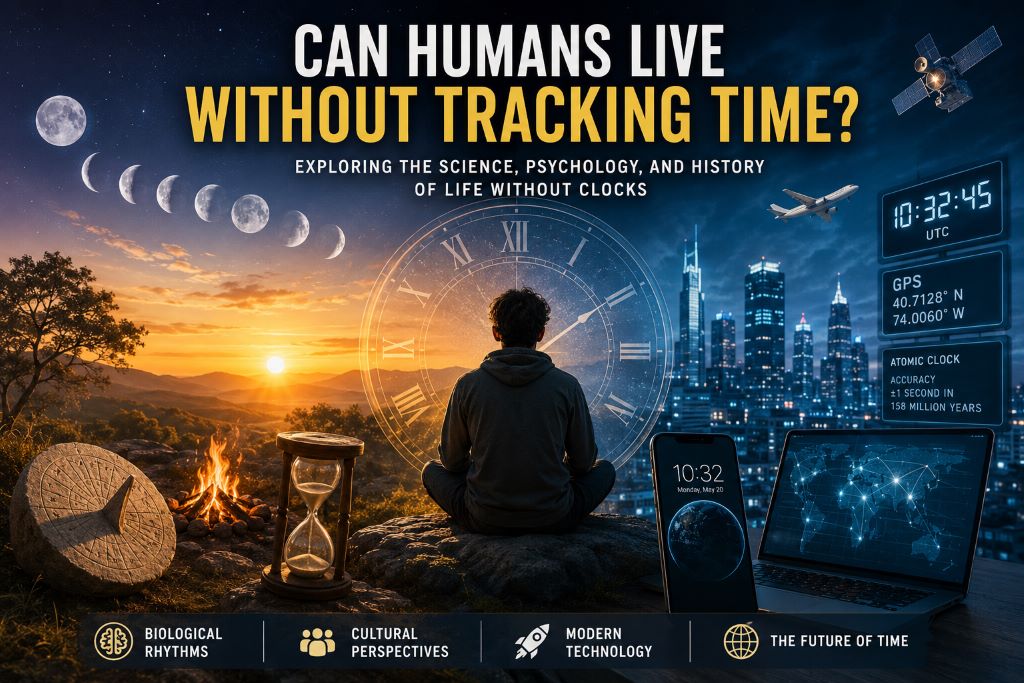
Although it may seem impossible today, humans spent tens of thousands of years living without mechanical clocks or digital timekeeping. Ancient societies relied on the Sun, Moon, stars, and changing seasons rather than hours and minutes. Yet in the modern world, almost every technology—from GPS navigation to financial markets—depends on extraordinarily precise time measurement.
So, can humans truly live without tracking time? The answer is more complex than a simple yes or no.
The Evolution of Timekeeping
Before Clocks: Nature Was Humanity's First Clock
Long before the invention of clocks, people measured time by observing nature.
Daily life followed predictable environmental patterns:
- Sunrise signaled the beginning of activity.
- Midday was determined by the Sun's highest position.
- Sunset marked the end of work.
- Moon phases tracked longer cycles.
- Seasonal changes guided agriculture and migration.
For hunter-gatherers, survival depended on understanding natural rhythms rather than counting minutes.
Why Humans Began Measuring Time
As villages grew into cities and civilizations expanded, relying solely on natural observations became increasingly difficult.
Communities needed standardized ways to coordinate:
- Farming seasons
- Religious ceremonies
- Trade
- Navigation
- Military campaigns
- Tax collection
This need led to the development of increasingly sophisticated timekeeping devices, including sundials, water clocks, candle clocks, hourglasses, and eventually mechanical clocks.
Your Body Already Keeps Time
The Human Biological Clock
Even without clocks, your body continues measuring time every day.
Scientists call this system the circadian rhythm, an internal biological clock controlled primarily by a small region of the brain known as the suprachiasmatic nucleus (SCN).
This natural clock regulates:
- Sleep and wake cycles
- Hormone production
- Hunger
- Body temperature
- Blood pressure
- Mental alertness
Sunlight resets this biological clock every morning, helping synchronize our bodies with Earth's 24-hour day.
What Happens Without Sunlight or Clocks?
Researchers have conducted isolation experiments in caves and underground laboratories where volunteers lived without:
- Sunlight
- Clocks
- Calendars
- Phones
- Outside communication
The findings were remarkable.
Although participants maintained sleep cycles, their internal clocks gradually drifted beyond 24 hours. Many completely lost track of how many days had passed.
These experiments demonstrate that while humans possess an internal sense of time, it requires environmental cues to remain accurate.
Could Humans Survive Without Measuring Time?
Individual Survival
From a biological perspective, yes.
A person living in nature could survive by following:
- Daylight
- Weather patterns
- Hunger
- Fatigue
- Seasonal changes
This is how humans lived for most of evolutionary history.
Modern Society
Civilizations, however, operate differently.
Without shared timekeeping, many essential systems would fail.
Transportation
Modern transportation depends on synchronized schedules.
Examples include:
- Airlines
- Railways
- Public transportation
- Shipping routes
- Traffic control systems
Even small timing errors can create significant disruptions.
Healthcare
Hospitals rely heavily on accurate timing.
Medical professionals schedule:
- Medication intervals
- Surgical procedures
- Emergency response
- Intensive care monitoring
Precise timing can directly affect patient outcomes.
Technology and the Internet
Perhaps surprisingly, the internet itself depends on highly accurate clocks.
Modern technologies requiring synchronized time include:
- GPS navigation
- Banking systems
- Cloud computing
- Cybersecurity
- Mobile networks
- Artificial intelligence
Many of these systems measure time down to millionths or even billionths of a second.
Nature Tracks Time Without Clocks
Humans are not unique in following natural rhythms.
Many animals possess biological timing systems.
Examples include:
- Birds migrating seasonally
- Bees navigating using the Sun
- Sea turtles nesting during specific lunar phases
- Flowers opening and closing with daylight
- Coral reefs spawning according to lunar cycles
These behaviors demonstrate that life evolved long before mechanical clocks existed.
Why Time Sometimes Feels Faster—or Slower
Psychological Time
One hour on a clock does not always feel like one hour.
Our perception of time changes depending on:
- Attention
- Emotion
- Stress
- Novel experiences
- Memory formation
For example:
- Vacations often seem to end quickly.
- Waiting in line feels much longer.
- Childhood appears longer than adulthood.
This difference highlights the contrast between physical time and perceived time.
Different Cultures Experience Time Differently
Anthropologists distinguish between two major approaches to time.
Clock Time
Industrial societies emphasize:
- Punctuality
- Deadlines
- Schedules
- Efficiency
This approach dominates much of Europe, North America, and East Asia.
Event Time
Many traditional cultures organize activities according to events rather than fixed clock times.
For example:
- Meetings begin when participants arrive.
- Meals occur when food is ready.
- Ceremonies conclude naturally rather than at scheduled times.
Both approaches have advantages depending on social and cultural priorities.
Life Beyond Earth: Time in Space
Astronauts aboard the International Space Station experience approximately 16 sunrises and sunsets every day as the station orbits Earth every 90 minutes.
Without artificial scheduling, their biological clocks would quickly become disrupted.
To maintain healthy sleep cycles and coordinate scientific work, astronauts follow carefully planned schedules based on Coordinated Universal Time (UTC) rather than natural daylight.
Could Humanity Become Happier Without Clocks?
Many philosophers have questioned whether constant time awareness contributes to stress.
Modern life often creates feelings of:
- Being rushed
- Missing deadlines
- Running late
- Time anxiety
Living without clocks might reduce some of this pressure.
However, it would also create significant uncertainty in daily coordination, communication, education, transportation, and healthcare.
Rather than eliminating time, the greater challenge may be learning to use it more wisely.
The Future of Timekeeping
Today's most accurate atomic clocks lose less than one second over millions of years.
Scientists are now developing optical clocks that are even more precise.
These technologies will support future innovations such as:
- Deep-space navigation
- Quantum computing
- Autonomous vehicles
- Global communication networks
- Scientific research
As technology advances, humanity's dependence on accurate timekeeping continues to grow.
Final Verdict
Can humans live without tracking time?
Biologically, yes.
Our internal biological clocks allow us to sleep, wake, eat, and survive without mechanical clocks.
As a global civilization, no.
Modern society depends on synchronized time for transportation, healthcare, communication, science, finance, and nearly every digital technology.
Ironically, one of humanity's most invisible inventions has become one of its most essential. While individuals can follow nature's rhythms, billions of people can only cooperate efficiently because they share a common understanding of time.
In the end, humans don't simply measure time anymore—we build civilizations around it.
Frequently Asked Questions
Can humans survive without clocks?
Yes. Humans can survive using natural light, biological rhythms, and environmental cues. However, modern civilization requires standardized timekeeping.
What is the human biological clock?
The biological clock, or circadian rhythm, regulates sleep, hormones, metabolism, and other daily bodily functions.
How did ancient humans measure time?
They observed the Sun, Moon, stars, seasons, and recurring natural events instead of using mechanical clocks.
Why do people lose track of time in caves?
Without sunlight and external cues, the body's internal clock gradually drifts, making it difficult to maintain a precise 24-hour cycle.
Why is accurate timekeeping important today?
Modern transportation, GPS, telecommunications, healthcare, scientific research, banking, and the internet all rely on highly synchronized clocks.
Comments
No comments yet.