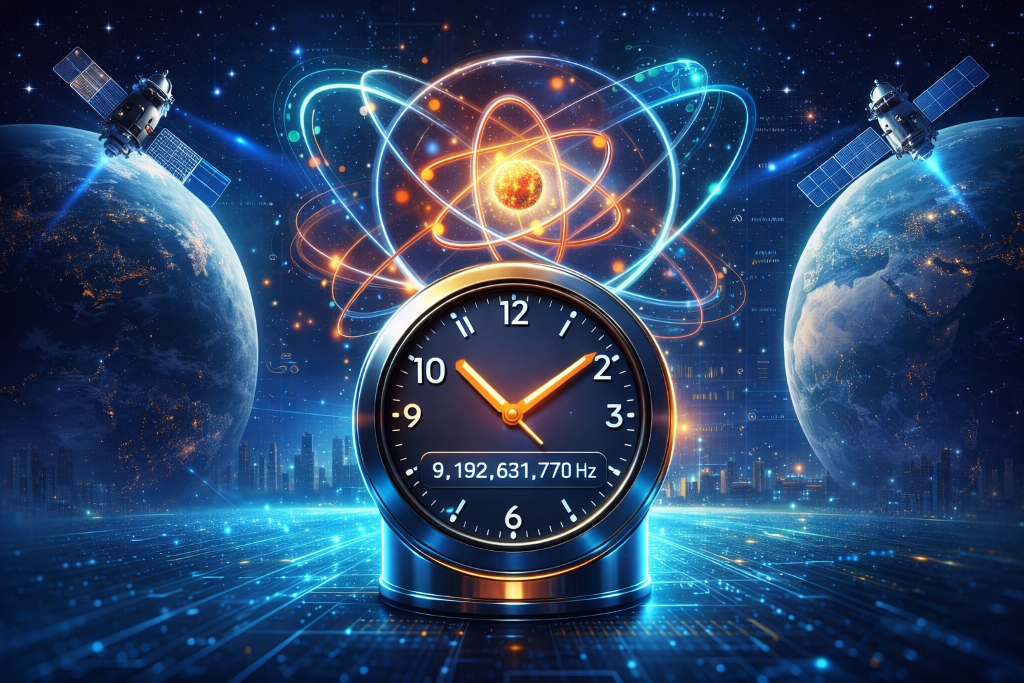
Atomic Clocks Explained: How Atoms Keep the World on Time
Time rules almost everything around us — from satellite navigation and global stock markets to your smartphone, smartwatch, and even the internet itself. Yet, have you ever stopped to wonder how a single second is defined so precisely?
The answer lies in one of humanity’s greatest scientific achievements: atomic clocks — the most accurate timekeeping devices ever created. These clocks are so precise that they would lose less than one second over millions (or even billions) of years.
Welcome to the fascinating world of atomic timekeeping.
What Is an Atomic Clock?
An atomic clock is a clock that measures time using the natural vibration frequency of atoms, rather than gears, springs, or quartz crystals.
Most atomic clocks use:
- Cesium-133
- Rubidium-87
- Hydrogen
- (In newer systems) Ytterbium or Strontium
🔑 Core Principle
Atoms oscillate at extremely stable and predictable frequencies. Atomic clocks count these oscillations to measure time with unmatched accuracy.
Unlike mechanical or quartz clocks, atomic clocks do not rely on physical movement that can wear out or drift over time.
Why Atoms Are Perfect Timekeepers
⌛ The Science Behind Atomic Precision
Atoms consist of:
- A nucleus (protons and neutrons)
- Electrons orbiting around it
Electrons can move between energy levels by absorbing or emitting energy. The energy difference between these levels is fixed and universal for each type of atom.
In cesium-133, when an electron changes energy levels:
- It oscillates 9,192,631,770 times per second
This number is so precise that it is used to define the second itself.
📏 Official Definition of One Second
1 second = 9,192,631,770 oscillations of a cesium-133 atom
This definition has been used worldwide since 1967.
How an Atomic Clock Works (Simplified)
Although atomic clocks sound complex, their working principle can be understood step by step:
⚙️ Step-by-Step Process
- Atom Source A beam of cesium atoms is produced inside a vacuum chamber.
- Microwave Oscillator The atoms pass through a microwave field tuned near their natural frequency.
- Resonance Detection When the microwave frequency exactly matches the atom’s natural vibration, atoms switch energy states.
- Feedback Control Sensors detect this change and automatically adjust the oscillator to stay perfectly tuned.
- Time Signal Output The stabilized microwave signal becomes the clock’s “tick.”
🧠 Simple Analogy
Think of an atomic clock as a super-accurate metronome, perfectly synchronized to the rhythm of the universe itself.
Why Atomic Clocks Matter in Everyday Life
Atomic clocks are not just scientific curiosities — they quietly power the modern world.
🌍 Real-World Applications of Atomic Time
| Application | Why Atomic Time Is Essential |
|---|---|
| GPS Satellites | Nanosecond accuracy determines location |
| Internet (NTP) | Synchronizes global computer networks |
| Stock Markets | Accurate timestamps for trades |
| Telecommunications | Data transmission coordination |
| Power Grids | Grid synchronization |
| Scientific Research | Astronomy, physics, space exploration |
Even a one-nanosecond error in GPS timing can cause location errors of 30 centimeters.
Types of Atomic Clocks
Different atomic clocks serve different purposes depending on size, accuracy, and stability.
⏱ Major Types of Atomic Clocks
| Clock Type | Atom Used | Accuracy |
|---|---|---|
| Cesium Beam Clock | Cesium-133 | Loses 1 second in ~100 million years |
| Rubidium Clock | Rubidium-87 | Smaller, portable, slightly less accurate |
| Hydrogen Maser | Hydrogen | Extremely stable short-term accuracy |
| Optical Atomic Clock | Ytterbium / Strontium | 1 second error in ~15 billion years |
International Atomic Time (TAI) and UTC
The world does not rely on a single atomic clock.
🕰 How Global Time Is Maintained
- Hundreds of atomic clocks operate worldwide
- Their average forms International Atomic Time (TAI)
- Coordinated Universal Time (UTC) is derived from TAI
- Leap seconds are occasionally added to keep UTC aligned with Earth’s rotation
This system ensures global synchronization.
Atomic Clocks and Einstein’s Theory of Relativity
🛰 Time Flows Differently in Space
According to Einstein’s General Relativity:
- Time moves slower in stronger gravity
- Time moves faster at higher altitudes
GPS satellites orbit Earth where:
- Gravity is weaker
- Satellites move very fast
As a result:
- Satellite clocks run about 38 microseconds faster per day
- Atomic clocks correct this difference automatically
Without this correction, GPS would become useless within hours.
The Future: Optical Atomic Clocks
🔬 Next-Generation Timekeeping
Optical atomic clocks use laser light instead of microwaves, operating at much higher frequencies.
🚀 What Optical Clocks Can Do
- Redefine the second (again)
- Detect gravitational waves
- Measure Earth’s shape and gravity changes
- Improve GPS accuracy to centimeters
- Test fundamental laws of physics
They are currently the most accurate clocks ever built.
A Brief History of Atomic Time
🗓 Key Milestones
- 1955 – First practical atomic clock built in the UK
- 1967 – The second officially redefined using cesium-133
- Today – Global atomic clock networks define world time
Atomic clocks now define the heartbeat of civilization.
Conclusion: Precision That Powers the World
Atomic clocks are the silent guardians of the digital age. They work invisibly behind the scenes, ensuring that satellites, smartphones, financial markets, and communication networks function flawlessly.
Every time you:
- Check GPS directions
- Make an online payment
- Sync your phone clock
You are relying on atoms vibrating over 9 billion times per second.
In a world driven by speed and precision, atomic clocks ensure that time itself never loses its rhythm.
Comments
No comments yet.